
Grocery List Printable
This grocery list printable is a one-page, free PDF sorted by store section: produce, meat and seafood, dairy and eggs, bakery and deli, pantry, frozen, snacks and drinks, and household. Each section has checkboxes beside common items and a few blank lines for everything else. Print it, cross out what you already own, add what you need, and shop the page from top to bottom.
Produce
- Bananas
- Apples
- Lemons or limes
- Onions
- Garlic
- Potatoes
- Leafy greens
- Tomatoes
Meat & Seafood
- Chicken breasts or thighs
- Ground beef or turkey
- Bacon or sausage
- Fish fillets
- Deli turkey or ham
Dairy & Eggs
- Milk
- Eggs
- Butter
- Cheese
- Yogurt
- Cream or creamer
Bakery & Deli
- Sandwich bread
- Tortillas or wraps
- Buns or rolls
- Hummus or dips
Pantry & Canned
- Rice or pasta
- Canned tomatoes
- Canned beans
- Broth or stock
- Cooking oil
- Pasta sauce
- Cereal or oats
- Coffee or tea
Frozen
- Frozen vegetables
- Frozen fruit
- Pizza or ready meals
- Ice cream
Snacks & Drinks
- Crackers
- Chips or popcorn
- Juice or sparkling water
- Lunchbox snacks
Household & Personal
- Dish soap
- Paper towels
- Toilet paper
- Trash bags
- Laundry detergent
- Toothpaste
Cross out what you already own, then number the sections in the order you walk your store.
Free for personal, classroom and office use. Prints on US Letter and fits A4.
The sheet also has spaces for the date, the store and your budget, so one page works as a plan for a single trip. Press Print or Download PDF above, and keep reading for ways to fill it in, adapt it to your store and household, and avoid the usual mistakes that make a list less useful than it should be.
How to use this grocery list printable

Start by printing one copy and putting it somewhere everyone in the home can see it, such as the fridge door, with a pen attached. A list only works if it collects items at the moment you notice them. When the milk is nearly gone or the last roll of paper towels comes off the holder, write it down right then rather than trusting yourself to remember on shopping day.
On shopping day, read the list once from top to bottom. Add anything you spot that is missing, then cross out anything you have since bought or no longer need. Take the page with you and tick each box as the item goes into the cart. A tick is more useful than a crossing out, because at the end of the trip you can see at a glance which boxes are still empty.
If you prefer to shop in a different order from the one printed, number the sections in the margin before you leave. That takes about ten seconds and it is the single change that makes a printed list feel built for you rather than for a generic supermarket.
What is on the sheet
The page has eight sections that match how most supermarkets are laid out. Produce comes first, then meat and seafood, dairy and eggs, bakery and deli, pantry and canned goods, frozen, snacks and drinks, and finally household and personal items. Each section is pre-filled with staples that most households buy often, such as bananas, onions, eggs, rice, canned tomatoes and dish soap.
The pre-printed items are there to jog your memory, not to limit you. Every section also ends with blank lines for the specific things you need this week, like a particular cheese, a brand of coffee or an ingredient for a new recipe. If you never buy fish, ignore that line. If you buy yogurt every trip, circle it.
At the top you will find three fill-in fields: date, store and budget. The date helps if you keep old lists to compare prices or spot habits. The store line matters when you shop at more than one place. The budget line gives you a number to keep in mind as you fill the cart, which is covered in more detail further down.
Check your kitchen before you write anything
The most useful step happens before you pick up the pen. Spend two or three minutes opening the fridge, freezer and pantry, and cross out every pre-printed item you already have enough of. This turns the sheet from a general reminder into a record of what is actually missing.
Look at the back of shelves too. Many people buy a third jar of cumin or a fourth bag of rice because the old ones were hidden behind newer packets. Check the things that run out silently: cooking oil, flour, sugar, spices, foil, bin bags, and dishwasher tablets. These are the items that cause a second trip mid-week.
Try this: Before your next shop, set a five-minute timer and walk through the kitchen with the printed sheet. Cross out everything you have, then write only the gaps on the blank lines. Compare the length of the list with your usual one.
Shop the page in store order

Supermarkets differ, but most put fresh produce near the entrance, meat, dairy and deli around the outer walls, and shelf-stable food in the centre aisles. Frozen food is often near the end. The sheet follows this common pattern, with perishables that need to stay cold toward the end of your trip wherever possible.
A practical order for most stores is to start with produce and bakery, move through pantry, snacks and household, then finish with meat, dairy and frozen. That way the cold items spend the least time out of refrigeration, especially on warm days or when the drive home is long. If your store puts dairy right at the front, just number your sections to match.
Shopping in order also reduces impulse buys. When you only walk each part of the store once, you pass fewer displays and fewer end-of-aisle offers. You will find that the cart stays closer to what is written on the list.
Who this printable suits
The sheet is a good fit for a household that shops weekly and wants one shared page for everyone to add to. It also suits people who are new to cooking for themselves, because the pre-printed staples act as a prompt for items beginners often forget, such as cooking oil, garlic, broth or trash bags.
It works well for families with children who like to write their own items, for older adults who prefer paper to a phone screen, and for anyone who has tried an app and found they never open it in the store. A printed page does not run out of battery, does not lose signal in a basement supermarket, and cannot be interrupted by a notification halfway down the aisle.
It is also useful for people who shop to a tight budget. A list with a stated spending limit at the top, and a habit of ticking items as you go, makes it easier to stop at what you planned to buy.
Reorder the sections to match your store
The printed order is a sensible default, not a rule. If the bakery in your supermarket is at the back, or the frozen aisle comes before the pantry aisles, write small numbers beside each heading so the page matches your walk. After two or three trips you will know the order by heart, and you can write the numbers on the master copy you print from.
Smaller shops and discount stores often have a very different layout. If you use more than one store, keep one marked-up sheet per store. Some people keep a pencilled note beside each heading, such as “back left” or “aisle 6”, for the one-off trips to a store they do not visit often.
Try this: On your next trip, carry the sheet and write a number beside each section heading as you first walk into it. Next week, shop in that numbered order and notice how many fewer times you cross the store.
Turn a meal plan into a grocery list
A grocery list is only as good as the meals behind it. If you plan dinners for the week first, you can list the ingredients for each recipe, check them against the pantry, and write only what is missing. A weekly plan such as the printable weekly meal planner fits neatly beside this sheet: fill in the meals, then move every missing ingredient onto the right section here.
If you only plan dinners, a simple dinner calendar is enough. Write seven meals, then go through them one at a time and ask what you need for each. Do the proteins and vegetables first, then the sauces and sides, then the staples. Doing it in that order stops you from buying five types of sauce and no vegetables.
Leave a few blank lines for flexible meals. A bag of frozen vegetables, a loaf of bread and some eggs can cover two or three evenings when the plan changes. A little slack in the list means you are less likely to order takeaway when a day goes wrong.
Write quantities and sizes on the lines
A bare word such as “milk” often leads to buying the wrong amount. Next to each item, write the number or size you need, like “2 x 1 gal” or “12 eggs”. This is especially helpful when more than one person adds to the list, because you do not have to guess what they meant.
For items you buy in different forms, be specific. “Tomatoes” could mean fresh, canned, passata or paste. “Cheese” could be sliced, shredded or a block for a recipe. A few extra words on the line save a lot of time in front of the shelf, and prevent the item being bought in the wrong form.
You can also use short marks to record how you plan to pay. A small star can mean a coupon, and a “B” can mean the store brand is fine. These marks cost nothing and help you stay on plan once you are in the aisle.
Keep a running budget
The budget field at the top gives you a ceiling for the trip. A rough figure is better than none. If you spent about 120 dollars last week and want to bring it down, write 105 and aim for that.
To keep track, jot an approximate price next to the bigger items as you add them. You do not need accuracy to the cent. Rounding each item to the nearest dollar and adding as you go gives you a number close enough to catch a surprise at the till. If you want something more structured, the weekly budget planner lets you set grocery spending alongside other weekly costs.
When you are trying to spend less for a stretch, a no spend calendar can help you plan which days are shop-free, so that grocery runs stay confined to the one planned trip. Fewer visits mean fewer chances to pick up things that were never on the list.
Share the list with the whole household
A shared list stops the familiar problem of one person doing the shopping and another saying, afterwards, that something was needed. Pin the sheet where it is easy to reach, and agree on one rule: if you finish something, write it down. If you want something specific, add it, with the size or brand.
For families with children, give each child a line or two at the bottom of a section. Younger children can draw or copy a word. This makes the weekly shop a shared task, and children often start to notice what the household uses.
If more than one adult shops, take a photo of the sheet before you leave. Then the other person can see what has been bought and what is left. Alternatively, tick boxes with a different coloured pen so both of you can tell who has handled which items.
Grocery list or shopping list
People use both terms interchangeably, but there is a useful difference. A grocery list covers food and household supplies, organised by store section. A shopping list is broader, and can include clothing, gifts, hardware, school supplies and errands across several shops.
This sheet is a grocery list, but the last section, household and personal, and the blank lines make it work as a general shopping list too. If your trip includes a pharmacy stop, a hardware store or a post office run, write those on the blank lines and label them by store. For a longer list of non-food errands, a printable to do list can sit beside it so the two do not get muddled.
Variations worth trying
You can adapt the same page to different needs without finding a new template. A few common approaches:
- Master list: mark up one copy with every item your household buys regularly, photocopy it, and circle items each week instead of writing them out.
- Diet-specific list: write your own staples on the blank lines for a vegetarian, gluten-free, low-sodium or high-protein plan, and keep that sheet as the master.
- Store-by-store list: use the store field to separate a bulk trip from a quick top-up trip, and keep one sheet for each.
- Pantry restock list: use the pantry and household sections only, once a month, for bulk and non-perishable items.
If you want a version with large print, enlarge the printout at the copy shop or print with the scale option set higher, and use a thick marker. For people with weaker eyesight, writing fewer words per line and using capital letters makes the list easier to read in a shop.
Paper or phone
A phone list is easy to share and always with you, but it has weaknesses. Screens dim, apps load slowly, and notifications interrupt. Many people also find that a phone list encourages scrolling away from the task. A paper list sits flat on the cart handle, shows every section at once, and gives you the small satisfaction of ticking each box.
A good hybrid is to use paper for the final shopping list and your phone for capturing items away from home. When you are out and think of something, add it to a note on your phone, then copy it on to the sheet before the next shop. The sheet remains the one source you actually shop from.
For a broader set of printable lists to keep alongside this one, browse the printable checklists collection.
Tips to forget less and overspend less
A few habits make any grocery list work better. Eat before you shop, since hungry shoppers buy more snacks and treats than planned. Shop alone when you can, or agree the list with anyone who comes with you. And stay with the page: if something is not on it, ask whether you will really use it before it goes in the cart.
Keep a few items as quiet staples that you check each week without thinking: eggs, bread, milk, fruit, onions and toilet paper. Many forgotten items come from the same short list, so a regular check catches most of the missing ones. At the end of each trip, spend a minute noticing what you wished had been on the list, and add it to your master copy.
Finally, keep the finished lists for a few weeks. Looking back at three or four of them tells you what your household really buys, which items you always forget, and where the budget goes. That is more useful than any generic advice.
Printing tips
The sheet is designed for standard US Letter paper, 8.5 by 11 inches, and prints cleanly in black and white. Choose actual size or 100 percent in your print settings so nothing is shrunk, which keeps the checkboxes large enough to tick quickly. Standard copy paper is fine, though a slightly heavier stock is easier to hold on a cart handle.
Print a small stack of five or ten at a time so a clean sheet is always at hand. If you want the page to survive a damp bag or a long trip, slide it into a clear sleeve and use a dry-erase marker on a laminated copy. A clipboard with a pen on a string also keeps everything together and stops the pen from vanishing.
If your printer is low on ink, use draft or grayscale mode. The page only has thin lines and text, so it prints clearly even at low quality.
Common questions
What is the best way to organize a grocery list?
Group items by store section, starting with produce and ending with frozen food, so you walk the store once without doubling back. Most supermarkets follow a similar order, but number the sections to match your own store after your first trip.
How many items should a weekly grocery list have?
There is no fixed number, but most households land between 25 and 50 items for a week. If your list is much longer than that, check it for duplicates and for items you already have at home.
What is the difference between a grocery list and a shopping list?
A grocery list covers food and everyday household supplies, usually sorted by store section. A shopping list is broader and can include errands, gifts, clothing and items from several different shops.
Can I print this grocery list on regular paper?
Yes. The sheet is sized for standard US Letter paper and prints in black and white with no special settings. Choose actual size or 100 percent in the print dialog so the checkboxes stay a comfortable size.
How do I stop forgetting items at the store?
Keep the list in one fixed place, such as the fridge door, and write items down the moment you notice they are low. Check the pantry and fridge before you finalize the list, and read the page once more before you head to the checkout.
Is this grocery list printable free to use?
Yes, you can print as many copies as you like for personal use at home. Print a small stack at a time so a fresh sheet is always ready.
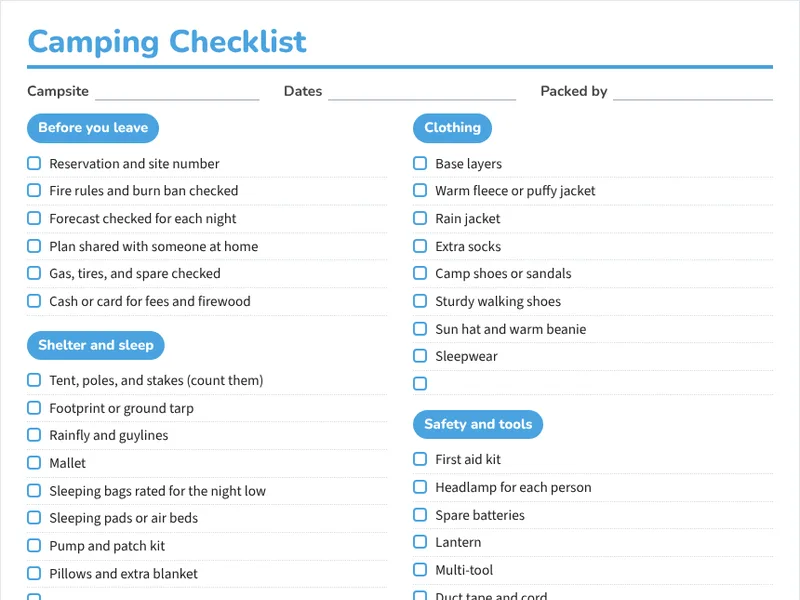 Camping Checklist Printable: Free One-Page Packing List