
Hundreds Chart Printable: Free 1-100 Chart to Fill In and Print

A hundreds chart is a 10 by 10 grid holding the numbers 1 to 100, with ten numbers in each row. Children use it to learn counting, number order, skip counting, place value, and adding and subtracting by tens and ones. The printable on this page is a blank chart you can fill in on screen or by hand, so your child can build the chart themselves rather than just look at one.
| Row | 1 | 2 | 3 | 4 | 5 | 6 | 7 | 8 | 9 | 10 |
|---|---|---|---|---|---|---|---|---|---|---|
| 1-10 | ||||||||||
| 11-20 | ||||||||||
| 21-30 | ||||||||||
| 31-40 | ||||||||||
| 41-50 | ||||||||||
| 51-60 | ||||||||||
| 61-70 | ||||||||||
| 71-80 | ||||||||||
| 81-90 | ||||||||||
| 91-100 |
Write 1 to 100 across each row, or tap cells to mark skip-counting patterns.
Free for personal, classroom and office use. Your entries are included in the print, PDF and PNG. Prints on US Letter and fits A4.
Black and White Hundreds Chart Printable
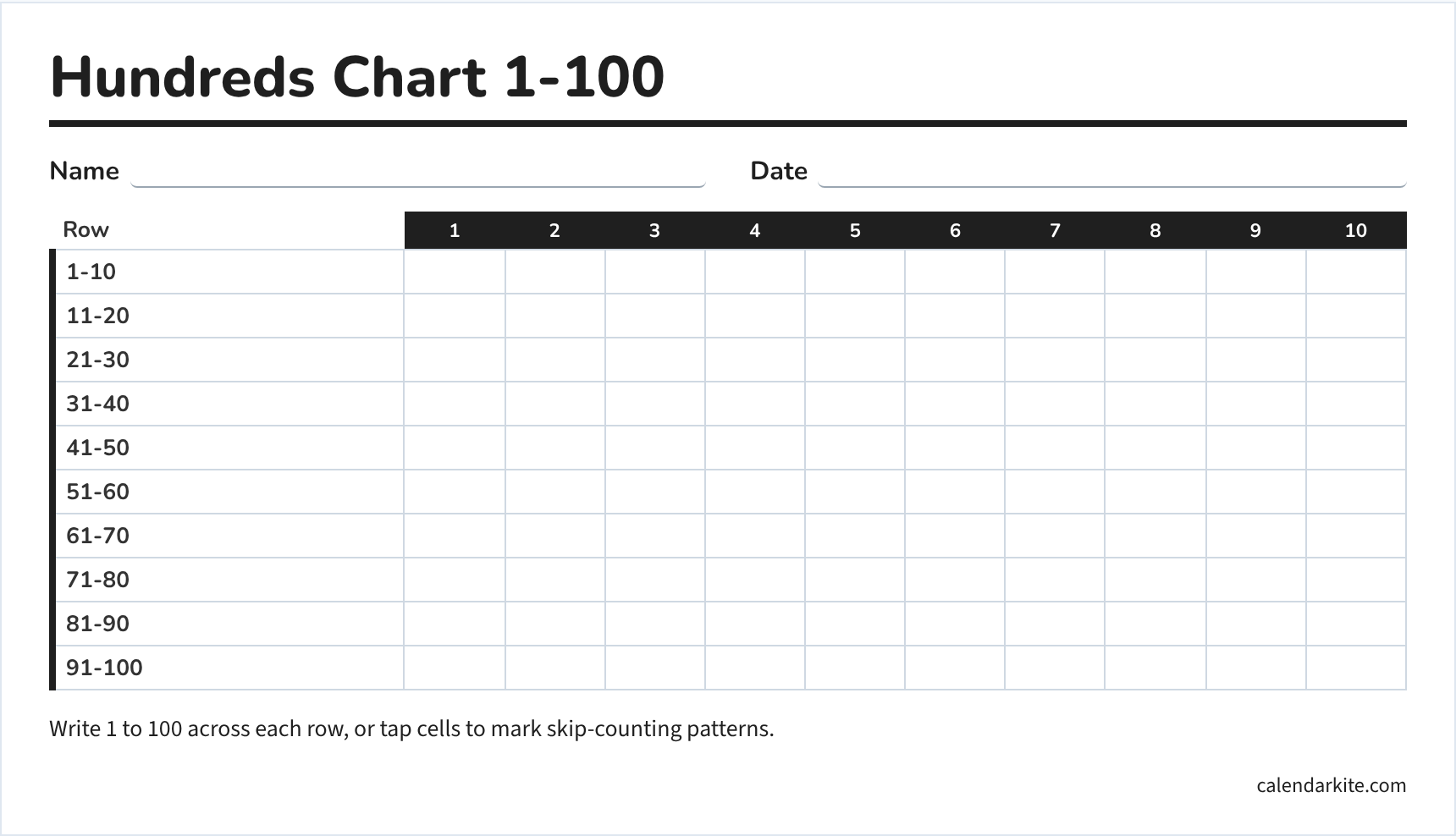
I made this one for classrooms and home printers where ink matters, and it's my go-to for skip-counting practice with a highlighter. I test-print it on my home inkjet, and the plain lines stay crisp on both US Letter and A4.
Pink Hundreds Chart Printable
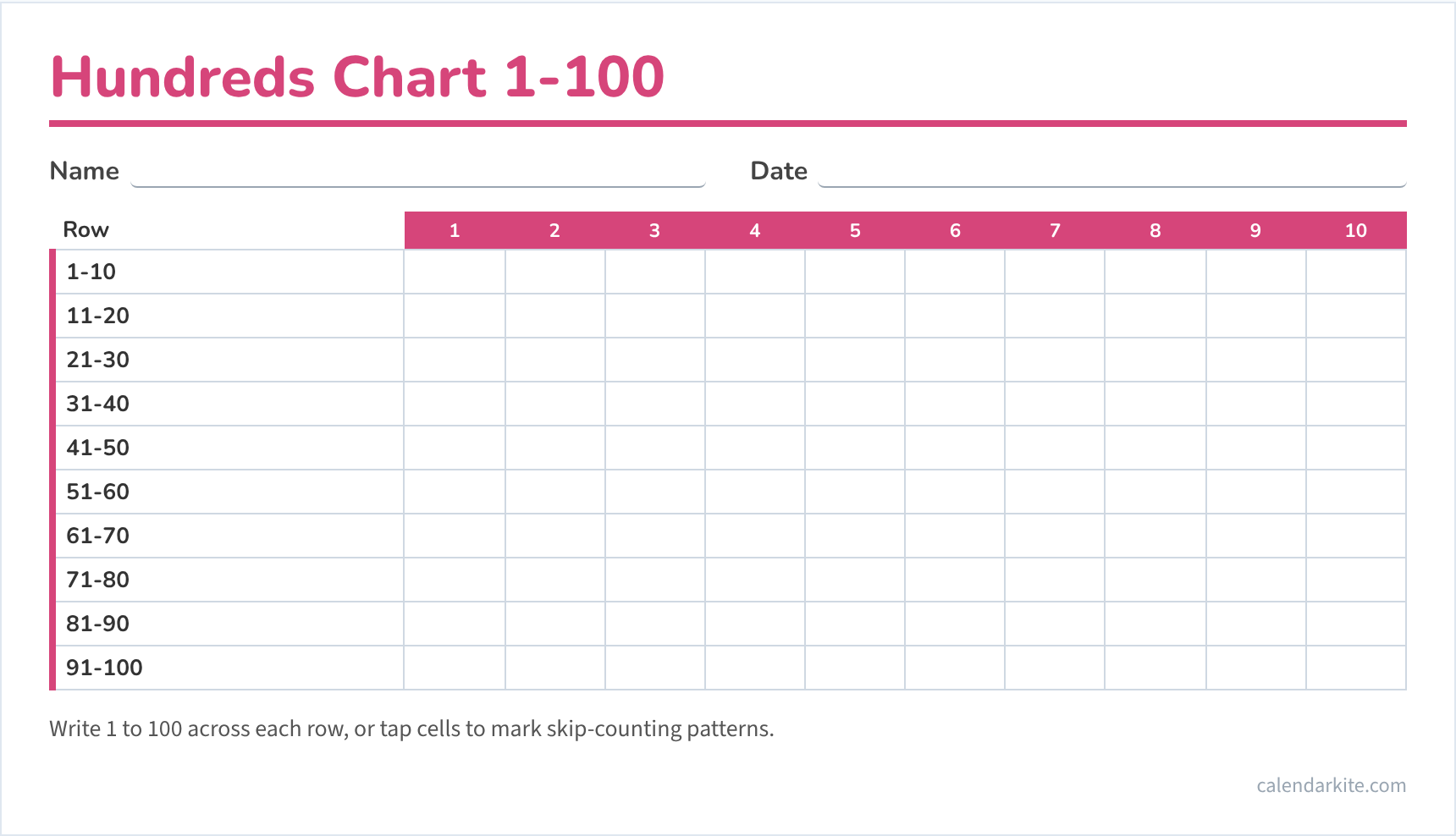
This soft pink chart suits young learners who find black grids a bit stark, and it works well for filling in numbers one row at a time. I kept the number boxes large enough for small handwriting.
Sage Green Hundreds Chart
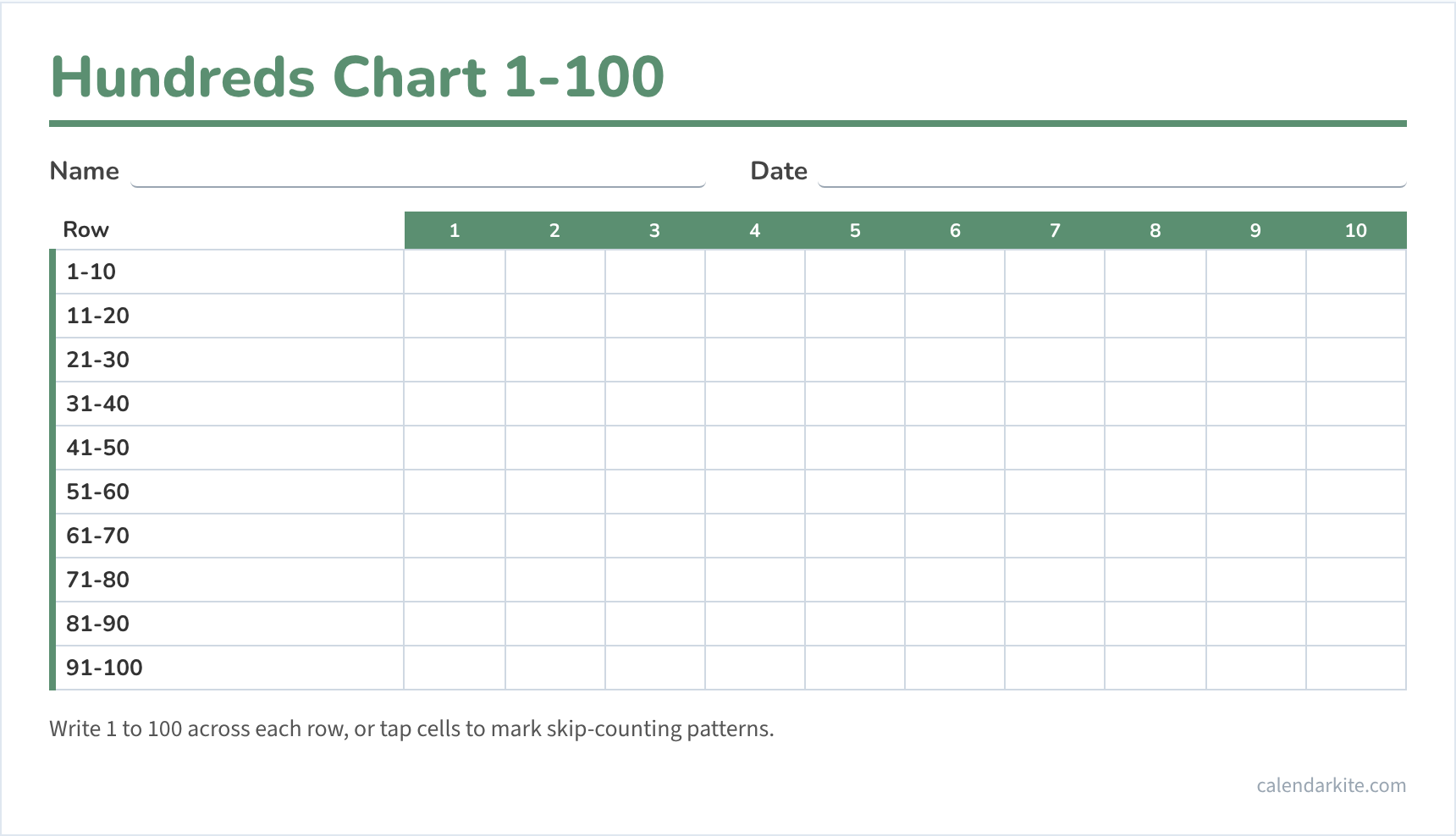
I like this calm green version for homeschool binders and quiet corners of the kitchen table, where it's handy for spotting number patterns. Slip it into a sheet protector and use a dry-erase marker to reuse it all week.
Lavender Hundreds Chart Printable
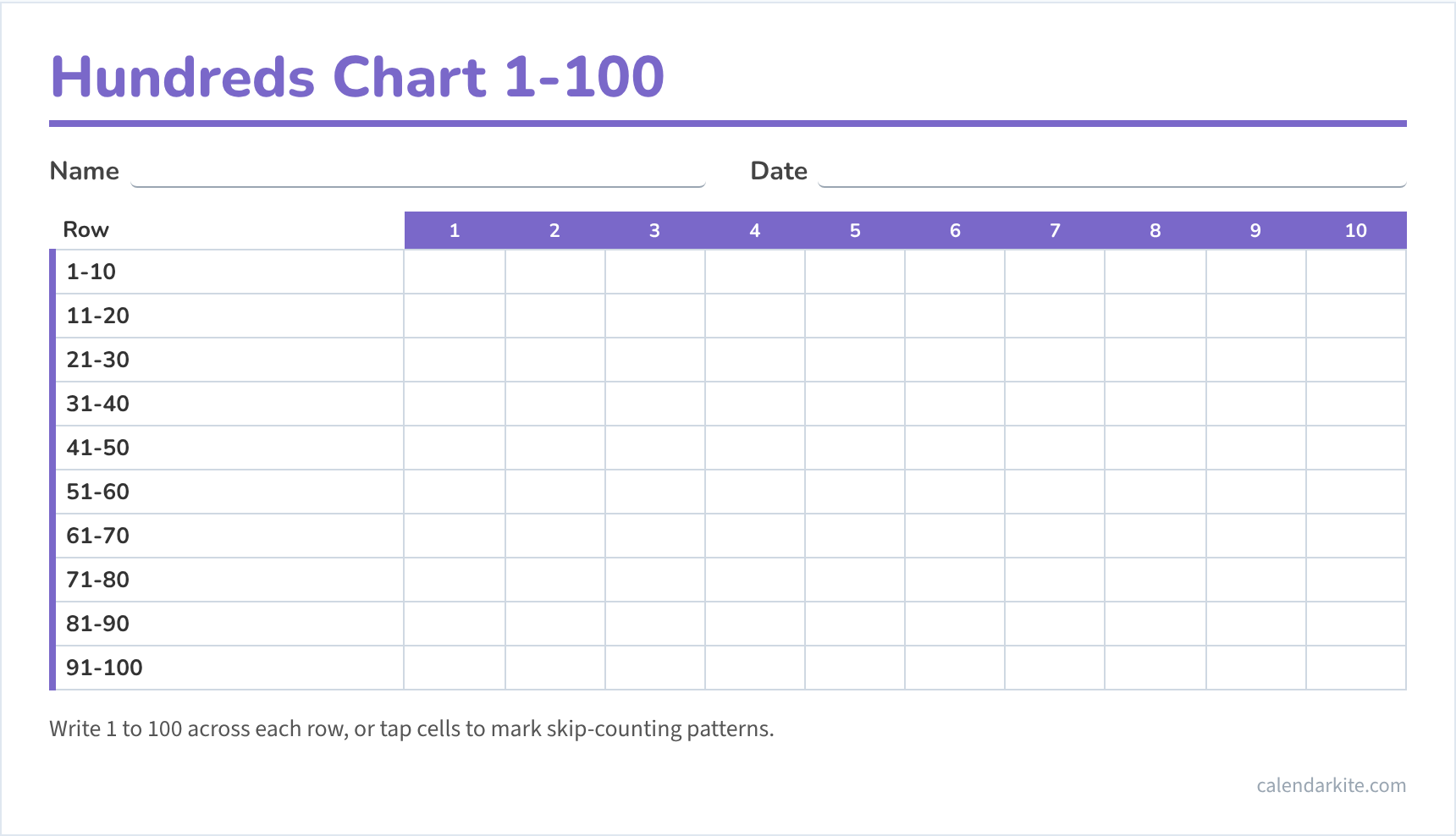
Lavender is a gentle choice for children who get overwhelmed by busy worksheets, and it suits quiet counting by tens or finding missing numbers. In my office years I learned that soft colors keep a dense grid readable.
Cute Hundreds Chart Printable
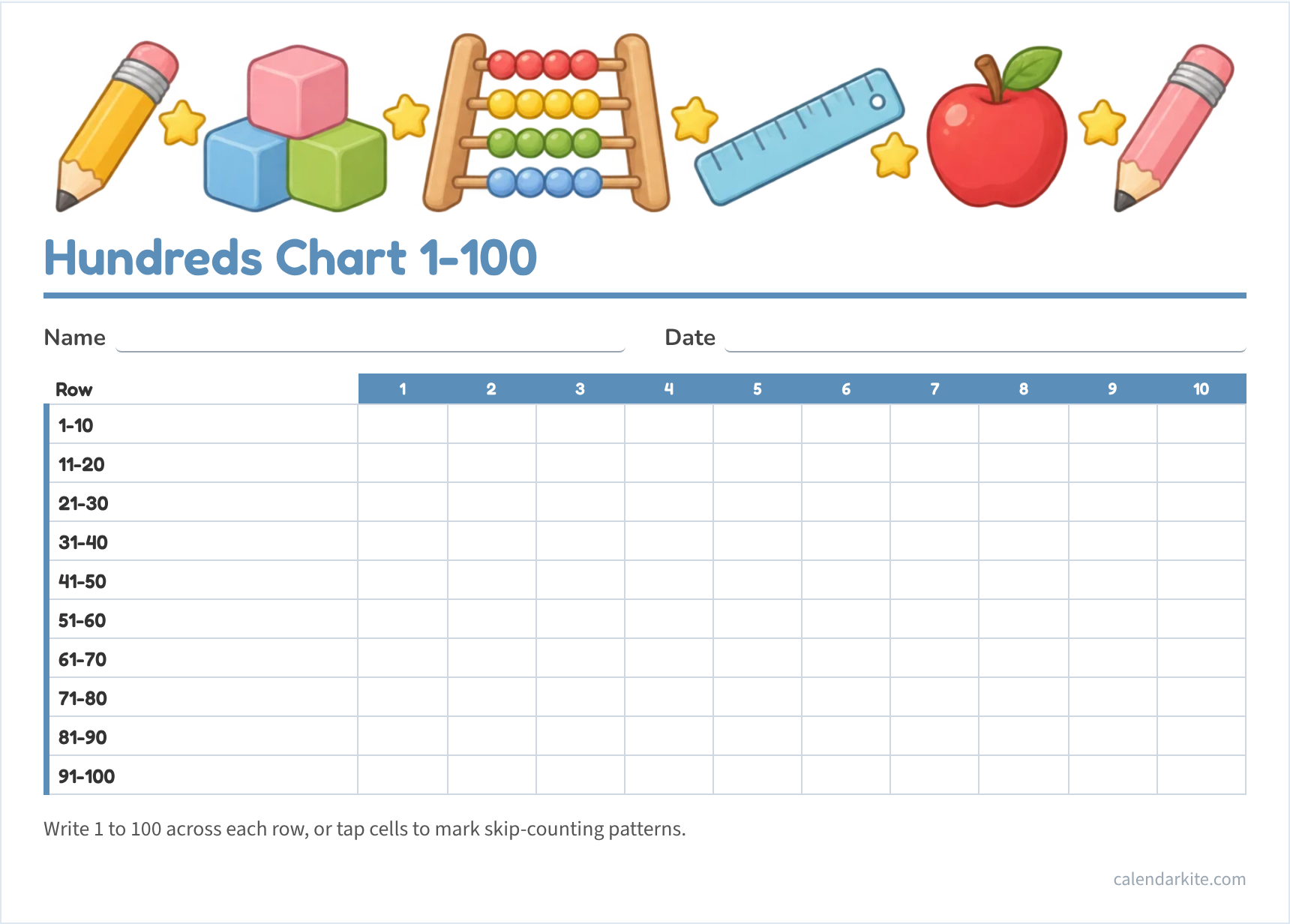
This pastel blue chart with little hand-drawn illustrations suits preschool and kindergarten children just starting to count to 100. Print it for a bedroom wall or a math folder and let your child color each number as they count.
Floral Hundreds Chart Printable
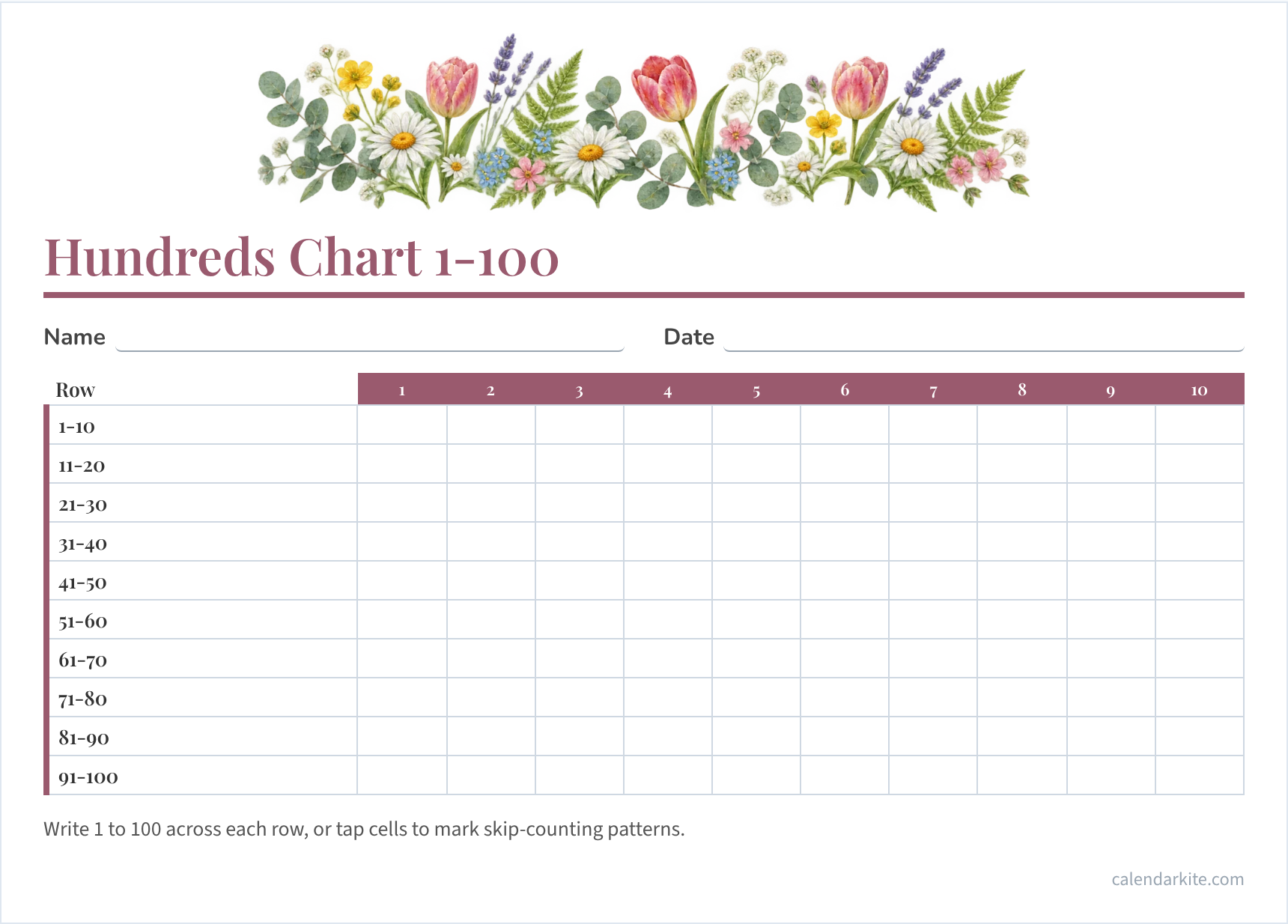
With its watercolor flowers and elegant serif headings, this one suits parents who want a math chart that looks nice on a homeschool wall. I'd print it on US Letter and laminate it for daily number practice.
Colorful Hundreds Chart for Kids
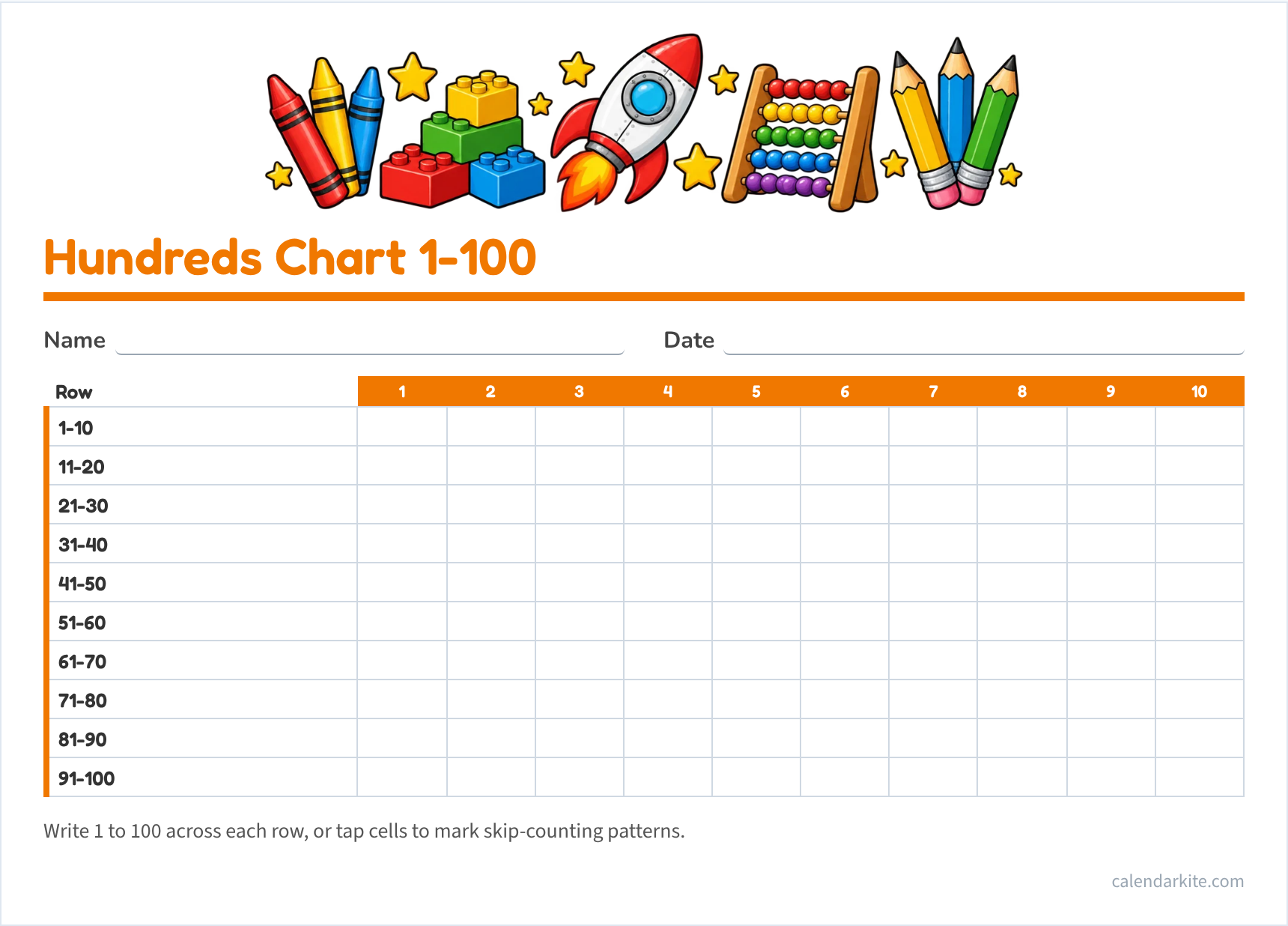
Bright orange and yellow with bold cartoon art makes this version a fun pick for first and second graders practicing skip counting. My own kids pay more attention to a chart that looks playful, so I use it for number games.
Simple Hundreds Chart Printable
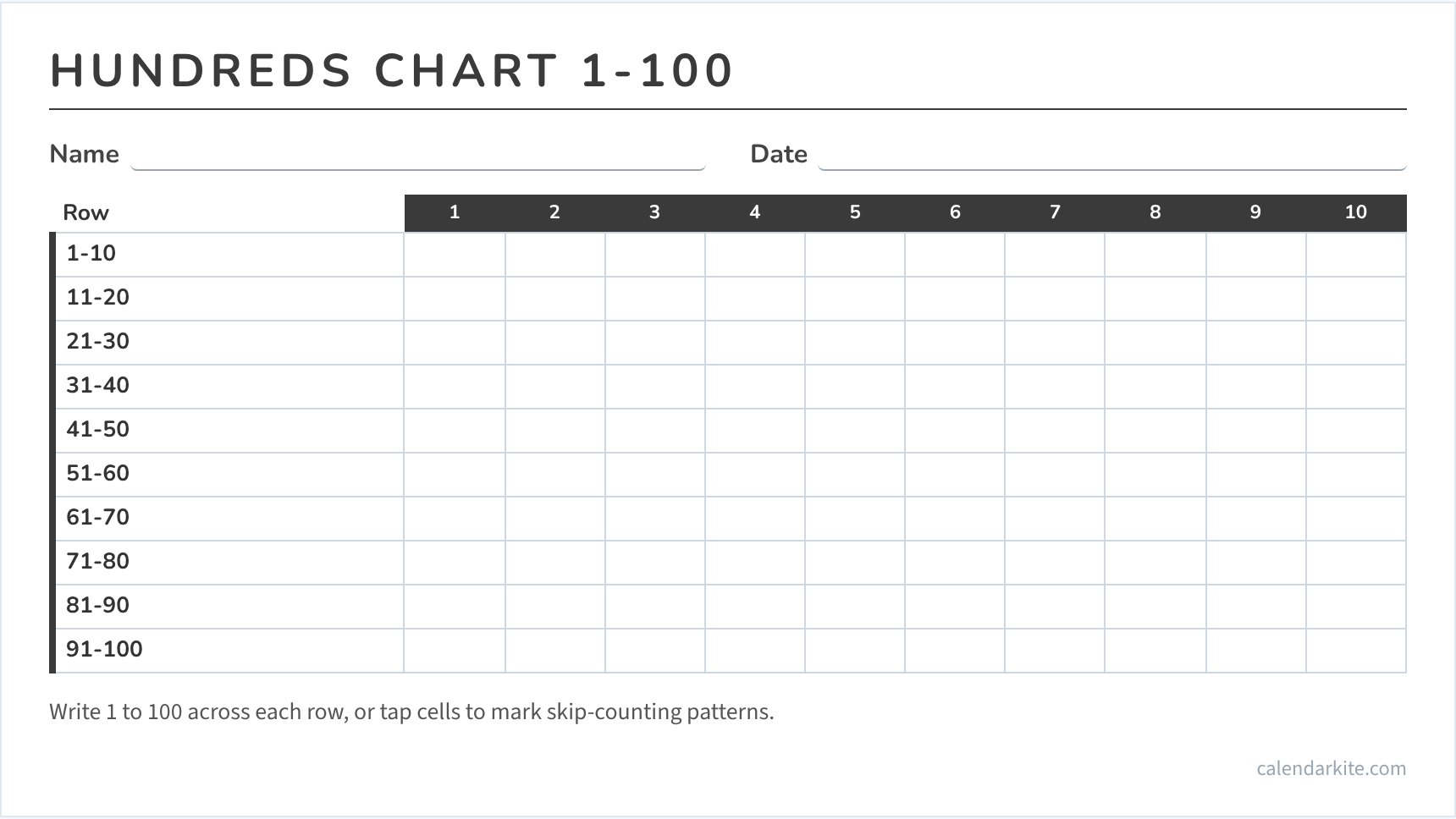
This thin-lined gray chart suits teachers and parents who want a clean reference sheet without distractions. I changed the line weight so the numbers stay readable when you shrink it to fit a notebook or desk.
Aesthetic Hundreds Chart Printable
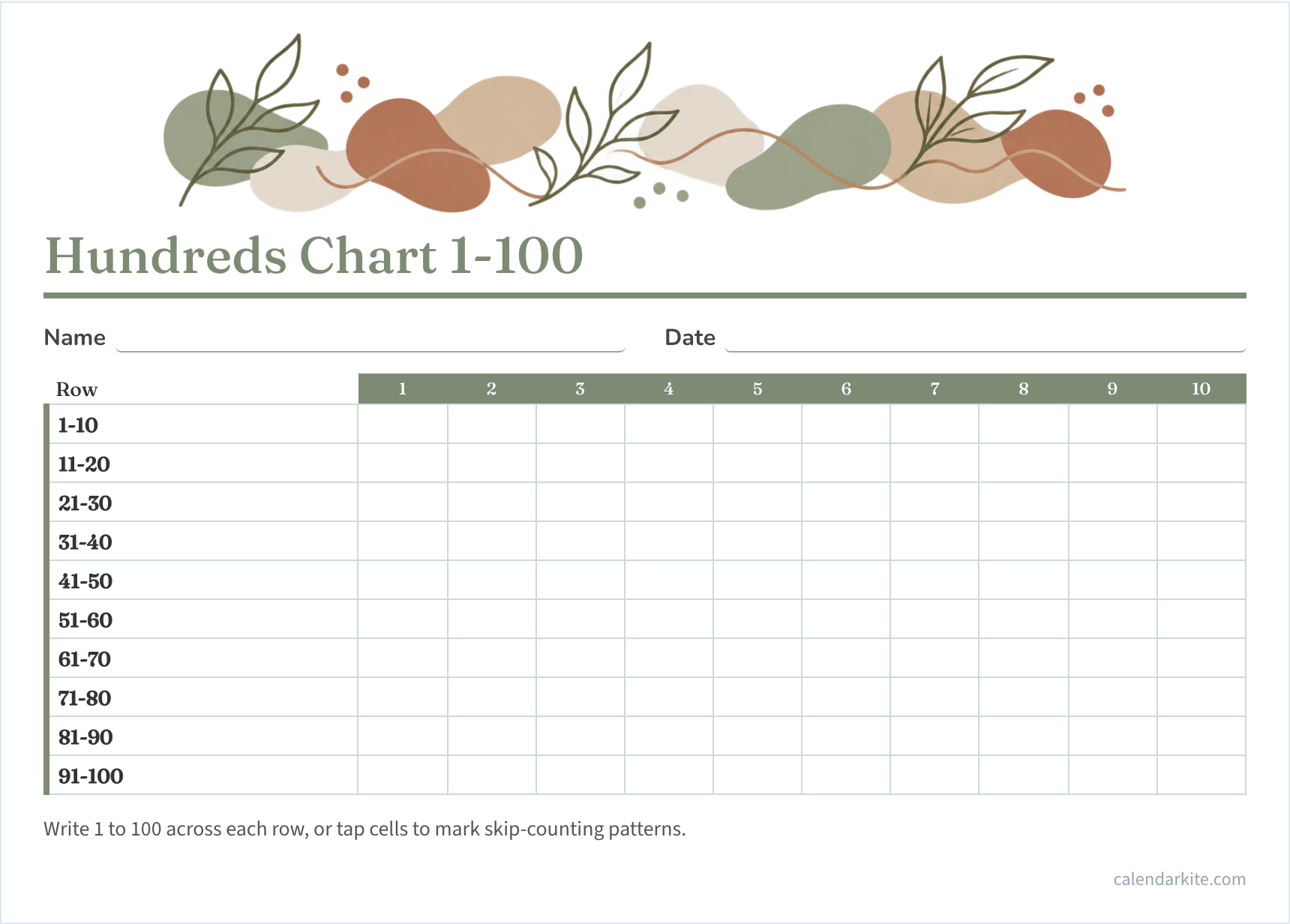
Muted sage, sand and terracotta with soft line-art leaves make this a good fit for homeschool shelves and neutral playrooms. I keep a sheet like this near the kitchen counter planner for quick counting pattern or addition checks.
Modern Hundreds Chart Printable
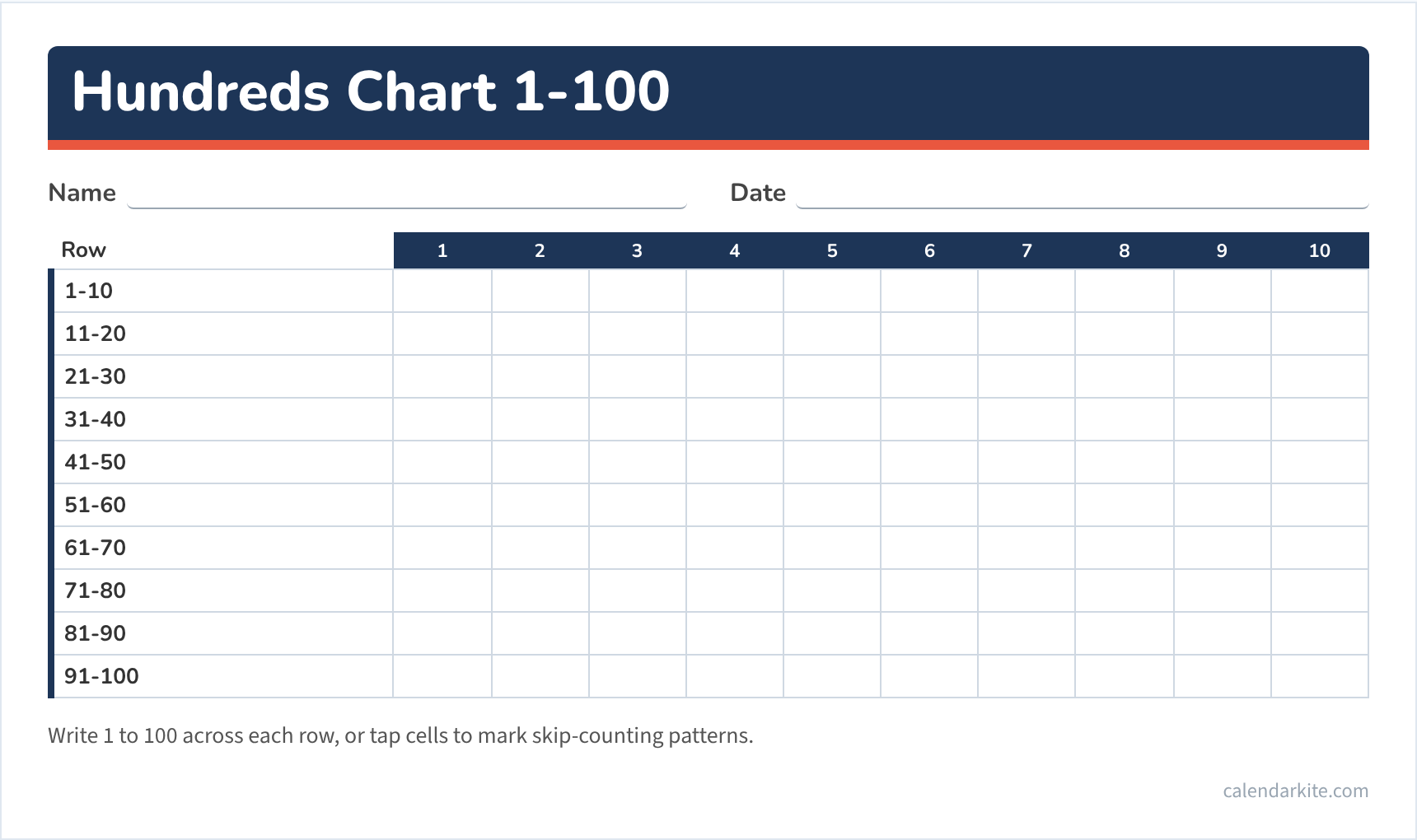
The navy header band and coral accent give this chart a modern, school-ready look for upper elementary students and classroom walls. I'd choose it when you need the title to stand out from across the room.
I test-print every sheet on my home inkjet, on both US Letter and A4, and I made sure the squares are large enough for a child to write a three-digit 100 without squeezing. Below you will find how to fill it in, what patterns to point out, and how to stretch one sheet into a week of maths practice. It works for classrooms, homeschool tables and kitchen counters alike.
What is a hundreds chart?
A hundreds chart is a number grid with ten rows and ten columns. Counting runs left to right along each row, then drops to the start of the next row, so the first row holds 1 to 10, the second holds 11 to 20, and the last holds 91 to 100. It is a number line folded into a square, which is why so many patterns show up once you know where to look.
The chart sits at the heart of early maths because it makes the base ten system visible. Move one square right and the number goes up by 1. Move one square down and it goes up by 10. A child who sees that on the grid, with a pencil in hand, understands it far better than one who is told it.
You will also see it called a 100 chart, a hundred chart, a number chart 1-100 or a hundreds board. They are all the same tool.
How to fill in this hundreds chart
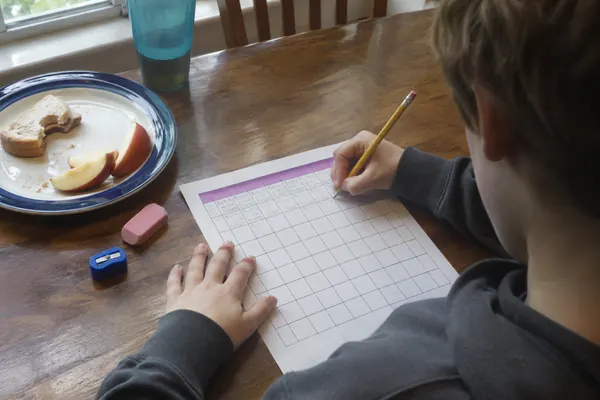
The row labels down the side show where each row starts, and the numbered columns across the top tell you how far along the row you are. Start at the top left square and write 1, then 2 across the first row. When you reach the end of a row, drop to the next row and carry on. Row two starts at 11, row three at 21, and so on until you write 100 in the bottom right corner.
On the page you can type directly into each square, and your work saves in your browser. That is handy for a teacher who wants to prepare a chart with some numbers already in, or a parent who wants to create a missing-number puzzle quickly. Fill in the numbers you want to show, leave the rest empty, and print. If you want a clean copy again, there is a blank PDF download.
For a first attempt with a young child, I suggest a pencil and a gentle goal. Let them write the first row alone, then take turns: you write a row, they write a row. A finished chart in one sitting is nice, but a half-finished chart that a five-year-old is proud of is better than a perfect one they felt rushed through.
Try this: Print one blank chart and fill in only the first column and the last column (1, 11, 21 and so on, then 10, 20, 30 and so on). Ask your child to guess what goes in the middle before they write anything.
Who this chart suits
Kindergarten and first-grade children are the main audience. They are learning to count to 100, to write numerals correctly, and to understand that 10 is a group of ten ones. A blank chart suits them because writing the numbers is the exercise. The act of filling every square slows counting down and shows where the gaps in knowledge are, such as a child who confidently reaches 29 but stumbles at 30.
Second graders and older children use it differently. They treat the chart as a calculating aid for adding and subtracting tens and ones, and as a place to spot number patterns before they meet multiplication. Children who find maths stressful sometimes do better with a physical grid in front of them than with abstract number work, and the chart gives them something to point at.
It also suits homeschool families, tutors and parents doing small bits of practice at home. If you plan lessons week by week, it slots in easily alongside a homeschool planner printable, and one printed copy can be reused several times if you put it in a page protector.
Counting and writing numbers 1 to 100
The simplest activity is also the most useful: count while you write. Ask your child to say each number aloud as they write it. This links the spoken number, the written numeral and the position on the grid, which are three separate skills for a young learner.
Watch for the common stumbling points. Many children write 13 as 31 at first, or pause at the jump from 19 to 20, 29 to 30 and so on. The “decade change” is where the counting rhythm breaks. When your child hesitates, point to the first square of the next row and say the tens word together, then fill in the rest.
Numeral reversals are normal at this age and nothing to worry about. A hundreds chart gives gentle, repeated practice with the same ten digits, and children usually settle on the correct form by simply seeing the right numbers in the right order again and again.
Skip counting patterns to look for
Once a chart is filled in, it becomes a pattern-finding sheet. Shade or tap the squares you land on when you count by 2s, 5s or 10s, and the patterns appear almost at once. Counting by 10s fills the entire right-hand column. Counting by 5s fills the last two columns. Counting by 2s colours every other square, forming neat vertical stripes.
Some patterns are less obvious and more fun to find:
- Multiples of 9 run in a diagonal line going down and to the left (9, 18, 27, 36 and on).
- Multiples of 11 run in a diagonal going down and to the right (11, 22, 33, 44 and on).
- Odd and even numbers alternate in columns, so the first column is all odd and the second is all even.
- Every number in a column ends in the same digit.
Skip counting patterns are the bridge to multiplication. If your child has coloured in the 3s and then the 4s, you can show them how those same numbers appear on a times table chart later on. They will recognise the numbers as old friends rather than new facts to memorise.
Try this: Print three blank charts. On the first, shade the 2s. On the second, shade the 5s. On the third, shade the 10s. Lay them side by side and ask which pattern has the most shaded squares and why.
Adding and subtracting on the chart
The chart works as a calculator for small sums. To add 10, move one square down. To add 20, move two squares down. To add 1, move one square right. So 34 plus 21 means two squares down and one square right, landing on 55. A child can trace it with a finger or a counter.
Subtraction works in reverse. Moving up takes away 10 and moving left takes away 1. Children often find subtracting 10 easier on the chart than in their heads, because they can see the number directly above. Over time they stop needing the chart because the movement becomes a mental picture. That is the aim: the grid is scaffolding, not a permanent crutch.
When your child is ready for more formal practice, pair the chart with a subtraction chart so they can check their answers. I find it best to let children use the hundreds chart for the first few weeks, then ask them to predict the answer before checking on the grid, which builds mental maths without removing the safety net.
Hundreds chart puzzles and missing numbers
A missing-number puzzle is the easiest way to turn the chart into a challenge. Fill in most of the numbers, leave a handful of squares blank, and ask your child to work out what belongs there. Starting with just a few gaps in the first rows keeps it friendly. Later, leave whole sections blank, or print a chart with only scattered numbers showing.
Puzzles get more interesting when they use pieces. Cut a filled-in chart into jigsaw shapes, then ask your child to put it back together by reading the numbers around the edges. They will quickly work out that the number below any square is 10 more, and that clue helps them place every piece.
Because this page lets you type into the squares before printing, you can build puzzles in a minute. Make one at an easy level for a younger child and a harder one for an older sibling, then print both. I do this for my own two kids, and a puzzle with a single missing number in each row keeps the five-year-old busy while the older one tackles a sparse chart.
Hundreds chart games to play
You do not need extra materials for a game. A pencil, some counters, a die and a printed chart are enough. Here are a few that work well at home and in small groups:
- Race to 100: each player rolls a die and moves a counter along the chart by that many squares. The first to reach 100 wins.
- Mystery number: one person picks a number and gives clues (“it is more than 40, it is odd, it has a 7 in it”). The other crosses out squares until only one is left.
- Cover and guess: hide a few numbers under small sticky notes and ask the player to name them.
- Roll and add ten: roll a die, start on that number, and keep jumping down by tens until you go off the bottom.
For small groups, give each child their own chart and a different coloured pencil. Everyone can play the same game, but each person tracks their own pattern. Kids pay close attention when their own colours are on the page.
Place value and number sense
The chart shows clearly that two-digit numbers are built from tens and ones. Every number in the same row shares a tens digit (the whole 40s row, for example), and every number in the same column shares a ones digit. Ask your child to put a finger on 47, then slide up and down the column and note which digit stays the same.
You can also colour by tens digit: one colour for the 10s, another for the 20s, and so on. The chart becomes a colourful map of place value. A child who colours every number with a 6 in the tens place can see at a glance that the whole 60s row belongs together.
Counting on and counting back are further number sense skills the grid supports. “What comes after 69?” is a harder question than it looks, because the answer sits at the beginning of the next row. Asking it with the chart in front of them helps the decade change finally click.
Variations: 0-99, 120 and 200 charts
The classic chart goes from 1 to 100, but you will meet a few close relatives. A 0-99 chart starts the first square at zero, so every number in a row shares its tens digit. That is neat for place value, but many younger children find counting from 1 more natural, and it ends at 99 rather than a satisfying 100.
A 120 chart adds two more rows, and it matches the standard in many first-grade classrooms where children are expected to count to 120. A 200 chart extends the idea to the second grade and helps children bridge from two-digit to three-digit numbers. If you want those, you can use this printable as a starting point: write in the numbers you need and adjust the starting figure in the first square.
I kept this sheet at the classic 10 by 10 because it fills a Letter page with generous squares. A 120 chart on one page makes the squares smaller, and when I tested it, small handwriting began to run into the edges. If your child is still learning to write numerals, bigger squares are worth more than a longer chart.
Beyond maths: using the grid as a 100-day tracker
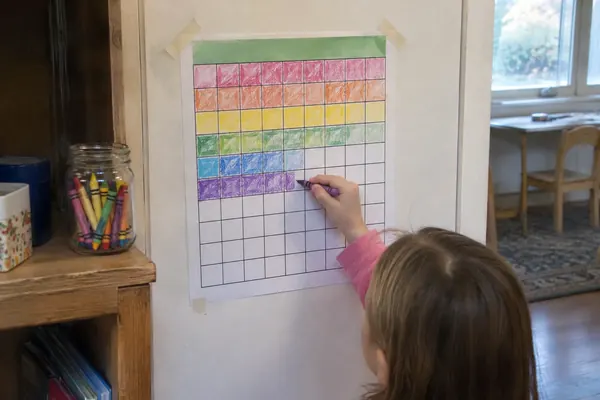
The grid is also a tidy way to track anything you want to count to 100. Tap or tick one square per day to follow 100 days of school, a 100-day reading goal, 100 days of a new habit, or a countdown to a big event. Each tap fills a square, and the grid shows progress at a glance.
Families I know use a chart like this for the 100th day of school celebrations, and it also works as a sticker board for small rewards. If you are working on a bigger habit, a potty training sticker chart or a chore chart for kindergarteners are more specific tools, but a 100-square grid is a good extra when you want a long-term goal that a child can see growing.
At home, my paper calendar lives on the fridge and the planner stays on the kitchen counter. A hundreds chart works well taped beside the calendar, so counting days and counting squares sit side by side. Kids love marking off a day and watching the grid fill.
Printing tips for Letter and A4
The sheet is designed for one US Letter page, and it scales onto A4. In your print dialog, choose “Fit to page” or “Scale to fit” rather than 100 percent if you are using A4, then check the preview. If the bottom row is cut off, scaling is the fix.
Use a plain white paper at 20 to 24 pound weight for everyday use, and card stock if you want the chart to last. For repeated use, slip it into a plastic page protector and write with dry-erase markers, which wipe off with a tissue. Laminating works too, and it is worth it if you plan to use the chart every day for a term.
I always print a draft in black and white first. Most inkjets handle the thin grid lines well on standard settings, so you do not need “best quality” mode, which can use more ink than it is worth. If you are printing a class set, copy the filled-in version once on a copier rather than running your inkjet dry.
Mistakes that make a hundreds chart less useful
The first common mistake is handing a filled-in chart to a child and expecting it to teach on its own. A chart on the wall helps only if someone points at it, asks questions and lets the child touch it. Ten minutes of talking about a pattern is worth more than a week of passive viewing.
The second is going straight to a full 100 when the child is not ready. If counting past 30 is still shaky, start with the first three rows and cover the rest with a sheet of paper. Short success builds confidence, and you can reveal a row at a time.
The third is printing it too small. In my office years I learned that a grid people cannot read is a grid people do not use, and the same goes here. Keep the squares big enough for a pencil, and make a fresh copy rather than reusing one that has been scribbled on so heavily that numbers are hard to read.
Ideas for teachers and homeschool parents
For a class, print one chart per child and keep a spare filled-in copy on the wall. Use the blank charts for warm-up activities, such as five minutes of filling in the next row, then cover the filled chart and ask a few mystery-number questions. Short, regular practice tends to work better than one long session.
For homeschool families, a single chart can live in a binder and appear in several lessons across a week: counting on Monday, skip counting on Tuesday, puzzles on Wednesday, adding tens on Thursday, and a game on Friday. If you keep a weekly record, a simple tracker saves time, and you can find more in our printable charts collection.
Keep a few extra blank copies in a folder, along with a pencil case of dry-erase markers and some counters. When a child asks for something to do, a hundreds chart and a die is a good answer that takes no preparation at all.
Try this: Fill in a chart yourself, leaving about ten squares blank, then swap sheets with your child. Ask them to make a puzzle for you in return and see who finds the missing numbers faster.
Common questions
What is a hundreds chart used for?
It is a 10 by 10 grid of the numbers 1 to 100 that helps children learn counting, number order, skip counting, place value, and adding and subtracting by tens and ones. Teachers and parents also use it for number puzzles and simple games.
What grade level is a hundreds chart for?
Most children meet it in kindergarten and first grade, when they learn to count to 100. It stays useful in second grade for adding and subtracting, and for older children who need extra support with number patterns.
Should a hundreds chart start at 0 or 1?
The classic chart starts at 1 and ends at 100, which is best for counting practice. A 0-99 chart keeps the tens digit the same along each row, which some teachers prefer for place value. This printable follows the 1-100 layout.
Can I print a blank hundreds chart and have my child fill it in?
Yes. Print it blank and let your child write the numbers in pencil, row by row. It is a good way to practise writing numerals, and the finished chart becomes their own reference sheet.
How do I make a hundreds chart last longer?
Slip it into a plastic page protector or laminate it, then use a dry-erase marker for games and patterns. Wipe it clean and it is ready for the next activity.
Will the chart print correctly on A4 paper?
Yes. It is built for US Letter, and choosing fit to page in your print dialog scales it cleanly onto A4. Check the preview first to make sure none of the edges are cut off.
More free charts
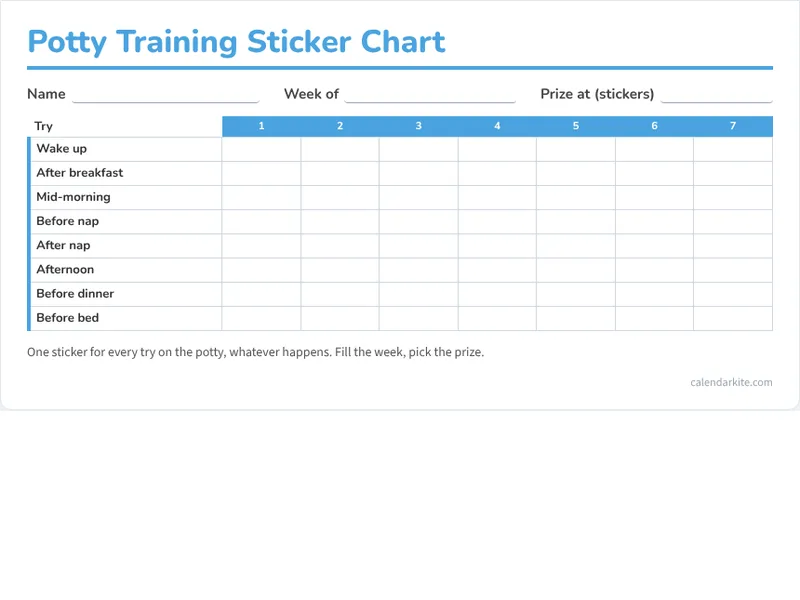 Potty Training Sticker Chart (Free Printable)
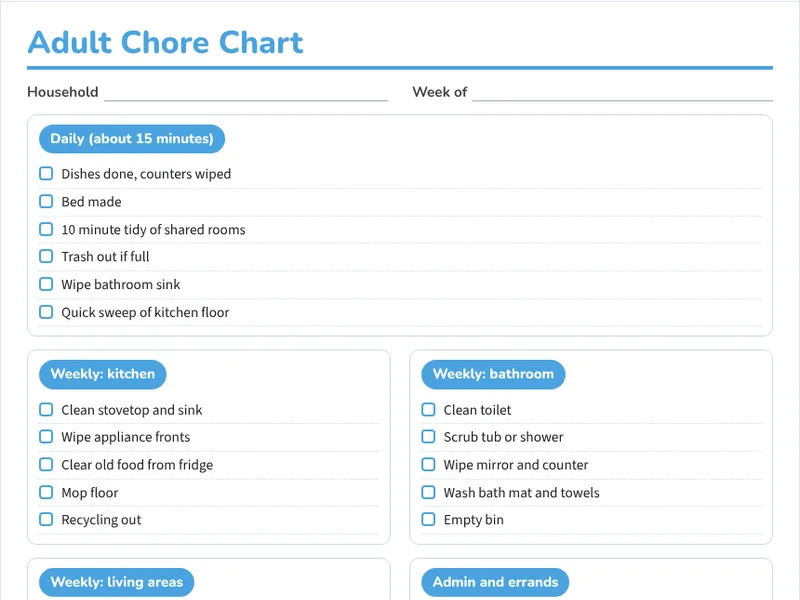 Chore Chart for Adults: Free Printable Weekly Chart
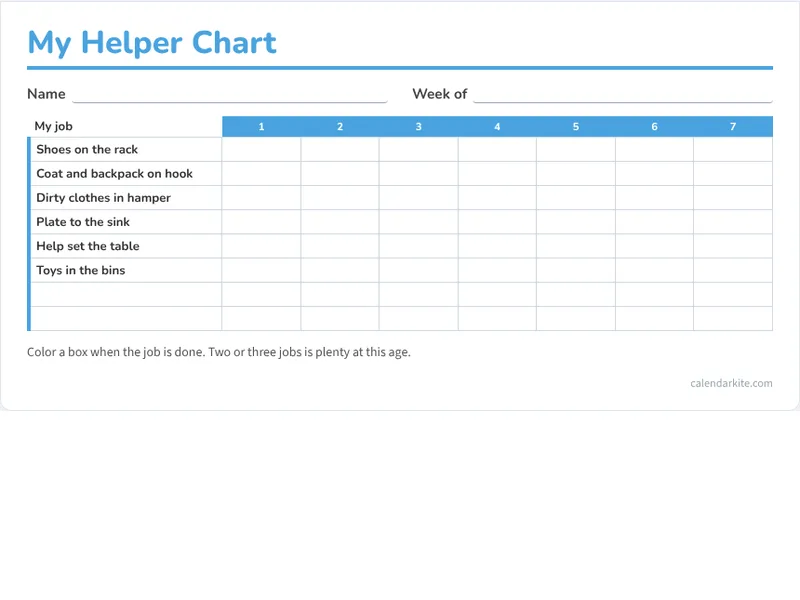 Chore Chart for Kindergarteners: Free Printable Weekly Sheet
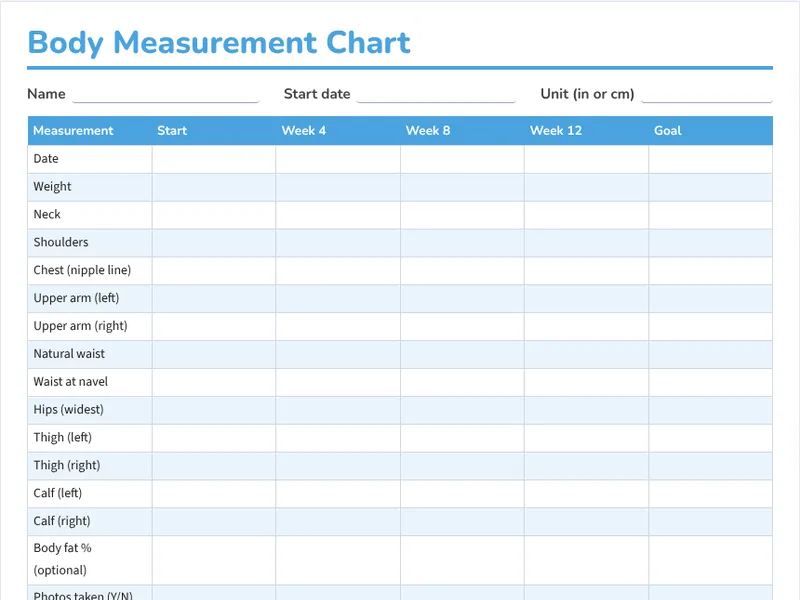 Body Measurement Chart: Free Printable 12 Week Tracker
 T Chart Example (Free Printable T Chart With Scoring)
 Weekly Chore Chart (Free Printable, Fill In Online)