
Trip Schedule Template (Free Printable, Fill In On Screen)

A trip schedule template is a one-page sheet that lays out your trip in order: the day, the time, what you are doing, how you get there, and the booking number or cost that goes with it. The free printable on this page does exactly that. You can type straight into it on screen, or print it blank and fill it in with a pen, and it fits on a single US Letter page.
| Day / date | Time | Activity and place | Getting there | Booking # and cost | Notes |
|---|---|---|---|---|---|
Fill the fixed bookings first, then add the extras. Leave one open slot each day.
Free for personal, classroom and office use. Your entries are included in the print, PDF and PNG. Prints on US Letter and fits A4.
Black and White Trip Schedule Template
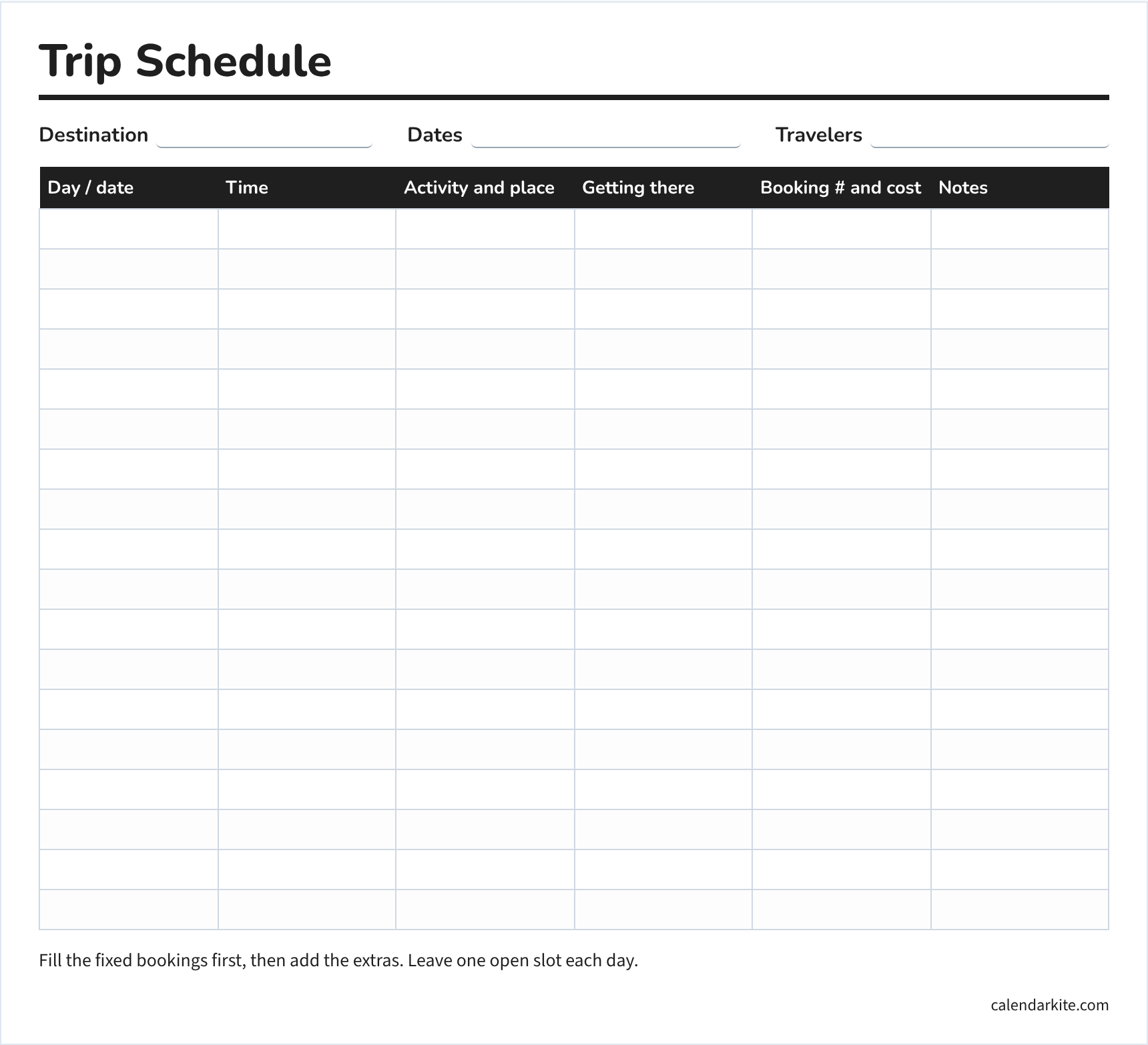
I like this one when you're printing a full itinerary for the whole group, since plain black lines go easy on the inkjet. I test-print every sheet on US Letter and A4, and this version stays crisp even on draft mode.
Pink Trip Schedule Template
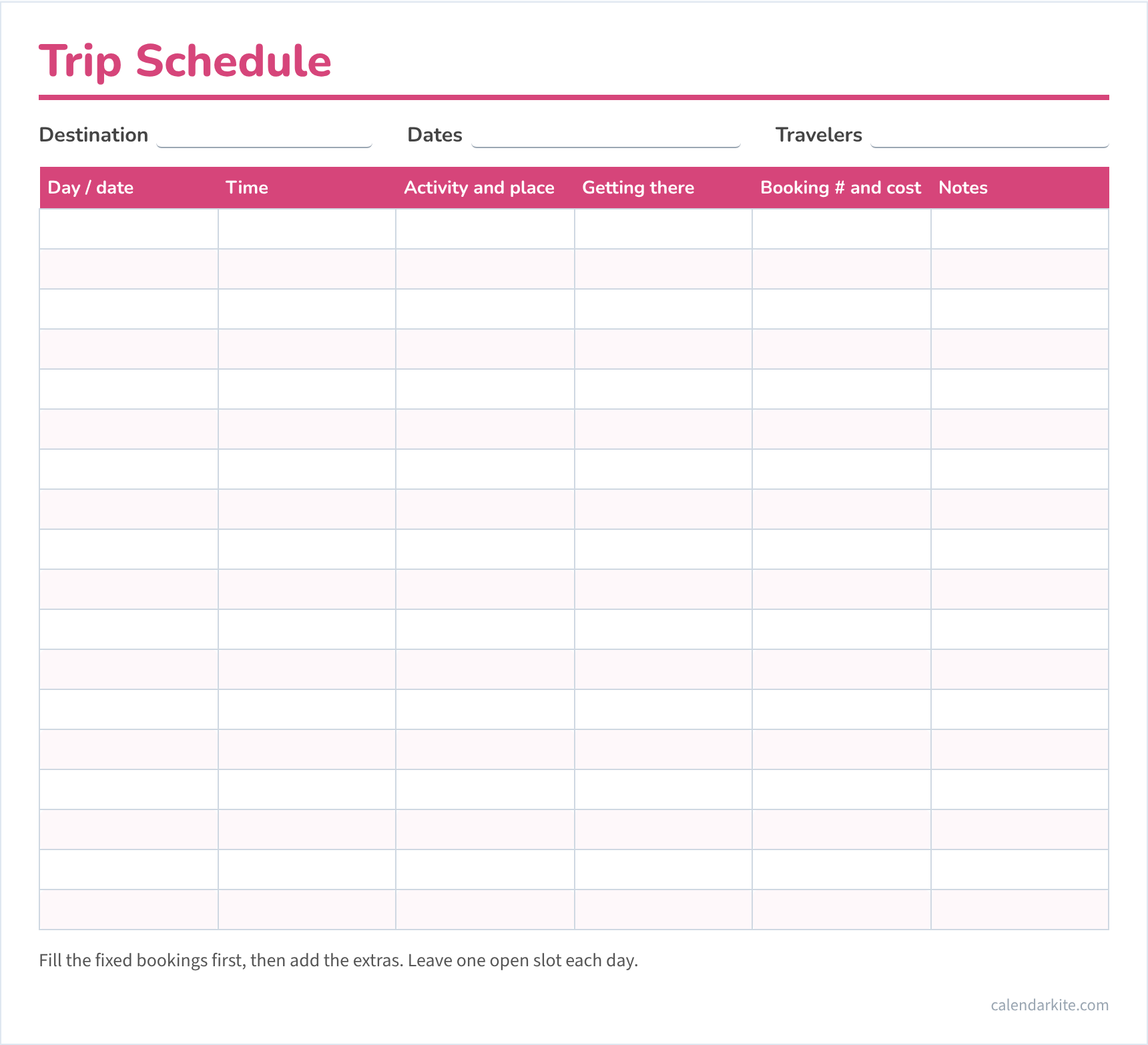
This soft pink version suits a girls' weekend or a mother-daughter getaway where you want hotel, dinner and activity times in one glance. It also works well as a shared plan, since everyone can read the same sheet.
Sage Green Trip Schedule Template
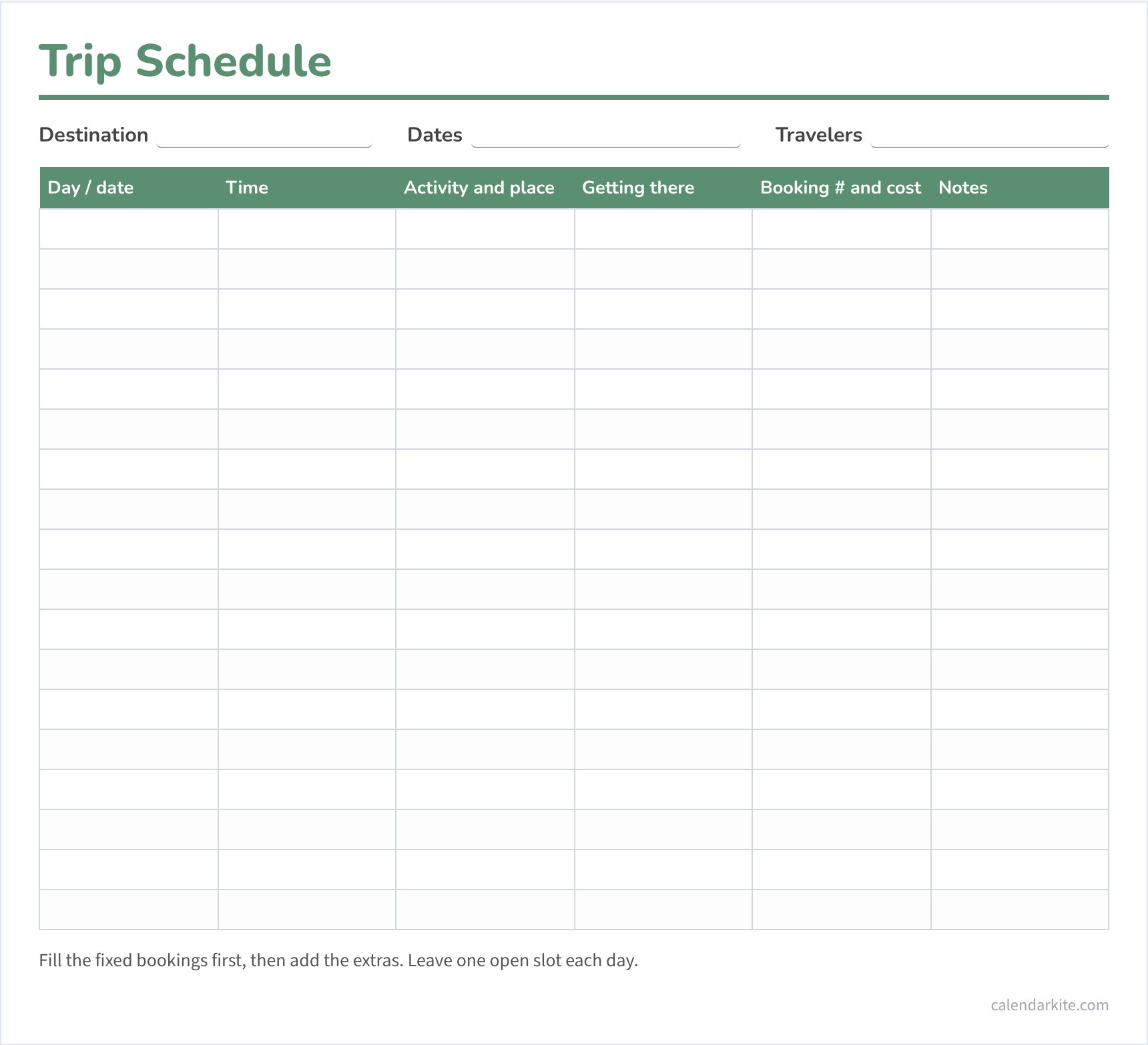
The calm sage green works well for road trips and nature getaways, where you jot down drive times, campsite check-ins and stops. I'd print it on US Letter and keep a pen clipped to it in the glovebox.
Cute Trip Schedule Template
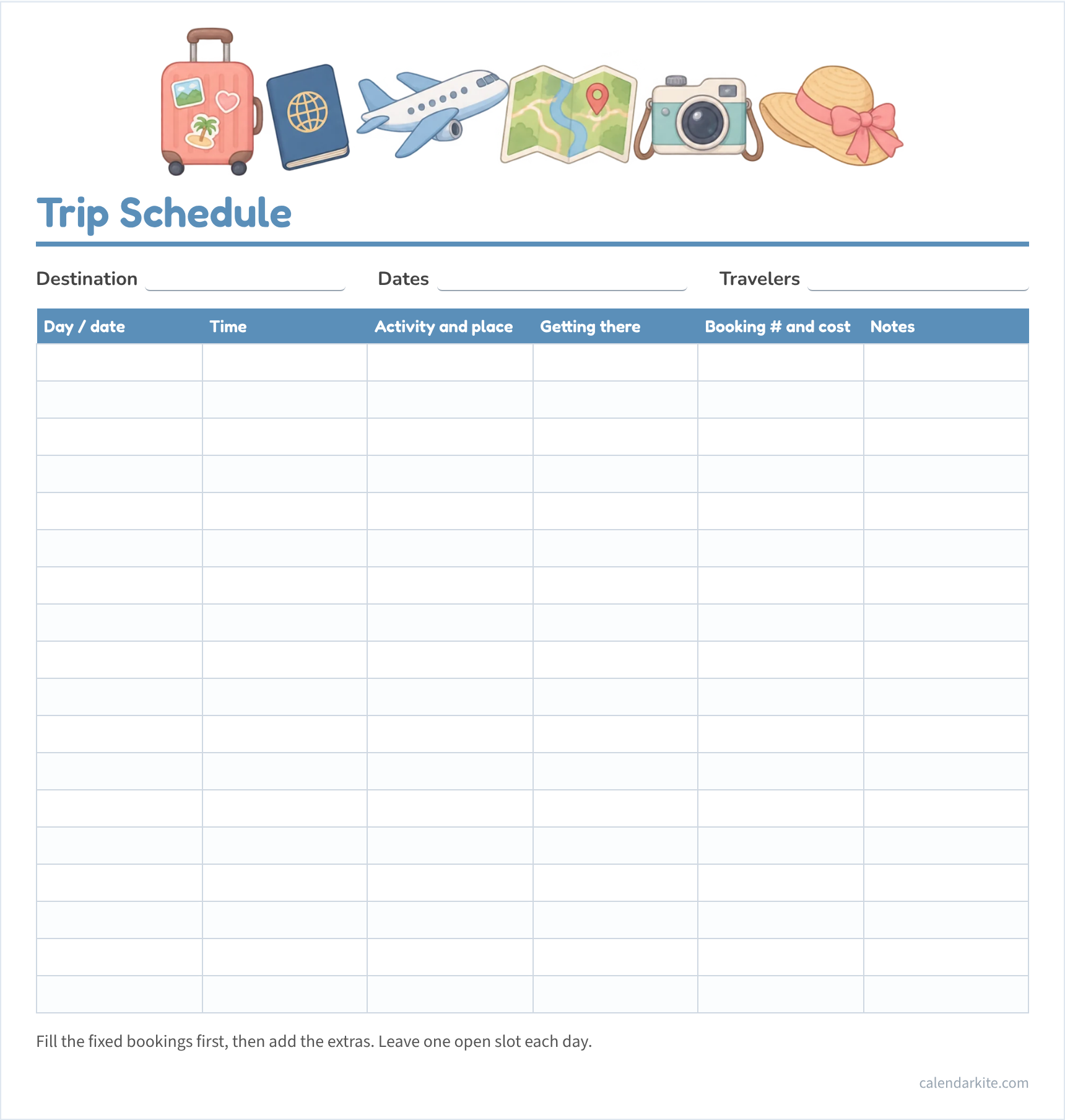
Pick this one for a family vacation where the kids want to follow along with the day's plan. The little illustrations at the top make it easy to spot, so tape it up in the hotel room or tuck it in a travel folder.
Floral Trip Schedule Template
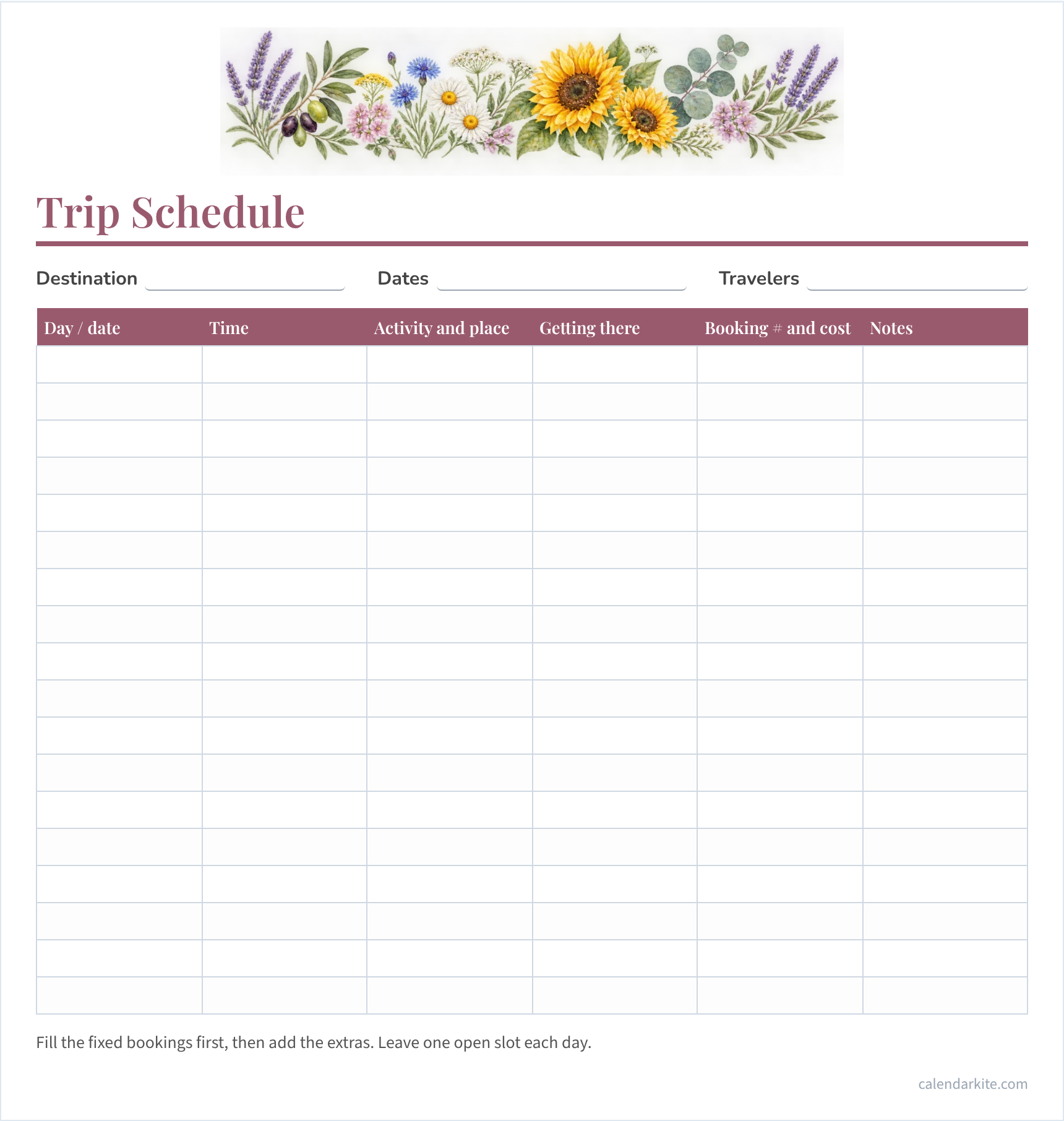
With its watercolor flowers and elegant serif headings, this suits a spring garden tour, a wedding weekend or a bridal party getaway. I'd use the rows for flights, tastings and dinner reservations so nothing overlaps.
Fun Colorful Trip Schedule Template
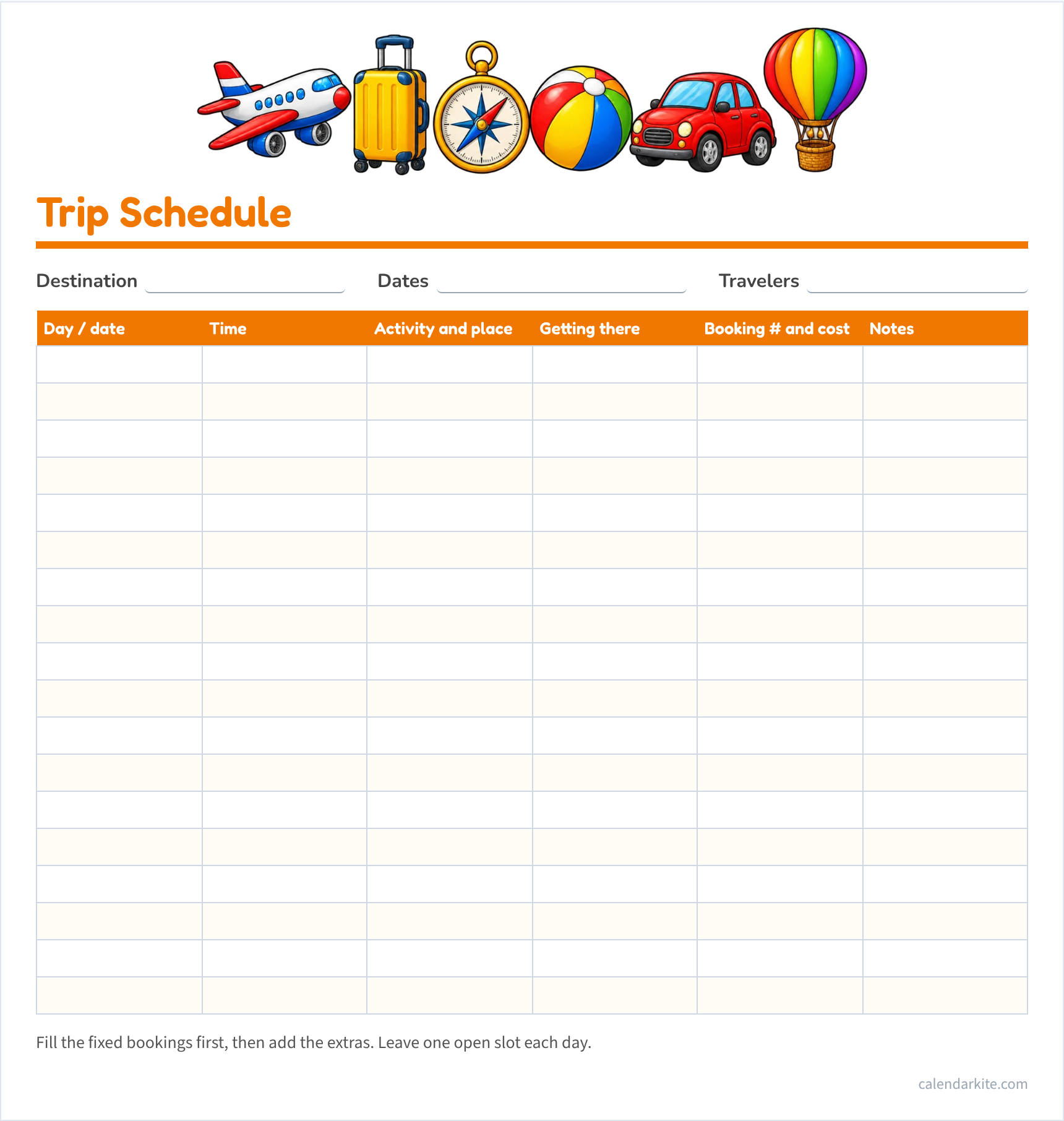
Bright and playful, this one suits a family road trip where the kids get a say in the next stop. I stick it on the fridge before we leave so my two can see what's coming each day.
Simple Minimalist Trip Schedule Template
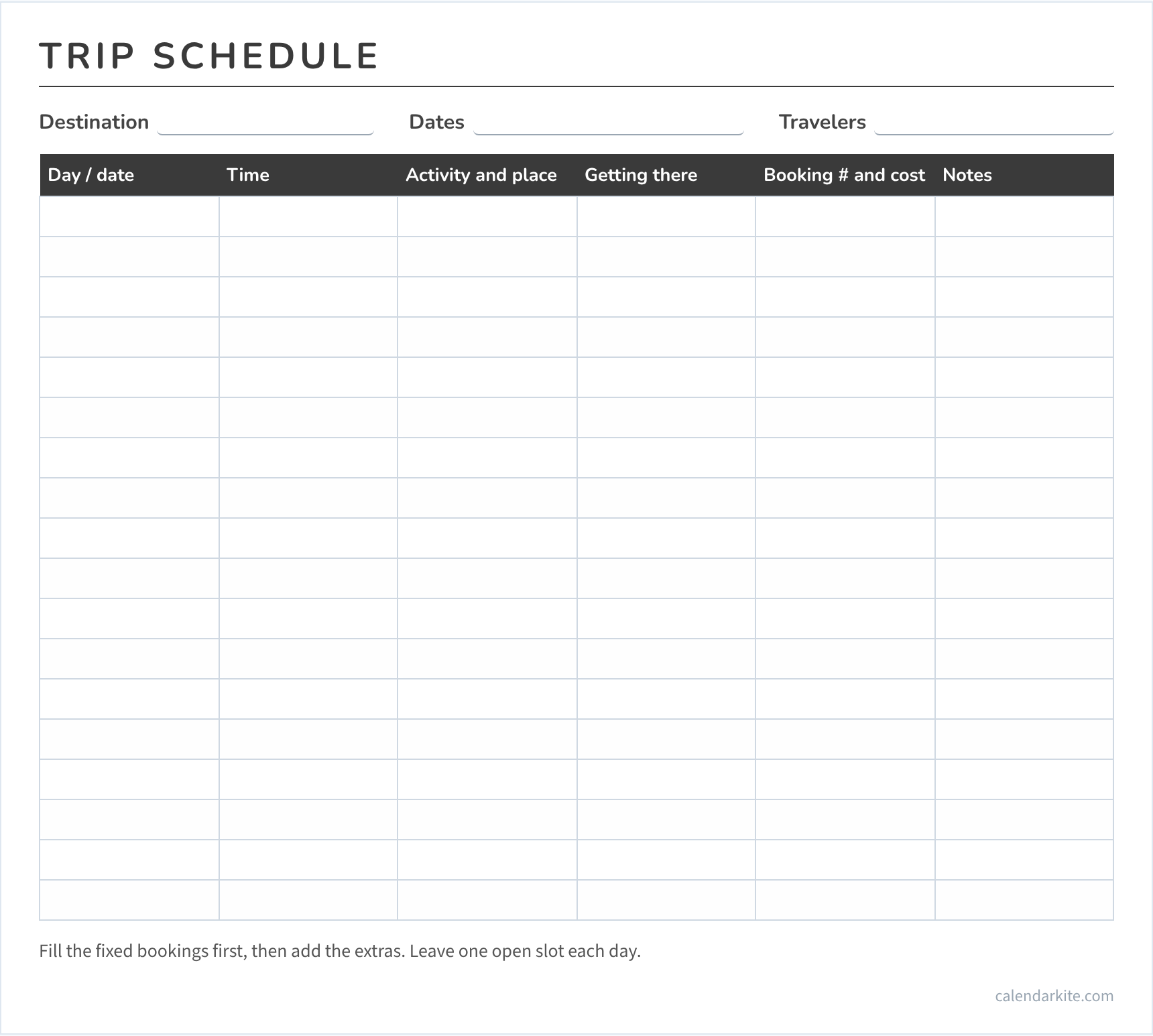
Thin gray lines keep this version clean for business trips, where meetings, flights and hotel confirmations need to be readable at a glance. After ten years in office administration, I learned that less decoration makes a travel itinerary easier to scan.
Aesthetic Trip Schedule Template
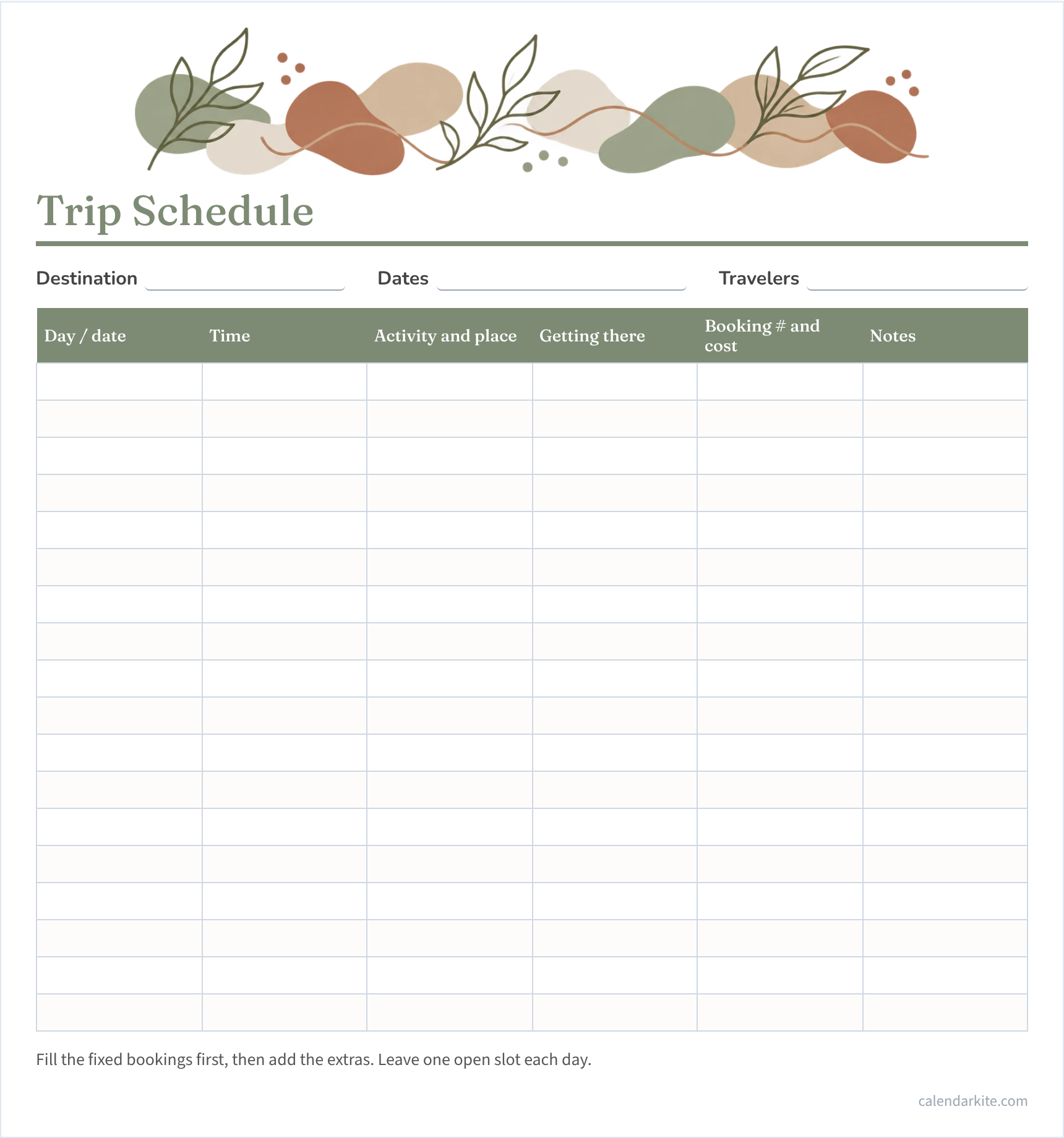
The muted sage, sand and terracotta palette suits a weekend city break or a honeymoon you'll want to keep in your planner. I widened the time column on this layout so longer notes like reservation numbers still fit.
Vintage Trip Schedule Template
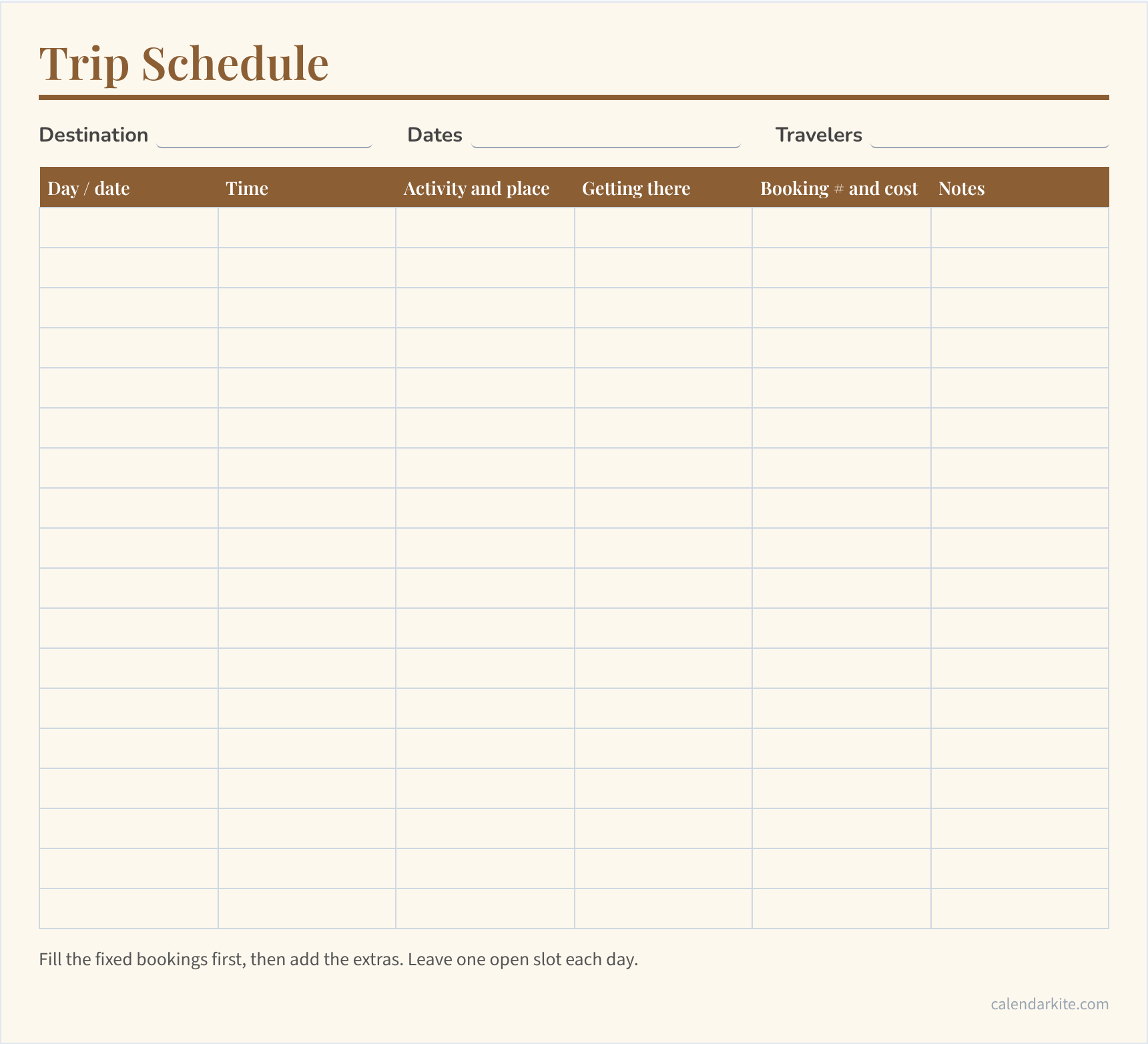
The cream paper and brown serif headings feel right for a road trip through small towns or a family reunion weekend. I like to print it, fold it into my planner, and tick things off with a pencil.
Modern Bold Trip Schedule Template
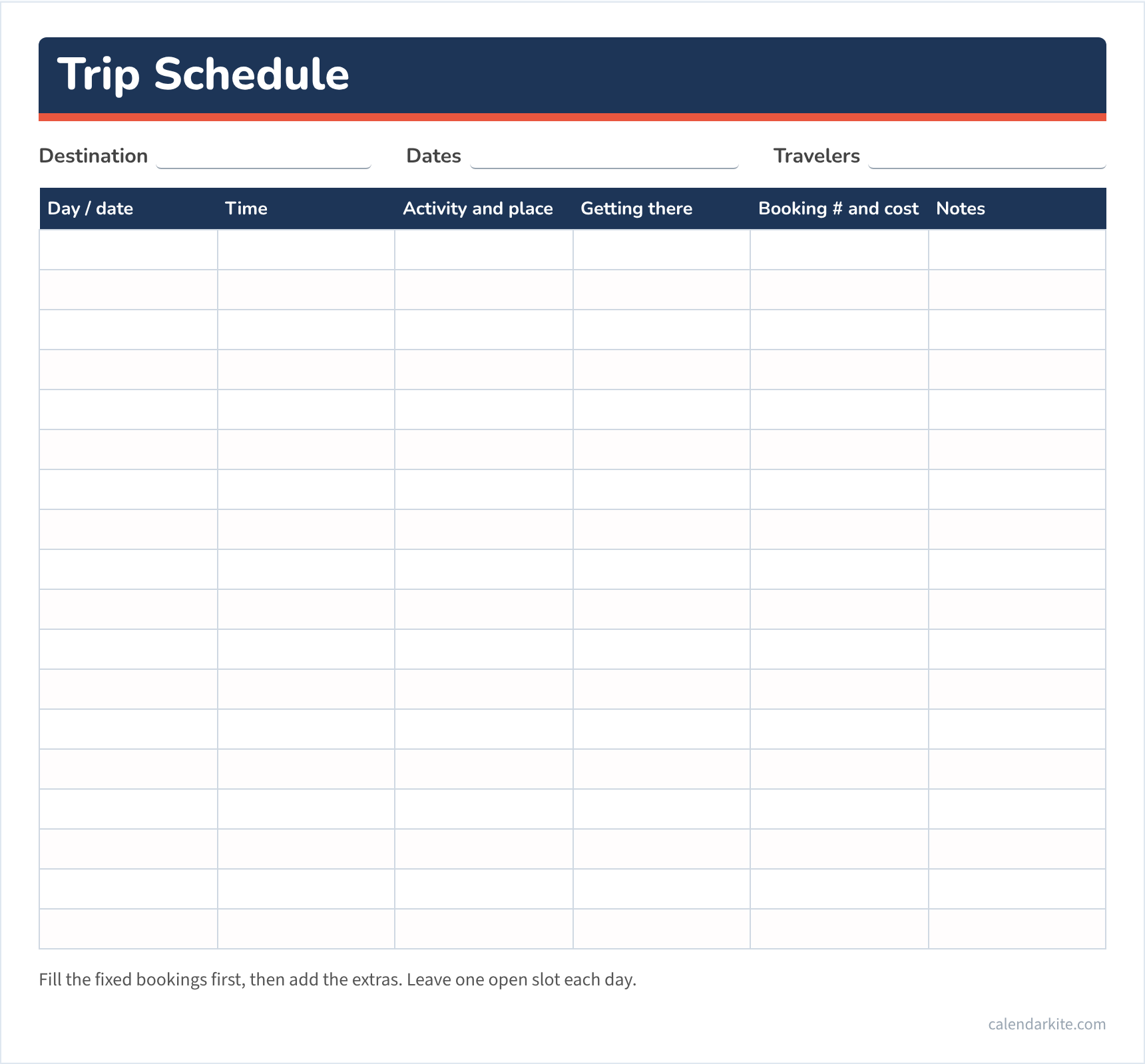
The navy header band and coral accent make this a strong pick for group trips or work travel, where the day's headline needs to stand out. A mistake I see often is cramming everything onto one page, so I'd use one sheet per day.
I keep a paper calendar on the fridge and a planner on the kitchen counter, and every family trip we take ends up on both. But the details (confirmation numbers, check-in times, which train) need a home of their own, and that is what this sheet is for. Below I explain how to fill it in, how much to plan, and how to adapt it for road trips, flights, group trips and work travel.
What a trip schedule template actually does
A good trip schedule does one job: it stops you from having to remember things while you are tired, hungry or standing in a queue. When the plan is written down in time order, you can glance at one line and know what comes next, where it is and what you already paid for.
It also shows you problems before you leave. When you put a 2 pm tour and a 3 pm museum slot on the same line of paper, you can see right away that the two are across town from each other. I spent about ten years in office administration, keeping schedules and rotas readable, and the lesson that carried over most is simple: clashes are easy to see on paper and easy to miss in your head.
A trip schedule is different from a packing list or a budget. It answers “what happens when”, not “what do I bring” or “what will this cost overall”. It pairs well with those, and I cover that later, but the schedule is the spine of the trip.
What is on this printable sheet
The sheet has a header with three fill-in fields: destination, dates and travelers. Below that is a table of 18 rows with six columns: day and date, time, activity and place, getting there, booking number and cost, and notes.
I added the “getting there” column on purpose. In my first draft, transport lived in the notes, and it got squeezed out by opening hours and restaurant names. Pulling it into its own column means you can scan down it and see every train, taxi, shuttle or drive in one pass. That is where trips tend to go wrong, so it earned its own space.
The booking column pairs the confirmation number with the cost. If something is prepaid, write “paid”. If it is due on arrival, write the amount. That small habit saves a lot of awkward searching at a desk or counter. The table fits on one page and prints cleanly in black and white, so you can run a copy for each traveler without using much ink.
How to fill it in, step by step
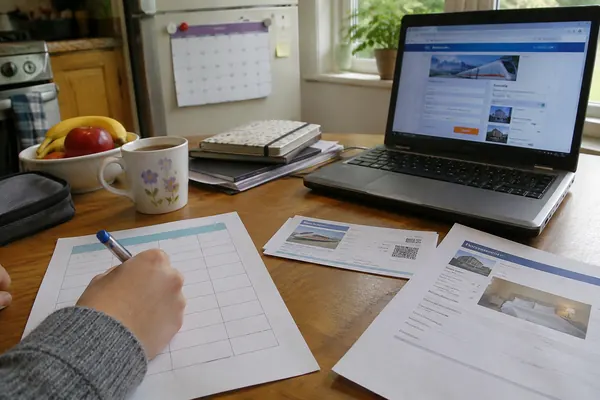
You can do this in about twenty minutes for a long weekend, and an hour for a longer trip. Work in this order, because each step makes the next one easier.
- Fill in the header: destination, dates and who is coming.
- Enter the fixed points first: flights, trains, hotel check-in and check-out, tours and reservations. These are the things you cannot move.
- Add the travel between them: airport transfers, drives, walking time between sights.
- Add the plans you most want to do, one or two per day, in the activity column.
- Put booking numbers and costs on the same line as each plan.
- Use the notes column for opening hours, the name a reservation is under and a backup option.
- Read the whole page top to bottom once, checking that each line can realistically follow the one before.
If a day needs more than three or four rows, use the next blank row and repeat the date. The sheet is built for a trip of about three to seven days. For longer trips, print one sheet per week of travel.
Try this: Before you add any activities, fill in only the rows for flights, hotels and prepaid bookings. Look at the gaps that are left. Those gaps are your real free time.
Start with the fixed points
Every trip has a few things that cannot move, and they should go on the sheet before anything else. Flights and train times are the obvious ones. Hotel check-in and check-out times matter too, because they set when you can drop bags and when you must be out.
Next come timed entries: a guided tour, a show, a ferry, a restaurant booking made weeks ago. Put the time and the meeting point in the activity column. If the meeting point is a specific gate or entrance, say so. “Main entrance, north side” is far more useful than “castle”.
Once those are in, the rest of the schedule fills in around them. This is the same method I used in the office for building a rota: lock in the shifts that cannot change, then place everything else. Trips are easier to enjoy when the pressure points are already sorted.
How much to plan each day
Most people over-plan the first draft. A day that looks full and exciting on paper often runs behind by lunchtime, and then the whole schedule slides. A good rule is two or three anchored plans per day, with open time between them for meals, wandering and rest.
Treat the first and last day as half days. On arrival you will be tired and dealing with luggage, and on departure you need slack for check-out and getting to the airport or station. One plan on each of those days is enough.
Think about who is travelling. With young children, one morning plan and one afternoon plan is often the limit before someone melts down. With older relatives, the same applies, along with a longer lunch. If you are travelling alone and love to move fast, you can pack in more, but still leave a slot or two empty.
Try this: For each day, draw a small star next to the one thing you would be sad to miss. Everything else on that day is allowed to slip if the day goes sideways.
Building in travel time and buffers
The biggest mistake I see on trip schedules is that they list activities as if people teleport between them. Every line needs the time it takes to get there, plus a buffer. Add 15 to 30 minutes to any city transfer, and more if you have luggage or kids.
For airports, add the time you need on your own terms, not the minimum a website suggests. Write the time you need to leave the hotel, not just the time of the flight. I like to put “leave hotel” as its own line, because that is the moment you actually act on.
Opening hours deserve the same care. Many museums and small shops close one day a week, and some places stop admitting people an hour before they close. Put a note in the notes column such as “closed Mon” or “last entry 4 pm” so you do not have to find that out at the door.
Who this template suits
This sheet suits anyone who wants a clear, one-page view of a trip: couples planning a long weekend, families with a mix of ages, friends splitting a rental house, and solo travellers who like to have a backup on paper. It also works for work trips, conferences and school or club outings, anywhere you have times, places and bookings to track.
It is especially handy for trips with other people. When one person holds the plan in their head, everyone else follows blindly. A printed schedule lets each traveler see what is coming and take a bit of ownership, whether that is finding the platform or checking the weather.
If you want a looser, day-by-day sketch with more writing room, my itinerary planner template is a better fit. This sheet is the tighter, time-and-booking version.
Variations for different kinds of trips
The same sheet adapts well. Here is how I would use it in a few common situations:
- Road trip: use “getting there” for the route and drive time, and put fuel and rest stops in as their own rows. Note the total miles in the notes.
- Flight and hotel trip: list each flight as a row with the airline, flight number and terminal in the booking column, then add the transfer to the hotel on the next line.
- Business trip: write meetings and travel times in the same table, and put the contact person or room number in the notes.
- Group or family trip: add initials in the notes for who is responsible for each booking.
- Camping trip: list drive time, check-in and any activities, and pair the schedule with a camping checklist for gear.
For a road trip with our two kids and the dog, I add a row for every planned stop and write the dog’s needs in the notes (“walk, water, 20 min”). It sounds small, but it keeps stops from getting skipped when everyone is tired and wants to keep driving.
Dates, times and time zones
Write the date in a way that no one can misread. If you are travelling internationally, “3/4” could be March 4 or April 3, so spell out the month, such as “Mar 4”. Add the weekday if it helps, because “Tue Mar 4” is easier to check against bookings than a bare number.
For times, pick either a 12-hour or 24-hour style and use it throughout. Many transport bookings abroad use 24-hour time, so if you are copying from tickets, it can be easier to keep that format on the sheet. Mark flights and trains as local time, and write the time zone in the notes when you cross one.
If your trip spans several time zones, add a note on the first row of each new place: “local time is +6 hours”. I also suggest checking your plan against a full year view such as the 2027 calendar when you are choosing dates, so you can spot public holidays, school breaks and busy weekends at your destination.
Booking numbers and what to keep with you
The booking column is the most practical part of the sheet. Write confirmation numbers clearly, and copy them exactly. If a booking is under a different name, put that in the notes. I once watched a colleague lose half an hour at a hotel desk because the reservation was under a manager’s name and nobody had written it down.
Keep the passwords, passport numbers and card details off this page. The schedule is meant to be handed around and left on tables, so it should hold references, not secrets. Keep sensitive documents in a separate folder or wallet.
For emergencies, add a line at the bottom of the sheet (in a blank row) with the address of your first hotel and a local phone number for it. If your phone dies, that one line can get you home.
Sharing the schedule with a group

For group trips, agree on one master version. Fill it in on screen, print it, and give everyone a copy, or take a photo of the printed page and share it in a group chat. That avoids three people each working from a different version of the plan.
Ask each person to check the lines that involve them: their flight, their room, their dietary needs. People notice mistakes in their own lines much faster than in someone else’s. Do this a few days before you leave, while there is still time to fix things.
If your group is large, use the notes column for who is in charge of each activity. A shared plan with named owners is much more likely to run on time than one where everyone assumes someone else is checking the tickets.
Printing tips
The sheet is set up for US Letter and prints cleanly on A4 too. I test-print every printable on my home inkjet on both paper sizes, and I check that nothing runs off the edge. For this one I made the writing rows tall enough for a normal pen, since cramped rows are the first thing people complain about.
Some quick tips:
- Print at 100% scale, not “fit to page”, so row heights stay generous.
- Use plain black and white to save ink. Colour adds nothing here.
- Print two copies: one to carry, one to leave at home with someone who can help if plans change.
- Slip the page into a clear sleeve or folder, so a spilled coffee does not wipe out your booking numbers.
Try this: Print your finished schedule, fold it in half, and slip it into your passport holder or bag today. If it is easy to reach, you will actually use it.
Pair it with a checklist and a budget
The schedule tells you when and where. Two other pages round out the planning. A packing checklist covers what you bring, and my printable checklists are a good start for building one. A budget page covers what you spend, and the budget planner printable helps you set a daily limit before you leave.
If you want to see how your trip fits around work and home life, a weekly calendar is useful for the weeks before and after. You can block out the days you will be away, note who is feeding the dog or collecting the mail, and keep the home side of the trip running without you.
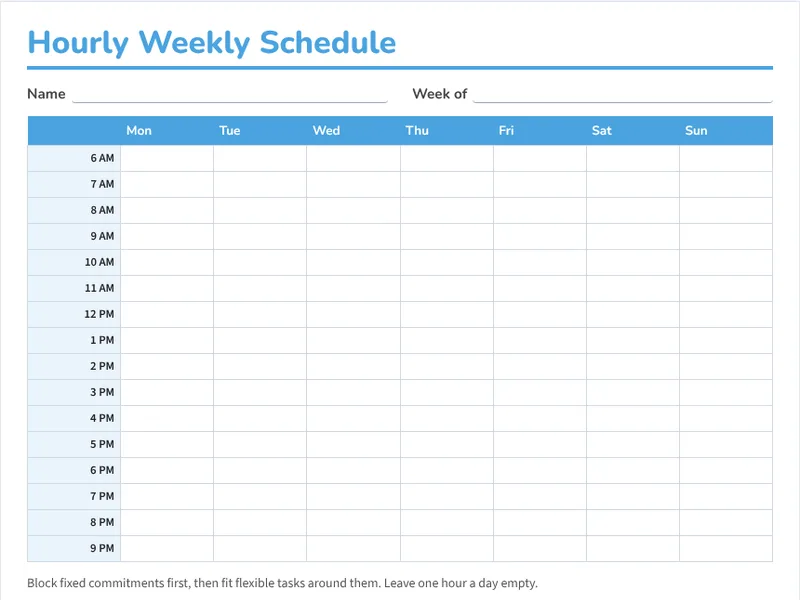
For very tight days, say a conference or a city sightseeing run, the hourly schedule template gives you a finer time grid than this sheet. I use this table for the whole trip and the hourly one for any single day that gets crowded.
Common mistakes to avoid
A few errors come up again and again, and all of them are easy to fix on paper.
- Scheduling something for every hour of the day, with no room for delays or rest.
- Forgetting travel time between plans, especially in big cities.
- Copying a time from a ticket without checking the time zone.
- Leaving off the check-out time on the last day.
- Keeping the plan only on a phone with no backup.
- Planning around attractions without checking opening days.
Most of these come from the same root: the schedule was built from what people want to do, not from how a day actually runs. A quick read-through from top to bottom, asking “can I really get from this line to the next?”, will catch nearly all of them.
Keep it after the trip
Once you are home, keep the filled-in sheet. It is a useful record for next time: which activities ran long, which transfers were tight, what you would skip or do again. I jot a few words in the notes column during the trip, such as “worth it” or “too rushed”, and those notes are gold when planning the next one.
If you are planning more than one trip a year, store your sheets together in a folder, and mark the dates on a year calendar so that nothing overlaps with school terms, birthdays or work deadlines. A filled-in schedule from last summer is also a great starting point if you go back to the same place.
Your entries on this page save in your browser, so you can come back and keep editing before you print. When the plan is settled, print it, fold it and take it along.
Common questions
What should a trip schedule include?
At minimum: the date, the time, what you are doing and where, how you get there, and any booking number or cost. Add a notes column for opening hours, reservation names and backup plans. Anything that would make you stop and search your email belongs on the sheet.
How many activities should I plan per day?
Two or three anchored plans per day is plenty for most trips, with free time around them. Travel days should hold one plan at most. If you are travelling with young children or older relatives, drop to one or two.
What is the difference between a trip schedule and an itinerary?
The two terms overlap a lot. An itinerary usually lists where you will be and when, in order. A trip schedule is a bit more time-focused, with set hours, transport and booking details alongside each plan. This sheet works as either.
Can I type into the template before printing?
Yes. You can type into every line and field on the page, tick boxes and edit items. Your entries save in your browser, so you can come back and add to them. When it looks right, print it, or download the blank PDF to write by hand.
Should I carry a paper copy if I have everything on my phone?
I would. Phones run out of battery, lose signal and get stolen. A single printed page with booking numbers, addresses and times is a cheap backup, and it is easier to hand to a travel companion than a phone.
How early should I make my trip schedule?
Start as soon as you book your first flight or hotel, then add to it as plans firm up. Finish a clean version two or three days before you leave so you have time to spot gaps, such as a missing transfer or a closed attraction.
More free planners
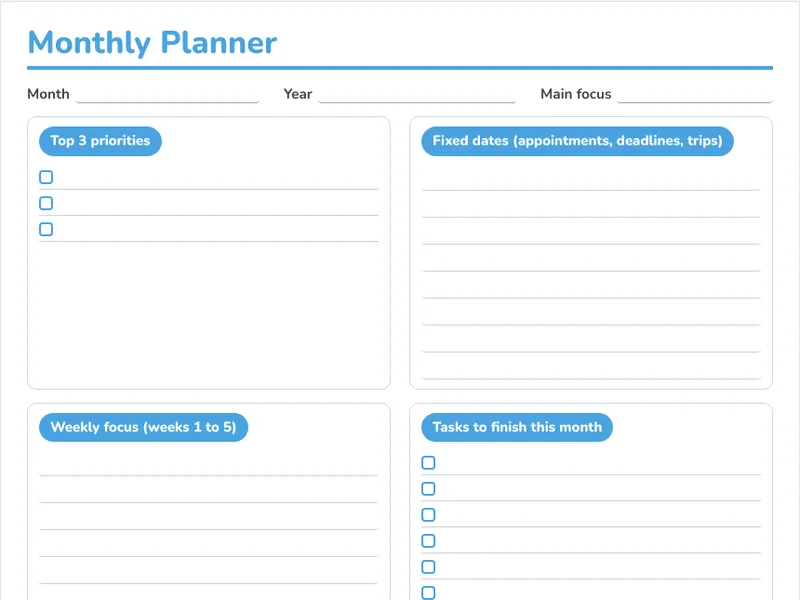 Monthly Planner: Free Printable One-Page Sheet
 Garden Planner: Free Printable Planting Sheet
 Printable Weekly Meal Planner
 House Cleaning Schedule: Free Printable for Daily, Weekly and Monthly Jobs
 Hourly Schedule Template: Free Printable Weekly Planner
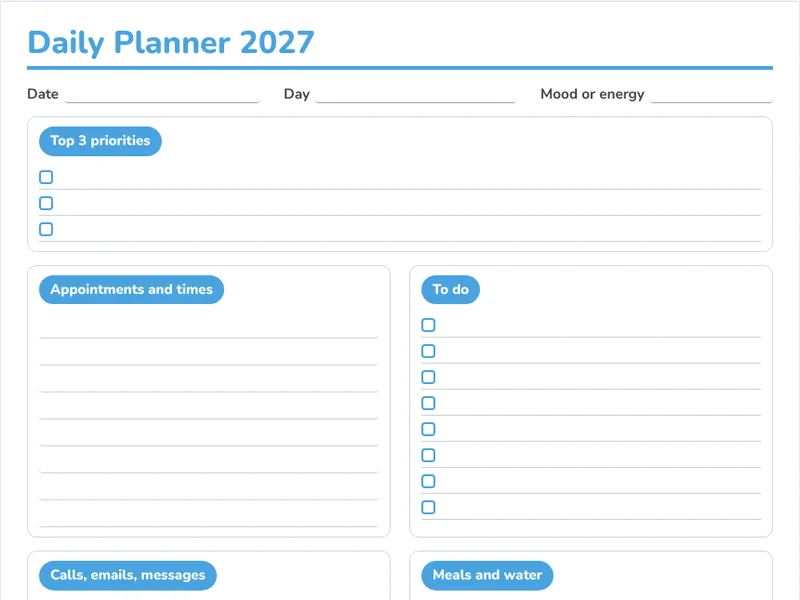 Daily Planner 2027: Free Printable Page for Every Day