
Fitness Planner Printable: Free Two-Week Workout Planner

A fitness planner printable is a page where you decide your workouts in advance, then record what you actually did. The one on this page covers two weeks on a single sheet, with a day, a planned workout, a start time, minutes, an effort score, a Done box and a notes column. You can type into it on screen, print it on US Letter, and keep it on a clipboard or the fridge.
| Day | Planned workout | Time | Minutes | Effort (1 to 10) | Done | Notes |
|---|---|---|---|---|---|---|
| Mon | ||||||
| Tue | ||||||
| Wed | ||||||
| Thu | ||||||
| Fri | ||||||
| Sat | ||||||
| Sun | ||||||
| Mon | ||||||
| Tue | ||||||
| Wed | ||||||
| Thu | ||||||
| Fri | ||||||
| Sat | ||||||
| Sun |
Plan it Sunday night. Log it the same day. Rest days count as part of the plan.
Free for personal, classroom and office use. Your entries are included in the print, PDF and PNG. Prints on US Letter and fits A4.
Black and White Fitness Planner Printable
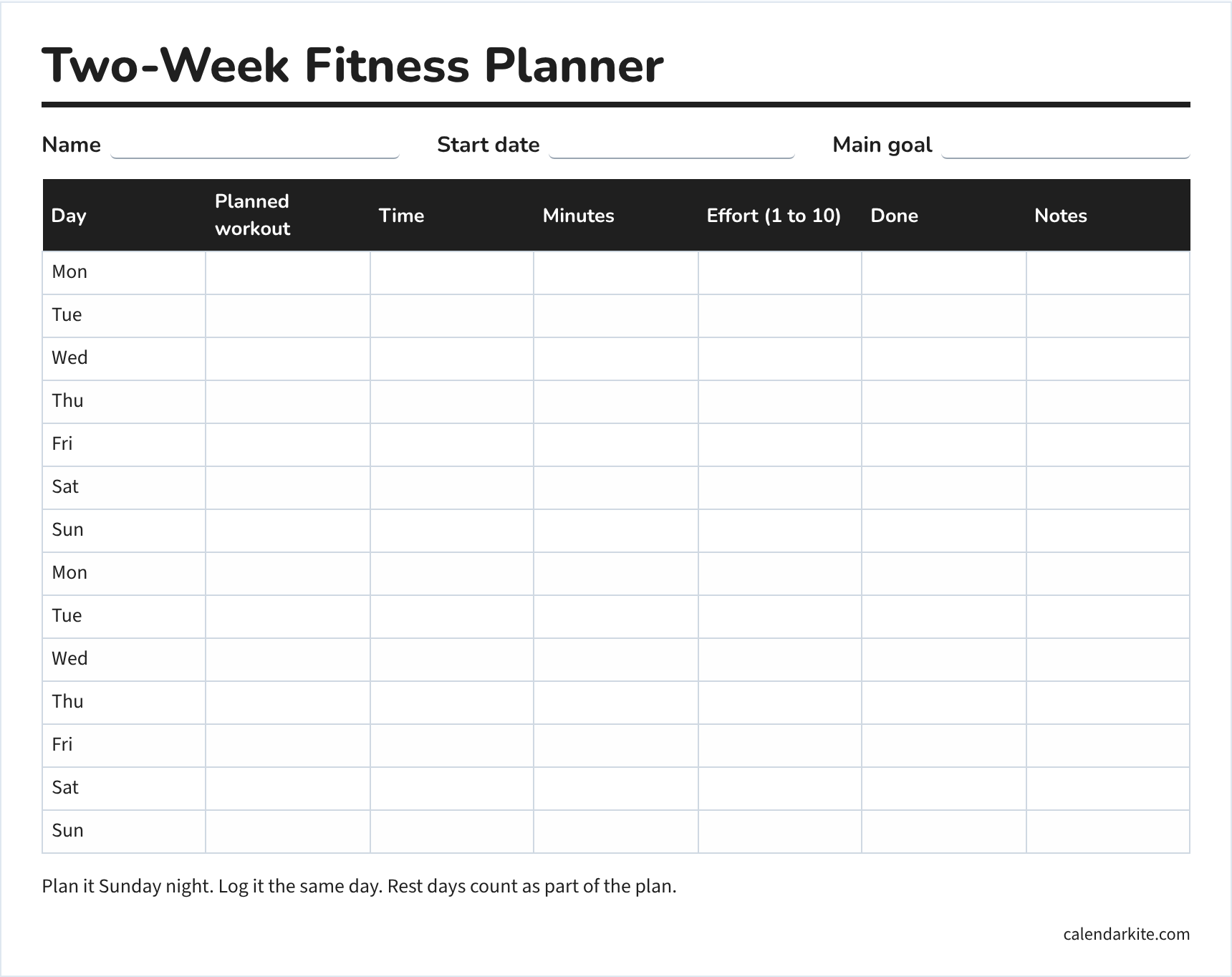
I made this one for people who print a lot, since plain black lines go easy on your inkjet cartridge. Tape it inside a closet door to log workouts; I test-print on my home inkjet and the lines stay crisp on Letter and A4.
Pink Fitness Planner Printable
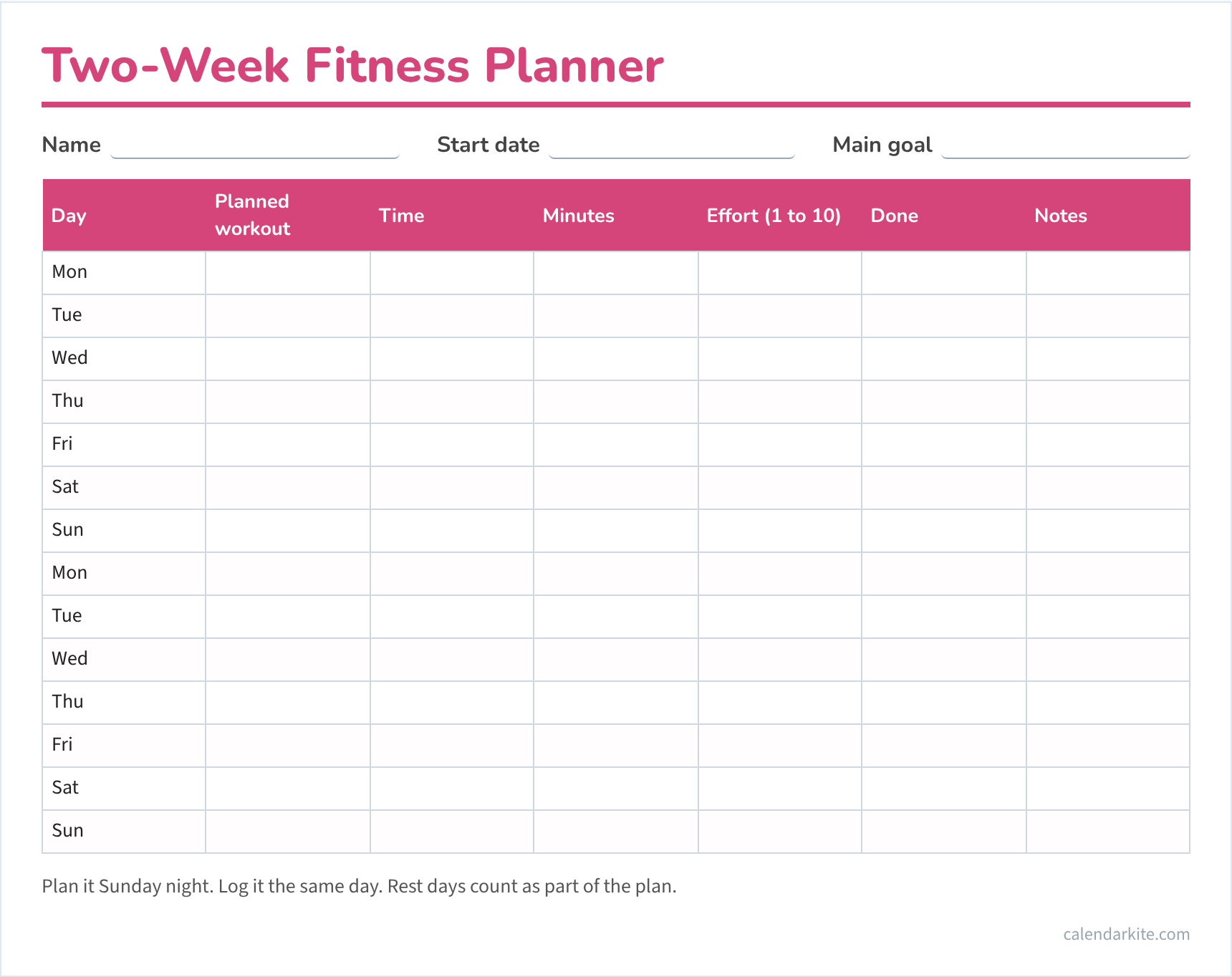
This soft pink fitness planner suits anyone who wants a gentle, encouraging look for weekly workouts and goals. Use it to schedule your classes, note your steps and jot down how each session felt.
Sage Green Fitness Planner Printable
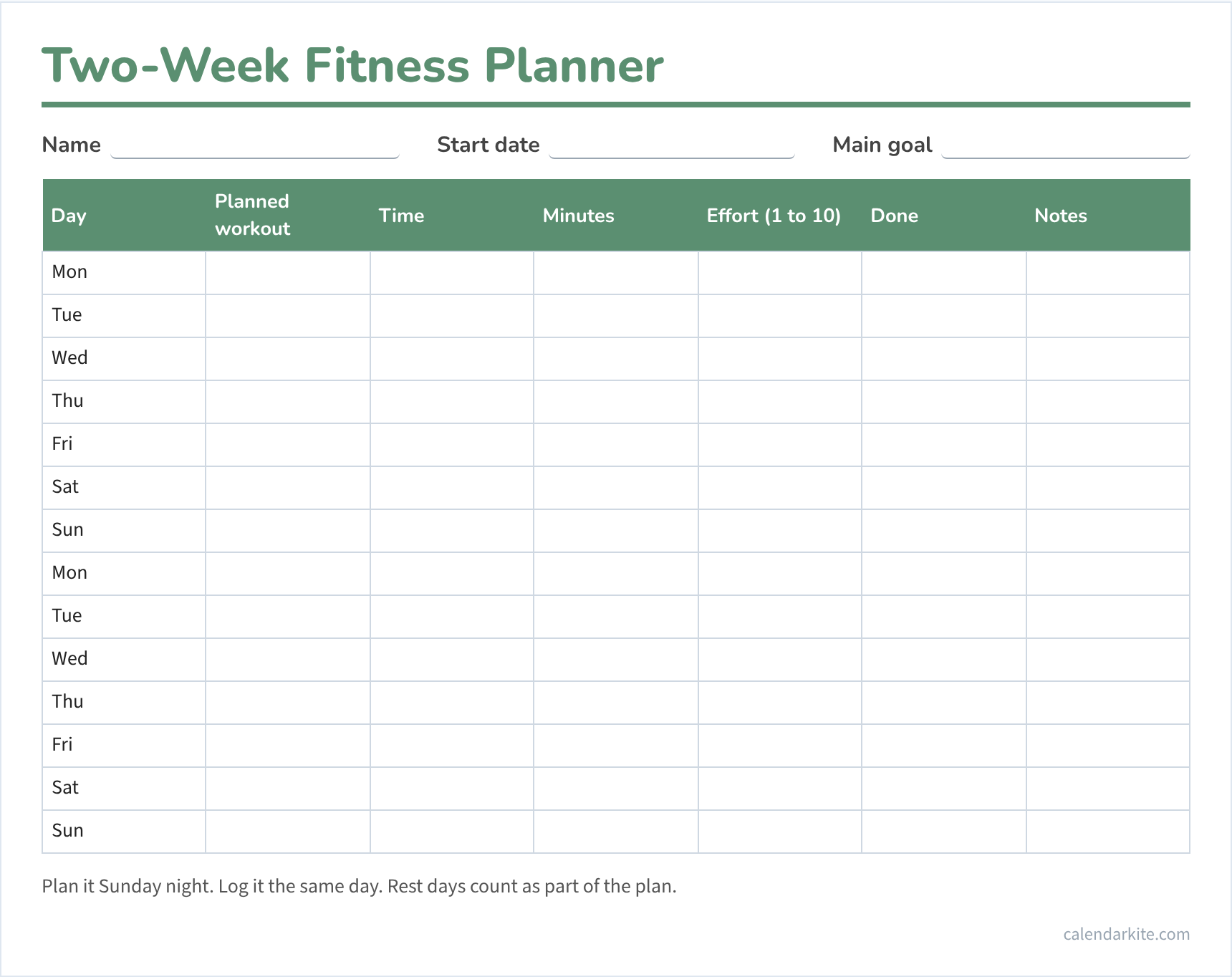
The sage green version suits a calm routine, like morning walks, yoga and a weekly strength day. I learned in the office that muted colors stay readable longer than loud ones, so I kept the text dark and the shading light.
Lavender Fitness Planner Printable
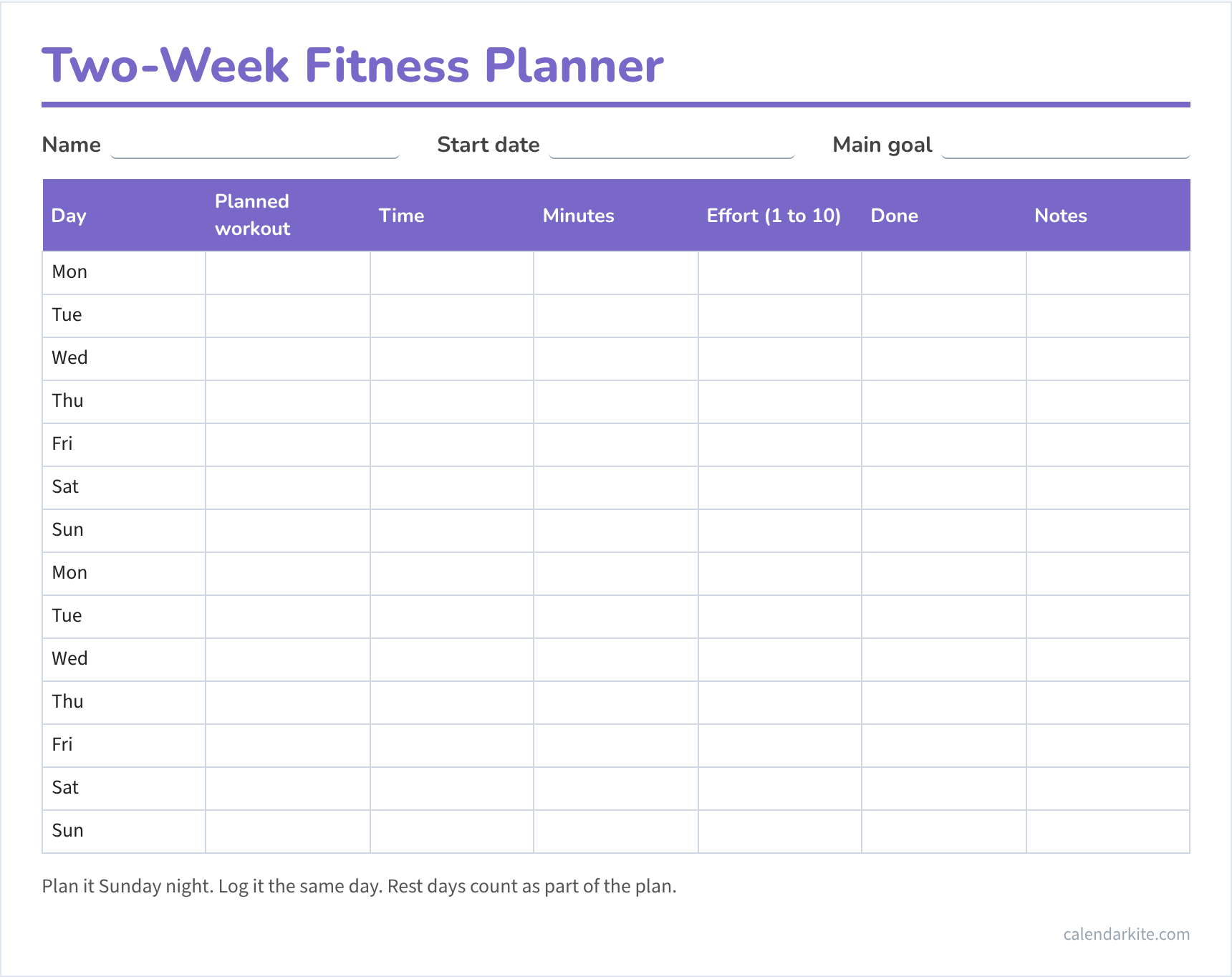
Lavender works well if you track workouts alongside sleep or self-care habits and want a relaxed, tidy page. Print it on US Letter or A4 and use it to plan three gym sessions and rest days for the week.
Cute Fitness Planner Printable
This pastel blue page is for anyone who finds a plain tracker boring and needs a little cheer to keep showing up. Pin it on the fridge like I do with my paper calendar and tick off each workout.
Floral Fitness Planner Printable
The watercolor flowers and mauve serif headings suit a more elegant planner for pilates, barre or walking routines. It makes a lovely gift or binder insert, with plenty of writing room for goals and weekly notes.
Fun Colorful Fitness Planner Printable
Bright orange and yellow with bold cartoon art makes this version fun for families who exercise together. With my two kids and a dog, I'd use it to log after-dinner walks, bike rides and backyard games.
Simple Minimalist Fitness Planner Printable
Thin gray lines and a light uppercase heading suit people who want a no-fuss planner for lifting sessions, sets and reps. A common mistake is cramming too much in, so I kept the boxes roomy enough for quick notes.
Aesthetic Fitness Planner Printable
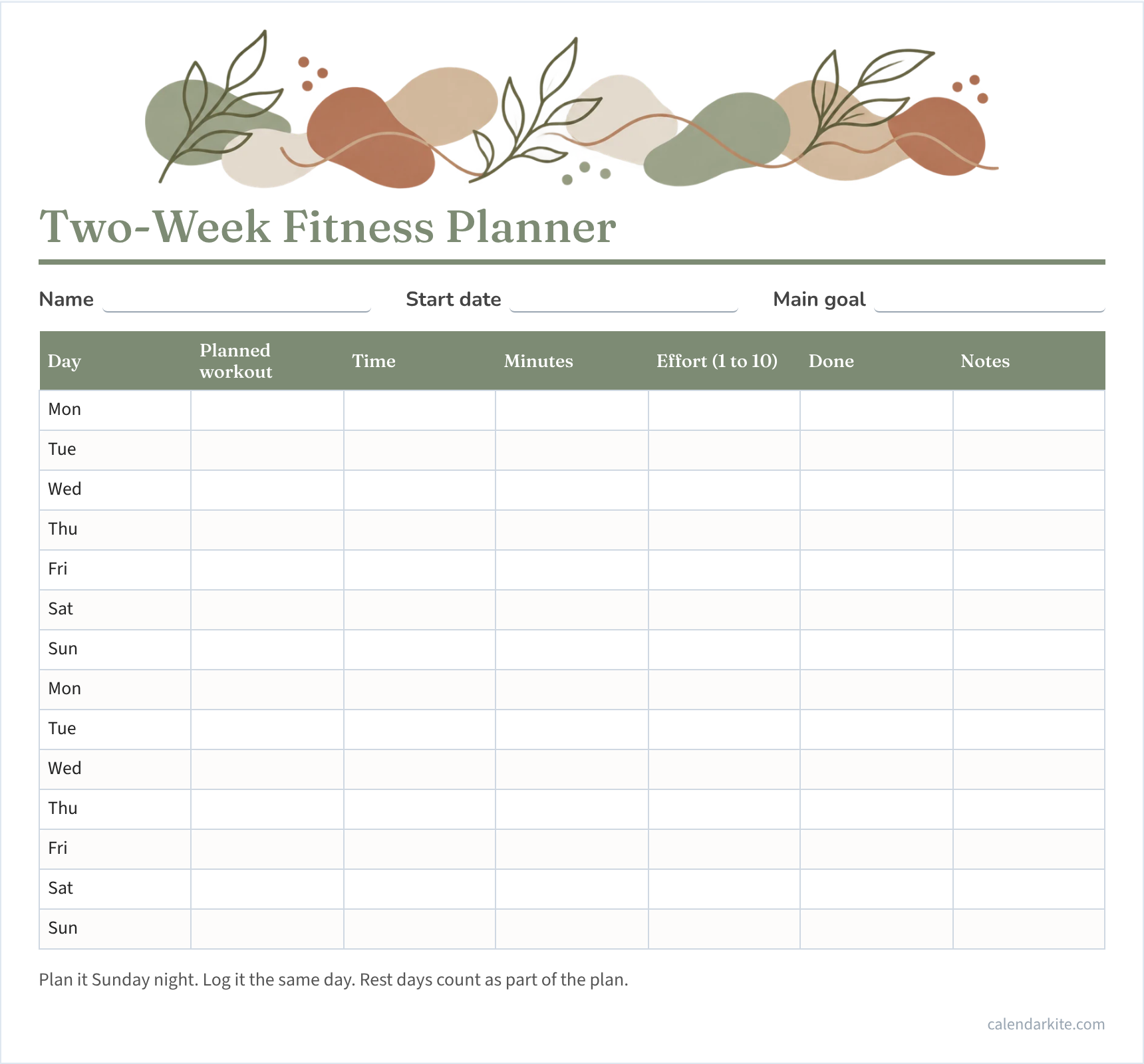
Muted sage, sand and terracotta with soft line-art leaves suit anyone who likes a planner that looks good on a desk. Use it to map out your week of workouts and meals before Sunday evening ends.
Modern Fitness Planner Printable
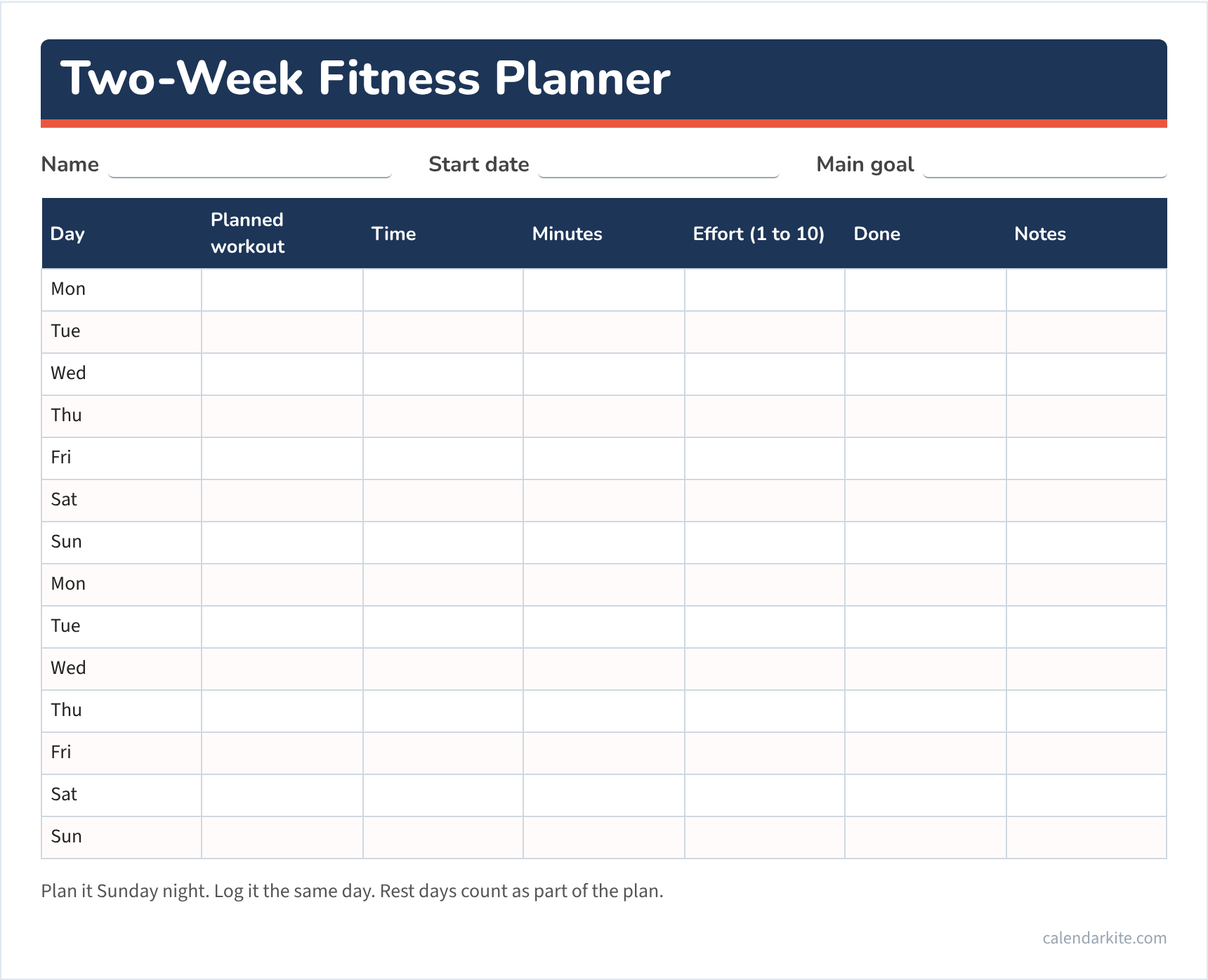
The navy header band and coral accent give a modern, businesslike layout for goal-focused training blocks. It suits someone following a 12-week program who wants the week's targets visible at a glance.
I built it that way because most fitness planners are either a blank grid with no guidance or a 50 page packet nobody finishes. Two weeks is long enough to see a pattern and short enough to start fresh when life changes. I print it on my home inkjet, check it against the real calendar, and it fits one page every time.
What a fitness planner printable should do
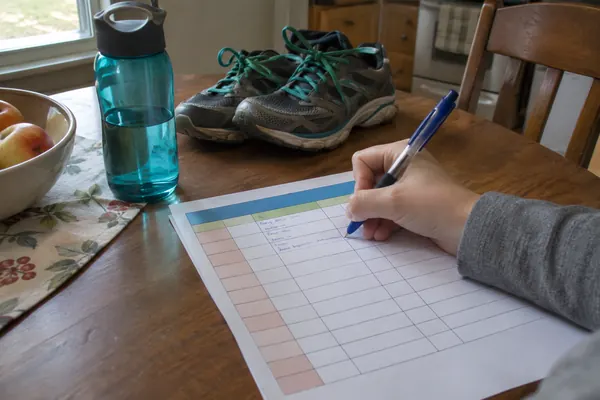
A good planner does three jobs. It makes you choose a workout before the day starts, it gives you a quick place to record the result, and it shows you the pattern across a couple of weeks. If it only does the first, it is a to-do list. If it only does the second, it is a log. The value comes from having both on the same page.
That is why this sheet puts the plan and the result in the same row. You write the workout in the Planned workout column on Sunday night, then fill in minutes, effort and a tick afterward. When a row stays empty, you can see it at a glance, and that tells you more than any motivational quote at the top of a page.
If you want a deeper record of sets, reps and weights, a separate workout log template works well alongside this one. Think of this sheet as the calendar and the log as the detail.
Who this planner suits
It suits beginners who want a simple routine without a spreadsheet, and people coming back after a break who need a gentle way to rebuild. It also suits anyone who already trains but keeps losing track of which days they planned to rest. Runners, lifters, class regulars, walkers and swimmers can all use it, because the workout column is free text.
It is a lighter tool than a full training programme. It will not tell you what to do, and it does not prescribe sets or paces. It simply holds whatever plan you have, whether that is a coach’s programme, a gym class timetable or three walks and a yoga video.
If you are new to exercise, have an injury, or have a health condition, check your plans with a doctor or qualified trainer first. The sheet records your decisions, and good decisions are worth getting advice on.
How the sheet is laid out
The sheet has 14 rows, one for each day across two weeks, with the days of the week already printed down the left side. The header has three fill-in fields: your name, your start date and your main goal. Putting the goal at the top matters more than it looks, because you see it every time you pick up the page.
The columns are chosen to answer the questions I actually ask myself after a workout:
- Planned workout: what you intended to do
- Time: when you will do it, such as 6:30 AM or after school pickup
- Minutes: how long it really took
- Effort (1 to 10): how hard it felt
- Done: a box to tick
- Notes: sleep, pain, mood, anything useful
Early versions of my layout had a Calories column. I took it out because it invited guessing and clutter, and swapped it for Time, which turned out to be the single most useful column for sticking to a plan.
How to fill in the planner
Start with the header. Write your name, the date of the first Monday you will use, and one main goal in plain words, such as “run 5 km without stopping” or “lift three times a week.” Keep it to a line.
Then fill the Planned workout column for the first week only. Look at your real week before you write anything: school runs, late meetings, travel, family dinners. Pencil in sessions on the days that have room, and leave the other days blank or write Rest. Add a start time to each workout, because a workout with a time attached is far more likely to happen than one that has “sometime.”
After each session, fill in Minutes, give an Effort score, tick Done and add a short note. Do it the same day while you remember. At the end of week one, glance at what worked and plan week two with that in mind.
If you fill it in on screen
You can type directly into every field, tick the boxes and edit the day labels. Your entries are saved in your browser, so you can plan on your laptop on Sunday and come back on Wednesday to update it. Print it when you are ready, or print it partly filled and finish by hand.
Try this: Before you print, fill in only the Planned workout and Time columns for week one. Leave Minutes, Effort and Notes blank for the pen. A half-filled page invites you to finish it.
Set a weekly goal you can hit
The most common mistake I see with fitness planners is a goal that sounds impressive and cannot survive a busy Tuesday. “Exercise every day” is a typical one. By Thursday the page is full of gaps, and gaps feel like failure, so the planner goes in a drawer.
A better goal is a number you can hit even in a bad week. Three sessions is a solid target for most people. If you reach it easily for two weeks, raise it to four. If you miss it twice in a row, lower it and keep the habit alive. A smaller target you hit builds more momentum than a bigger one you miss.
Write the weekly goal in the main goal field at the top, and count your ticks on Sunday night. If your ticks match your target, you hit it. That is the whole scoring system.
Plan your week around real life
I spent about ten years in office administration, and the lesson that stuck is that a schedule only works if it matches what people actually have time for. A rota that ignores someone’s school pickup gets ignored right back. Fitness plans are the same.
Start by marking the fixed things on your week: work hours, kids’ activities, commitments you cannot move. If you want a fuller view, a weekly calendar printable next to this sheet makes clashes obvious. Then drop workouts into the gaps, preferring the same times each week. Morning people should protect mornings, and evening people should not pretend otherwise.
At home, I keep a paper calendar on the fridge and a planner on the kitchen counter, and my own workouts get written in both places. It feels repetitive, but a plan I see in the kitchen gets done far more often than one hidden in an app.
Use the effort score honestly
The Effort column runs from 1 to 10. A 1 is barely moving, a 5 is steady and you could talk in full sentences, and an 8 or 9 is hard enough that you only manage a few words. A 10 is everything you have. Most of your sessions should sit between 4 and 7.
Honest scores are what make the planner useful. If every session is a 9, you are either overreaching or not scoring honestly. If every session is a 3, you may be underloading. Over two weeks, the column shows whether your hard days and easy days are actually different, which is one of the most common mix-ups for people training on their own.
The effort score also helps when workouts are not comparable. A 45 minute walk and a 20 minute interval session can both be a 6, and that is useful information you would not get from minutes alone.
Try this: After your next three workouts, write the effort score before you look at the clock or any watch data. Compare how your gut score matches the numbers later.
Schedule rest days on purpose
Rest days belong in the plan, not in the gaps between plans. Write Rest, Walk or Stretch in the Planned workout column on those days, and tick Done when you have followed it. It sounds silly, but ticking a rest day makes it feel like part of the plan and not a day you skipped.
A simple pattern for beginners is a workout day, a rest or light day, and then repeat. As fitness improves, many people move to two days on, one day off. The right balance depends on your age, sleep, stress and what kind of training you do, so treat any pattern as a starting point and adjust from your notes.
Use the Notes column to flag soreness, poor sleep or a joint that feels off. If the same note shows up three times in a week, that is a reason to ease off or ask a professional.
A sample week, filled in
Here is what week one might look like for someone building a three-day routine with walking in between. The details are an example, not a prescription.
- Mon: Full body strength, 6:30 PM, 40 minutes, effort 6, Done
- Tue: Rest, ticked as planned
- Wed: 30 minute brisk walk, 12:15 PM, effort 4, Done
- Thu: Rest
- Fri: Easy 20 minute jog, 7:00 AM, effort 6, Done
- Sat: Family bike ride, 10:00 AM, effort 3, Done
- Sun: Plan next week, stretch for 10 minutes
Notice how many rows are modest. A good plan is mostly sessions you can repeat, with one or two that stretch you. The notes column in this example might say “legs sore Wednesday,” which would be a signal to keep Thursday as a true rest day.
Fitness planner ideas for different goals
The Planned workout column is flexible, so the same sheet can serve different goals. Here is how I would adapt it.
For strength, write the body part or movement pattern, such as “push” or “squat and hinge,” and keep exact sets and weights in a separate log. For running, write the session type and distance, like “easy 5 km” or “intervals,” and use Effort to keep easy runs easy. For weight loss or general health, aim for consistency first: walks, a couple of strength sessions and a Done tick on most days.
If you attend classes, write the class name and time in the row so you can see how many hard sessions you have stacked in one week. For a challenge such as 75 Hard, you may prefer a daily checklist, but this sheet is useful for planning which workouts will fill your two daily slots.
Track more than workouts
Exercise is only part of the picture. Sleep, hydration and food all change how workouts feel, and a few extra trackers can explain a lot. You do not need to track everything, and I would add one at a time.
A water tracker printable is the easiest add-on, because it takes seconds and shows up in your energy. A sleep log helps if your effort scores drift upward for no obvious reason. For body changes, a body measurement chart once a month is more reliable than weighing yourself daily.
If food is part of your plan, a printable weekly meal planner keeps dinners from derailing a good training week. I keep ours on the same counter as my planner, which means both get looked at at the same moment.
Fill it in on screen or by hand
Both work, and I do a mix. Typing the plan on screen is faster for Sunday planning, particularly if you reuse the same workouts week after week. Handwriting the result afterward feels more deliberate, and it is hard to do on a phone while your hands are sweaty.
If you prefer a clean start, there is a blank PDF you can download and print. That version is useful for gym lockers, shared household binders or anyone who simply likes pen on paper. If you want to keep your goal and labels, fill them in on the page first and print that copy.
One advantage of paper that people underrate is how visible it is. A page on the fridge gets seen every day, and an app does not unless you open it. For a wider view of how paper and digital tools compare, see the free digital planner page.
Printing tips
This sheet is made to fit one US Letter page, and I test-print each printable on my home inkjet on both US Letter and A4. If you are on A4, choose Fit to page in your print dialog rather than Actual size, and you will get clean margins.
Portrait gives you the standard look. If your handwriting is large, try landscape, which widens the Planned workout and Notes columns. Use black and white mode to save ink, since the sheet has no colour that matters. Standard 20 lb copy paper is fine, but a slightly heavier 24 lb paper stops pen from showing through if you write on both sides.
Print two copies at a time if you plan to keep going. That way week three and four are ready and you are never held up by a missing page.
Where to keep it
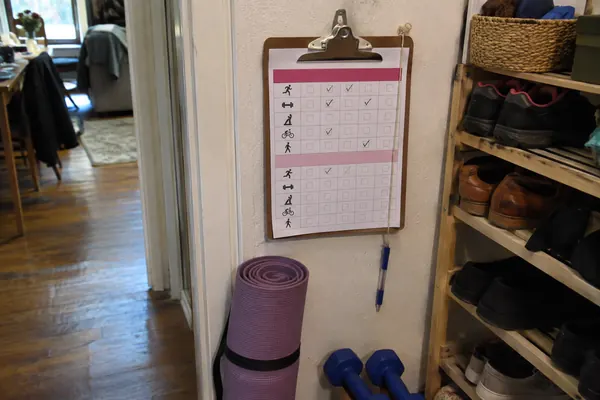
Visibility matters more than neatness. Good spots are the fridge, a clipboard by the door, the inside of a gym bag or a binder with the rest of your planning pages. Pick the place you pass most often, and put a pen right beside it.
For a longer plan, punch holes and keep each completed sheet in a binder. After two months you will have a record you can flip through, which is far more motivating than any progress quote. If you already use a printable planner for the rest of your life, slot this sheet behind your weekly pages.
Common mistakes to avoid
A few mistakes come up again and again, in offices and at home. The first is planning only the best-case week. Plan for the week you really have, including the evening you will be tired. The second is leaving out times, so workouts float and drift. The third is skipping the notes column, which is where the useful patterns hide.
Another one is treating a missed workout as the end of the plan. Missing one row is normal. Leave it unticked, do not try to cram it into the next day, and carry on with the next row. Finally, avoid changing the whole plan every week. Give a routine at least two weeks before you judge it, which is exactly what this sheet allows.
Variations you can make
You can stretch the planner without a new design. For a month, print the sheet twice and keep the pages together. For twelve weeks, print six copies and clip them behind a goal page, perhaps one built from a habit tracker printable so you can tick daily basics like stretching or a walk.
You can also cut the page in half and use it on a smaller clipboard, or print two to a sheet in a smaller size. Change the day labels to match a Monday start or a Sunday start, edit the column names if you want to track distance instead of minutes, and add a line in Notes for how you felt before and after. When the two weeks are done, tally your ticks, scan the Effort column, and start the next sheet with one small change.
Common questions
What should a fitness planner include?
At minimum it needs the day, the planned workout, how long it took, how hard it felt and a tick for done. A notes column and a weekly goal make it far more useful, because they show you what to change next week.
How many days a week should I plan to work out?
Start with the number you can repeat for a month without dread, often three or four. Add rest days on purpose, then increase only when the current plan feels easy for two weeks in a row.
Can I fill in this fitness planner on my computer?
Yes. You can type into every field on the page, tick the Done boxes and edit the labels. It saves in your browser, so your entries are there when you come back, and then you print it.
Does the planner work for running, weights and classes?
Yes. The Planned workout column is free text, so you can write a 30 minute easy run, a push day or a spin class. The effort score keeps different types of exercise comparable.
What paper size should I print it on?
The sheet is built to fit one US Letter page and also prints cleanly on A4 if you choose fit to page. Use portrait or landscape depending on which gives you bigger writing space.
Is a paper fitness planner better than an app?
Neither is better for everyone. Paper is faster to glance at and has no notifications to dismiss, which suits people who forget to open apps. If you need automatic step or heart rate data, an app can sit alongside it.
More free planners
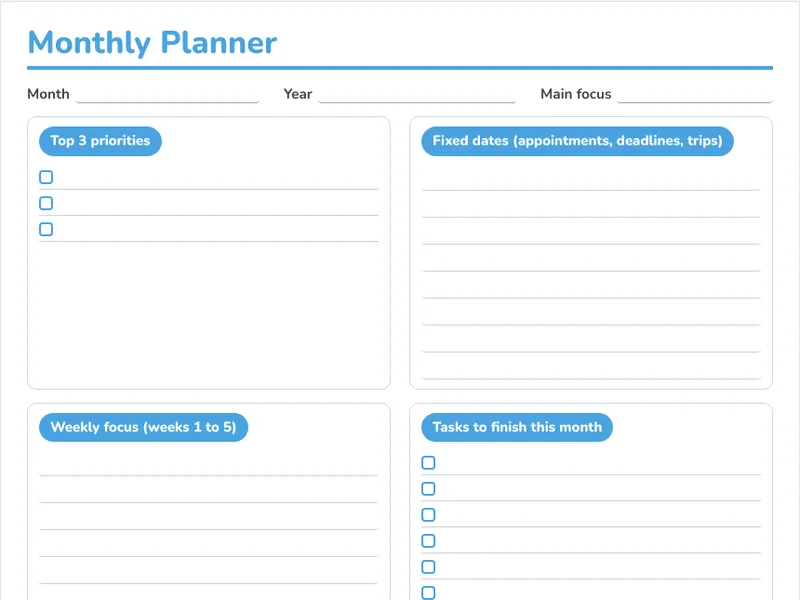 Monthly Planner: Free Printable One-Page Sheet
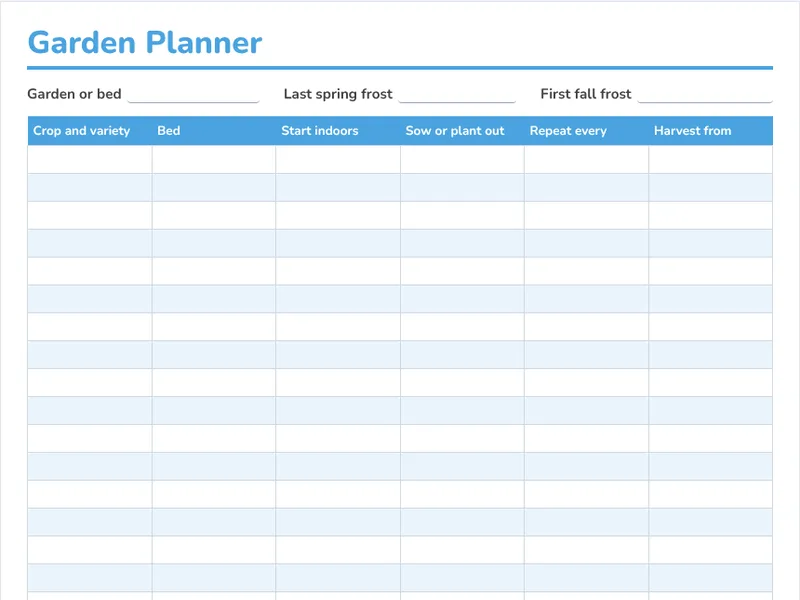 Garden Planner: Free Printable Planting Sheet
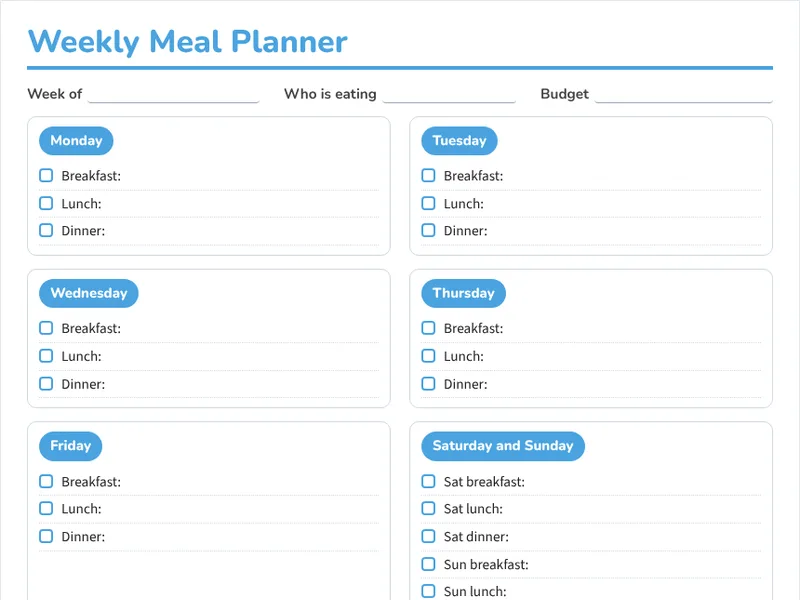 Printable Weekly Meal Planner
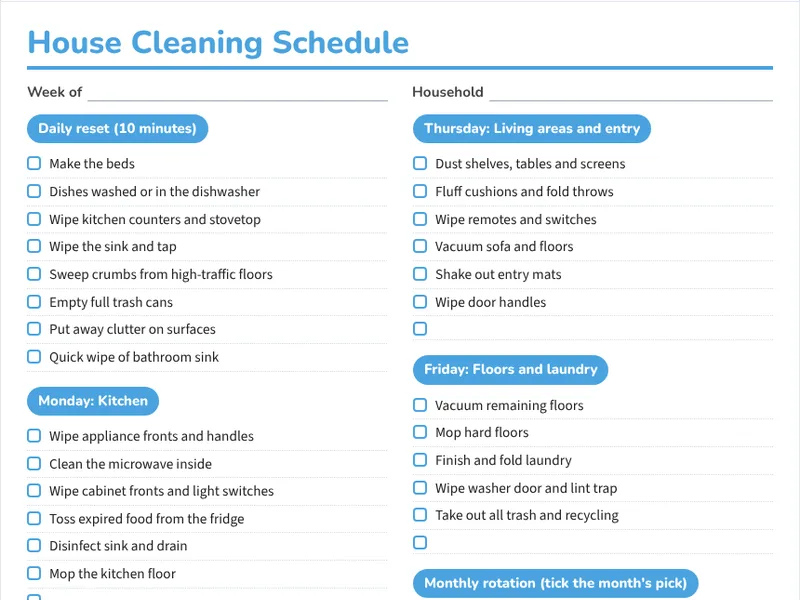 House Cleaning Schedule: Free Printable for Daily, Weekly and Monthly Jobs
 Hourly Schedule Template: Free Printable Weekly Planner
 Daily Planner 2027: Free Printable Page for Every Day