
Workout Log Template (Free Printable Fitness Log)

A workout log template is a sheet where you record each session in the same layout every time: the date, the exercises, the weight, sets and reps (or time and distance), and a short note on how it felt. The free printable above does exactly that on one US Letter page, and you can type into it on screen before you print, or print it blank and fill it in with a pen at the gym.
| Exercise | Target | Set 1 | Set 2 | Set 3 | Set 4 | Notes |
|---|---|---|---|---|---|---|
Write weight x reps in each set box (example: 135 x 8). Next time, aim to beat it by one rep.
Free for personal, classroom and office use. Your entries are included in the print, PDF and PNG. Prints on US Letter and fits A4.
Black and White Workout Log Template Printable
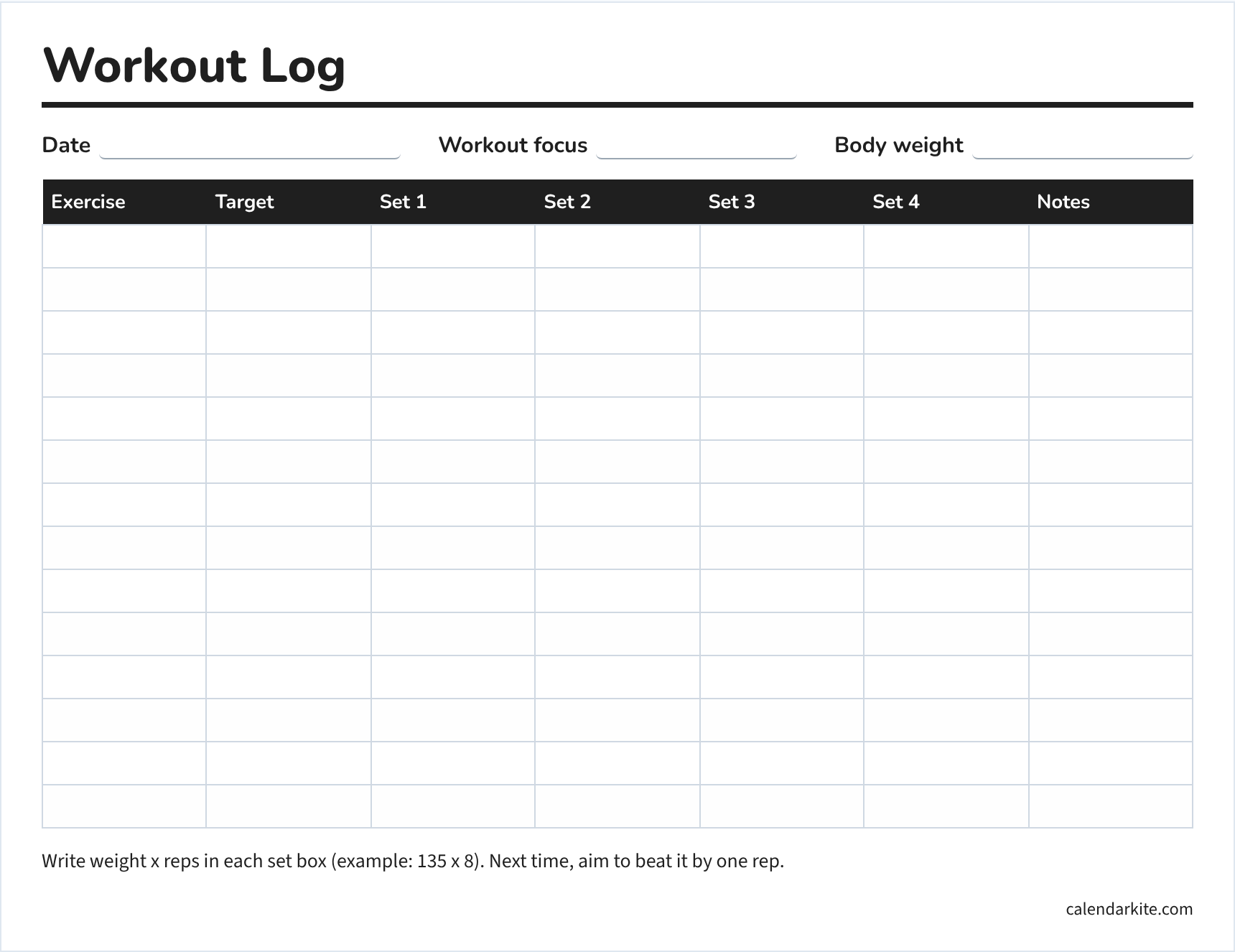
I suggest this one if you print a lot, since plain black lines go easy on the inkjet. I test-print every page on my home printer, and this version stays crisp for logging sets, reps and weights at the gym.
Pink Workout Log Template
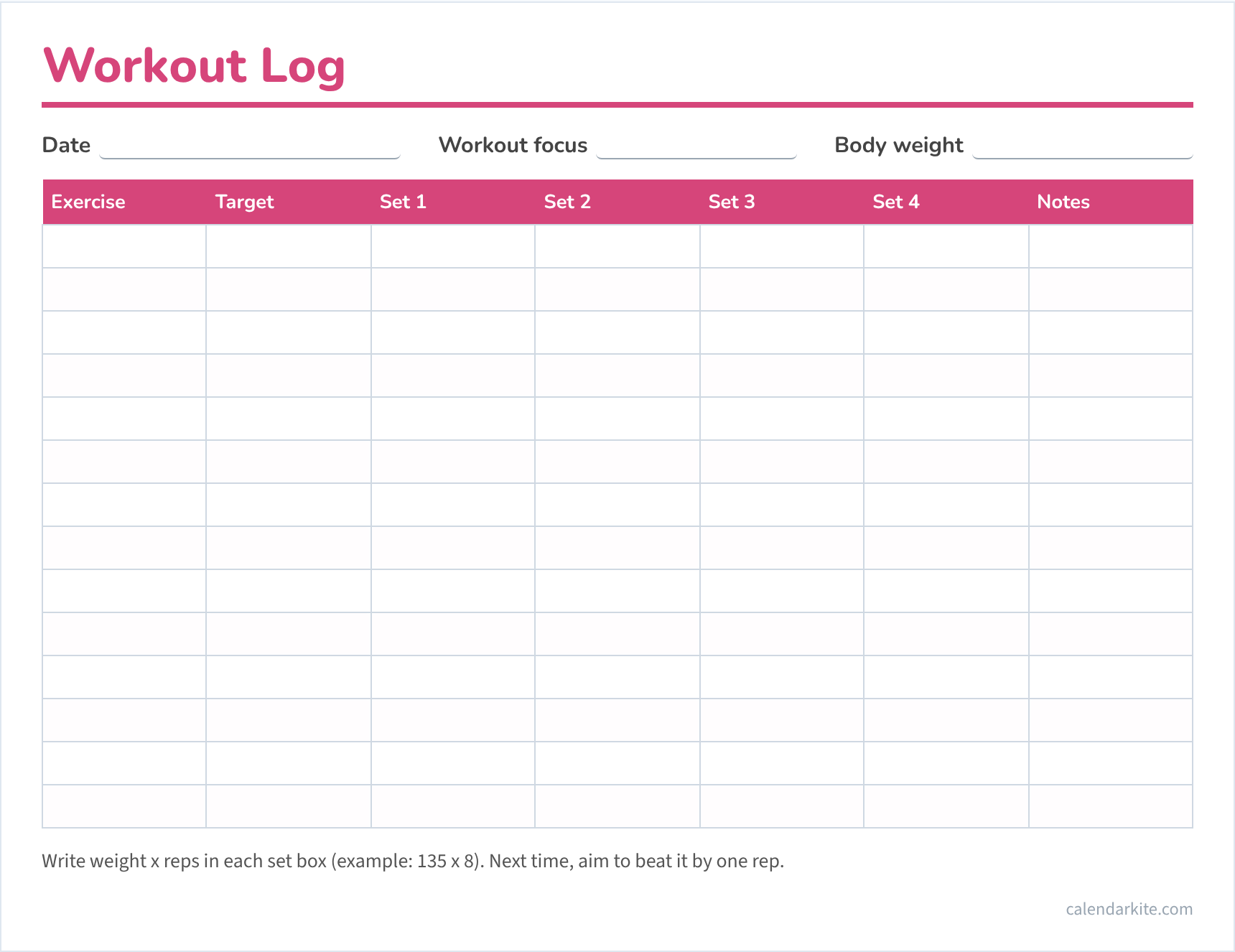
This soft pink version suits anyone who wants a gentle, friendly look for a home workout routine. Clip it to a clipboard by the yoga mat and jot down exercises, sets and how each session felt.
Sage Green Workout Log Template
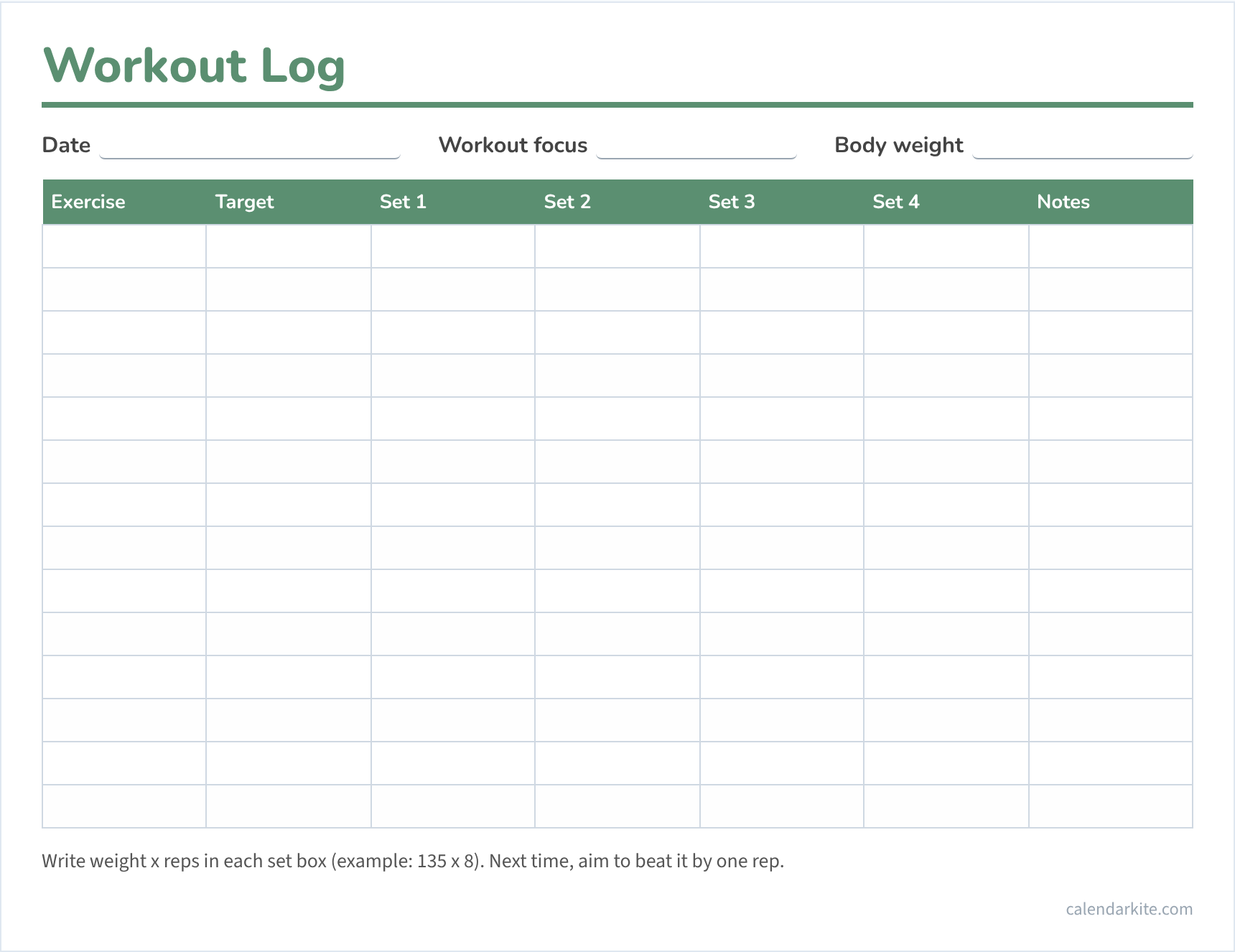
Sage green is calm and easy on the eyes, which makes it a good match for a strength training log you fill in every week. In my office years I learned that muted colors keep dense grids readable, so I kept the lines light.
Lavender Workout Log Template
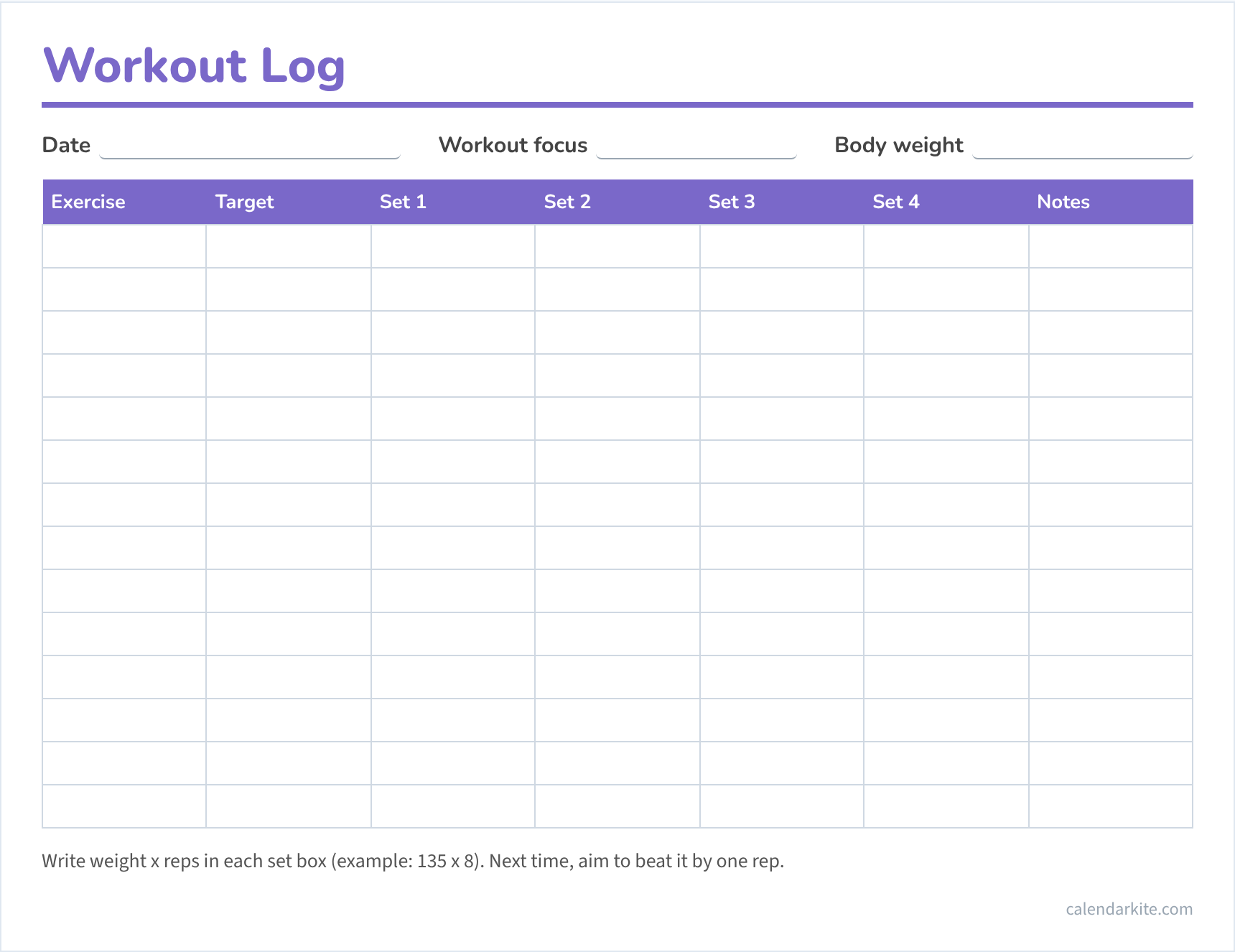
I like this lavender design for anyone tracking a yoga, Pilates or stretching routine and wanting something relaxed. Use it to note your sessions, durations and how your body felt, then tuck it into your planner.
Cute Workout Log Template
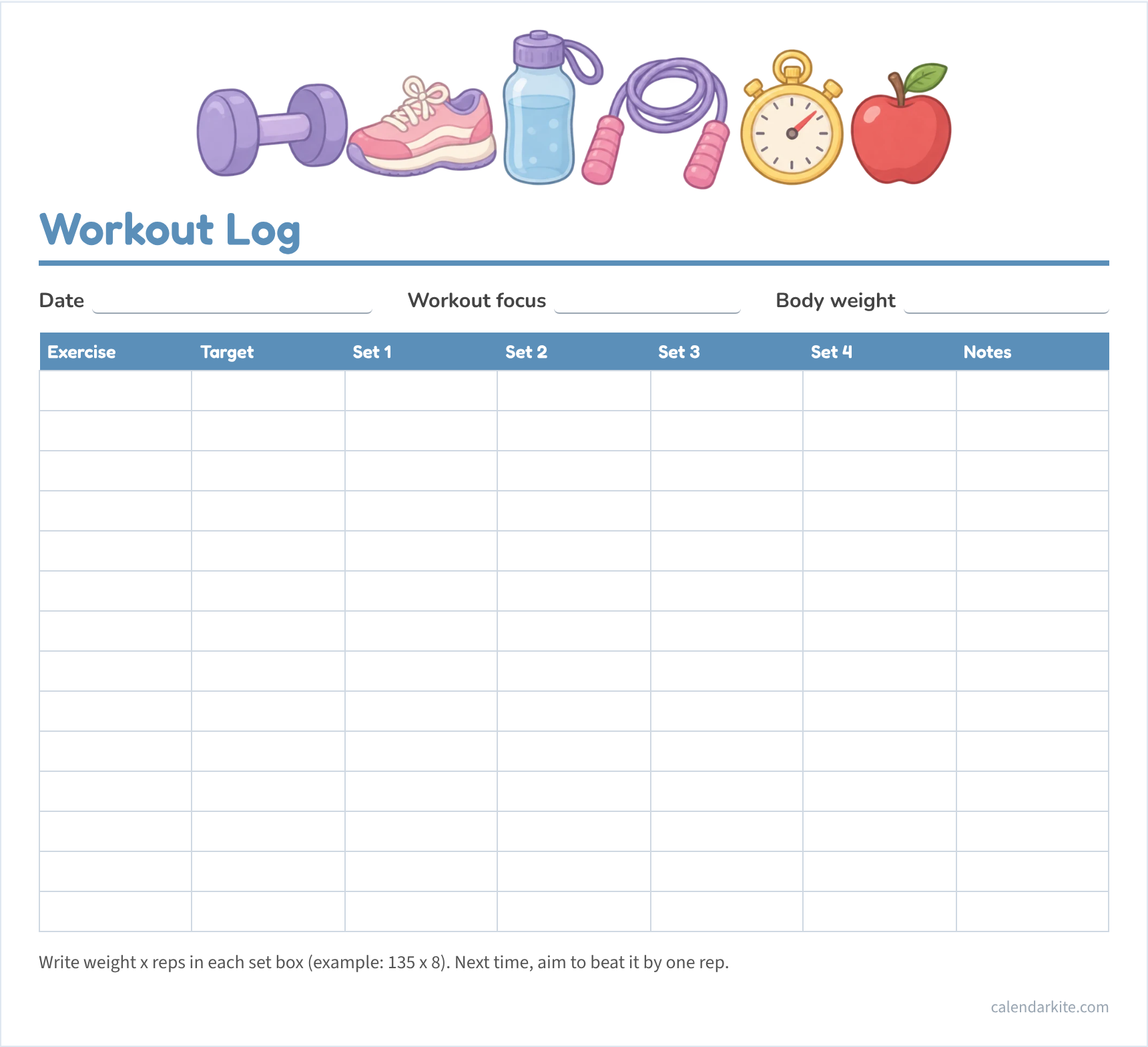
The pastel blue and small hand-drawn illustrations at the top make this a friendly pick for beginners who need a bit of motivation. Print it and stick it on the fridge, the way I do with my own paper calendar, so you see it daily.
Floral Workout Log Template
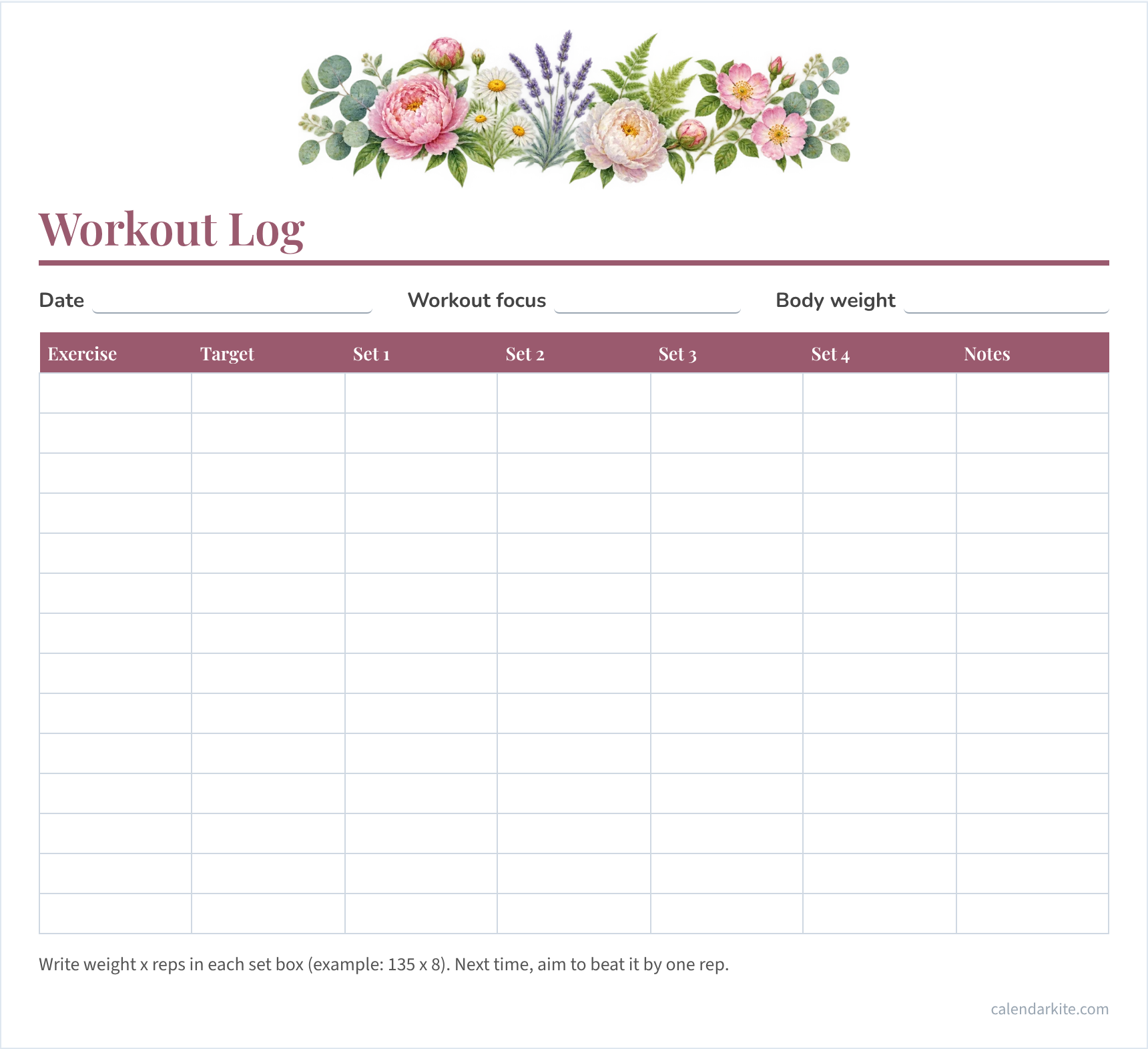
Watercolor flowers and elegant serif headings give this version a polished feel for a wellness or self-care fitness journal. It works well for a weekly walking, running or barre log you keep in a binder.
Fun and Colorful Workout Log Template
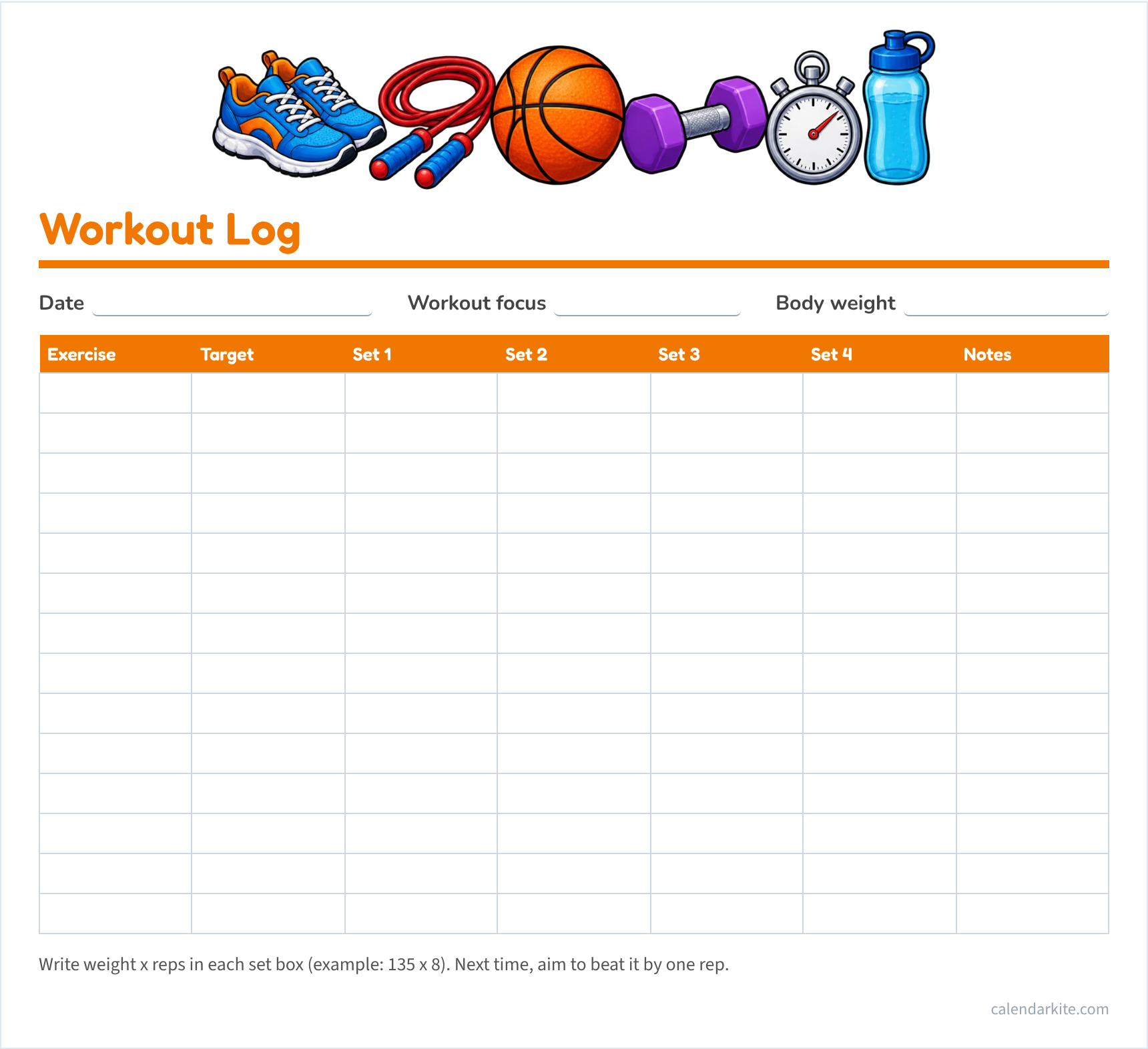
Bright orange and yellow with bold cartoon illustrations make logging exercise feel like a game, perfect for a family challenge or a youth sports routine. With two kids at home, I know a fun page gets filled in far more often.
Simple Minimalist Workout Log Template
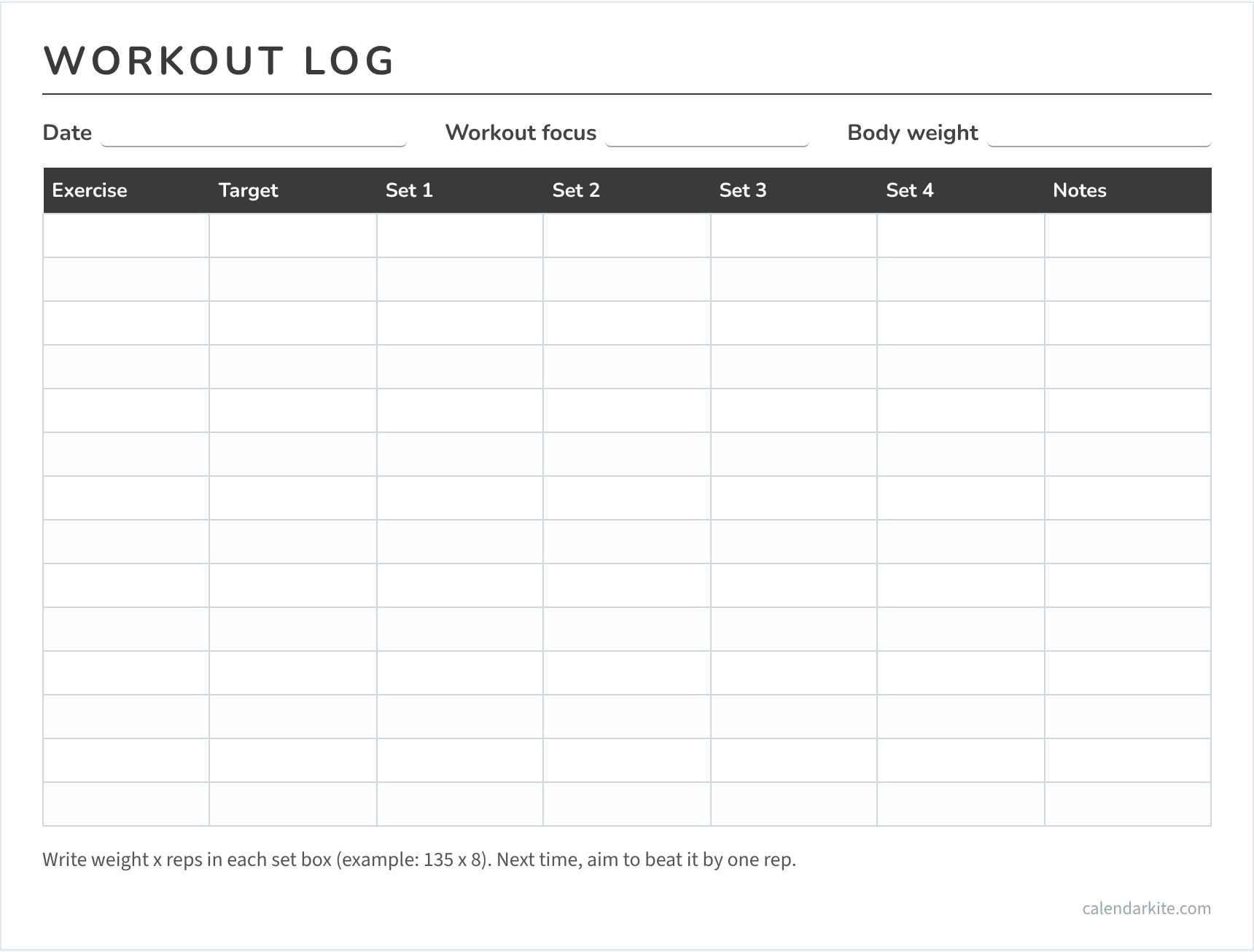
Thin gray lines and a light uppercase heading keep this version clean for people who want to record exercises, sets and weights without distraction. I trimmed the layout to leave generous rows, since cramped boxes are the most common mistake I see in logs.
Aesthetic Workout Log Template
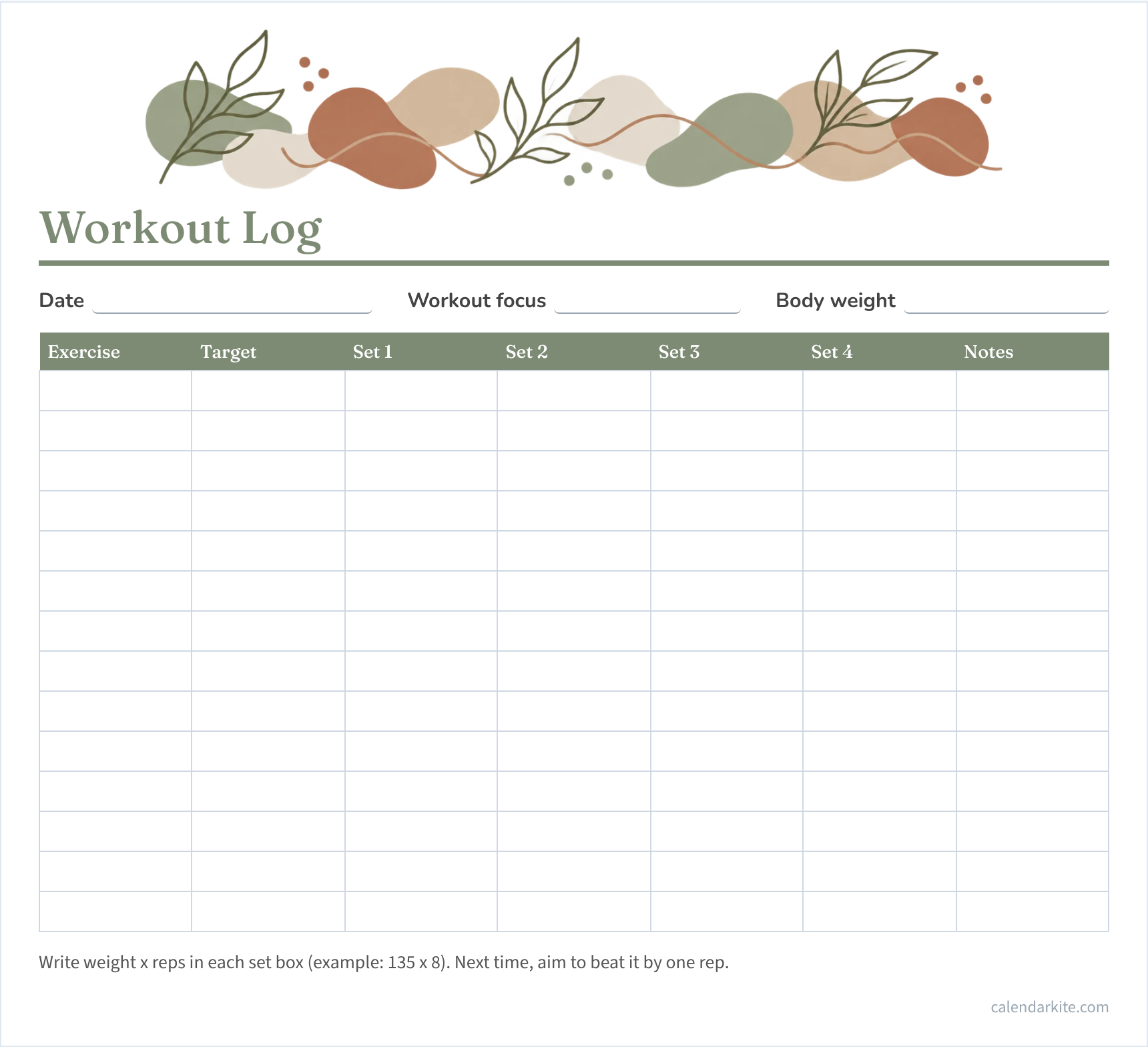
Muted sand, sage and terracotta with soft line-art leaves suit a tidy, calm planner setup. It pairs nicely with a weekly planner, so you can log workouts alongside meals and appointments.
Bold Modern Workout Log Template
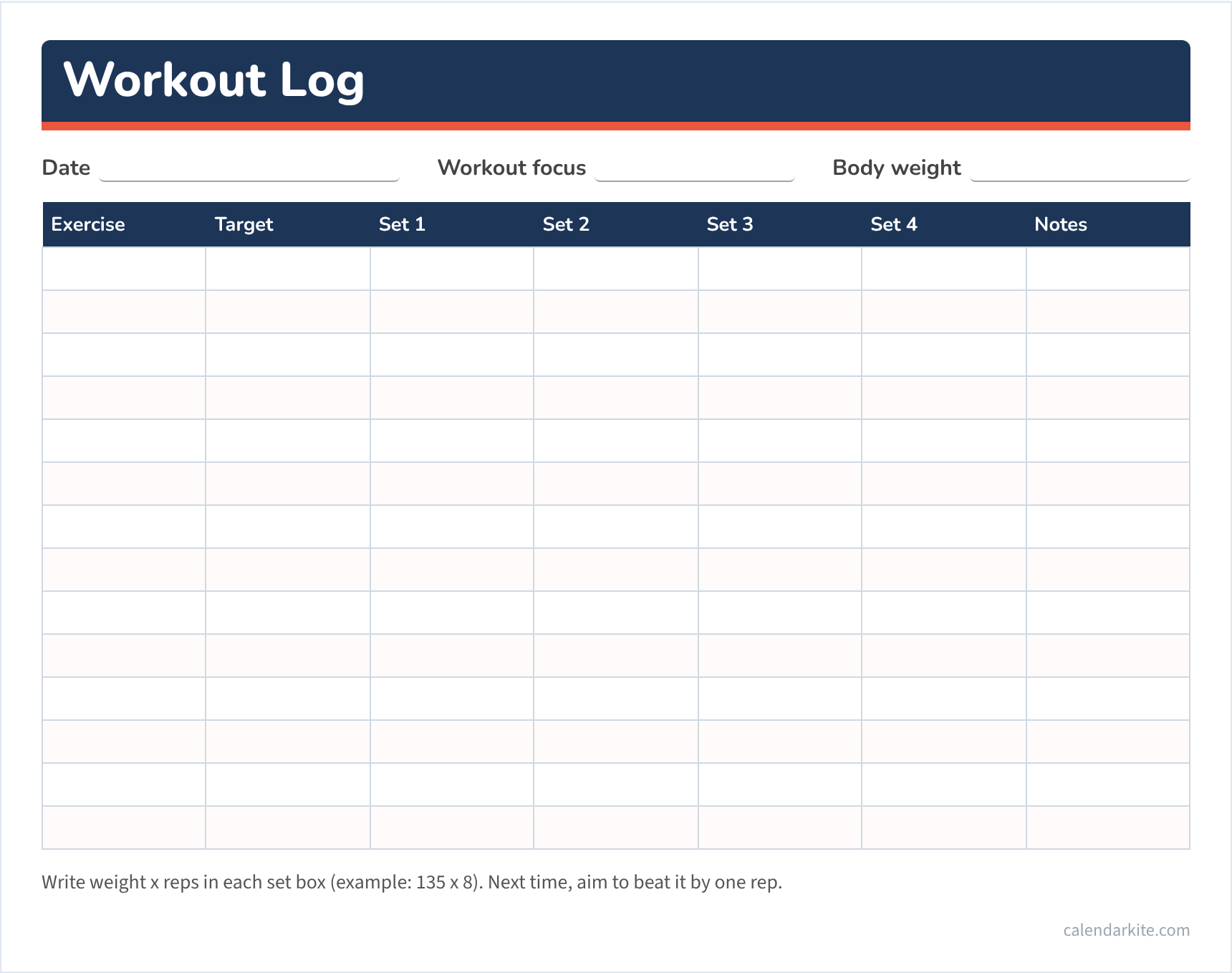
The navy header band and coral accent give this a modern, serious look for gym-goers following a lifting program. I check that the columns fit weights and reps legibly when printed on US Letter and A4, so nothing gets cut off.
The point of a log is simple. Memory is bad at numbers. Two weeks from now you will not remember whether your third set of rows was 40 pounds for 10 or 45 for 8, and a page that shows it takes the guesswork out of your next workout. Below, I explain how to fill the sheet in, who it suits, and how to adapt it for lifting, cardio, home workouts and anything in between.
What a good workout log template needs
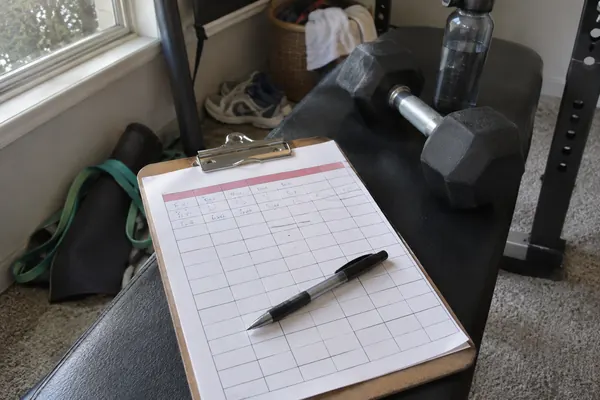
Most workout logs fail for one of two reasons. They are either so bare that you cannot record what actually happened, or so crowded that you stop filling them in by week three. I try to land in the middle. This sheet has a header for the date, the workout focus and your body weight, then 14 exercise rows with a target, four set boxes and a notes column.
Four sets covers nearly every normal strength routine. Three sets is the most common prescription, and the fourth box is there for a heavy top set, a back-off set or an extra one on a good day. If you only do two sets of something, leave the rest blank. An empty box does not mean you failed to fill the page in, it just means you did what the plan said.
I test-print every sheet on my home inkjet, on both US Letter and A4, and I made the set boxes wider than my first draft after writing “185 x 5” in a cramped cell and not being able to read it afterwards. That is the main rule I use for any log: if it is not readable in a tired hand, it is not wide enough.
How to fill in the workout log, step by step
Fill in the header before you start. Write the date, the focus of the day (Push, Legs, Full body, Long run, Yoga) and your body weight if you track it. Body weight is optional, and many people only fill it in once a week at the same time of day.
Then work through the page as you train:
- List your exercises in the order you plan to do them, or write them as you go.
- In the Target column, write the goal for that exercise, such as “3 x 8” or “20 min”.
- After each set, write the weight and reps in the next box, like “135 x 8”.
- Use the Notes column for anything that explains the numbers: slept badly, elbow twinge, new grip, felt easy.
- When you finish, look over the page for 30 seconds and circle anything you want to improve next time.
On screen, you can type your routine into the exercise column once, print several copies, and write only the numbers by hand. That saves the most time if you repeat the same workout each week.
Try this: Before your next workout, write the exercises and targets in the sheet on screen, print it, and clip it to a clipboard. At the end, check whether any single set beat last time, even by one rep.
What to write in each column
Exercise is the name of the movement. Use the same wording every time, because “bench,” “bench press” and “flat BB press” will look like three different lifts when you flip back through your pages. If you swap equipment, add it in brackets, for example “Row (cable)”.
Target is your plan for the session. For strength work it is sets and reps. For cardio it might be a time, distance or pace. Writing the target first means you are comparing the result with an intention, not just recording numbers.
Set 1 to Set 4 are for what you actually did. I use weight x reps, so “50 x 10” means 50 pounds for 10 reps. For bodyweight moves, write “BW x 12” or just the number of reps. For timed holds like planks, write seconds. Notes is the space for effort, pain, form cues and mood. It is the column people skip and later wish they had used.
Who this workout log suits
Beginners get the most from a log, because progress in the first months comes quickly and it is motivating to see it written down. Seeing “40 x 8” turn into “50 x 8” over a month is real evidence that the routine is working, which is useful on days you feel like you are going nowhere.
It also suits people who train from a programme: a coach’s plan, a gym class schedule, a physio’s rehab list or a free routine from a book. The Target column lets you copy the prescription in, and the set boxes show how close you got. Physical therapy patients can use the notes to record pain levels and which movements felt different, which gives a clinician something concrete to look at.
Lifters coming back after a break, runners adding strength work, and busy parents fitting in 30 minutes at home all benefit too. In my office years I kept rotas and schedules readable for other people, and what I learned is that a good record does not need to be fancy. It needs to be the same each time, and quick enough that people actually keep doing it.
Using the log for strength training
For lifting, treat each page as one session. List the big compound lifts first (squat, deadlift, bench press, overhead press, rows) because they matter most and you want to log them while you are fresh. Accessory work, like curls, lateral raises and calf raises, goes below.
The most useful habit is to look at the last page of the same workout before you start. If you did 135 x 8, 135 x 8, 135 x 7 last time, your goal today is clear: get all three sets to 8, then add weight. This is called progressive overload, and it just means asking your body to do slightly more over time. You do not need to add weight every week. Adding one rep, or finishing with better form, still counts.
Keep warm-up sets out of the numbered boxes unless you want them in. I write warm-ups in the Notes column as “WU 95 x 5, 115 x 3” and keep the four boxes for working sets. That way the numbers I compare week to week are always the sets that count.
Try this: Pick one lift this week and write its target as a rep range, like 3 x 6 to 8. Add weight only after every set hits the top of the range.
Cardio, running and home workouts
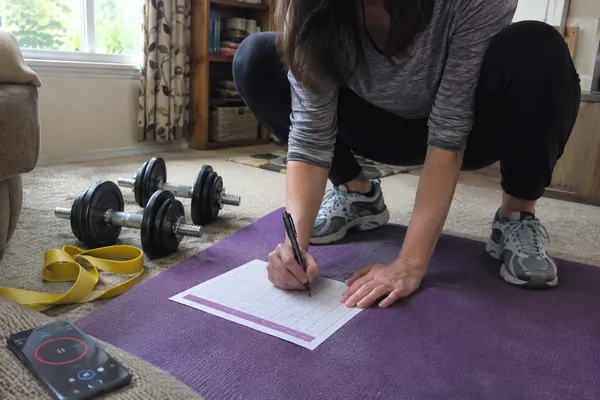
The same sheet handles cardio with a small change in what you write. In the Exercise column put the activity (run, bike, row, swim). In Target, write the plan: “30 min easy” or “5 x 400 m”. In the set boxes, write intervals, laps or splits. Use the notes for pace, distance, heart rate, weather or how your legs felt.
For home workouts, circuits and bodyweight routines, the layout works well with rounds in place of sets. Round 1 to Round 4 can sit in the four boxes, with reps or time written inside. For a class, such as spin, HIIT or yoga, one row is enough: name the class, the length and a line on how hard it felt.
If you want a fuller weekly plan around your sessions, the fitness planner printable lays out the week and goals, and this log then becomes the place where you record each day’s detail.
Rating effort and writing useful notes
Numbers alone do not tell you how a workout felt. A simple 1 to 10 effort score in the notes column adds a lot. Many lifters use RPE, which stands for rate of perceived exertion: a 10 means you could not have done another rep, an 8 means you had about two reps left. You do not need to be precise. Even “easy,” “solid” or “grind” works if you use them consistently.
Short notes beat long ones. Good notes are things like “slept 5 hrs,” “left knee tight,” “new shoes,” “gym was packed,” or “ate late.” After a few weeks, patterns show up. You may find your best lifts come on days after eight hours of sleep, or that a particular exercise always bothers your shoulder.
At home, I keep a pen on a string next to the planner on my kitchen counter so there is no excuse for writing notes later. Later never happens. If you only have time for one note, write what you would tell yourself before the next session.
Printing tips and building a workout log book
Print on standard US Letter or A4 paper at 100% scale, not “fit to page,” or the boxes will shrink. If you write with a pen at the gym, 24 lb paper or any slightly heavier sheet stops ink from showing through to the back. A pencil is more forgiving if you sweat or make errors.
A clipboard is the easiest way to carry a single page. For a longer-term setup, punch holes and keep your pages in a slim binder, which becomes your own workout log book. Put a tab for each routine (Push, Pull, Legs, or Day A and Day B), then file the newest page at the front of its tab. When you start a session, the last one is the first thing you see.
Print four to eight copies at once so you never end up without one. I do a batch on Sunday and clip the week’s pages to the fridge. For planning around the rest of your week, the weekly calendar printable is handy for blocking out which days you train. If you want everything in one place, the trackers and logs section has more sheets that go well with this one.
Variations to try
The sheet is a flexible template, so adapt it to what you do. Here are the changes I see work best:
- Full body, three days a week: Use the same page for each workout and change the focus line to A, B or C.
- Push, pull, legs: Print a stack and label the focus line before you leave home.
- Running or cycling: Replace set headings with intervals or split times.
- Rehab or recovery: Use the target for reps and the notes for pain on a 0 to 10 scale.
- Home workout: Replace weight with the exercise variation, such as incline push-up or knee push-up.
You can also edit the items on screen before printing, so create the version you want once and reuse it. If your routine changes every six or eight weeks, print a fresh batch each time you start a new block.
Beyond the sheet itself, a monthly view helps with the bigger picture. A printable monthly calendar lets you tick off each day you trained, which is a quick way to see consistency at a glance.
Mistakes that make workout logs useless
The most common mistake is logging too much. If you track 20 data points per session, you will stop. Start with weight, reps and one note, and add more only if you find you miss it.
The second is inconsistent naming and units. If you switch between pounds and kilograms, or call the same movement by different names, comparing becomes harder. Decide once and stay with it. The third is writing the log up from memory later. Details disappear within hours, and the notes you add end up being what you think happened, not what did.
The fourth mistake is treating the log as a judgment. A lower number on a bad day is not a failure, it is data. In the office I learned that a record is only useful when people feel safe writing down the true number, and the same goes for a fitness log. Write what happened, including the bad days, and the page will be a lot more helpful.
How often to review your log
Glance at the previous page before every session, and do a deeper review once a week. On Sunday, flip through the last seven days. Which lifts went up? Which sessions did you skip, and why? What do your notes say about energy, sleep or pain? Choose one thing to change next week, no more than that.
Once a month, take a longer look. Count your sessions and compare them with what you planned. Look at your main lifts and see how far they have moved. If a number has not changed in four to six weeks, that is the moment to change something: more recovery, a different rep range, better sleep, or a lighter week to reset.
Try this: At the end of this month, count how many pages you filled in and write the number at the top of the first one. That one number is a decent measure of consistency.
Pairing the log with other trackers
A workout log records what you did in the gym. Other things affect how well that goes. If you want to see how habits fit around your training, a habit tracker printable can show stretching, protein, steps or whatever else you are working on. A sleep log is useful if you suspect poor rest is behind a flat month.
For body changes, the scale is only one measure. A body measurement chart captures waist, chest, arms and thighs every few weeks, which often shows progress when weight stays the same. Take measurements at the same time of day and under the same conditions, and write the date on the sheet so you can line it up with your workout pages.
You do not need to use all of these at once. Start with the workout log alone for a month. Add a second sheet only if you have a specific question you want it to answer.
Paper log or app?
Both have a place. Paper is fast, works without signal, never runs out of battery and does not tempt you to check messages between sets. It is also easy to scan, because you can see a whole session at a glance and flip back to last week. Apps are better for charts, auto-calculating volume, and syncing across devices.
At home I use paper for everything, partly because a printed page sits on the counter where I can see it. If you like both, log on paper at the gym and enter your key lifts in a phone note or spreadsheet once a week. That gives you the immediacy of paper and the searchability of a digital record without doubling the work.
The one thing I would avoid is switching systems every few weeks. Pick the format you will actually use on a tired Tuesday, and stay with it long enough to see a trend.
Getting started today
You do not need a perfect plan to begin. Pick the next workout you intend to do, fill in the header, type the exercises you plan to do into the sheet, and print it. After the session, finish the notes and put the page in your binder or on the fridge.
The first page will feel slightly awkward, and that is normal. By the third or fourth, the layout will feel familiar, and the habit of checking last time’s numbers will start to shape how you train. That is when a plain printed sheet starts doing its job.
Common questions
What should a workout log include?
At minimum: the date, the exercises, and the weight, sets and reps (or time and distance) for each one. A notes column for how it felt is the part that makes the log useful later, because it explains why a number went up or down.
How do I use a workout log to get stronger?
Write down what you lifted, then look at it before your next session of the same workout. Try to beat one number by a small amount: one more rep, a little more weight, or a cleaner set. The log makes that comparison easy so you are not guessing from memory.
Is it better to track workouts on paper or in an app?
Both work. Paper is quicker to scan, never needs charging and has no notifications to pull you away from your set. An app is better for charts and sharing. Many people log on paper at the gym and look back at it weekly.
How many exercises should I put on one workout log page?
Most sessions fit in 5 to 10 exercises, so a 14 row sheet leaves room for warm-ups, a few extras and a cool-down stretch. If you do long sessions, print two pages and staple them.
Can I use this workout log for cardio?
Yes. Put the activity in the Exercise column, the goal in Target, and write time, distance or pace in the set boxes. Use the notes column for heart rate, route or how your breathing felt.
Can I save and edit the log before printing?
Yes. You can type into every line and field on the page, tick boxes and edit items, and it saves in your browser. When you are happy with it, print the sheet, or download the blank PDF to write on by hand.
 Reading Log: Free Printable You Can Fill In and Print
 College Assignment Tracker: Free Printable Sheet
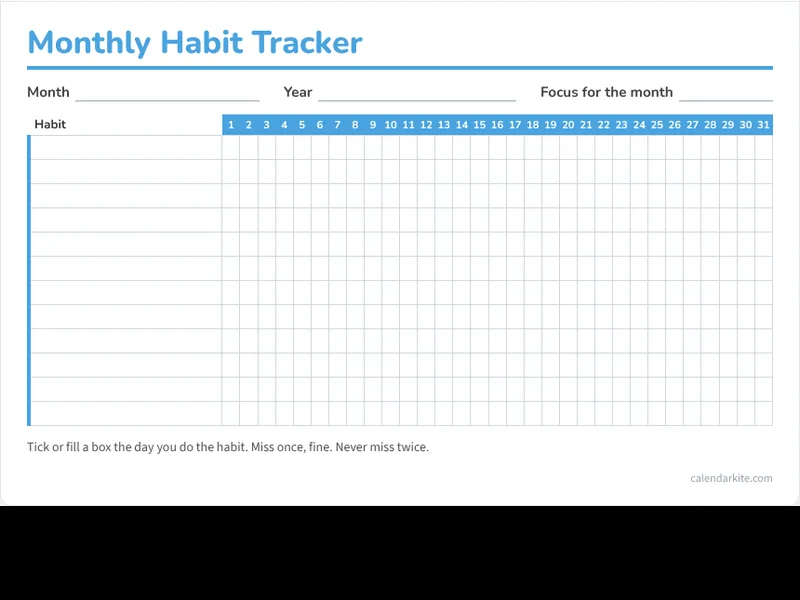 Habit Tracker Printable (Free Monthly Sheet)
 Goal Tracker: Free Printable Sheet You Can Fill In and Print
 Job Application Tracker: Free Printable Sheet
 Reading Log for Kids (Free Printable)