
Morning Routine Chart (Free Printable)

A morning routine chart is a one-page list of the steps you do between waking up and leaving the house, with a box to tick for each step on each day. The one on this page covers a full week, has a minute count beside each step, and lets you type in your own tasks before you print. Use it for a child, a teen, a partner or yourself.
| Morning step | 1 | 2 | 3 | 4 | 5 | 6 | 7 |
|---|---|---|---|---|---|---|---|
| Wake up, drink water (5 min) | |||||||
| Toilet, wash face (5 min) | |||||||
| Get dressed (10 min) | |||||||
| Make bed (2 min) | |||||||
| Eat breakfast (15 min) | |||||||
| Brush teeth (3 min) | |||||||
| Hair, sunscreen (5 min) | |||||||
| Pack bag and lunch (5 min) | |||||||
| Shoes and coat (3 min) | |||||||
| Keys, phone, water bottle (2 min) | |||||||
Edit any step, add your own times, and tick each box as you finish. Add up the minutes to find your wake-up time.
Free for personal, classroom and office use. Your entries are included in the print, PDF and PNG. Prints on US Letter and fits A4.
Black and White Morning Routine Chart Printable
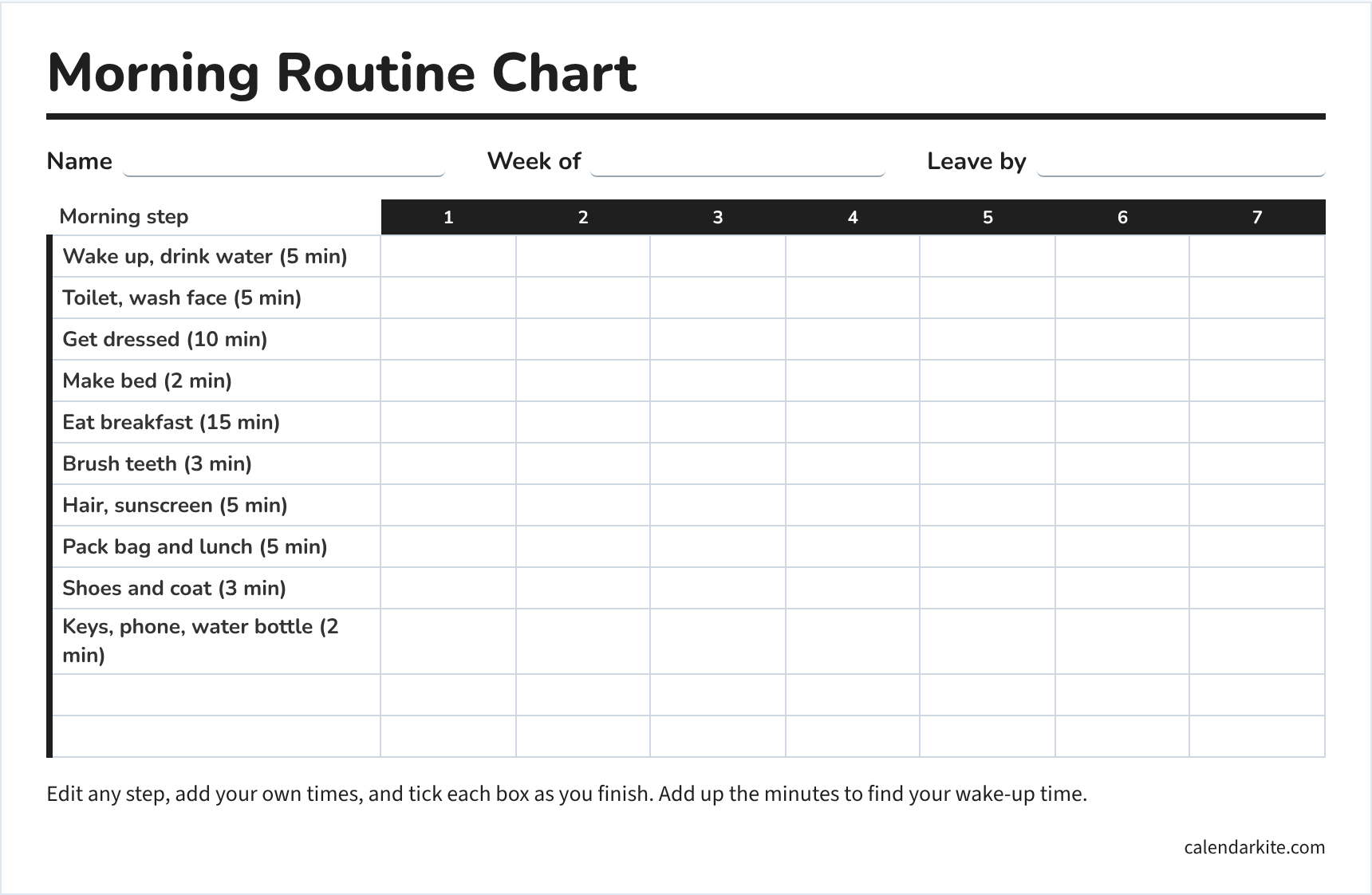
I made this one for anyone who wants a chart that prints cheaply, since plain black lines barely touch the ink on my home inkjet. It suits a bathroom cabinet door, with teeth, face and vitamins checked off.
Pink Morning Routine Chart
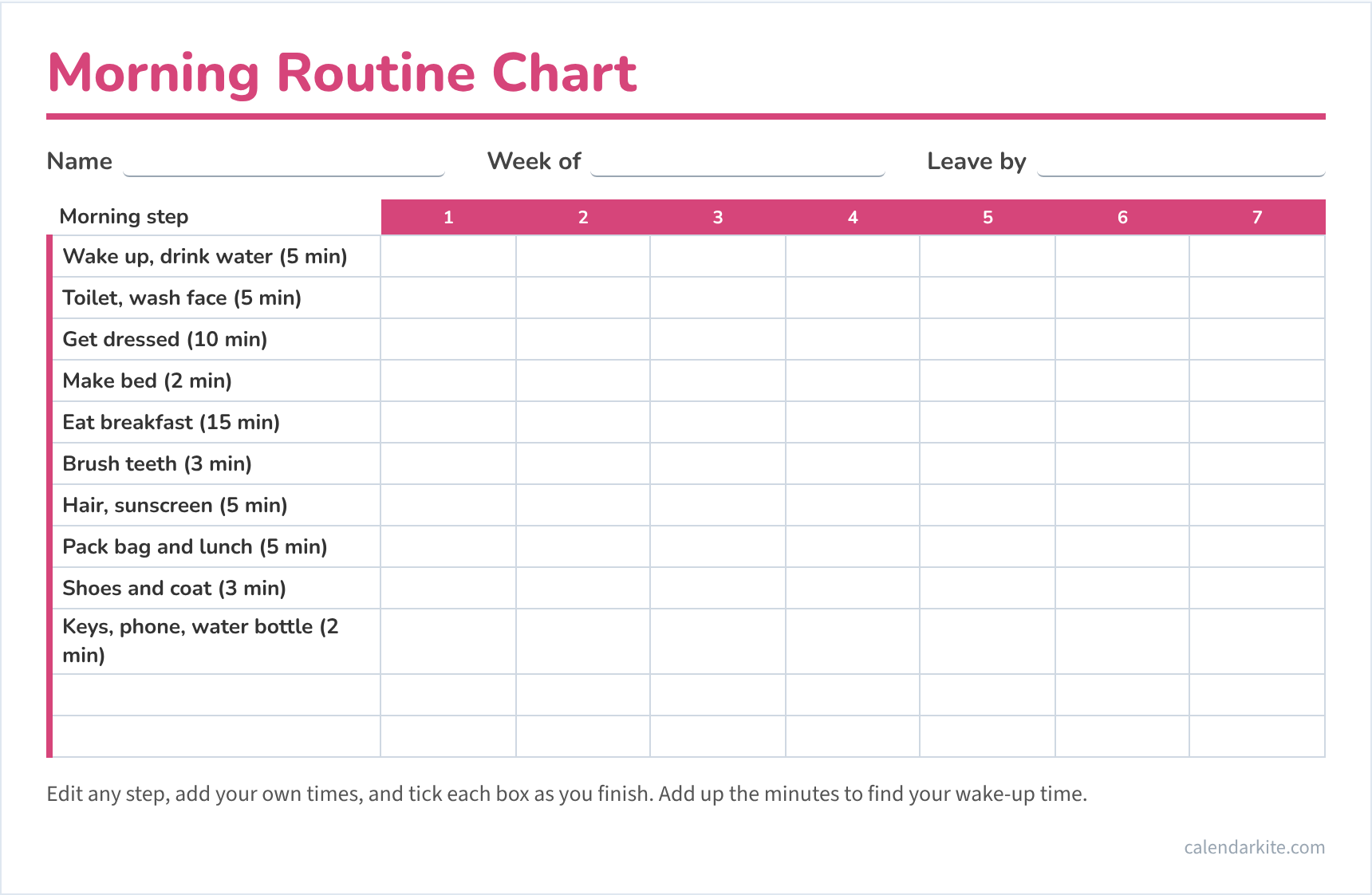
I like this soft pink version for a child's bedroom wall or a teen's mirror, where a gentle color feels friendlier than a stern checklist. Use it for the basics: get dressed, make the bed, breakfast, brush teeth, pack the bag.
Sage Green Morning Routine Chart
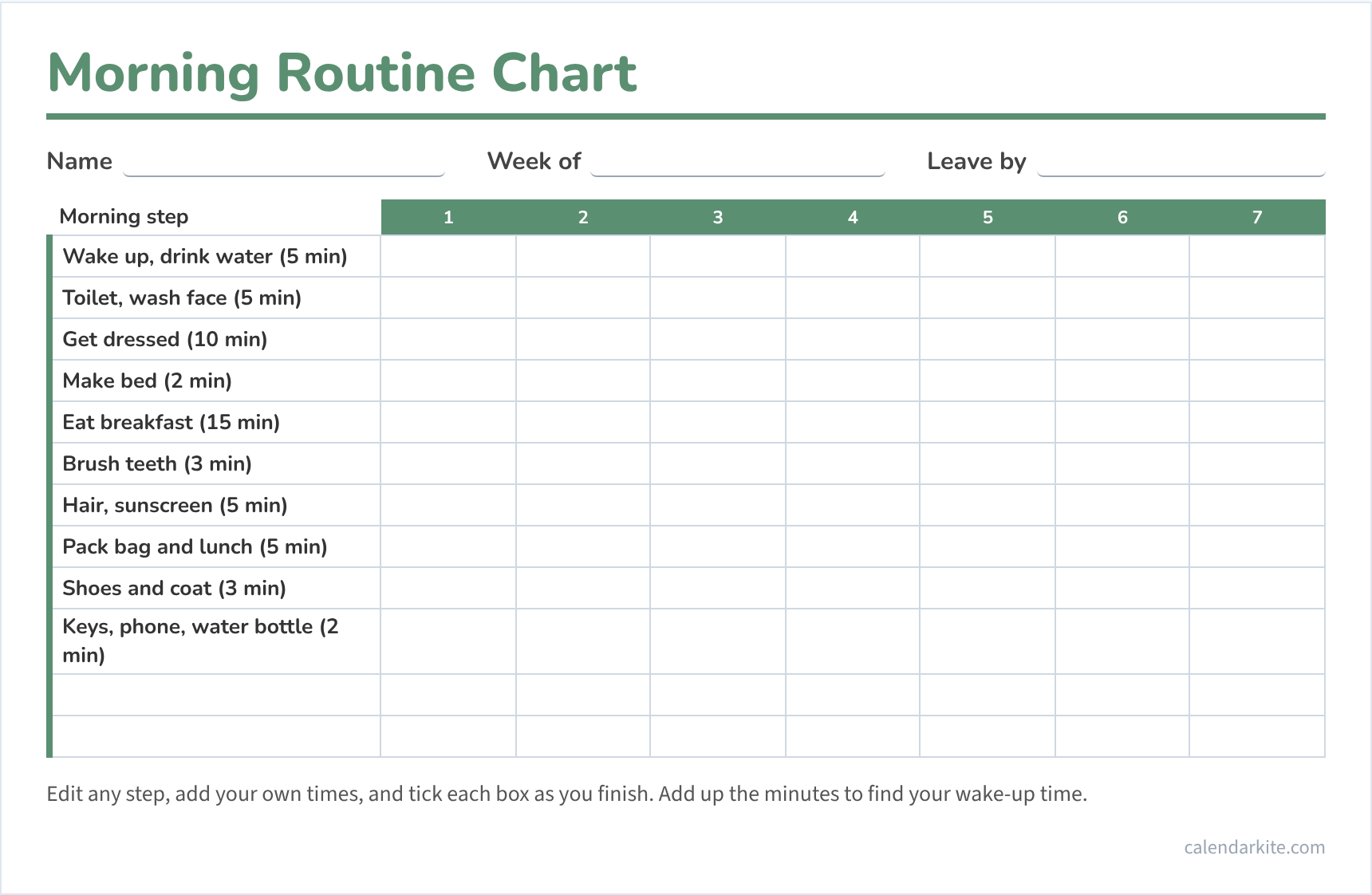
This calm sage green chart is my pick for adults building a slow morning habit, like stretching, water and journaling. In my office years I learned that a quiet, uncluttered sheet is the one people actually keep using.
Lavender Morning Routine Chart
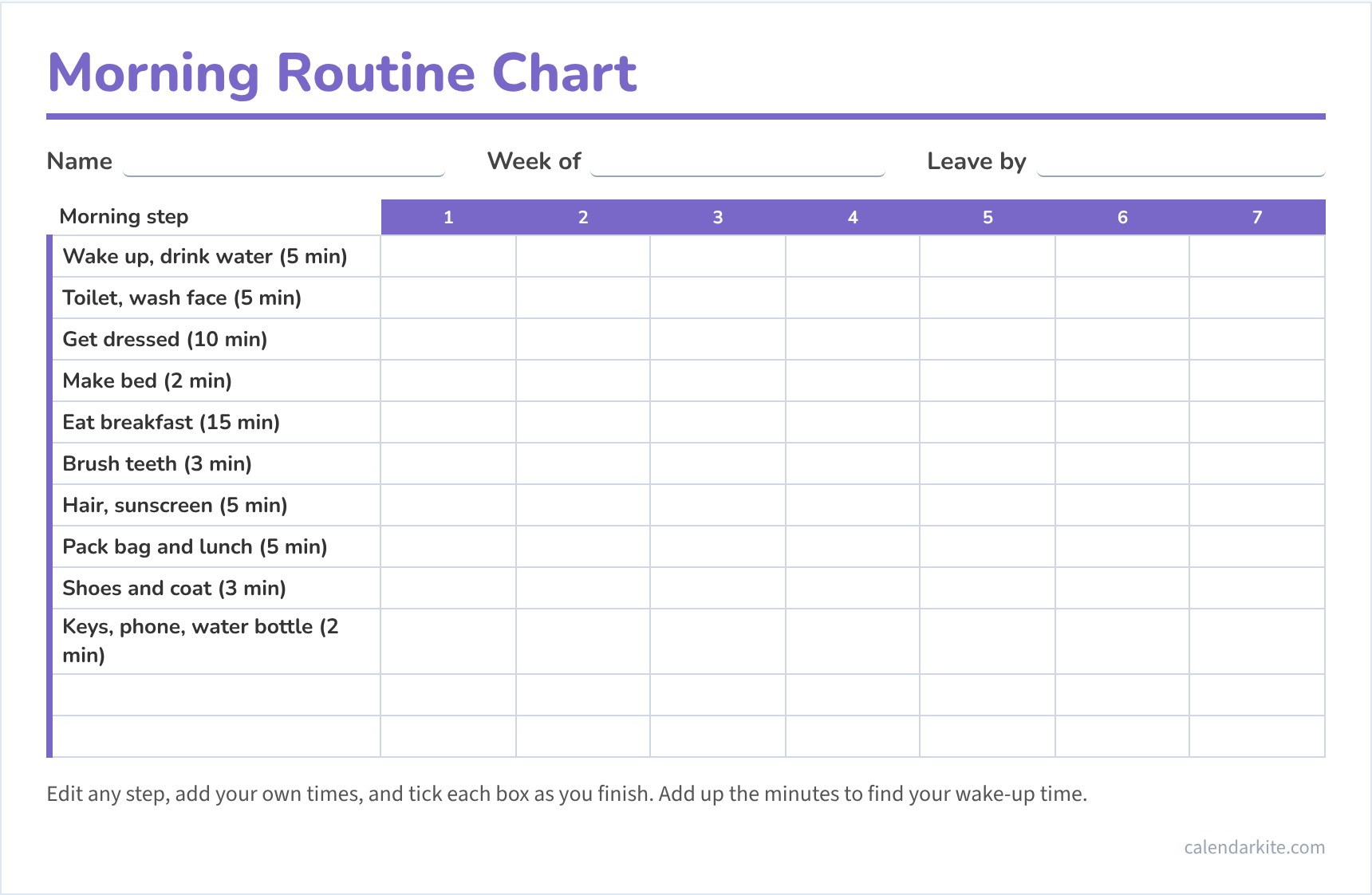
The lavender chart works well for a calming start to school-day mornings or for anyone who needs a gentle reminder list. I keep my planner on the kitchen counter, so a chart placed beside it gets seen while I rush past.
Cute Morning Routine Chart
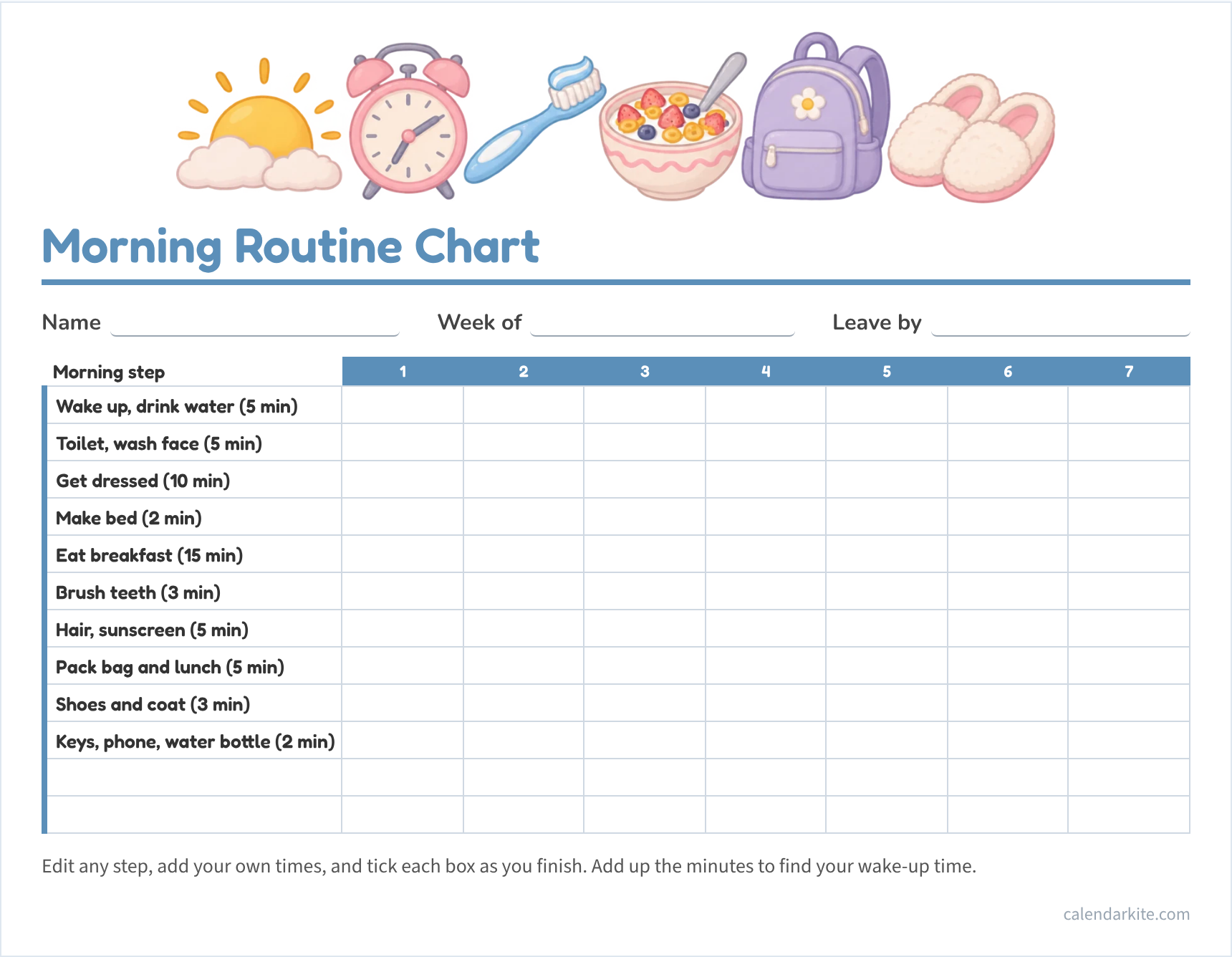
I picked the pastel blue design for younger children who like ticking off steps beside little drawings. It works nicely on a bedroom door for the usual run of waking up, getting dressed, eating breakfast and packing a backpack.
Floral Morning Routine Chart
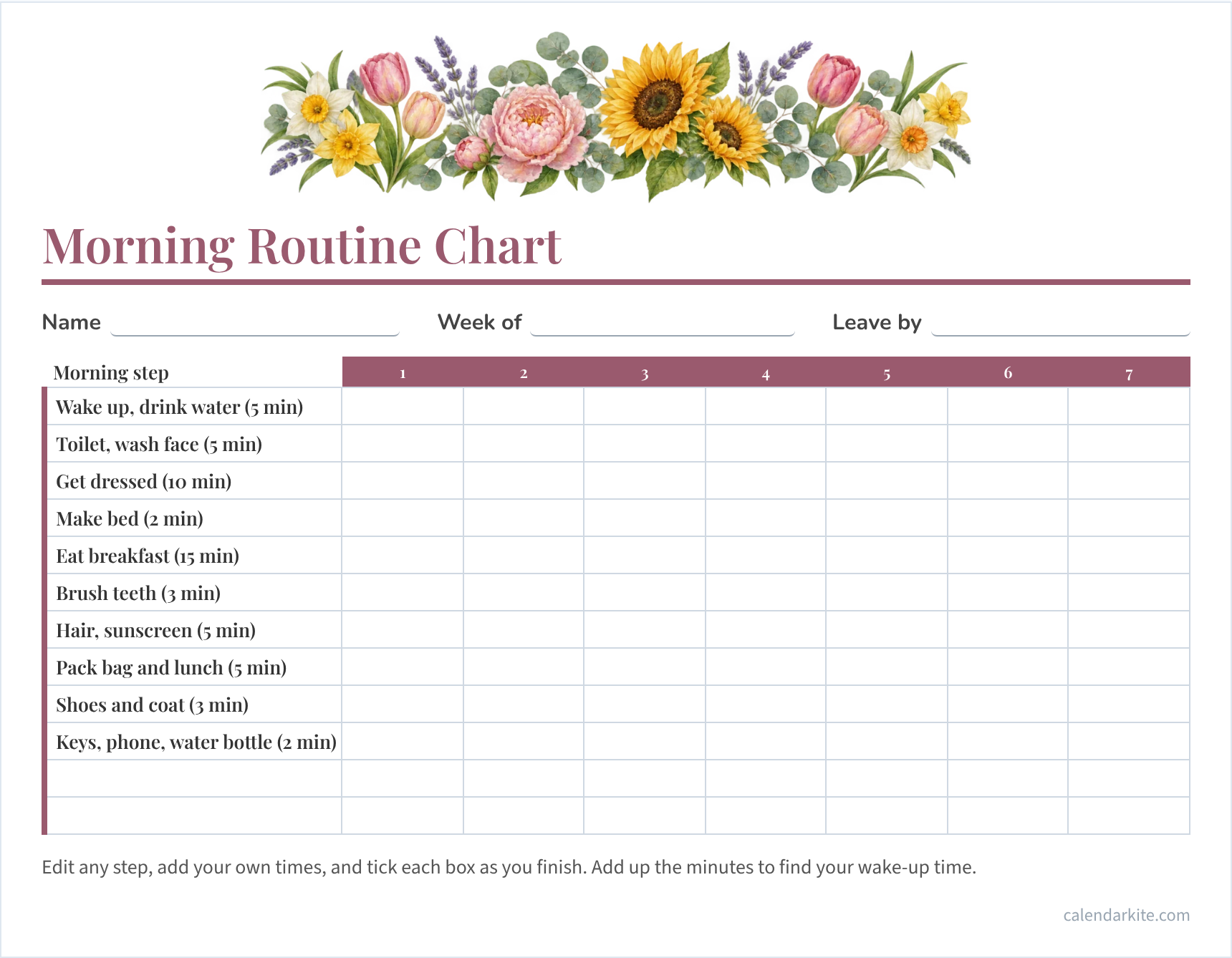
This watercolor floral chart suits a grown-up routine, such as skincare, coffee and a few minutes of planning before work. The serif headings feel like a pretty note, and I kept the checkbox column wide so ticks stay easy to see.
Fun Colorful Morning Routine Chart
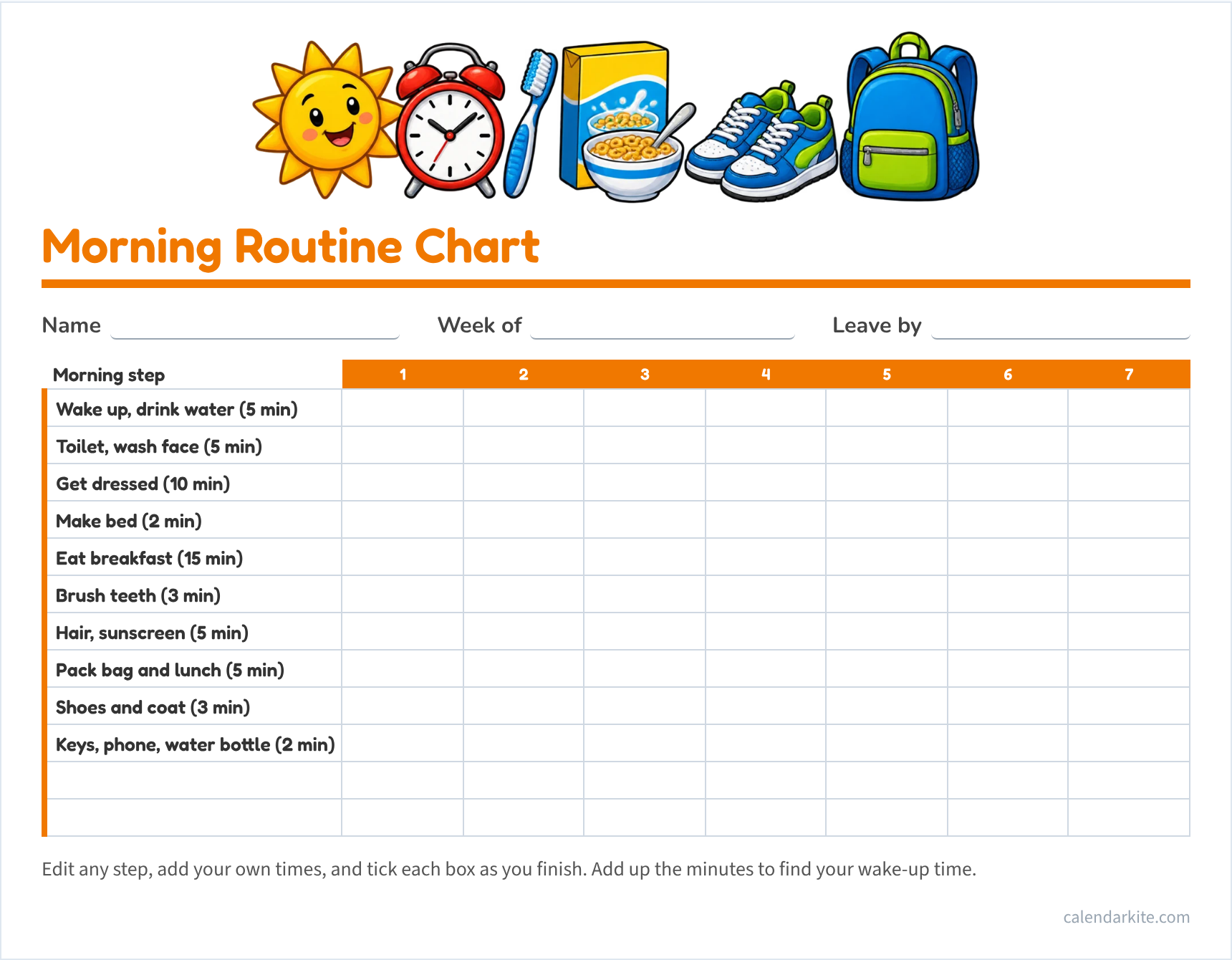
I chose this bright orange and yellow version for energetic kids who need some fun to get out the door. Hang it at kid eye level, because I've noticed charts placed too high simply get ignored.
Simple Minimalist Morning Routine Chart
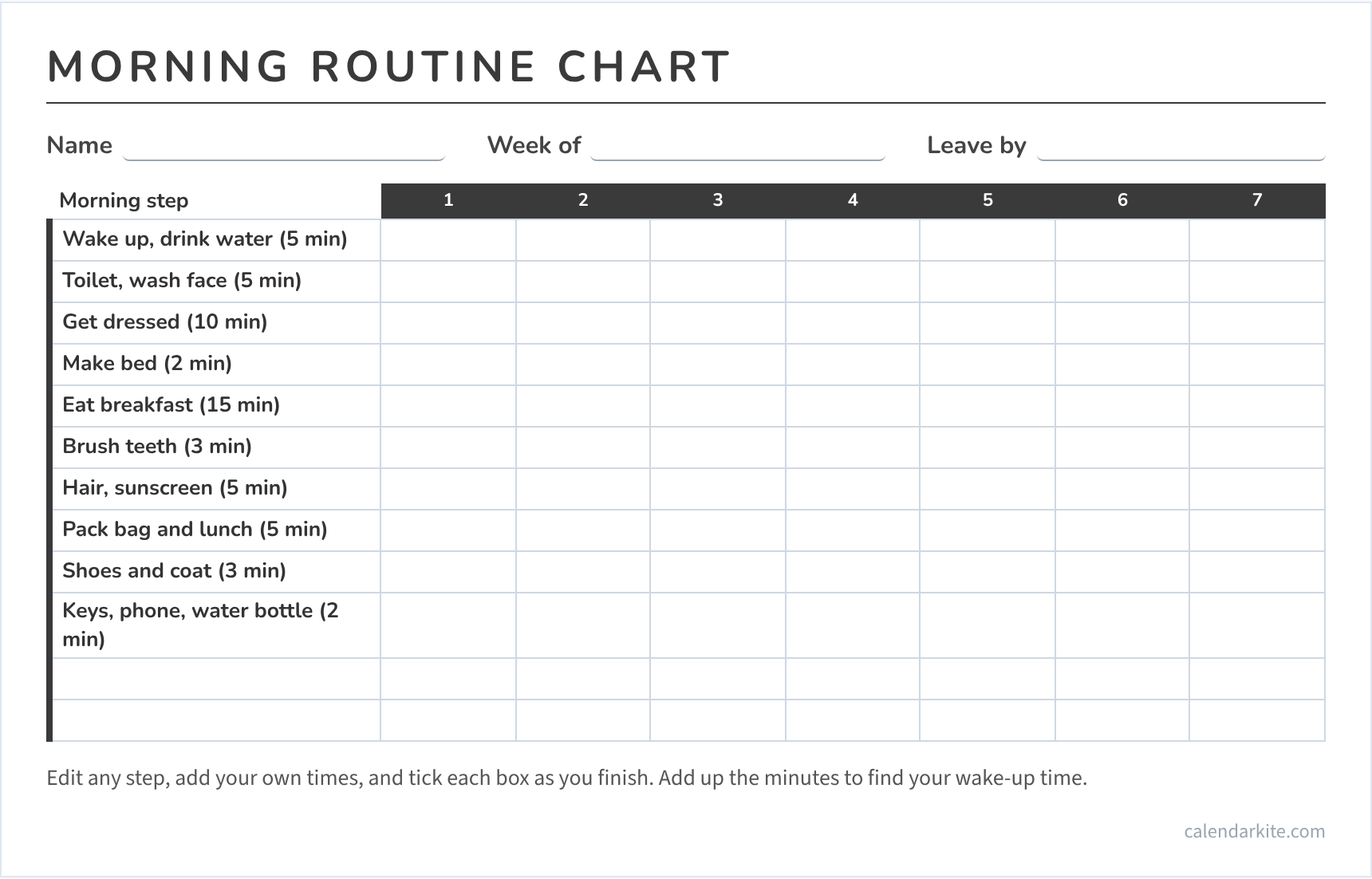
For a clean, no-fuss look, the minimalist chart uses thin gray lines and no color, which fits a desk or planner insert. At the office I kept rotas this plain on purpose, so the times and tasks stay readable at a glance.
Aesthetic Morning Routine Chart
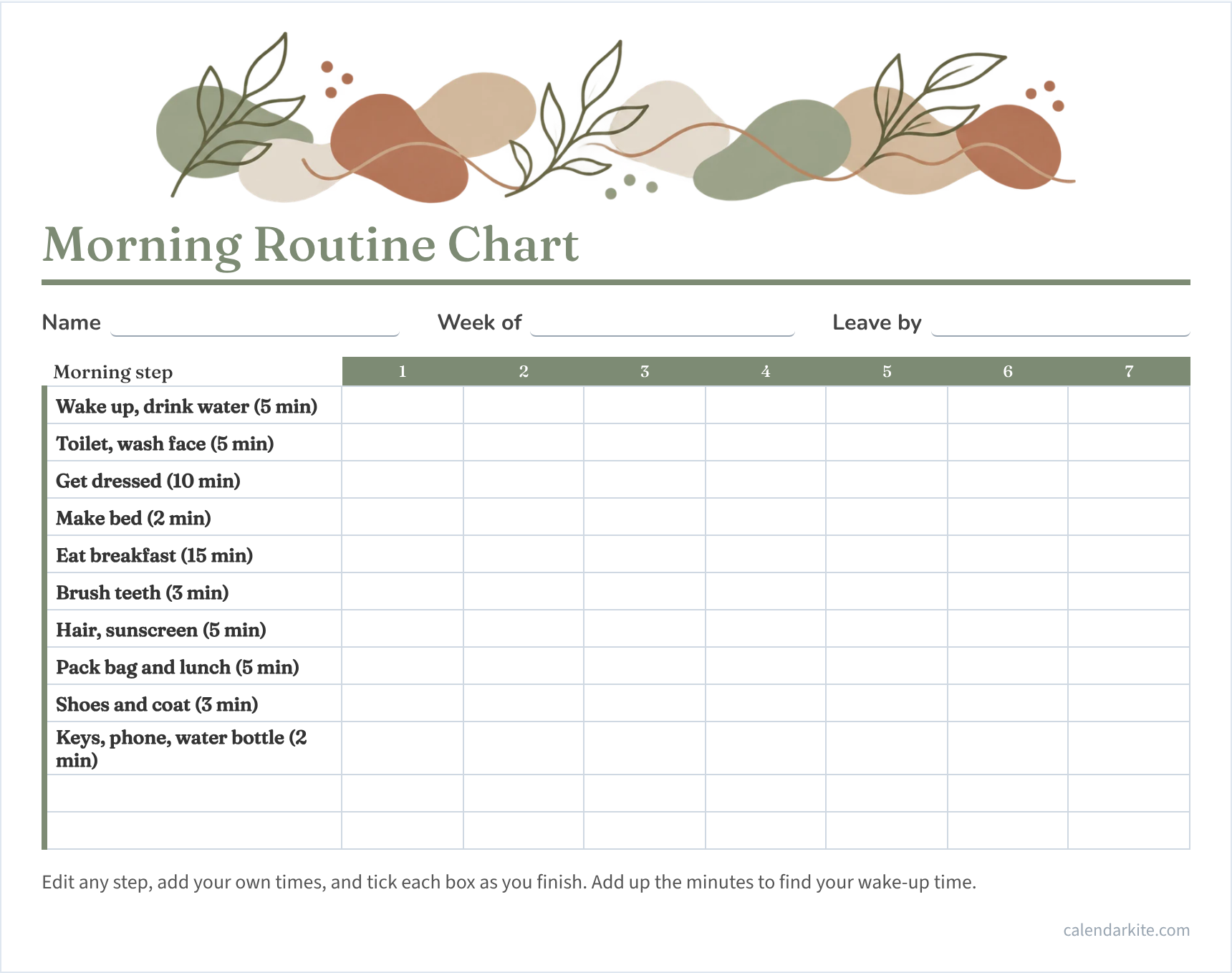
The aesthetic version uses muted sage, sand and terracotta with soft line-art leaves. It suits a bedroom wall or a journal-style morning reset where you want the chart to look good enough to leave out.
Modern Bold Morning Routine Chart
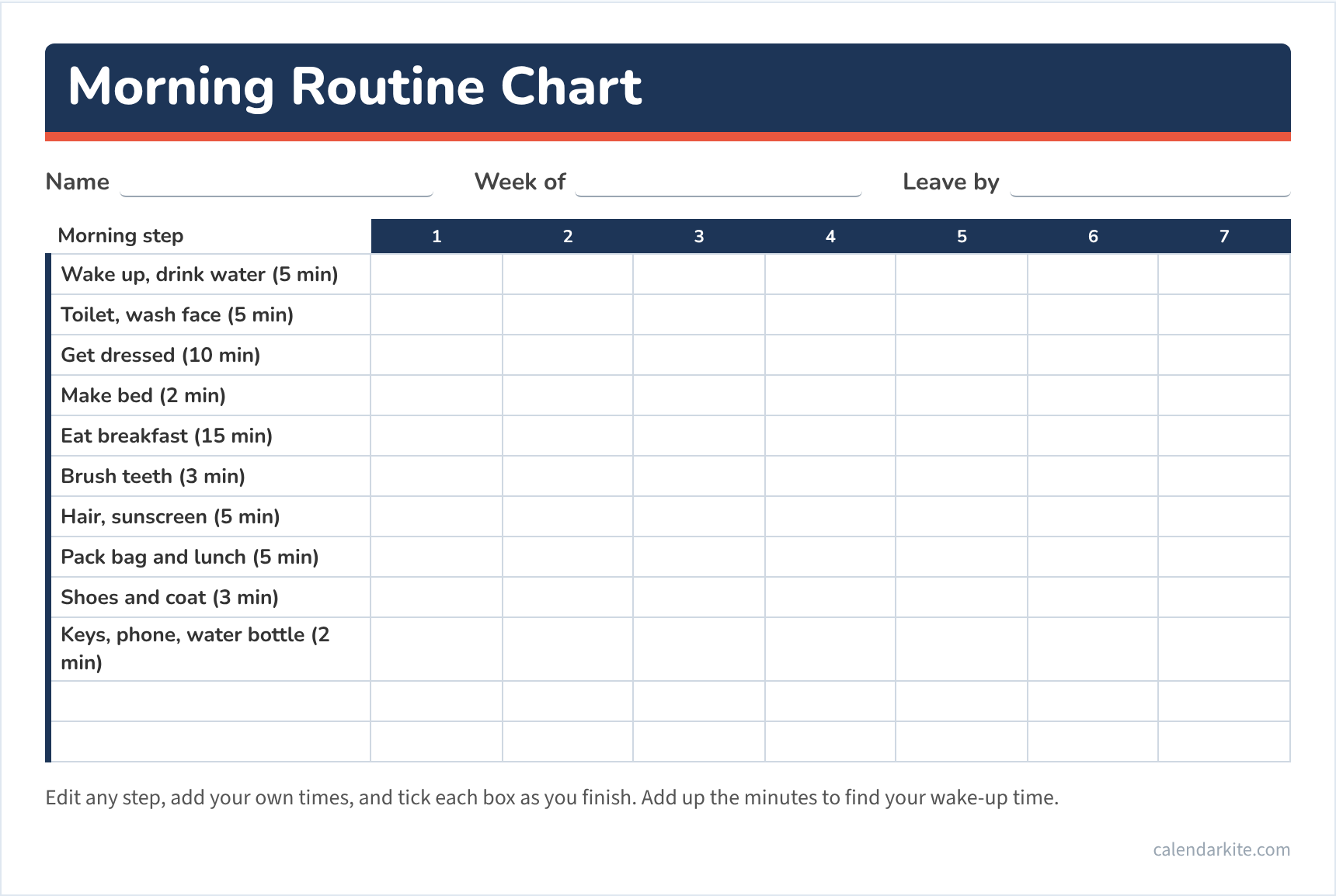
The bold navy and coral chart is a modern pick for teens and busy adults who want a clear, businesslike checklist. The strong header band makes it easy to spot on a fridge, door or desk.
I keep a paper calendar on the fridge and a planner on the kitchen counter, and mornings in our house still go wrong in the same small places. Nobody forgets the big things. It is the gaps between steps that cost us ten minutes. This chart is built to show those gaps and close them.
What a morning routine chart actually does
A good chart does three jobs. It puts the order of the morning in writing, so nobody has to be the narrator. It shows how long each step is meant to take, so the whole routine can be checked against the clock. And it gives a small, satisfying tick at the end of each step, which is more motivating than it sounds.
The part most charts skip is the time column. In my years of office administration I kept schedules and staff rotas readable, and the lesson was always the same: a list without durations is a wish. A list with durations is a plan you can test. That is why every step on this sheet carries a minute count you can edit.
The weekly grid matters too. One row per step and one box per day means you can see at a glance which step keeps getting missed. If “Pack bag and lunch” is empty on Tuesdays and Thursdays, you do not need a pep talk. You need to move that step to the night before.
Who this chart suits
The most common user is a parent of a child between about four and ten, because that is the age when kids can follow a written list but still need a prompt. A pre-reader can use it too if you sit with them and add a small drawing next to each step. Toddlers need fewer steps and bigger visuals, and for them I would pair this with something like the chore chart for kindergarteners approach: three or four tasks, one tick each.
Teens and adults are the group most charts ignore. A teen who oversleeps and misses the bus will often cooperate with a chart they set up themselves, because it is their list, not yours. Adults who work from home, start shifts at odd hours or are returning to a regular schedule after a big change find it just as useful.
It also suits anyone who benefits from seeing a routine rather than remembering it: people with ADHD, anyone with a new baby or a new job, and families sharing one bathroom. If your mornings change a lot, the editable steps matter more than any design choice.
How to fill in the chart
Everything on the sheet can be typed into before you print, and the page saves your work in your browser, so you can come back and adjust it. Here is the order I would follow.
- Type the name and the week-of date at the top, then set the “Leave by” time. This is the one number the rest of the chart depends on.
- Read through the prefilled steps and delete or rewrite any that do not apply. Swap “Hair, sunscreen” for “Feed the dog” if that is your reality.
- Edit the minute counts to match how long each step really takes in your house, not how long you hope it takes.
- Use the blank rows at the bottom for anything specific: medication, a lunch note, a musical instrument.
- Print, then tick the boxes by hand each day. You can also tap the boxes on screen if you keep the chart open on a tablet.
Try this: Before you edit anything, time your normal morning once without telling anyone. Write down each step and how long it really took. Use those numbers on the chart, not the ones I prefilled.
Work backwards from your leave time
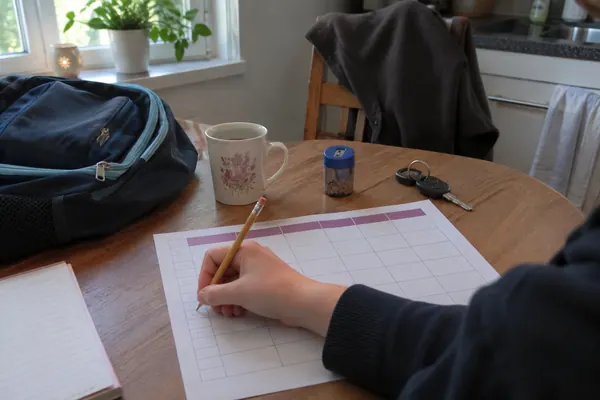
The most reliable way to build a morning routine is to start at the door and count backwards. Decide the time you need to leave, then add the minutes for each step in reverse order until you reach your wake-up time. The prefilled steps on this sheet add up to 55 minutes, so a 7:45 departure means waking at 6:50 with nothing to spare.
Then add a buffer. I add ten minutes, because someone always cannot find a shoe. Ten minutes of slack turns a small hiccup into a non-event, while a routine with zero slack turns every hiccup into an argument. If the total looks too long, do not squeeze the minute counts. Remove a step, or move it to the evening.
Write the wake-up time somewhere obvious, ideally at the top of the chart near the “Leave by” field. When a child can see that 6:50 is the start and 7:45 is the finish, the morning stops being open-ended.
Sample steps and timings by age
These are starting points, not rules. Your child, your bathroom and your commute will change them. I would run any version for a full week before changing it.
- Ages 3 to 5 (4 to 6 steps): toilet and wash hands, get dressed with clothes laid out, breakfast, brush teeth, shoes on. Expect 40 to 50 minutes with help.
- Ages 6 to 9 (7 to 9 steps): the above plus make bed, brush hair, pack bag and check the homework folder. Expect 45 to 60 minutes.
- Ages 10 to 13 (8 to 10 steps): add a personal step such as deodorant, a water bottle or a pet task. Many kids this age can run the whole chart themselves.
- Teens and adults (6 to 12 steps): group small tasks, and add the things only you need, such as coffee, medication, a commute check or a quick look at the day’s calendar.
A tip on order: put brushing teeth after breakfast, not before, so it never gets skipped or has to be done twice. Put shoes and coat last, because they are the signal that you are leaving.
A chart for younger children
Children under six or so rely on pictures more than words, and a pre-reader will ignore a text-only list. Print the chart, then add a small sticker or a quick pencil sketch next to each step. Taking five minutes to do this together is worth it, because the child feels they helped write the chart.
Keep the language in their voice. “Teeth” works better than “oral hygiene,” and “Shoes” works better than “prepare for departure.” Use the same words you use out loud so the chart and the spoken reminder match.
Let the child do the ticking. It is the reward, and it is also how you spot where the routine breaks. If you are still working on bathroom habits, the potty training sticker chart is a gentler place to start before moving to a full routine.
A chart for adults and teens
Adults rarely write a morning routine down, which is why most of us drift into the same rushed 20 minutes. Fill in the chart for yourself for one week and you will probably notice two things: a step you always forget (water, vitamins, charging your phone) and a step that takes three times longer than you assumed (usually scrolling).
For teens, give them the pen. Let them set the order, change the minute counts and cross out steps they think are pointless. The only fixed items should be the leave time and the non-negotiables, like breakfast or medication. A chart a teenager designed is much more likely to stay on the wall than one handed down.
If you want the routine to sit alongside other daily habits, a habit tracker covers the longer view, such as a month of exercise or journaling, while this chart covers just the hour before you leave. I also use a daily checklist template for the rest of the day and keep the morning chart separate, so neither sheet gets crowded.
Set up the night before
Most failed mornings were lost the evening before. If the bag is not packed, the clothes are not chosen and the lunch is not made, you are asking the morning to do the work of two parts of the day.
I put the evening steps on a small list beside the morning chart, and our kids tick them off before bed. It is a short list, and it takes about ten minutes.
- Choose and lay out clothes, including socks and shoes
- Pack the school bag and check the homework folder
- Make or prep lunch, and put it in the fridge
- Put keys, wallet and phone in the same spot
- Set the alarm and plug in devices
If you struggle with bedtime itself, a sleep log for a week or two can show whether the real problem is a late night, not a slow morning. For school-age kids, a homework checklist near the bag makes the “pack bag” step much faster.
Try this: Pick the one step that most often slows your morning and move it to tonight. Do it for five evenings and compare how Monday to Friday feel.
Using the check boxes and rewards
Tick boxes work because they give a visible end point. For young children, I suggest ticking each step as it is done, with a pen or a pencil they choose. For older kids, ticking at the end of the routine is fine.
Keep rewards small and tied to the process, not the speed. A full row of ticks across the week can earn a choice, like picking Friday’s breakfast or the family movie. Avoid rewards that make the morning a race against a sibling. A chart that turns into a competition tends to end in tears before 8 a.m.
If a step is missed, leave the box empty and say nothing. Empty boxes are information, not failure. At the end of the week, look at them together and ask one question: “What got in the way here?” You will often hear something simple, like the bathroom being occupied or the shoes living in another room.
Weekday and weekend versions
School days and weekends need different charts, or at least different expectations. I print one copy for weekdays with the full list and a second, shorter copy for Saturday and Sunday that keeps only the anchors: toilet, dressed, teeth and one chore.
You can do this with the same sheet. Edit the steps, delete the minute counts you do not need, and save it as the weekend version. A lighter weekend chart keeps the habit alive without making family time feel like a timetable.
If your weekday mornings vary, such as early starts on Tuesdays and Thursdays, print two weekly charts and change the “Leave by” time on each. For more detail on the rest of the week, a weekly chore chart can run beside it so morning tasks and household jobs do not overlap.
When the routine is not working
When a morning routine fails, it is almost always one of four things, and none of them is a bad child. Check these before you change the chart.
The first is too many steps. If a child cannot finish the list in the time, remove two steps and try again. The second is unrealistic minute counts, so re-time the real thing. The third is a missing prompt, such as no clock in view or no one reminding them to look at the chart. The fourth is a hidden problem upstream: poor sleep, a hungry child, a sensory issue with certain clothes.
One mistake I see often is adding a new step every time something goes wrong. A chart with 18 rows is not a chart, it is a list of grievances. I would rather have eight steps that get done than eighteen that get ignored.
Give any new version one full week before judging it. Habits take longer than three days to settle, and the first week often looks worse than the second.
Support for ADHD and other needs
Visual routines are widely used with children who find sequencing or time hard, and a written, timed list helps many adults too. I am not a clinician, so treat this as practical tips from home, not medical advice, and talk to your child’s teacher or doctor if you need more specific support.
What helps most is making each step small, concrete and visible. “Get ready” is too vague. “Pull on socks and shoes” is clear. Break any step that regularly stalls into two lines, and put a timer or visual clock next to the chart if a child struggles to sense time passing.
Reduce the number of choices where you can. Same breakfast on school days, same clothes drawer, same shoe spot. Fewer decisions mean more energy for the steps themselves, and the chart carries less weight.
Printing and display tips
The sheet is set up for one US Letter page and prints cleanly on A4. I test-print every printable on my home inkjet on both sizes, and I check that the boxes are big enough to tick with a pen and that the step names do not run into the grid lines. Use “Fit to page” or “Actual size” and leave margins on default.
To reuse the chart, slip it into a plastic sheet protector or laminate it, then tick with a dry-erase marker and wipe it clean each Sunday. A cheap clear sleeve is enough. If you would rather keep a record, print a fresh sheet each week and clip the old ones together, so you can see patterns over a month.
Black and white works fine. If you have a colour printer, print on light coloured paper or use a coloured pen for ticking, which makes the chart easier to spot on a busy fridge door.
Where to put the chart
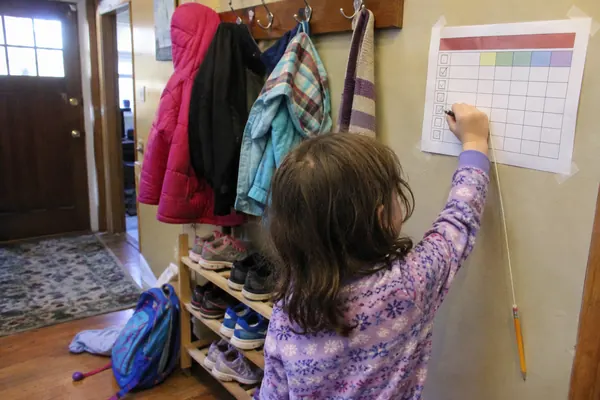
Hang the chart where the morning actually happens. For most kids that is the bedroom door, the bathroom mirror or the spot beside the shoe rack. For adults, the inside of a wardrobe door or next to the coffee maker works well.
Eye level matters more than you would expect. A chart hung at an adult’s eye height is invisible to a six-year-old. Put it where the person who needs it will see it without being told.
Our own chart lives near the fridge, with a pen on a string. It sits within arm’s reach of the paper calendar, so one glance covers both the day’s plans and the routine that gets us there. If your week is busy, a weekly calendar beside it keeps appointments and routine in one place.
Variations to try
Once the basic chart is working, a few small changes can keep it fresh. Swap the prefilled steps for a picture version for a younger child. Add a “Leave by” time per day if your schedule varies. Turn the grid into a monthly sheet by printing four weeks and clipping them in a folder.
You can also use the same layout for other routines: an after-school list, a bedtime routine, a work-from-home startup or a shutdown routine at the end of the day. Rename the heading, edit the steps and the layout still works.
Finally, review the chart every month or after any big change, like a new school year or a new job. A chart that fits last term will not fit this one, and the editable sheet makes it a two-minute job to update.
Try this: At the end of week one, circle the step with the most empty boxes. Reword it, shorten it or move it to the night before, then print a fresh sheet for week two.
Common questions
How many steps should a morning routine chart have?
Aim for 6 to 10 steps. Toddlers and preschoolers do best with 4 to 6, school-age kids can handle 8 to 10, and adults can group small tasks (like keys, phone and wallet) into one line.
What should be on a morning routine chart for kids?
Start with the things that must happen before you leave: toilet and wash, get dressed, breakfast, brush teeth, pack the bag and put on shoes. Add hair, sunscreen, pets or a small chore only if your morning has room for them.
How long should a morning routine take?
It depends on your leave time and your steps. Add up the minutes for each step, then add a 10 minute buffer. For many families with school-age kids that lands between 45 and 75 minutes.
Should I use a morning routine chart on weekends too?
You can, but a shorter weekend version works better. Keep two or three anchor steps (toilet, dressed, teeth) and drop the time pressure, so the habit stays in place without the rush.
Can adults use a morning routine chart?
Yes. The same layout works for adults: list the steps in order, put a minute count next to each, and tick them off for a week. It is a quick way to see where the time actually goes.
Is the chart free to print?
Yes. Fill it in on the page and print it, or download the blank PDF and write on it by hand. It fits one US Letter page and prints cleanly on A4 too.
More free charts
 Potty Training Sticker Chart (Free Printable)
 Chore Chart for Adults: Free Printable Weekly Chart
 Chore Chart for Kindergarteners: Free Printable Weekly Sheet
 Body Measurement Chart: Free Printable 12 Week Tracker
 Hundreds Chart Printable: Free 1-100 Chart to Fill In and Print
 T Chart Example (Free Printable T Chart With Scoring)