
Homework Checklist: Free Printable Sheet for Students

A homework checklist is a short, repeatable list of steps that takes a student from sitting down to packing the bag, so nothing gets missed and nobody has to remember the routine. The best ones cover more than assignments. They include getting set up, finding what is due, choosing an order, doing each subject, checking the work and putting it where it will not get lost.
1. Get ready
- Snack eaten and water filled
- Bathroom break done
- Phone and tablet out of reach
- Desk or table cleared
- Pencils, pens and eraser at hand
- Laptop charged if needed
2. Find the work
- Planner or assignment page open
- Online class portal checked
- Teacher notes and messages read
- Every subject listed below
- Due dates marked
- Books and handouts gathered
3. Plan the order
- Due tomorrow marked with a star
- Hardest task picked to go first
- Minutes guessed for each task
- Break planned after 25 to 30 minutes
- Big project: one small step chosen
4. Do the work
- Math
- Reading or reading log
- Writing or English
- Science
- Social studies
- Spelling or vocabulary
- Test or quiz studying
- Music, language or other
5. Check it
- Directions read one more time
- Every question answered
- Work shown where needed
- Name and date on each page
- Writing read aloud once
- Questions saved for the teacher
6. Pack up
- Finished work in the right folder
- Signed forms in the bag
- Books and supplies in the bag
- Laptop or tablet plugged in
- Tomorrow's gear set by the door
- Desk tidied
7. Grown-up check-in
- Asked what was hardest tonight
- Looked at tomorrow's tests or projects
- Initials or signature added
- Reading time or reward earned
Print one per night, or one per week and tick each day in a different colour.
Free for personal, classroom and office use. Your entries are included in the print, PDF and PNG. Prints on US Letter and fits A4.
Black and White Homework Checklist Printable
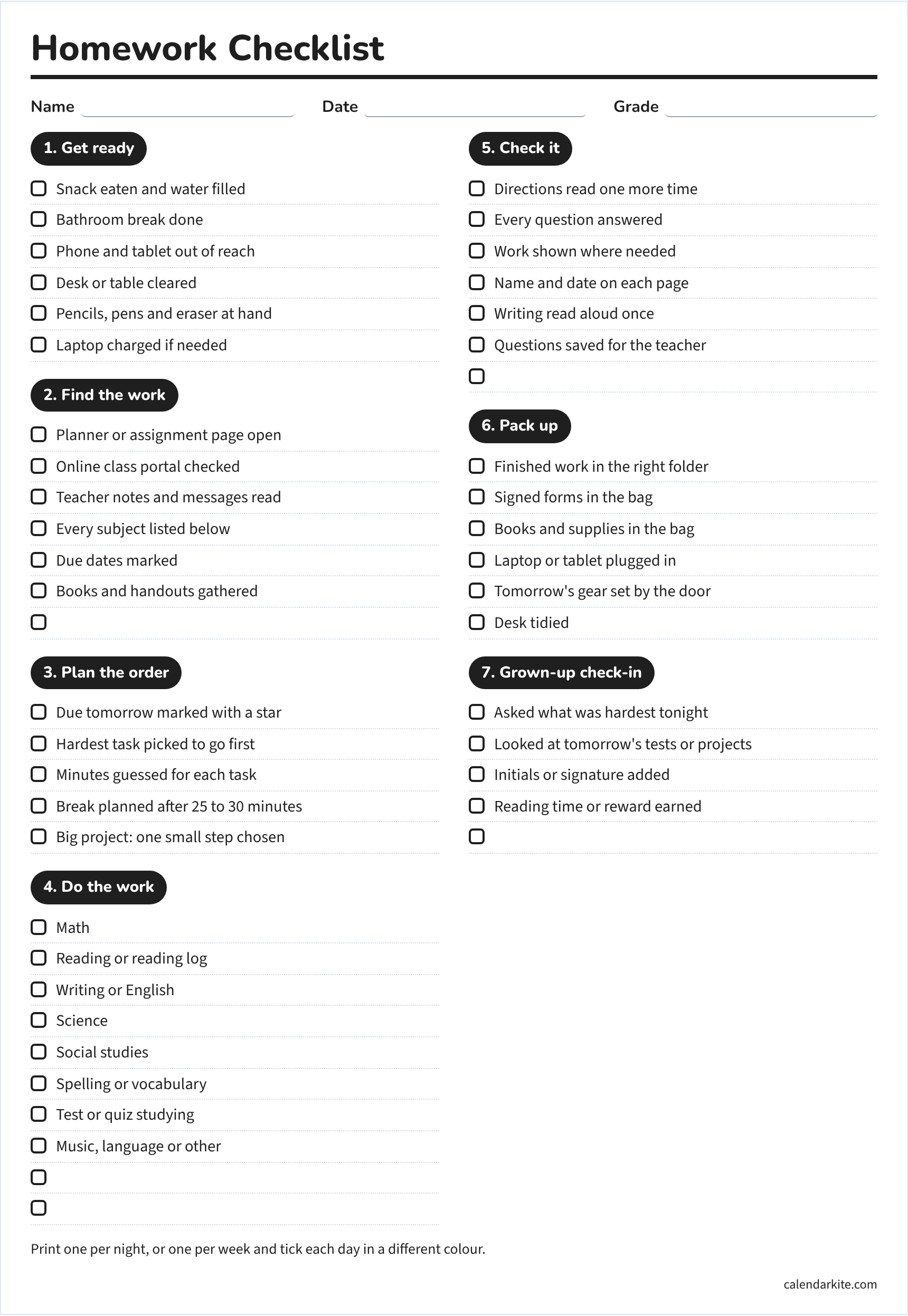
This ink-saving version suits families who print a fresh checklist every week and don't want to burn through color cartridges. I test-print each page on my home inkjet, and the plain black lines stay crisp on both US Letter and A4.
Pink Homework Checklist
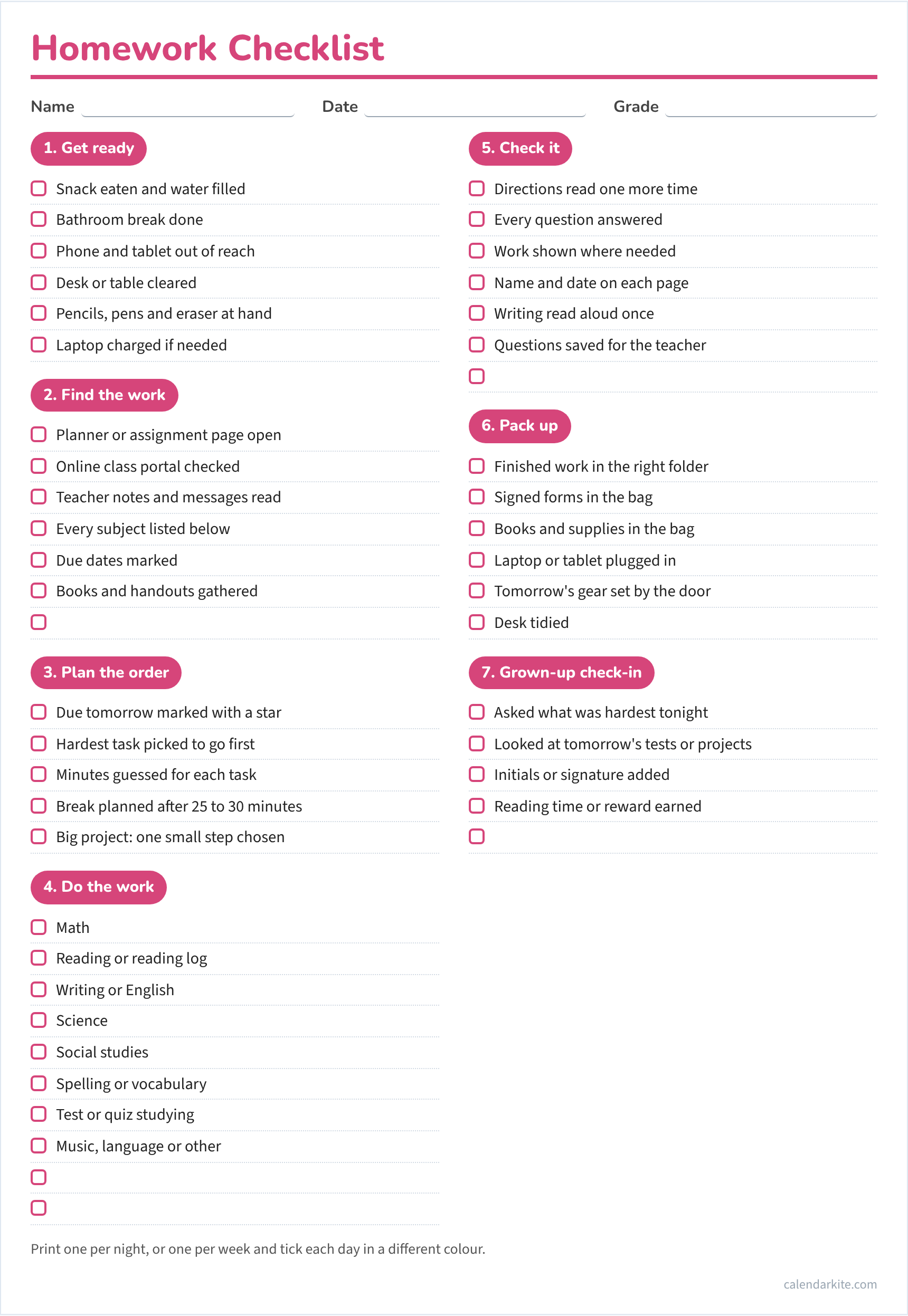
A soft pink checklist works well for younger students who like a friendlier look at the homework table. Print a few copies, slip one into a folder, and tick off reading, math and spelling each evening.
Sage Green Homework Checklist
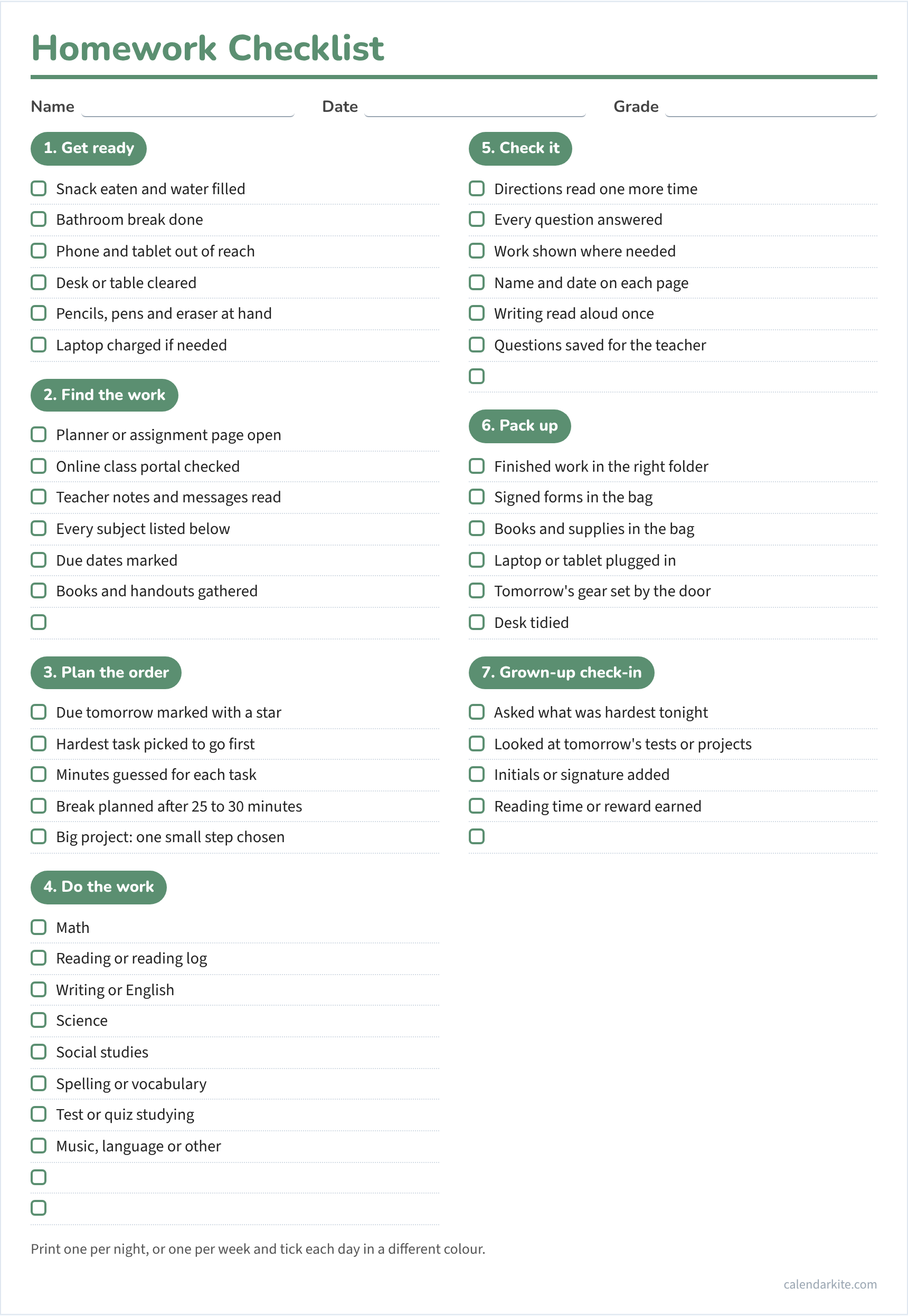
The calm sage green suits middle schoolers and parents who prefer a muted look on the fridge. I keep a paper calendar on my fridge, so I hang a checklist beside it to see due dates and tasks together.
Lavender Homework Checklist
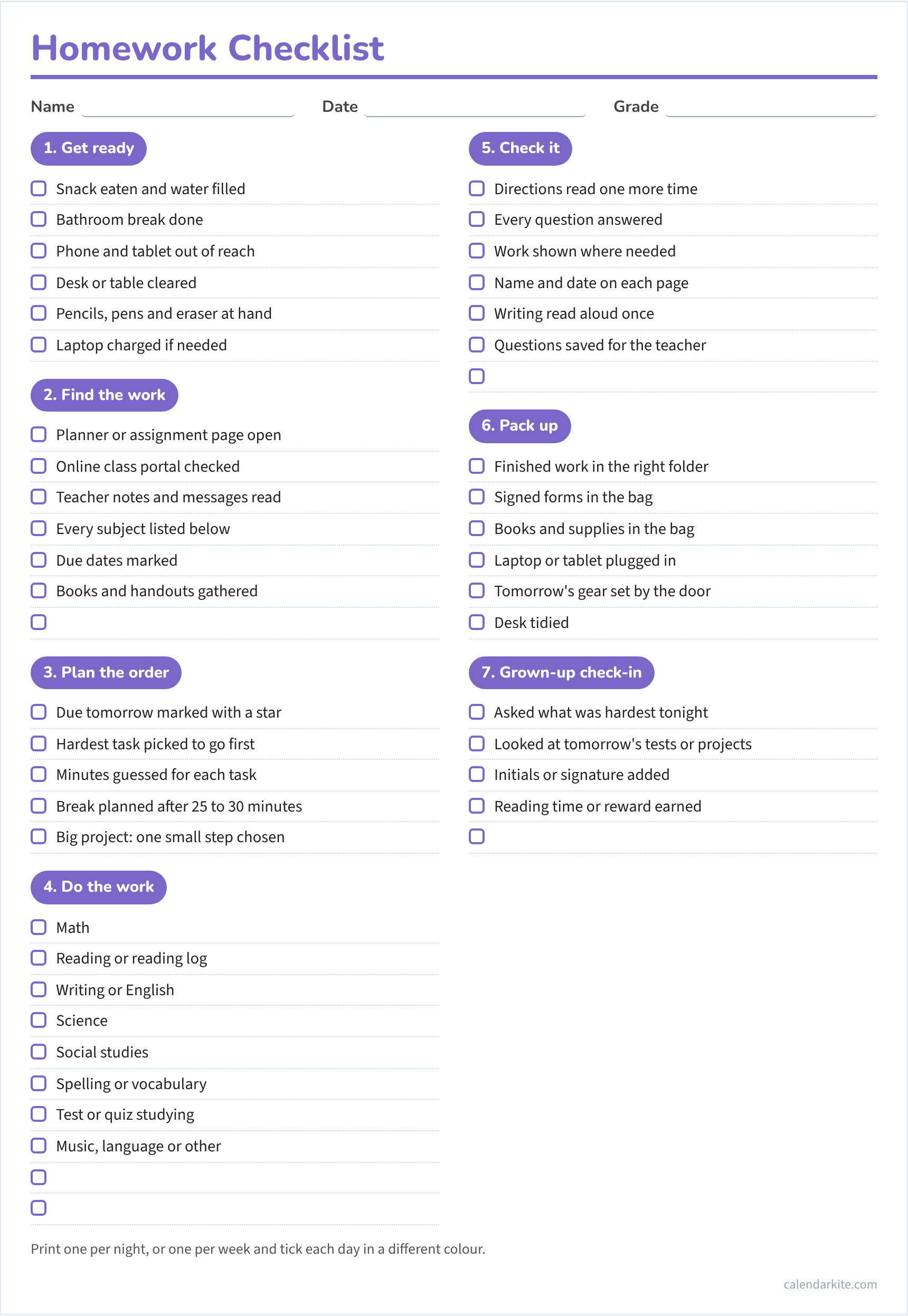
Lavender is a gentle choice for students who get anxious about long assignment lists, since the soft color keeps the page from feeling loud. Use it to break a night's work into small steps: start, finish, pack up.
Cute Homework Checklist
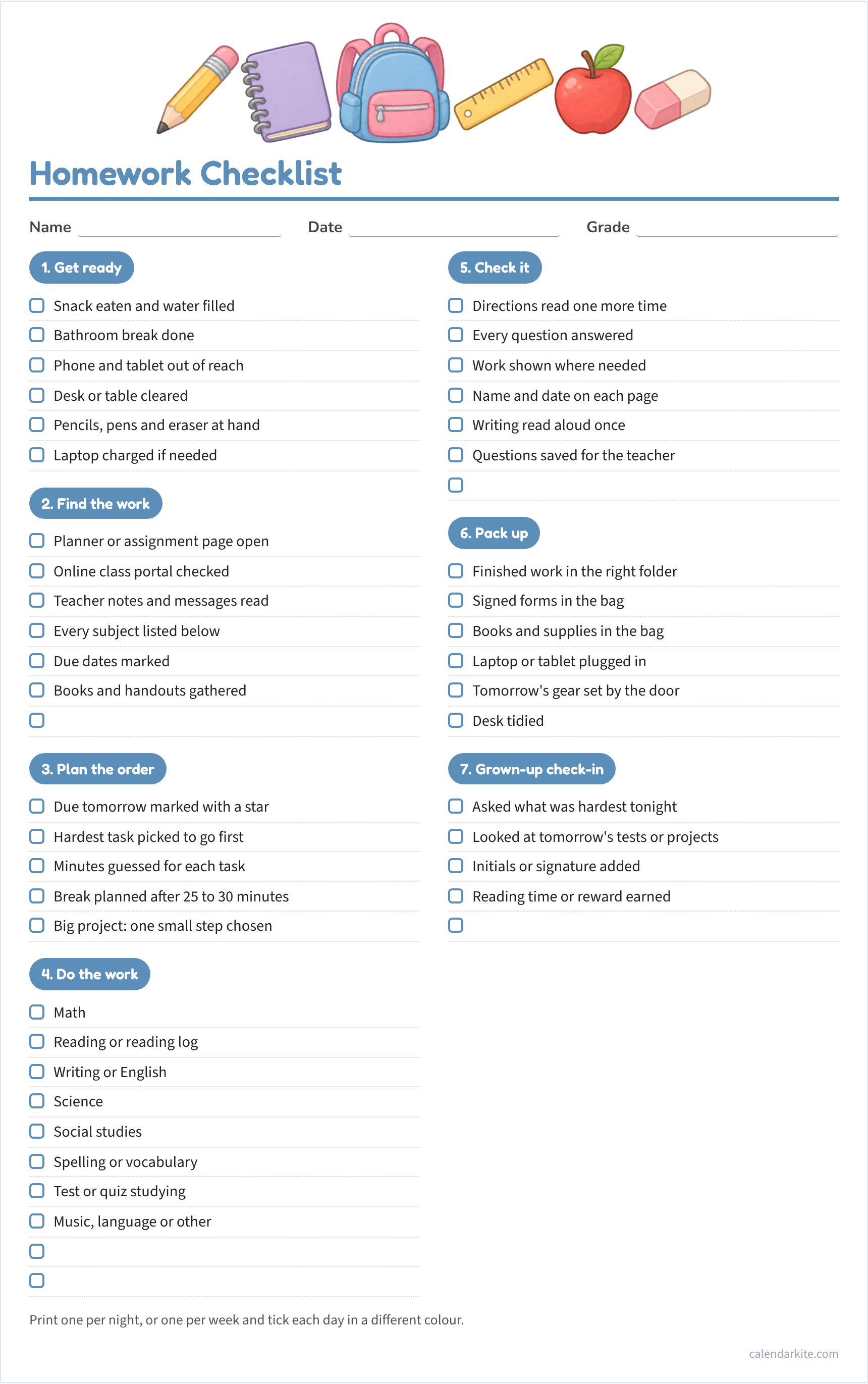
This pastel blue page with little school illustrations is made for elementary kids who need a bit of fun to sit down and start. Tape it above the desk so the first thing they see after a snack is what to do next.
Floral Homework Checklist
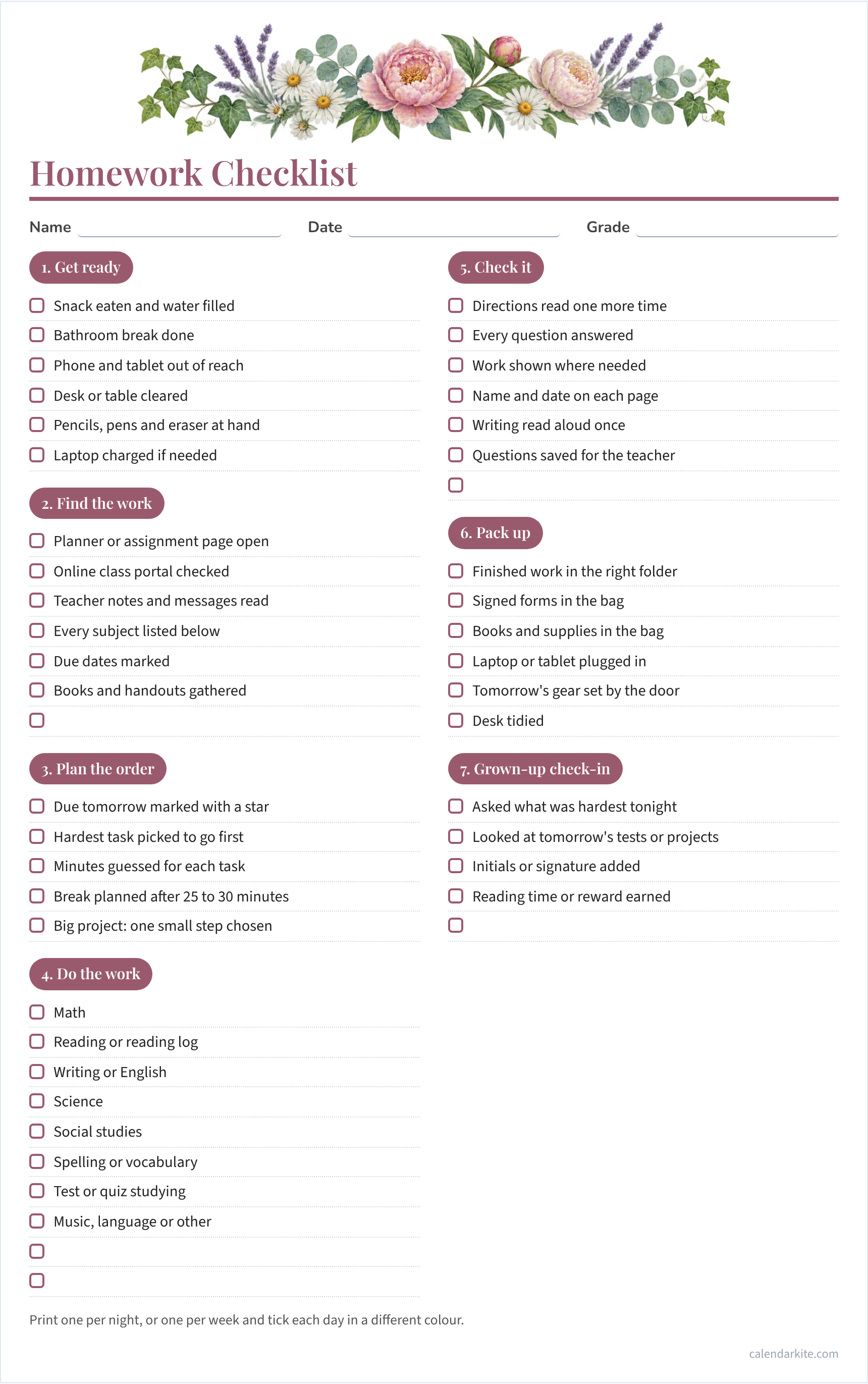
Watercolor flowers and elegant serif headings suit teens and college students who want a homework checklist that feels like a nice planner page. It fits in a binder, and I leave generous check boxes so handwriting never gets cramped.
Homework Checklist for Kids
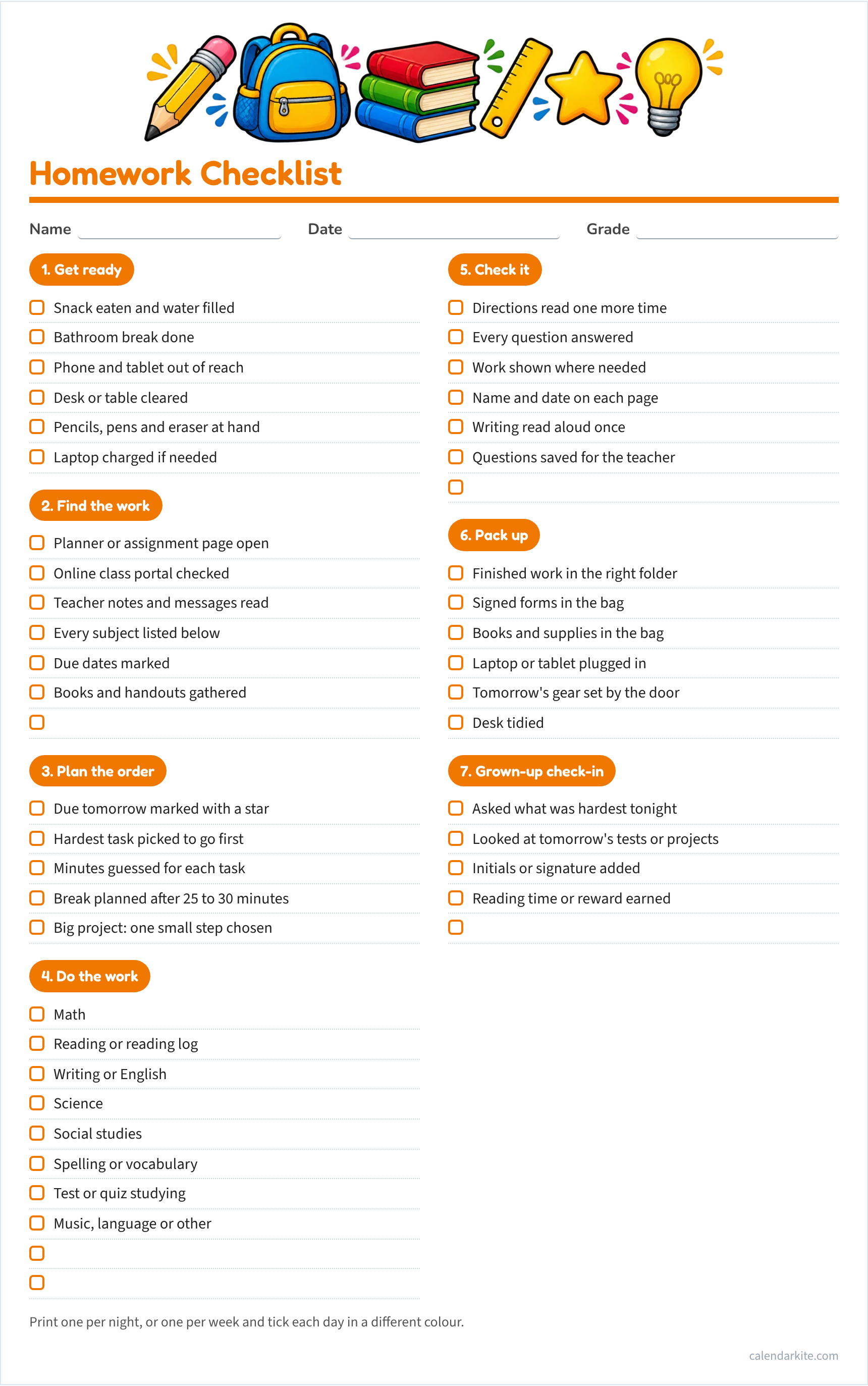
Bright orange and yellow cartoons make this the one for energetic kids who treat homework like a chore. Stick it on the fridge and let them check off each subject the moment it's done.
Simple Minimalist Homework Checklist
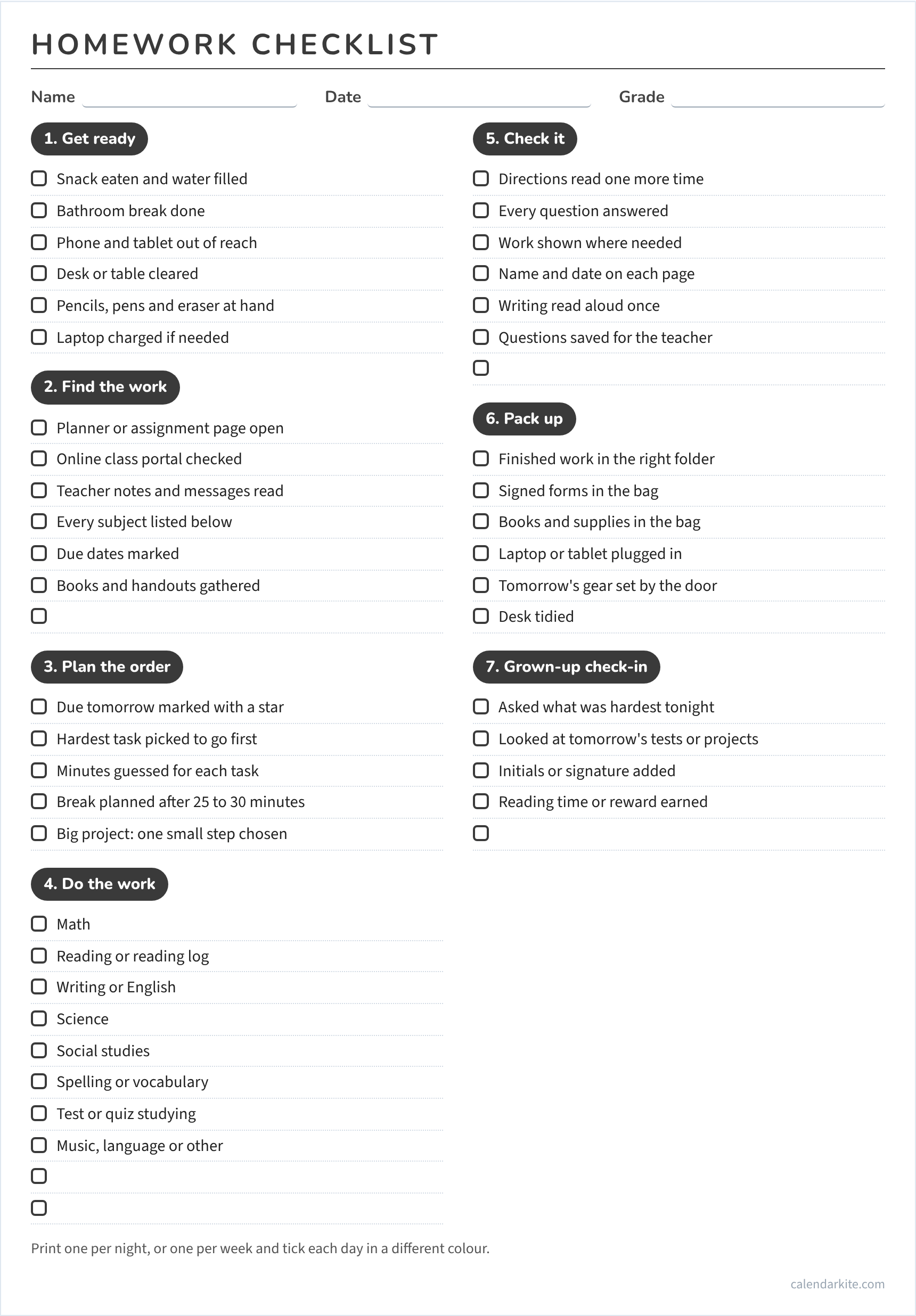
Thin gray lines and no color suit older students and anyone who wants a distraction-free list. A common mistake I see is cramming too many tasks onto one page, so I keep this layout sparse on purpose.
Aesthetic Homework Checklist
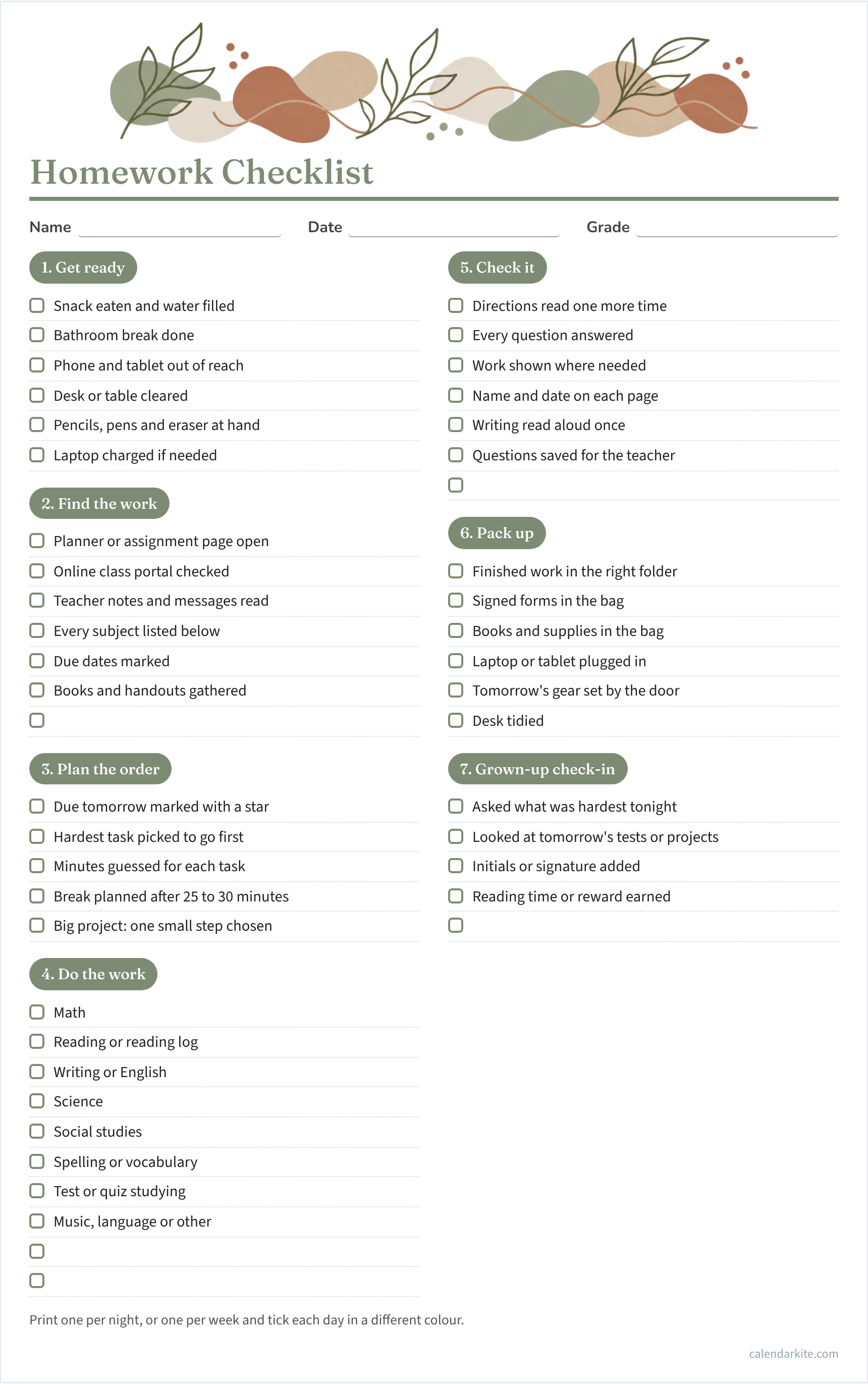
Muted sand, sage and terracotta with soft leaf line art suit high schoolers who like a calm desk setup. I keep a planner on my kitchen counter, and this one sits nicely beside it for weekly assignments.
Modern Homework Checklist
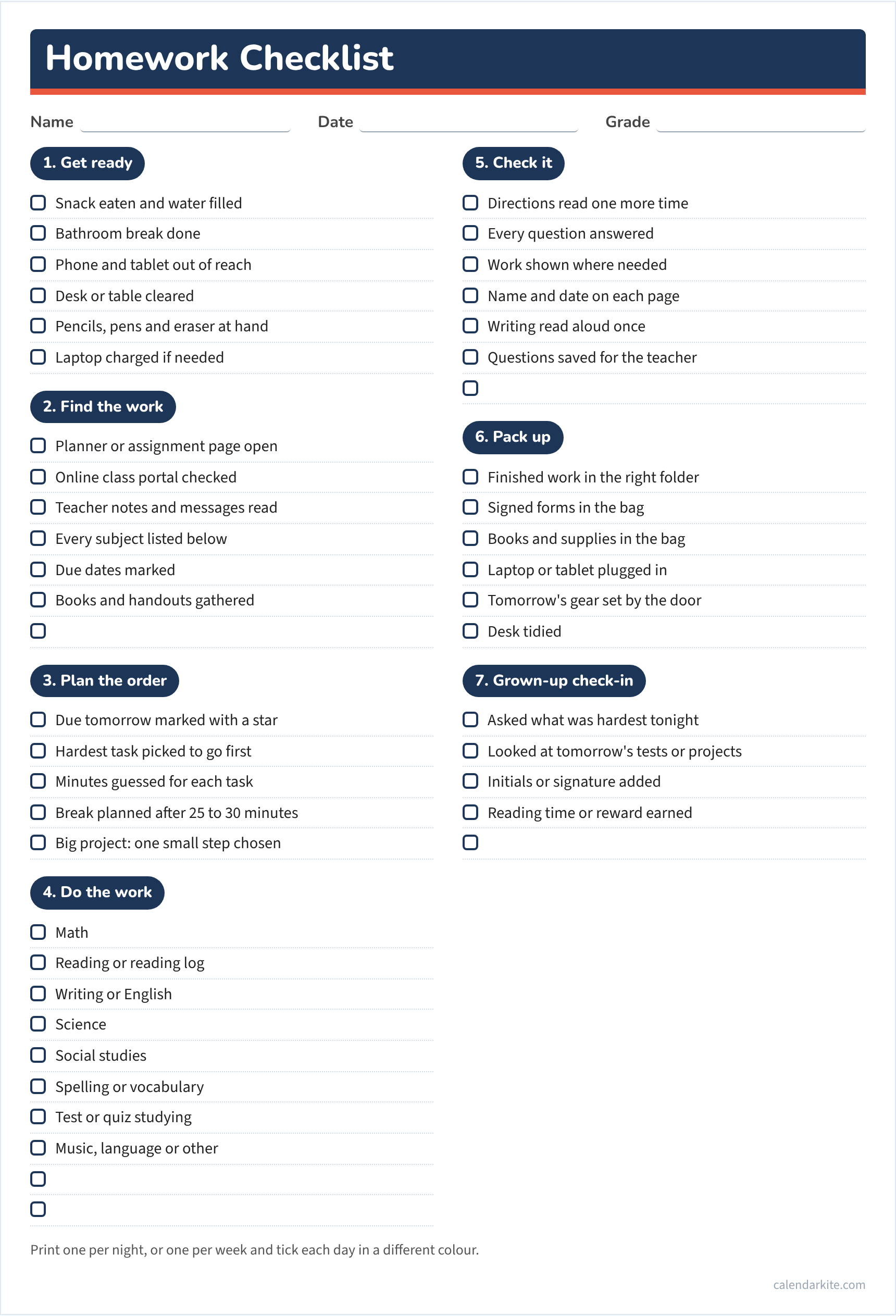
The navy header band and coral accent give a clear, modern look for busy students juggling several classes. I made the subject column wide enough to list a full assignment name, which is where most checklists run out of room.
The sheet on this page does exactly that on one US Letter page. You can type straight into it, tick the boxes, change any item, and print it when you are happy. Below I explain what each section is for, how to fill it in, and how to adjust it for a first grader, a middle schooler or a college student.
What is on this printable homework checklist
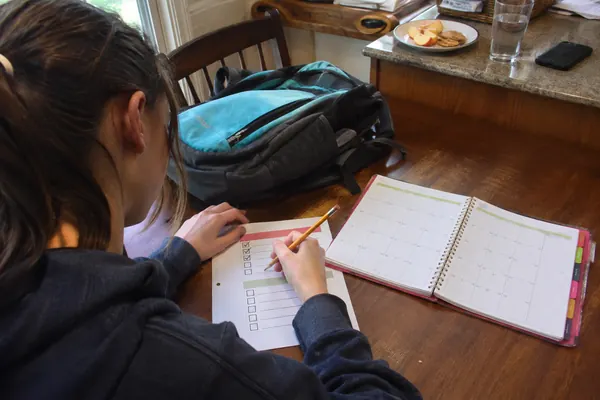
The sheet has seven short sections that follow the order of a real evening. Get ready covers snack, water, a bathroom break and putting the phone out of reach. Find the work is about checking the planner, the online portal and teacher notes, then listing every subject with its due date. Plan the order asks the student to star anything due tomorrow and pick the first task.
Do the work has a line for each common subject, plus a couple of blank rows for anything unusual that week. Check it is a quick pass: directions reread, every question answered, name and date on the page. Pack up gets finished work into the right folder and the bag by the door. The last section is a grown-up check-in, which is deliberately small so the sheet stays the student’s tool, not yours.
I spent about ten years in office administration, and the lesson that stuck is that people rarely forget the hard part of a job. They forget the first and last steps: the setup and the handoff. That is why the sheet starts with preparing and ends with packing up. Plenty of homework is finished and then left on the kitchen table.
How to fill it in
Print one sheet per night, or fill it on screen first and print it. Start with the top fields: name, date and grade. Then work down in order. The student ticks each item as it happens, not at the end of the evening, because ticking in real time is what makes the sheet useful.
In section two, the blank row is for anything the standard items do not cover, such as “bring cardboard for science.” Section four is where most of the writing happens. Beside each subject, jot the task in a few words, like “p. 42, odd numbers” or “chapter 3 questions.” If a subject has nothing tonight, draw a line through it so the page does not look unfinished.
Try this: Tonight, fill in only sections one to three with your child and stop there. Notice how much calmer the first ten minutes feel when the plan is written down before the first pencil moves.
You can also edit the wording on screen. If “Bathroom break done” feels silly for a ten-year-old, replace it. Your changes are saved in your browser, so the same version is waiting tomorrow.
A sample evening, step by step
Here is how a fourth grader’s Tuesday might go. She sits down at 4:15, eats a snack, fills her water bottle and leaves the tablet in the kitchen basket. That is section one, five minutes, six ticks.
Next she opens her planner and the class portal and writes the tasks under each subject: math worksheet, spelling words (write each three times), 20 minutes of reading, and a science sheet due Thursday. She stars math and spelling, because both are due tomorrow. She picks math first because it is the hardest, and guesses 15 minutes.
After math she takes a short break, does spelling and reading, and saves the science sheet for tomorrow with a note: “Wednesday, 10 min.” Before packing up she rereads the math directions, checks her name and date, and slides everything into the blue folder. Her parent asks one question, “What was the trickiest part?”, and initials the sheet. The whole routine takes a bit longer than homework alone, but the evening has fewer arguments in it.
Who this checklist suits
The sheet works for any student who has homework and a habit of losing track of it. That includes elementary kids who need a visual routine, middle schoolers juggling five or six teachers for the first time, and high schoolers with multiple deadlines. It also suits homeschool families who want a clear start and finish to independent work, and tutors who want a consistent structure.
It is especially helpful for students who start homework easily but finish unevenly: the ones who complete the worksheet and forget to hand it in. The pack-up section is aimed squarely at them.
It is a less natural fit for students who mainly need a long-term view of big projects. For that, pair it with a weekly view such as the weekly calendar printable, where you can see the whole week of deadlines at a glance.
Setting up for younger children
For kindergarten through second grade, treat the checklist as a shared routine. You read the items aloud, they tick the boxes, and you write the subjects. Keep it to the sections that matter: get ready, do the work, pack up. Cross out or cover the rest with a sticky note for now.
Young children do better with a clear finish line. I put the check boxes in a column down the left edge for exactly this reason: a small hand can tick them quickly, and the page visibly fills up. A sticker beside the final tick works well, and the potty training sticker chart page shows how simple reward charts can be if you want one for other routines.
If reading is part of nightly homework, a separate log helps. The reading log for kids is a good companion, and you can tick “Reading” on the checklist once the log is filled in.
Middle school and high school students
Older students need less hand-holding and more ownership. Give them the sheet and let them decide how to use it. Section two matters most at this age, because the work is spread across several teachers, planners and online systems. Listing every subject in one place stops the Sunday night surprise.
Encourage them to use the “Plan the order” section honestly. Starring what is due tomorrow, then picking the hardest task first, is a habit that carries straight into college. A guess at minutes per task is also a skill: after a few weeks, most students notice they consistently underestimate writing and overestimate math, and they plan better.
When deadlines stretch over weeks, add a line for the milestone, not the whole project. “Outline for history essay” is a tick you can earn tonight. “History essay” is not. Students who move on to university can graduate to a college assignment tracker, which handles syllabi and long-range due dates.
Students who struggle to start or stay focused
Some children can sit down and begin, and some cannot. If starting is the sticking point, the checklist helps because it makes the first step tiny: eat the snack, clear the desk. Those steps are easy wins that move the evening forward without anyone saying “go do your homework.”
Shorten the plan for these students. Keep the sections but pick only three or four items from each, and use the break line in section three on purpose, with a timer. Twenty-five minutes of work and a five-minute break is a common pattern, and you can shrink it to 10 or 15 minutes for younger kids.
If your child has a diagnosis or a learning plan at school, check with the teacher or specialist, and ask whether they already use a routine that this sheet could match. I am not an educator, and I would rather the checklist echo what the school does than compete with it.
Setting up a homework spot
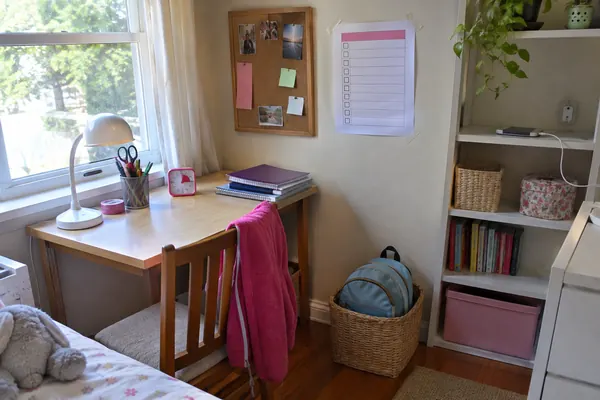
A checklist works better in a consistent place. Pick a table or desk with good light, a flat surface and as few distractions as you can manage. In our house, that is the kitchen table, mostly because I am nearby and the dog is not allowed under it. It is not glamorous, but it works.
Keep a small supply bin within reach: pencils, eraser, ruler, scissors, glue, highlighters, sticky notes. Half of “I cannot find my pencil” is a supply problem, and the first section of the sheet quietly solves it by having a “supplies at hand” tick.
Clip the sheet to a clipboard or tape it inside a folder, and keep a spare stack nearby. If a student has to hunt for the checklist, they will skip it. Next to the planner on the counter is where mine lives, right beside the family calendar on the fridge.
Try this: Spend five minutes on Sunday gathering a homework bin with pencils, paper and a timer. Then print a week’s worth of checklists and clip them together next to it.
How long homework should take
A commonly cited rule of thumb is about 10 minutes per grade level per night, so 10 minutes in first grade and an hour in sixth. It is a guide, not a law, and schools differ. Use the “minutes” guess in section three to see how your child’s real evenings compare.
If the sheet regularly shows much more time than that, do not just push harder. Write down which subject takes longest and share it with the teacher. A page of notes is much more useful in a conversation than “homework takes forever.”
If it takes much less, that is fine too. A fast evening is a good one. Use the spare time for reading, play or sleep, and let the sheet stay short.
Checklist, tracker or planner: which one do you need?
They solve different problems. A checklist guides one session of work and makes sure the steps happen in order. A tracker records assignments over days or weeks, with subject, description and due date. A planner is the wider view, mixing homework with activities, tests and family plans.
Many families do well with two pieces. Use the homework tracker to capture what is assigned, and this checklist to turn it into an evening’s work. The tracker answers “what is due?” and the checklist answers “what do I do now?”
For students who prefer a single tool, a general daily checklist template can fold homework in with chores and activities. I tend to start families on the simple two-sheet system, because it keeps each page short enough to read at a glance.
Variations to try
You do not have to use the sheet exactly as printed. These changes have worked well for me:
- Weekly version: print one sheet and tick each night’s boxes in a different colour, so a week’s habits show on one page.
- Reward version: add “earn a tick toward Friday movie night” in the grown-up check-in, with a simple tally in the margin.
- Subject-only version: cross out sections one, three and six on busy nights and just use “Do the work” and “Check it.”
- Test week version: replace the blank rows in section four with “study 15 minutes: spelling” or “review flashcards.”
- Two-child version: print two copies in different colours so no one argues about whose boxes are whose.
Pairing the sheet with a morning routine can also help. The morning routine chart uses the same idea of tick-as-you-go, so children recognise the pattern and treat it as normal.
Tips for parents: help without taking over
The easiest way to turn homework into a fight is to sit over a child and correct every answer. The sheet’s grown-up check-in is designed to keep you in a supporting role: ask what was hardest, look at what is coming tomorrow, and initial the page. That is the whole job on most nights.
When your child is stuck, try questions before answers. “What is the question asking?” or “Which part do you want to start with?” gives them a way in without you doing the work. If a teacher has asked for parent signatures, put them in the grown-up row so they are not forgotten.
Keep your own calendar visible as well. Seeing that you plan ahead helps children learn to do it. A printed 2027 calendar on the fridge with test dates, project due dates and school holidays means the whole family sees what is coming.
Printing tips
The sheet is built to fit one US Letter page and prints cleanly in black and white. On my home inkjet I test every printable on both US Letter and A4, and I changed this one so the check boxes are large enough to tick quickly and the lines leave room for handwriting. In your print dialogue, choose “Actual size” or 100 percent, not “Fit to page,” or the margins will shrink.
If you plan to use it every night, print on slightly heavier paper, around 24 lb, or slip it into a plastic sleeve and use a dry-erase marker. Then it is reusable and you are not printing 180 sheets per school year.
For classroom or tutoring use, print a stack, hole punch it and keep it in a binder. A blank PDF is available too, if you would rather write everything by hand.
Mistakes I see most often
The first mistake is printing a beautiful checklist and never putting it where homework happens. It needs to sit at the table, not in a drawer. The second is making it too long: if a student sees 50 items and feels tired before starting, cut it to the items that matter and add more later.
Another is the grown-up filling it in for the child. That makes the sheet your tool, and children quickly learn to ignore it. A third is skipping the pack-up step because the work feels “done.” In the office, the report that was finished but never sent was the commonest kind of failure, and homework is no different.
Finally, many people abandon the sheet after a bad week. Missing a night is normal. Pick it up again the next day, and keep the routine small enough that restarting is easy.
Keeping the habit going all year
Habits stick when they are boring. Use the same sheet at the same time, in the same place, for at least a few weeks before changing anything. After that, review it with your child: which sections do they actually use, and which are just clutter?
Check in monthly. September routines often need a tweak by November, when workloads climb. A look at the October 2027 calendar or the month ahead is a good prompt to ask what tests and projects are coming and whether the checklist needs another row for study time.
Finally, celebrate the boring wins. A finished sheet is a small piece of evidence that your child can plan, work and finish. Let them see it, and let them see you notice.
Common questions
What should a homework checklist include?
A good one covers more than a list of assignments. It should include getting set up, finding and ordering the work, doing each subject, a quick check, and packing the bag. The sheet on this page has all of those steps so nothing finished ends up left at home.
How long should homework take each night?
A commonly cited guideline is about 10 minutes per grade level, so roughly 20 minutes in second grade and 60 in sixth. Schools and kids vary, so treat it as a rough guide. If the checklist regularly shows far more time than that, talk to the teacher.
Should my child fill in the checklist or should I?
Let your child do it, with you sitting nearby for the first couple of weeks. Younger kids can tick boxes and you can write the subjects. Older students should own the whole sheet, and you only do the grown-up check-in at the bottom.
What is the difference between a homework checklist and a homework tracker?
A tracker records assignments over time, with subjects, descriptions and due dates. A checklist guides one evening of work from start to finish. Many families use a tracker for the week and a checklist for each night.
Can I edit the checklist before printing?
Yes. You can type into every line and field on the page, tick boxes, and change any item to suit your child. Your changes save in your browser, and there is also a blank PDF if you prefer to write by hand.
Is the printable checklist free?
Yes, it is free to fill in, print and download for home or classroom use. It prints on US Letter and A4 paper in black and white without losing anything.
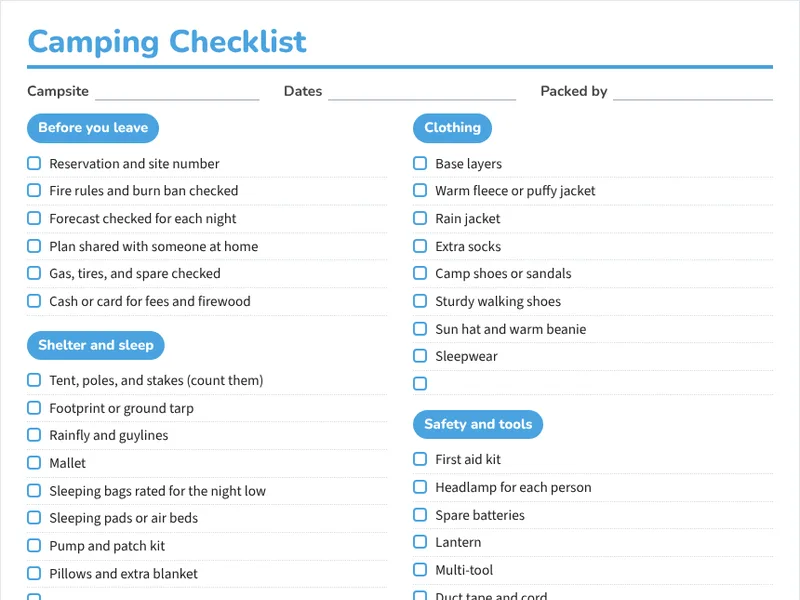 Camping Checklist Printable: Free One-Page Packing List
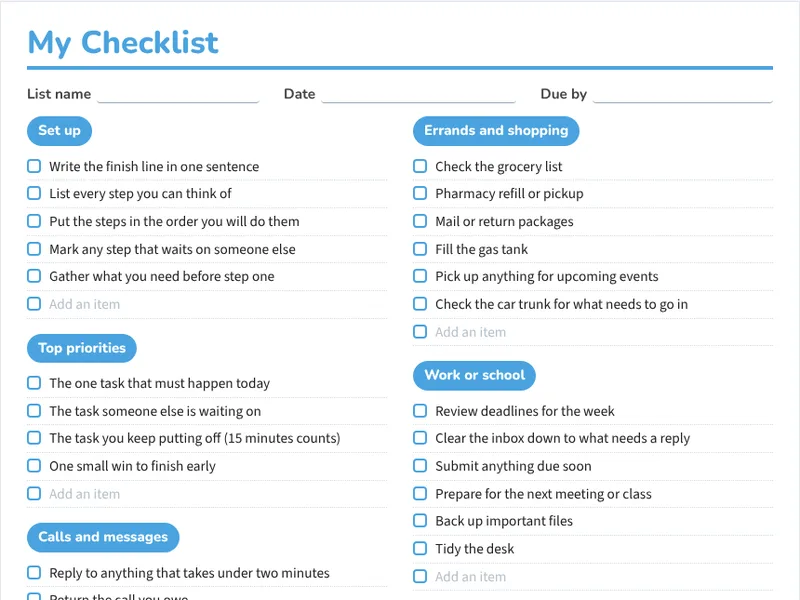 Checklist: A Free Printable You Can Fill In, Edit and Print
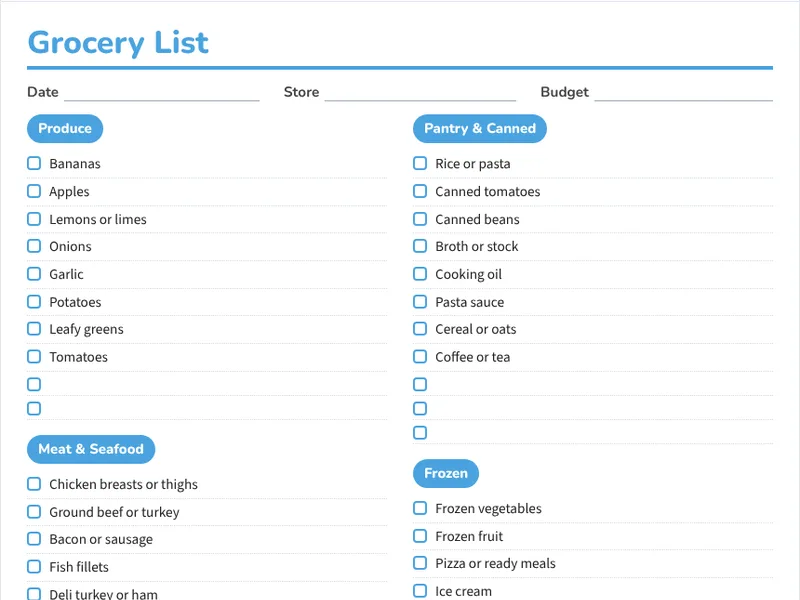 Grocery List Printable
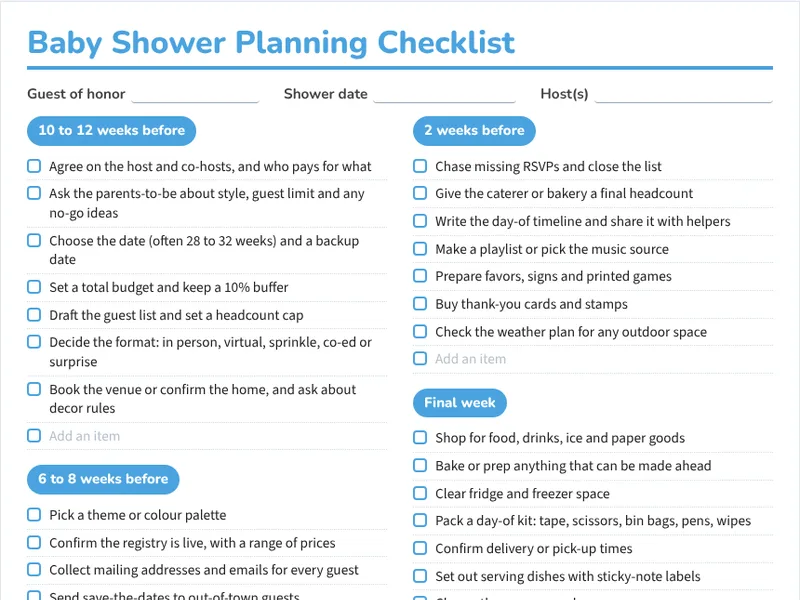 Baby Shower Planning Checklist (Free Printable)
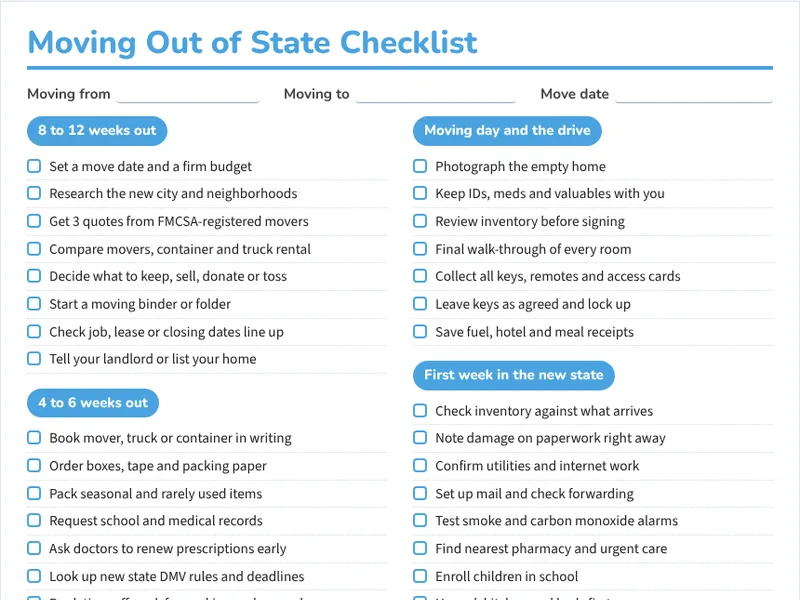 Moving Out of State Checklist
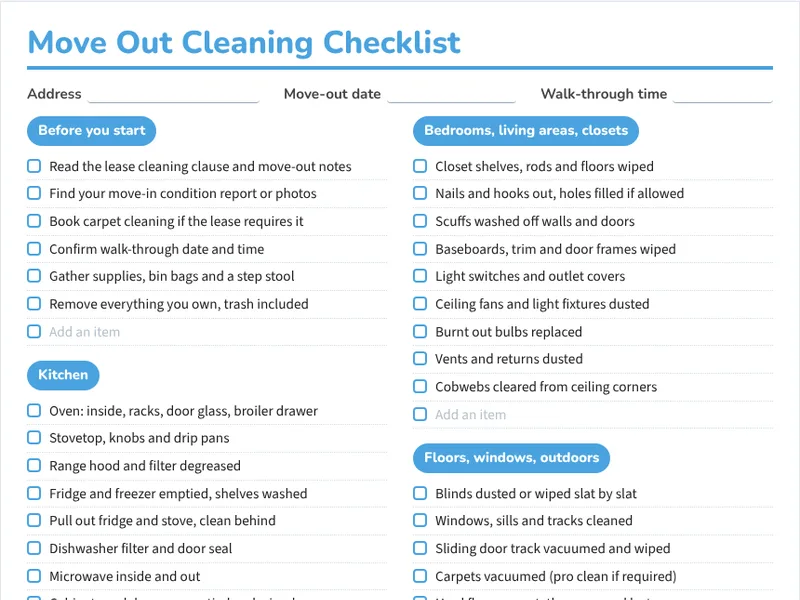 Move Out Cleaning Checklist (Free Printable)