
Sign Up Sheet Template: Free Printable You Can Fill In

A sign up sheet template is a one-page form with an event header at the top and a numbered list of lines below, where each person writes their name, a contact detail and what they are taking on. The sheet on this page does exactly that. You type the event details in, fill the slots or items you need, print it on US Letter, and pin it where people will see it.
| # | Name | Phone or email | Slot, shift or item | Notes |
|---|---|---|---|---|
| 1 | ||||
| 2 | ||||
| 3 | ||||
| 4 | ||||
| 5 | ||||
| 6 | ||||
| 7 | ||||
| 8 | ||||
| 9 | ||||
| 10 | ||||
| 11 | ||||
| 12 | ||||
| 13 | ||||
| 14 | ||||
| 15 | ||||
| 16 | ||||
| 17 | ||||
| 18 |
Print your name clearly. One line per person. Write the slot or item you are taking.
Free for personal, classroom and office use. Your entries are included in the print, PDF and PNG. Prints on US Letter and fits A4.
Black and White Sign Up Sheet Template
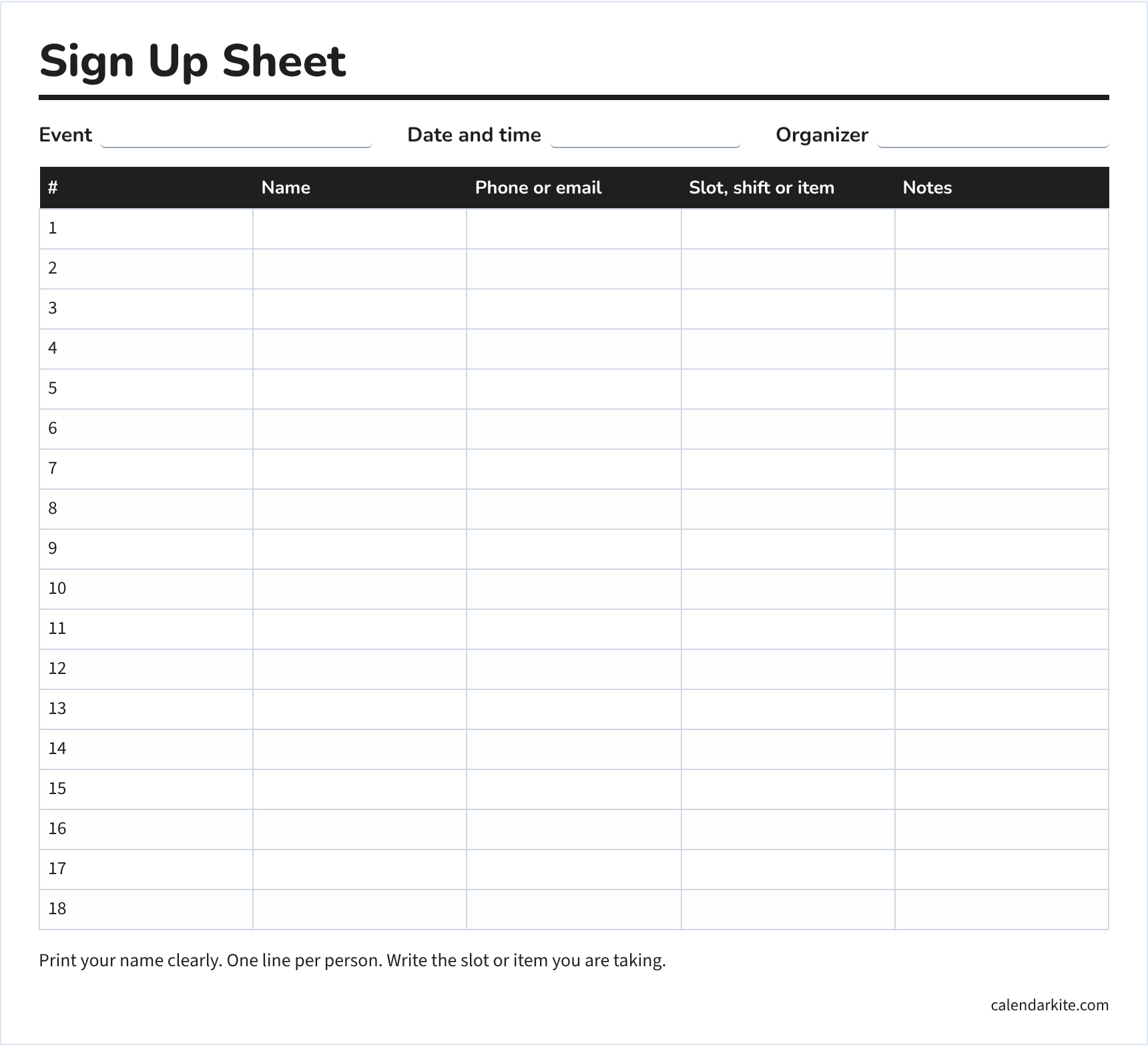
This is the one I print most for school events and potluck lists, since plain black lines use little ink. In the office I learned that high-contrast lines copy cleanly, so I kept the rules dark and the rows roomy for handwriting.
Pink Sign Up Sheet Template
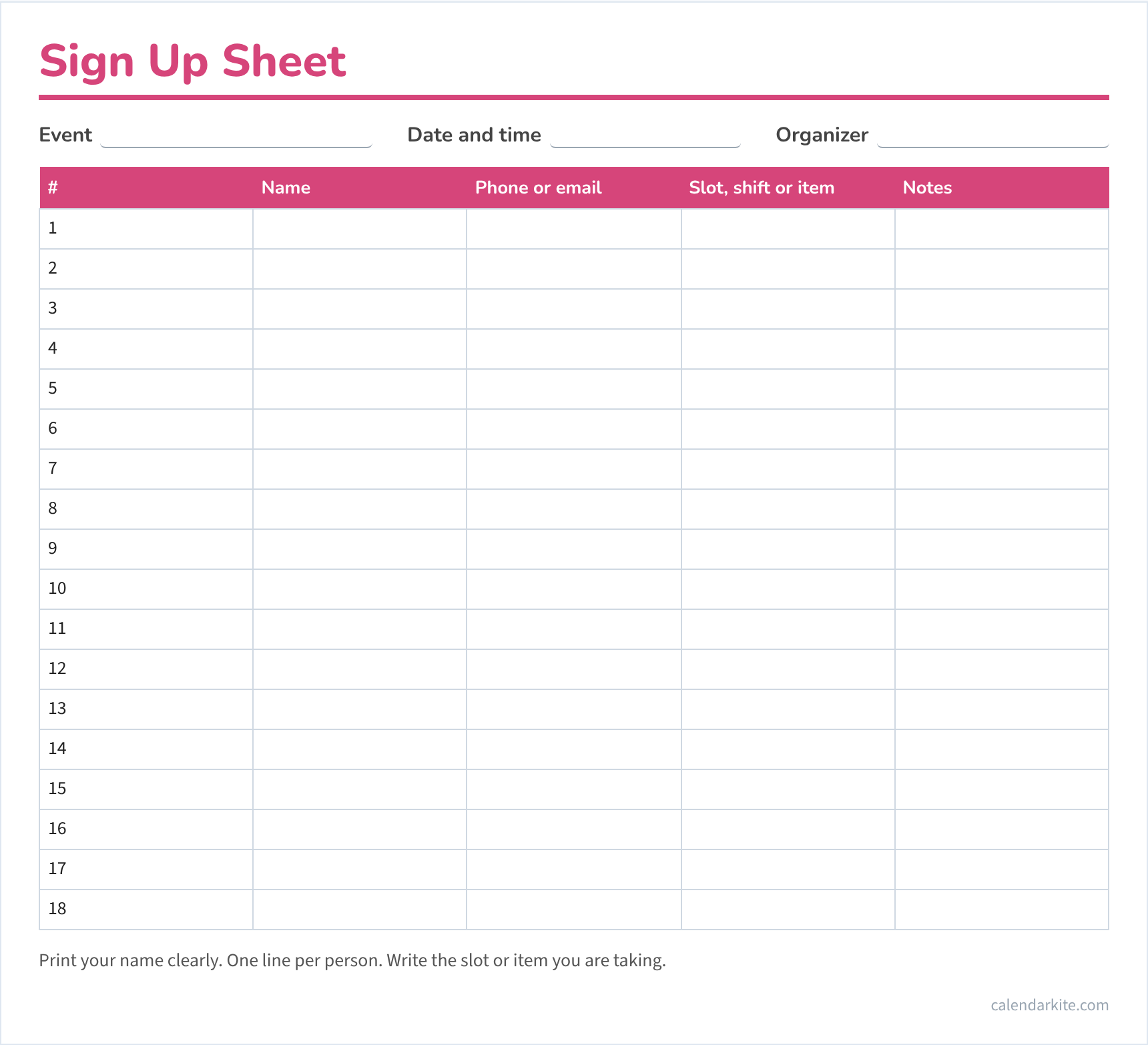
A soft pink sheet suits a baby shower, bake sale or girls' team snack rota where you want something friendlier than a plain grid. The pale tint keeps names and times easy to read once everyone has filled in their slots.
Sage Green Sign Up Sheet Template
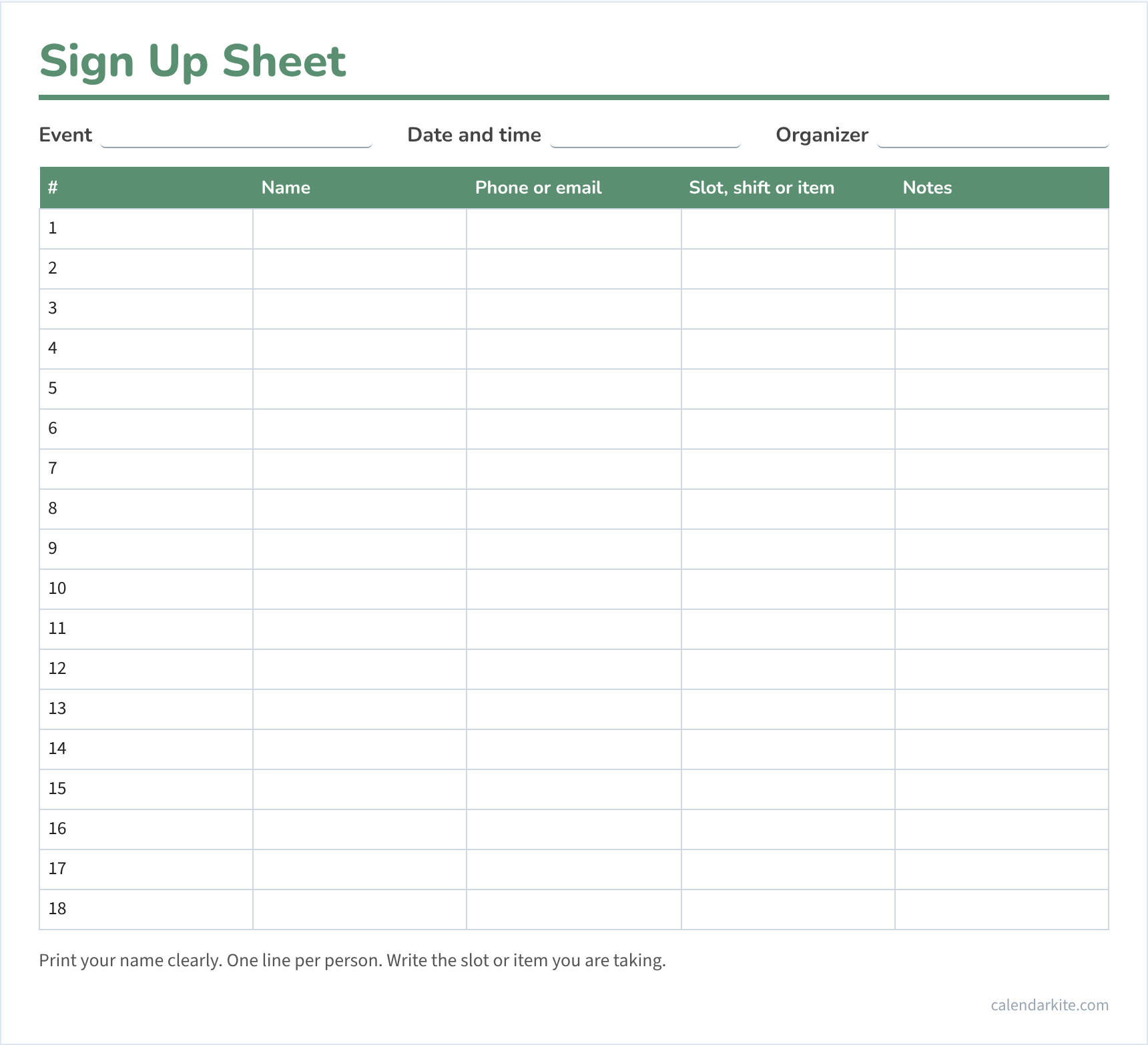
The sage green version works well for a book club, church volunteer list or garden club meeting where you want calm, muted colors. I always leave a wide name column, because squeezed handwriting was the mistake I saw most on office sheets.
Lavender Sign Up Sheet Template
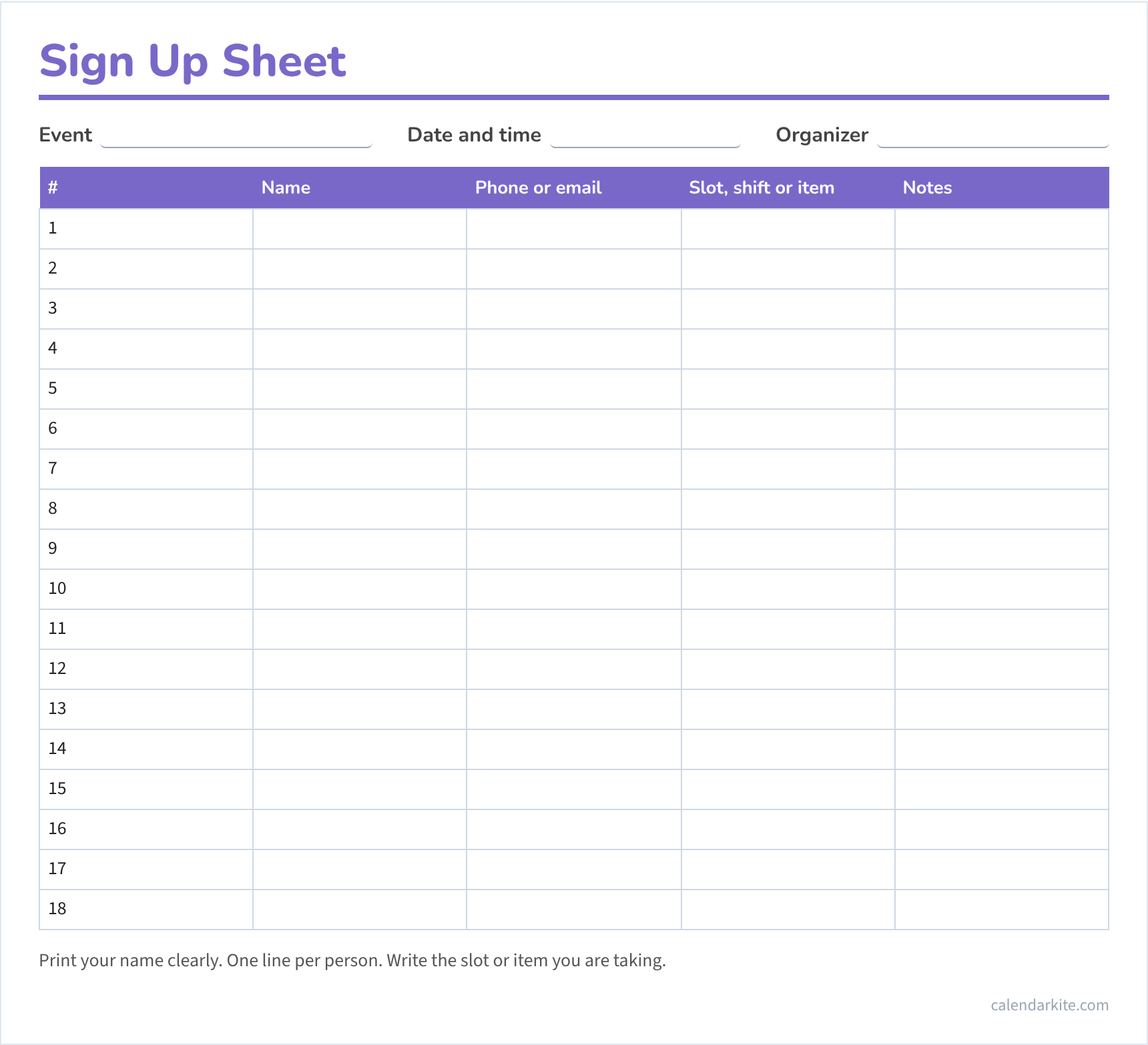
Lavender suits a classroom volunteer list, a PTA event or a craft night where you want something pretty but still professional. I keep a copy on my fridge next to the paper calendar so my family can see which slots are still open.
Cute Sign Up Sheet Template
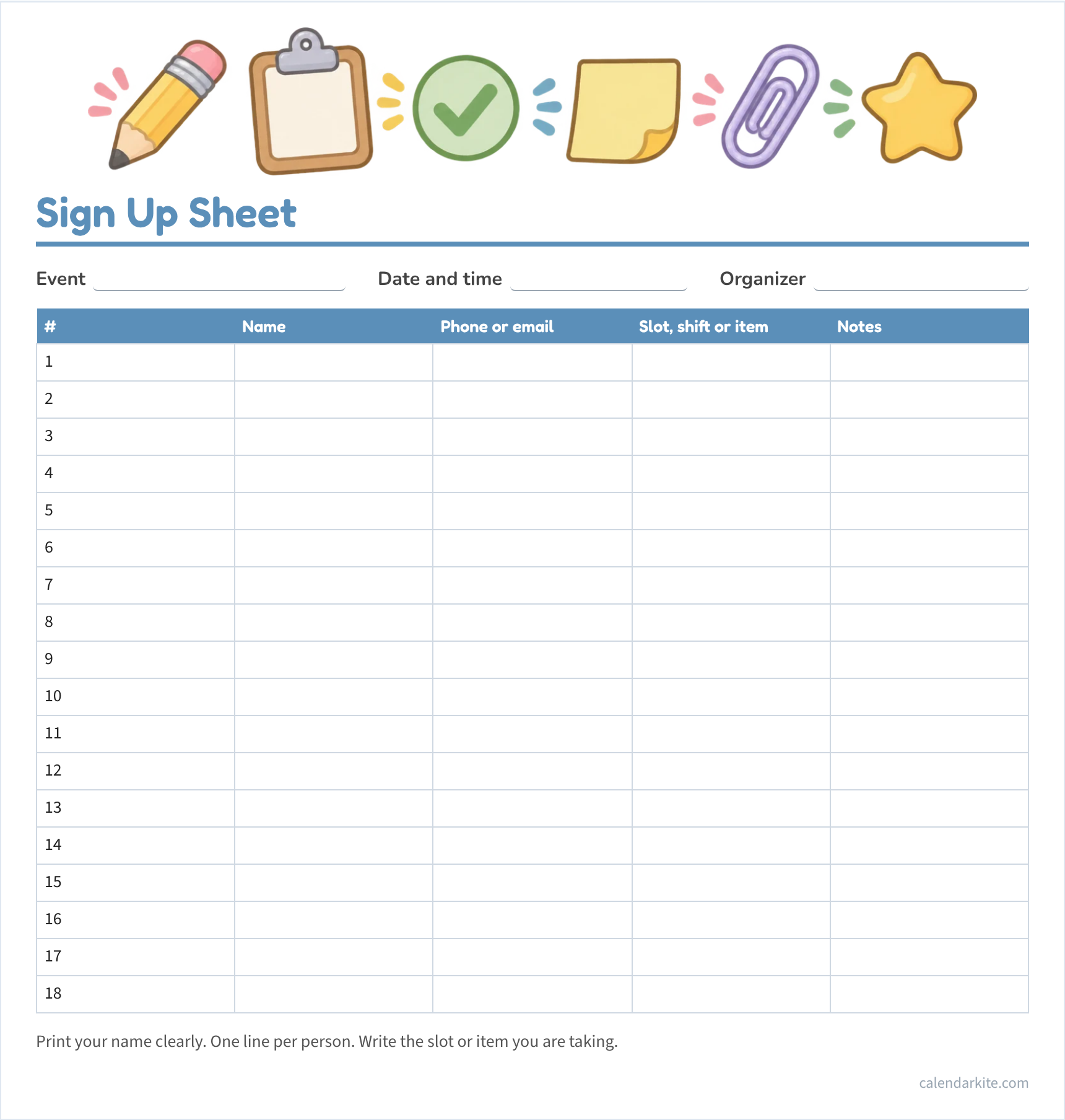
With hand-drawn style illustrations across the top, this one is perfect for a classroom party, bake sale or playdate snack schedule. Pastel blue keeps it cheerful, and the artwork leaves plenty of space for the first rows.
Floral Sign Up Sheet Template
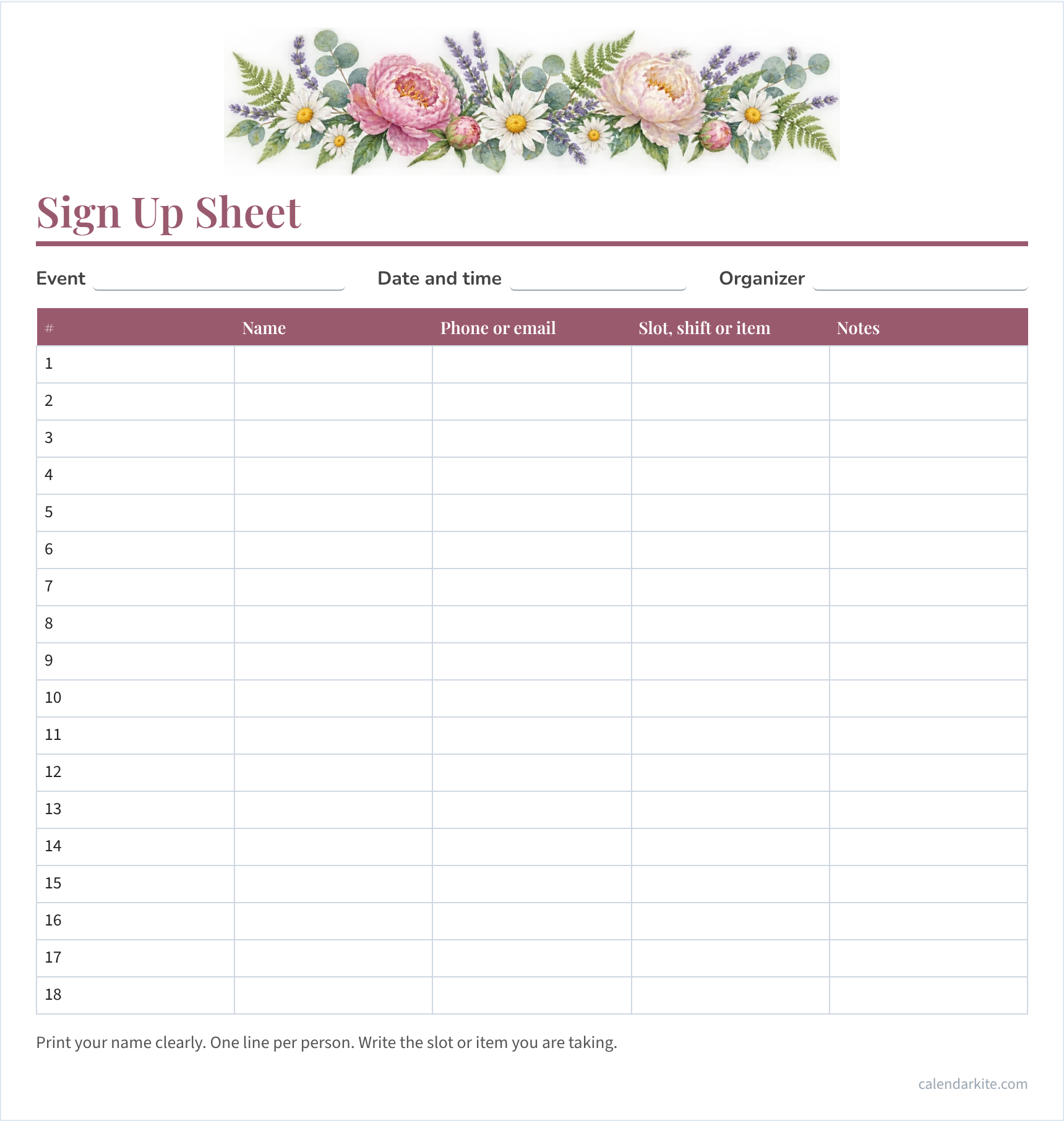
Watercolor flowers and elegant serif headings make this a good fit for a bridal shower, tea party or church luncheon list. Fancy headers can eat space, so I trimmed the top band to give the sign-up rows more room.
Fun Sign Up Sheet Template
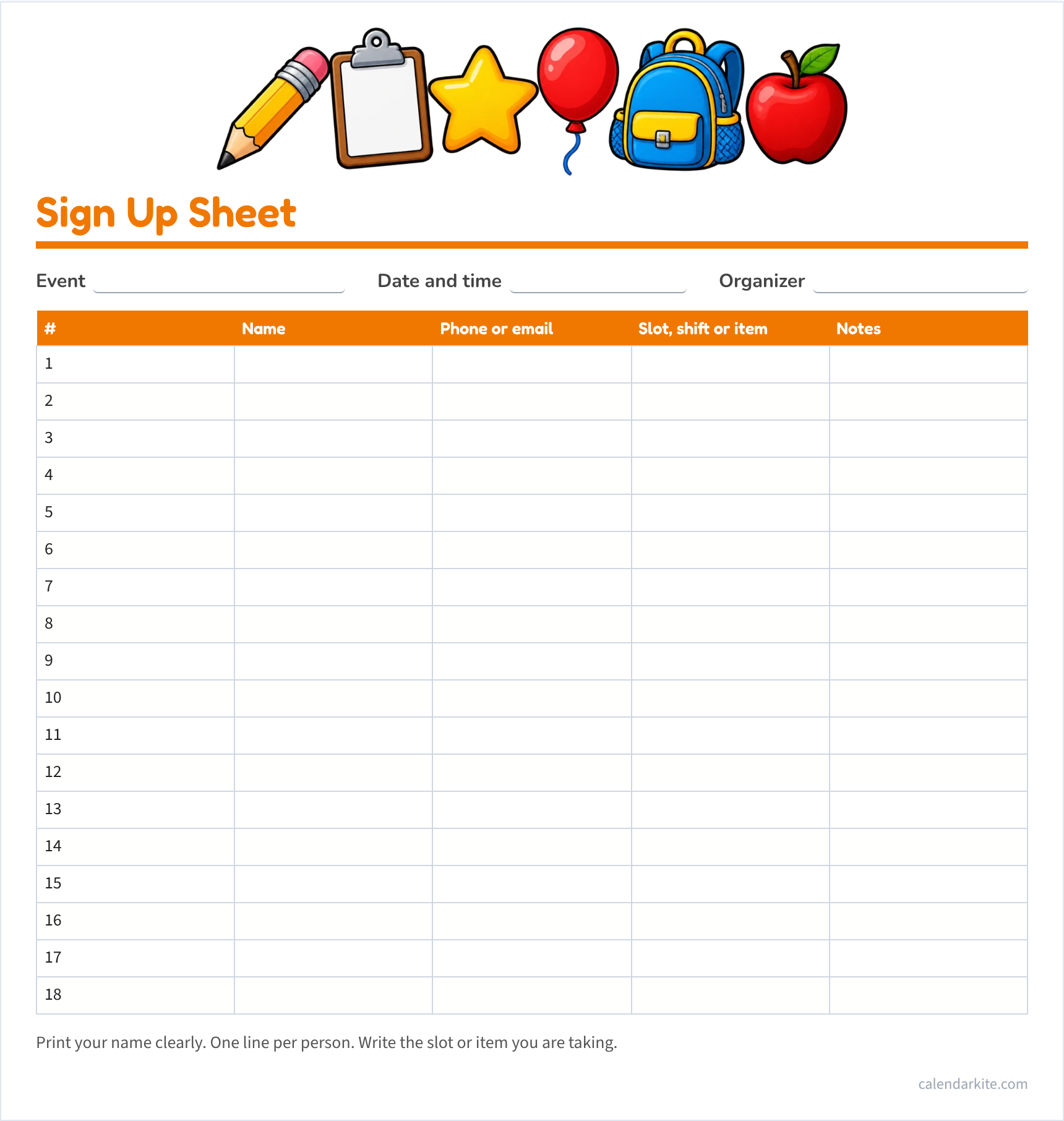
Bright orange and yellow with bold cartoon pictures make this great for a classroom helper list, a sports team snack rota or a birthday party. The bold artwork sits at the top so the writing rows stay clear and easy for little hands.
Simple Sign Up Sheet Template
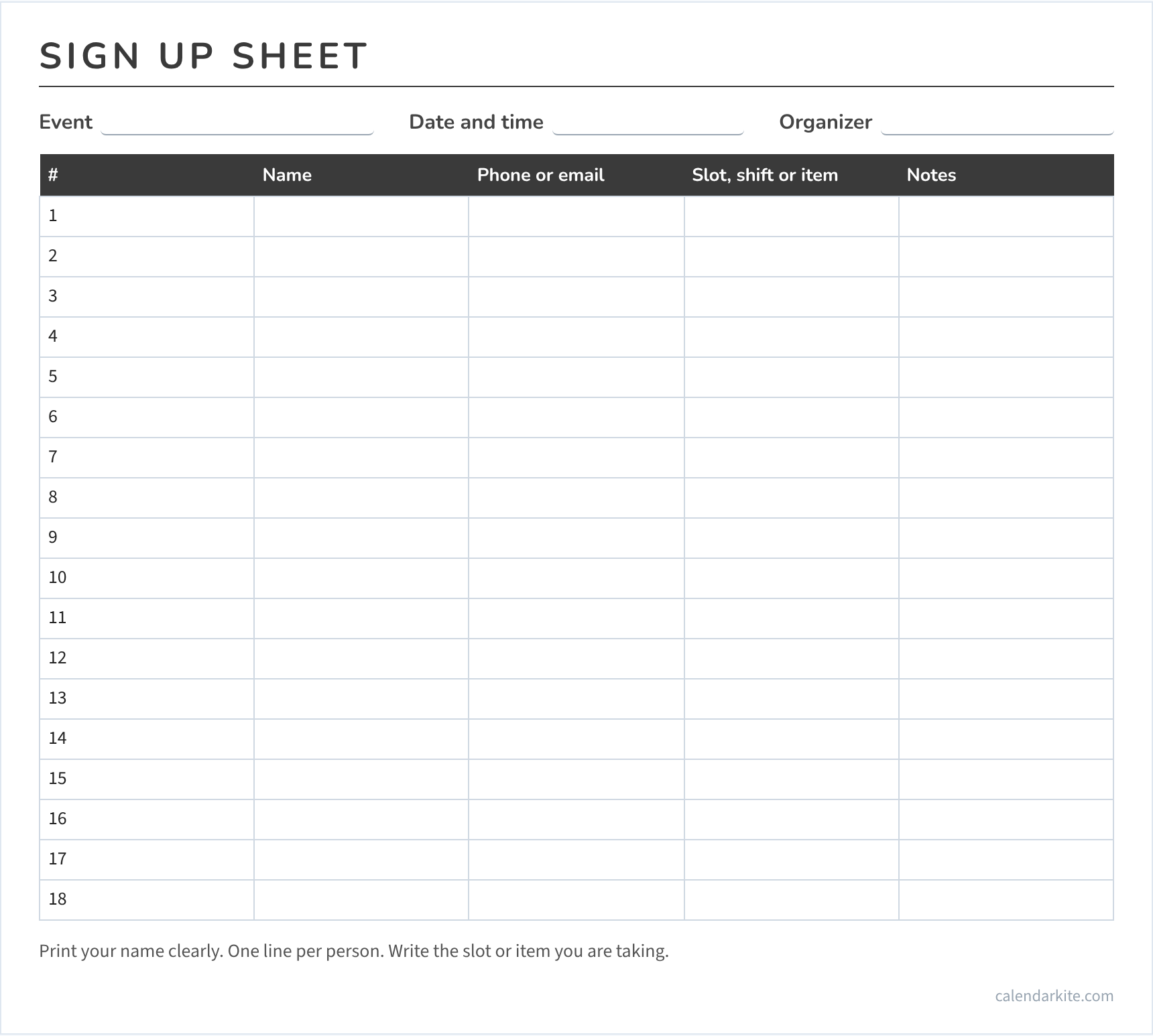
A thin gray line layout is my pick for office sign-ups like meeting slots, shift swaps or equipment checkout. After ten years in office administration, I know people fill in simple sheets faster than busy ones.
Aesthetic Sign Up Sheet Template
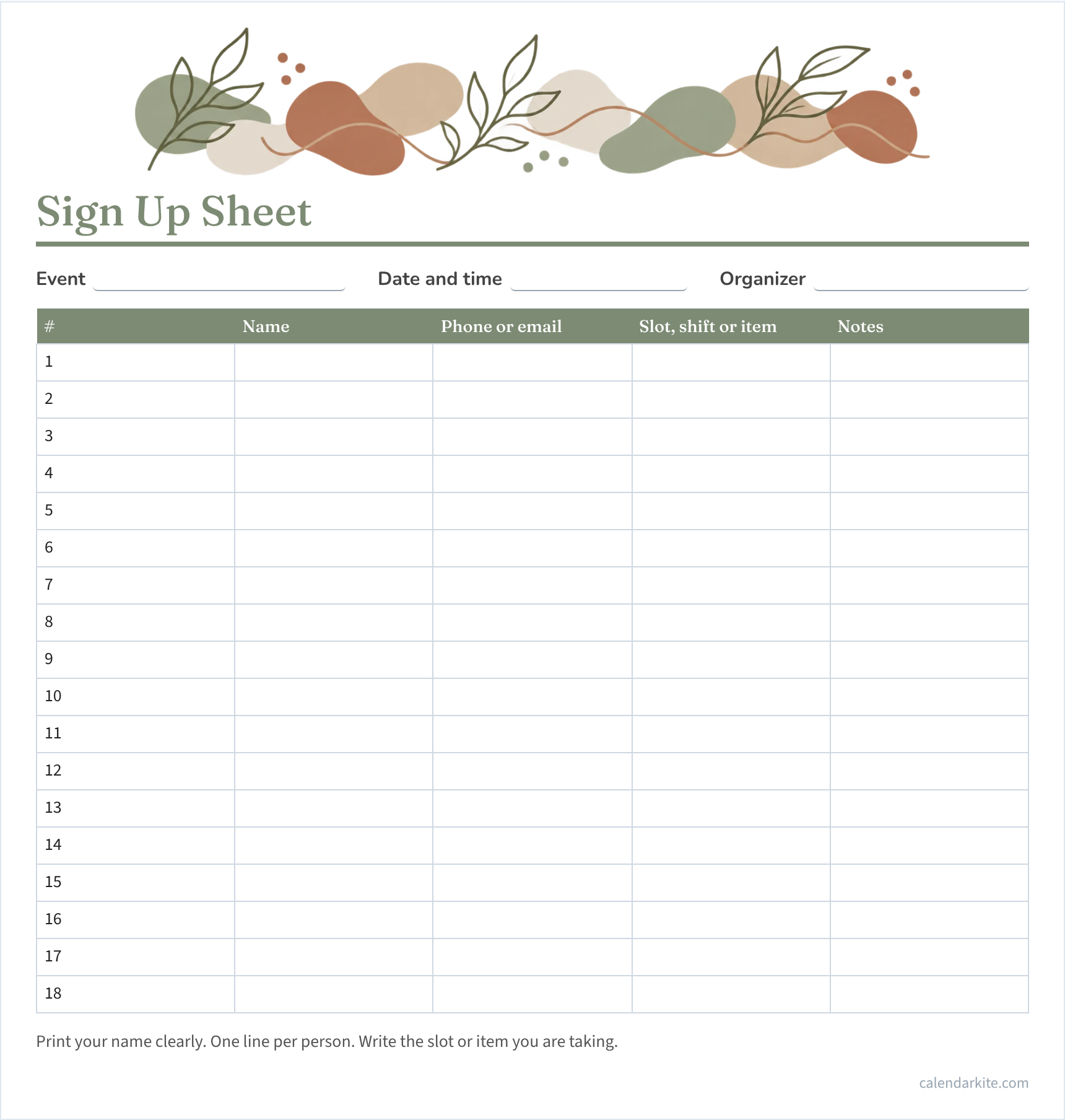
Muted sage, sand and terracotta with soft leaf line art suit a brunch, workshop or neighborhood swap where you want the list to look good on display. The line art stays light so handwritten entries remain the focus.
Modern Sign Up Sheet Template
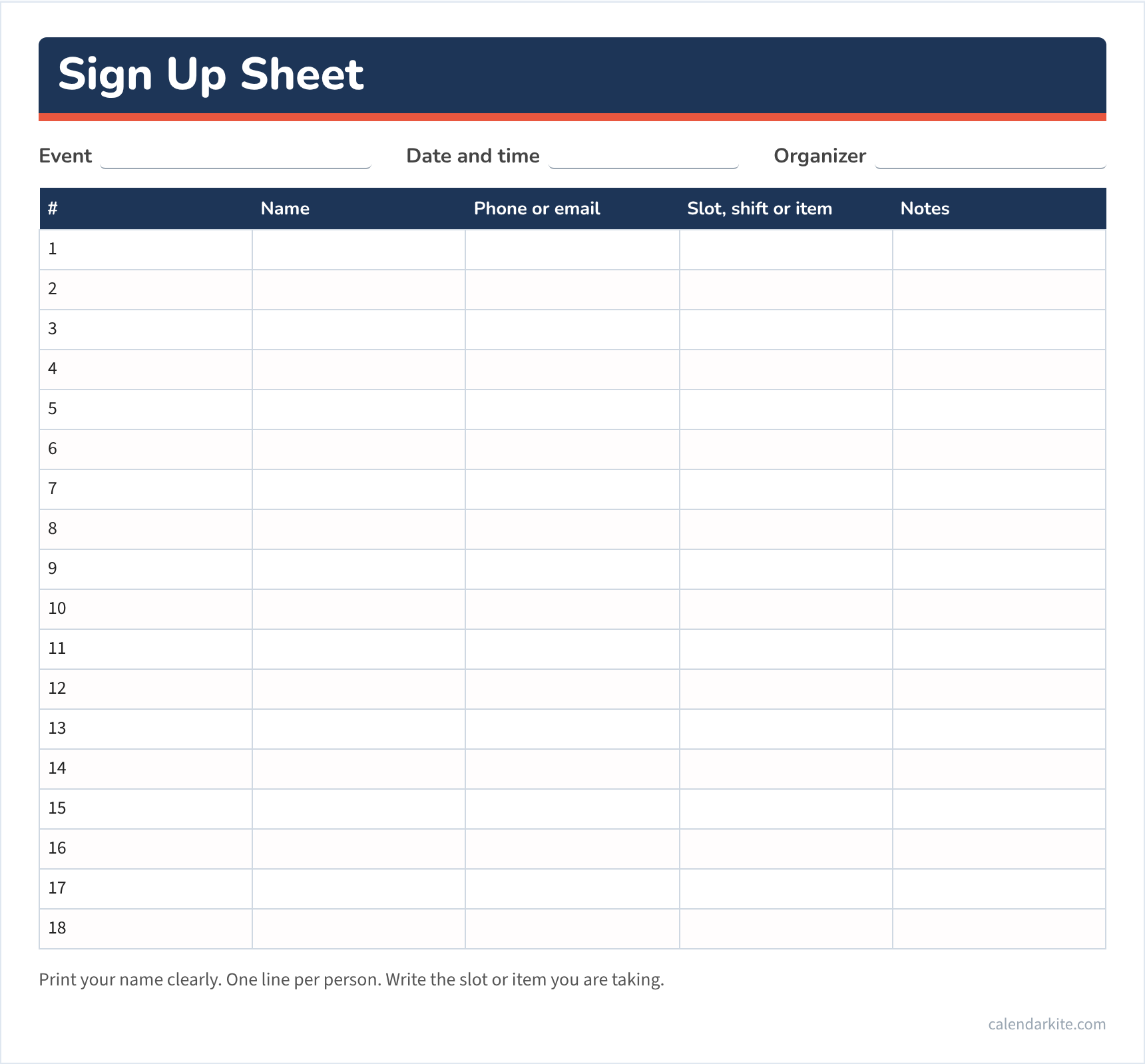
A navy header band with a coral accent gives a modern look for a fundraiser, company potluck or volunteer shift list pinned on a board. Strong headers are easy to spot from across a room, so people notice the sign-up before they walk past.
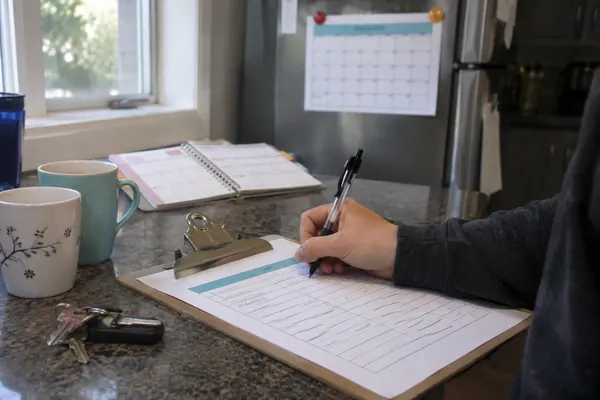
I keep a paper calendar on the fridge and a planner on the kitchen counter, and sign up sheets are the third thing in that system: the one that turns “someone should do that” into a name next to a job. Ten years of office administration taught me that a sheet is only useful if a stranger can fill it in correctly in ten seconds. That is how I built this one.
What a good sign up sheet template does
A sign up sheet has one job: to convert a vague offer into a specific commitment. “I’ll help” becomes “Dana, Saturday 9 to 11, setting up tables.” Everything on the page should serve that. If a line can be filled in without saying what is being promised, the sheet has failed, however nice it looks.
That is why this sheet has a slot, shift or item column and not just names. Many free templates give you a long list of blank name lines and leave the rest to chance. You then get four people bringing rolls, nobody bringing cups, and a Saturday morning shift with a single volunteer. A sheet that records what each person is doing lets you see the gaps while there is still time to fix them.
The page is also built to be filled in before you print, which saves you from the cramped handwriting problem. You can type the event name, the slots you need and any pre-filled rows, print one clean copy, and let people fill in the rest by hand.
Who this sign up sheet suits
It suits anyone organizing a small to medium group of people on paper: a teacher collecting parent helpers for a class party, a coach assigning game-day snacks, a church or community group staffing a table, a neighbor organizing a street cleanup, an office running a holiday lunch. It works for twenty people or fewer on one page, and for more if you print extra copies and number them.
It is less suited to events with hundreds of sign-ups, where you need online tools and automatic reminders. Paper wins when people are standing in the same hallway, break room or church foyer, and when some of them would rather hold a pen than create an account. For those groups, a clipboard still gets better results than a link.
If your event is specifically about food, I made a dedicated potluck sign up sheet template with dish categories built in. This general sheet is the one to start with when the “thing” being signed up for might be anything.
How to fill in the sheet on this page
Click any field and type. The header has three fill-in fields: the event name, the date and time, and the organizer. Below that you will find an 18-row table with five columns. Every cell can be typed into, and what you enter saves in your browser, so you can close the tab and return to the same sheet later on the same device.
For most events, I fill in the slot column first and leave the names blank. If you need two people at the registration table from 9 to 10, type that on two separate rows. Then, if you want, add your own name on the first row as the organizer so the sheet does not look untouched. A sheet with one name already on it gets filled faster than a sheet with none, because nobody wants to be first.
When it looks right, print it. If you would rather hand-write everything, there is a blank PDF download too. I use the typed version when the slots are the point, such as time windows or a list of items, and the blank version when I just need a quick list at the door.
Try this: Before you print, type your slots into the fourth column and add the first slot’s name yourself. Then glance down the sheet and ask: could a stranger tell what they are agreeing to on each line?
What each column is for
The first column is a number. It looks like decoration, but it does real work: it lets you say “I’ve got spot 7 open” on a phone call, and it shows at a glance how many of your spots are taken. It also makes it obvious when someone has skipped a line or squeezed in sideways.
The second column is for the name, and the third is for one way to reach the person, a phone number or an email. The fourth is the slot, shift or item, the column that makes this sheet more than a list of names. The last is notes, which I use for allergies, “can only stay until 11,” “bringing a friend” and similar details that otherwise get lost.
You can retitle any column by editing the sheet, and you can leave one blank if you do not need it. Here are a few ways I have set the columns for different events:
- Class party: slot becomes “Item I’m bringing,” notes becomes “Allergy notes”
- Volunteer day: slot becomes “Shift,” notes becomes “Skills or tools I can bring”
- Parent conferences: slot becomes “Time,” notes becomes “Child’s name”
- Team snacks: slot becomes “Game date,” notes becomes “Dietary rules”
Setting up the header before you print
The header is the part people read first, so make it do the explaining. Put the event name in plain words (“Spring Book Fair Helpers,” not “Sign Up”). Put the date and the start time together, and add the place if it is not obvious. If you have room, list your name as organizer so people know whom to ask.
I add one more thing that the printed sheet has no field for: a deadline. I write “Please sign up by Friday” in the event field or in a short line on the notes column of the first row. Without a date, a sign up sheet sits on the wall until the event is two days away, and then you are chasing people by text.
If the event is part of a bigger schedule, glance at where it sits in the week. A weekly calendar printable is a good companion, since you can check that the date does not collide with something else before you tape the sheet up.
How many lines you need
Count the spots you need first, then add two or three. If you need eight volunteers, a sheet with eleven lines works. The spare lines give a late friend somewhere to sign without squeezing into the margin, but they do not look so empty that people think the event is going nowhere.
This sheet has 18 rows. If you need fewer, simply leave the extra rows blank or fill them with a line like “Closed, see organizer.” If you need more, print a second copy and number the first row of it 19 by typing over the number. That way the numbers carry on and you do not end up with two sheets that both start at 1.
One thing I learned the hard way in an office: a long sheet with many empty lines makes the first few sign-ups feel pointless. People look at 30 blank lines and assume the event is too big for their one contribution to matter. A short sheet with a clear target makes each name feel necessary.
Writing slots that people can say yes to
The best slots are concrete, short and bounded. “Help with setup” is vague. “Set up tables, 8:30 to 9:15” is something a person can say yes to without worrying that it will eat their whole morning. Where you can, give a start and an end time.
For items, be specific about categories, not recipes. “Drinks (12 bottles)” or “Paper plates” lets people choose without needing to coordinate with one another. If you want a balance of dishes, pre-fill the item column with the categories you need, such as mains, sides, desserts and drinks, and leave the name column empty. People claim a category, and the table stays balanced without you lifting a finger.
Keep the number of choices modest. Past about twenty slots, people freeze or pick whatever is nearest the top. If you have a large event, split it into two sheets by day or by task.
Try this: Take your longest slot, the one that says something like “help all day,” and split it into two or three shorter ones. Count how many extra names you collect.
Time slot sign up sheets
Time slots are the most common reason I print this sheet. Parent-teacher conferences, interviews, music lessons, photo sessions and equipment bookings all follow the same pattern: one row per slot, and each person claims one.
Type the times into the fourth column, one per row, at an even interval. Fifteen or twenty minutes works for most conversations, and I leave a gap of five minutes between blocks if people need to walk in and out. Then leave the name column blank. Do not ask people to write their own time. Fixed rows prevent overlaps, and a glance down the sheet shows the open times.
If your slots stretch across a whole day, you may find an hourly schedule template easier for planning the day itself, with this sign up sheet used only for the claiming. I often build the schedule first, then copy the times onto the sheet.
Volunteer and shift sign up sheets
For volunteer events, the details matter more than the layout. Each shift should say what the job is, when it starts and ends, and where to go. I put the job in the slot column and the time at the start of the same cell, for example “Registration table, 9:00 to 10:30.”
Ask volunteers for the contact detail you will really use. If you plan to send a reminder text the night before, ask for a mobile number. If you only email, ask for an email. Collecting both doubles the writing and halves the legibility. Use the notes column for anything that affects the job: “needs a chair,” “bringing two kids,” “can drive.”
If you also want to track who actually turned up and for how long, use a separate sheet on the day. An attendance chart works well for that, and it keeps your sign up sheet as the plan and the attendance record as the proof.
Potluck, snack and party variations
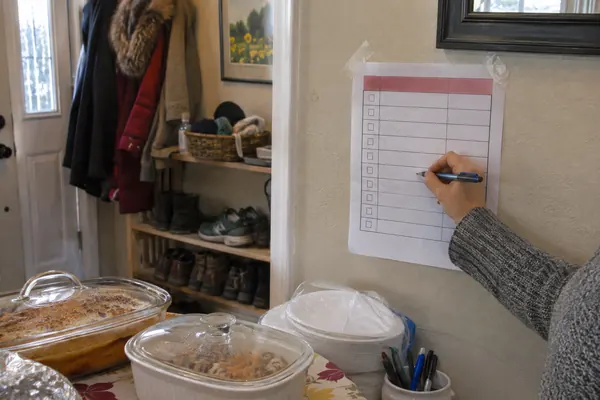
For food events, the sheet’s slot column becomes the dish column. Pre-fill it with categories and keep a short notes column for allergens such as nuts or gluten. At home, I find a printed sheet on the fridge works better than a group text, because people can see what is already taken before they decide.
For a party or celebration, the sign up sheet sits alongside a planning list. If you are organizing a graduation, my grad party checklist covers the tasks, and this sheet covers the helpers who will do them. Use the checklist to decide what needs doing, then turn each task into a row here.
For a class or team, think in terms of a rotation. List dates down the slot column, such as game days or snack weeks, and let families claim one. At the end of the season you have a record of who did what, which settles most “I thought it was my turn” conversations.
Sign up versus sign in
People mix these up, and it causes real confusion on the day. A sign up sheet is a promise made in advance: I will bring, I will work, I will come at 3:30. A sign in sheet is a record made at the event: I am here now. The columns are similar, but the timing and purpose are different.
If you need both, print two copies and label them clearly. Use this sheet for sign-ups, then use a fresh printout for sign-in at the door, with the names from the first sheet typed in. You get a quick way to see who confirmed and who actually arrived, and the gap between the two is useful for planning next time.
For safety or legal reasons, such as school volunteers or building access, sign in is often required, and your organization may have its own form. In that case use this sheet only for scheduling.
Where to put the sheet
Put it where your people already stand still. For a school, that is the pickup line or the classroom door. For an office, the break room fridge. For a congregation, the table by the coffee. A sheet in a drawer gets zero names.
Use a clipboard with a pen attached on a string or a sticky strip. Without a pen, people walk away and forget. I tape the sheet to the fridge at home, with a pen hanging from a magnet, and the whole family adds to it. At eye level, with the header facing outward, it takes less than ten seconds to read.
If you are sharing the event by message too, take a photo of the sheet each day or two and send it round. Paper stays the source of truth, but the photo shows people the remaining gaps.
Collecting contact details without oversharing
A sheet on a wall is a public document. Anyone walking by can read every phone number on it, which makes some people hesitate to sign. For small groups of friends or neighbors, that is fine. For a school or an open community event, think twice.
Two options work well. The first is to ask for names only on the public sheet, and collect contact details at the point of follow-up. The second is to fold the contact column over, or cover it with a strip of paper, so only the organizer sees it. I have also seen organizers put a first name and an initial in the name column, with the full details on a private list.
Whatever you choose, tell people what the details are for. “Phone number, for reminders only” gets more sign-ups than a bare column that says nothing.
Following up and sending reminders
The sheet is not finished when it is full. A day or two before the event, send a short message to everyone who signed up with their slot, the time and the place. Many no-shows come from people who simply forgot what they signed for, not from people who changed their mind.
I keep a simple log of who I contacted and when. If you do a lot of this, a communication log keeps the record tidy, so you are not asking “did I already text Priya?” at ten at night.
If a slot is still empty a week out, ask for it directly. Pick one name, ask for one slot, and say what it involves. “Could you take the 2:00 shift?” gets more yeses than “We still need help.”
Printing tips
Print on US Letter at 100 percent, with no “fit to page” scaling, and use black and white. The table is designed to sit on one page with room around the edges for a hole punch or a clipboard clip. If you print on A4, choose the A4 paper option in your print dialog so nothing gets cut off at the bottom.
Use a good pen, not a pencil, and give people one that works. I test-print every printable on my home inkjet, and the thing I changed most on this sheet was the line height. Early versions had rows that looked fine on screen but were too tight for real handwriting, especially for people filling it in standing up. The rows here are tall enough for a normal signature-size scrawl.
If the sheet will hang outdoors or get handled a lot, slip it into a plastic sleeve or print it on slightly heavier paper. For a one-off meeting, ordinary copy paper is fine. Print two copies if you want a spare, and keep the blank PDF handy for the next event.
Mistakes that leave you with gaps
The most common mistake I see is writing a sheet with no deadline and no slot detail, then wondering why half the lines are blank two days before. The second is asking for too much: name, address, phone, email, child’s name and t-shirt size on one line. People skip the sheet or write illegibly.
The third is forgetting to close the sheet. Decide when sign-ups end, say so on the page, and then count. If you are short, you know early. If you are over, you can offer a waiting list instead of a muddle on the day.
The last is treating the sheet as the whole plan. It is a list of people, not a schedule. If your event has many moving parts, a general checklist helps you track what needs doing, while this sheet tracks who is doing it.
Try this: Fill in a copy for your next event right now, with the header, the slots and your own name on row one. Print it and put it where you will pass it tomorrow.
Common questions
What should a sign up sheet include?
At minimum: the event name, date, time and place, who is organizing it, and a line for each person with a name and a way to reach them. If people are choosing slots or items, add a column for that, plus a notes column for allergies, sizes or questions.
Can I type into this sign up sheet before printing?
Yes. Every line and field on the page is editable, and your entries save in your browser so you can come back to them. When it looks right, print it, or download the blank PDF if you want to write everything by hand.
How many lines should a sign up sheet have?
Make the lines match the number of spots you actually need, plus two or three spare. A sheet with 40 empty lines for a 12-person event tells people nobody is counting, and it tends to get fewer sign-ups.
Should I ask for phone numbers or email addresses?
Ask for one contact method, not both, and only if you will really use it. A sheet on a public wall is visible to everyone, so for larger groups collect contact details on a separate list that you keep.
What is the difference between a sign up sheet and a sign in sheet?
A sign up sheet collects commitments before an event: who will come, bring or work a slot. A sign in sheet records who actually showed up on the day. You can use the same layout for both, but they do different jobs.
How do I make a sign up sheet for time slots?
Write one slot per line in the slot column, such as 4:00 to 4:15 PM, and leave the name column blank. People then claim a row, and nobody has to guess who is taking which time.
More free planners
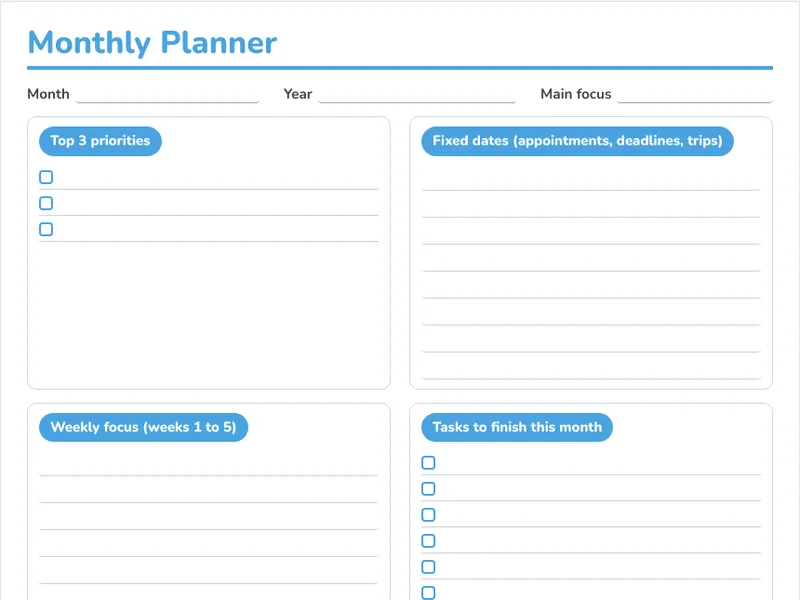 Monthly Planner: Free Printable One-Page Sheet
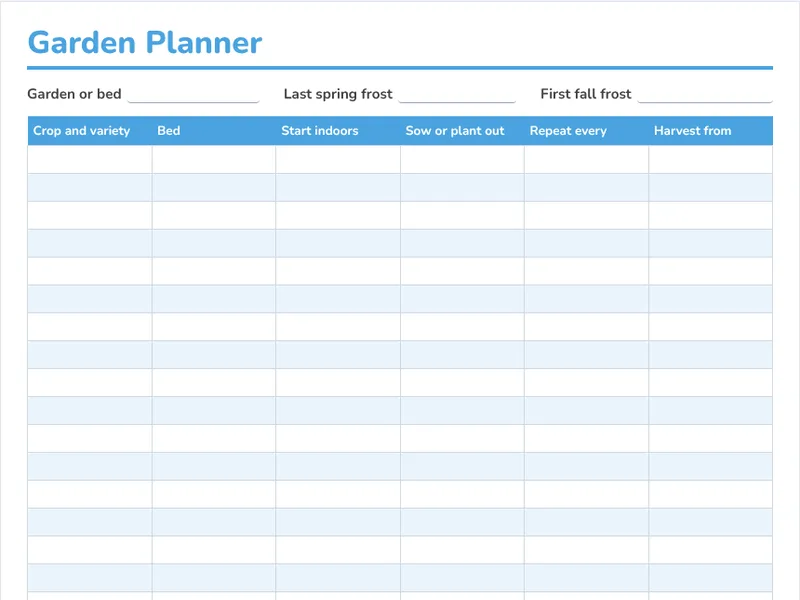 Garden Planner: Free Printable Planting Sheet
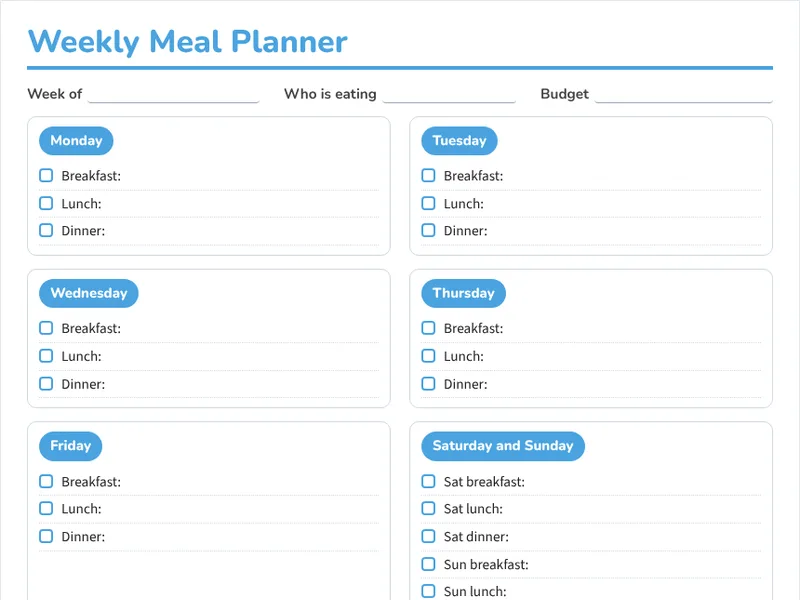 Printable Weekly Meal Planner
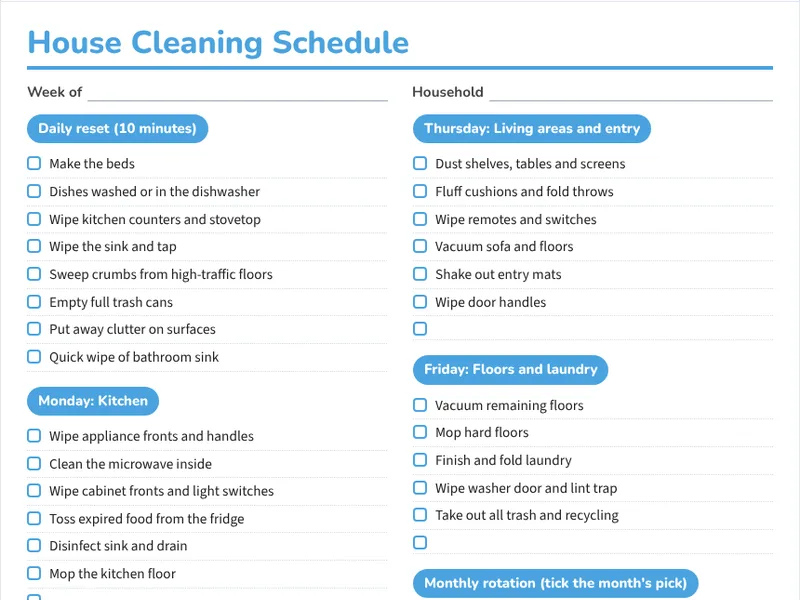 House Cleaning Schedule: Free Printable for Daily, Weekly and Monthly Jobs
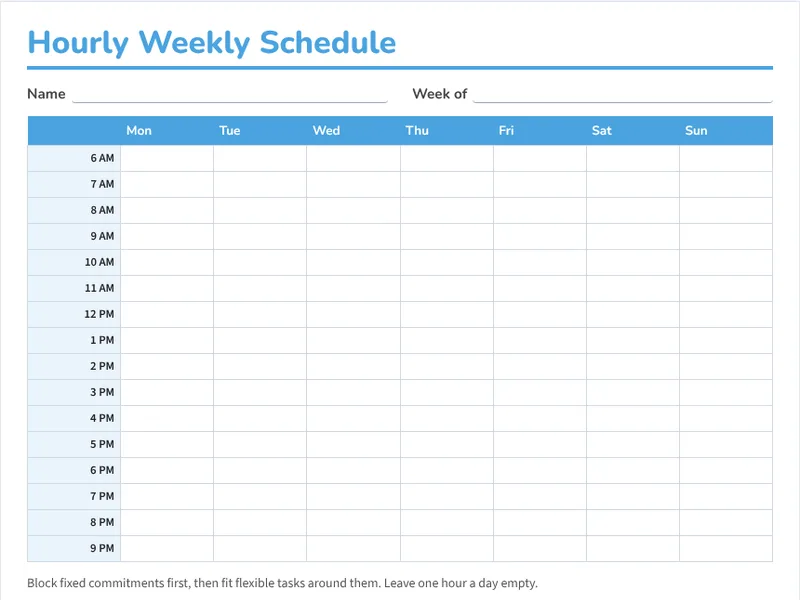 Hourly Schedule Template: Free Printable Weekly Planner
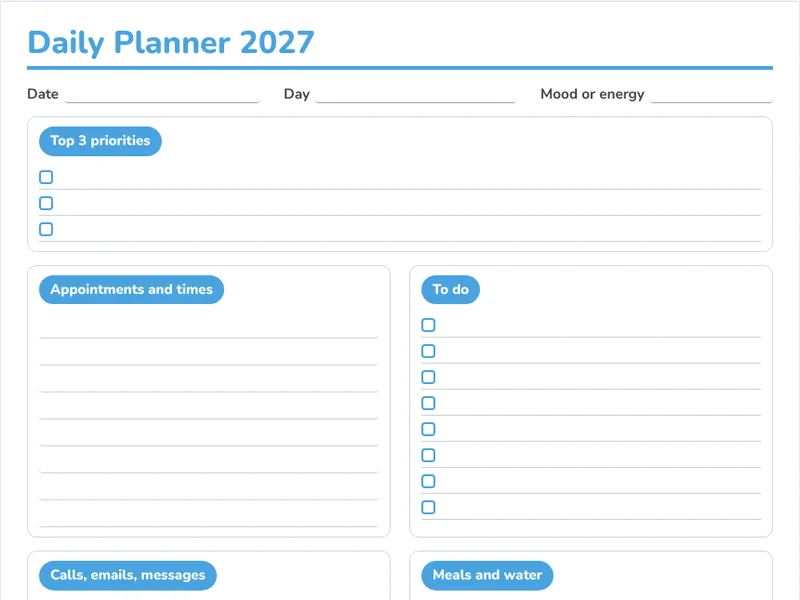 Daily Planner 2027: Free Printable Page for Every Day