
Potluck Sign Up Sheet Template: Free Printable

A potluck sign up sheet is a single page where guests write their name and the dish they plan to bring, so the table ends up balanced instead of crowded with five pasta salads. The best version has pre-set dish slots, a serving count and a column for allergens. The sheet on this page has all three, and you can fill it in right here, print it on one US Letter page, or download a blank PDF.
| Slot | Name | Dish | Serves | Allergens or needs |
|---|---|---|---|---|
| Main | ||||
| Main | ||||
| Main | ||||
| Side | ||||
| Side | ||||
| Side | ||||
| Side | ||||
| Salad or veg | ||||
| Salad or veg | ||||
| Appetizer | ||||
| Appetizer | ||||
| Appetizer | ||||
| Dessert | ||||
| Dessert | ||||
| Dessert | ||||
| Drinks | ||||
| Drinks | ||||
| Plates, cups, utensils |
Please write allergens (nuts, dairy, gluten, egg) and say if your dish needs an oven or outlet.
Free for personal, classroom and office use. Your entries are included in the print, PDF and PNG. Prints on US Letter and fits A4.
Black and White Potluck Sign Up Sheet Template
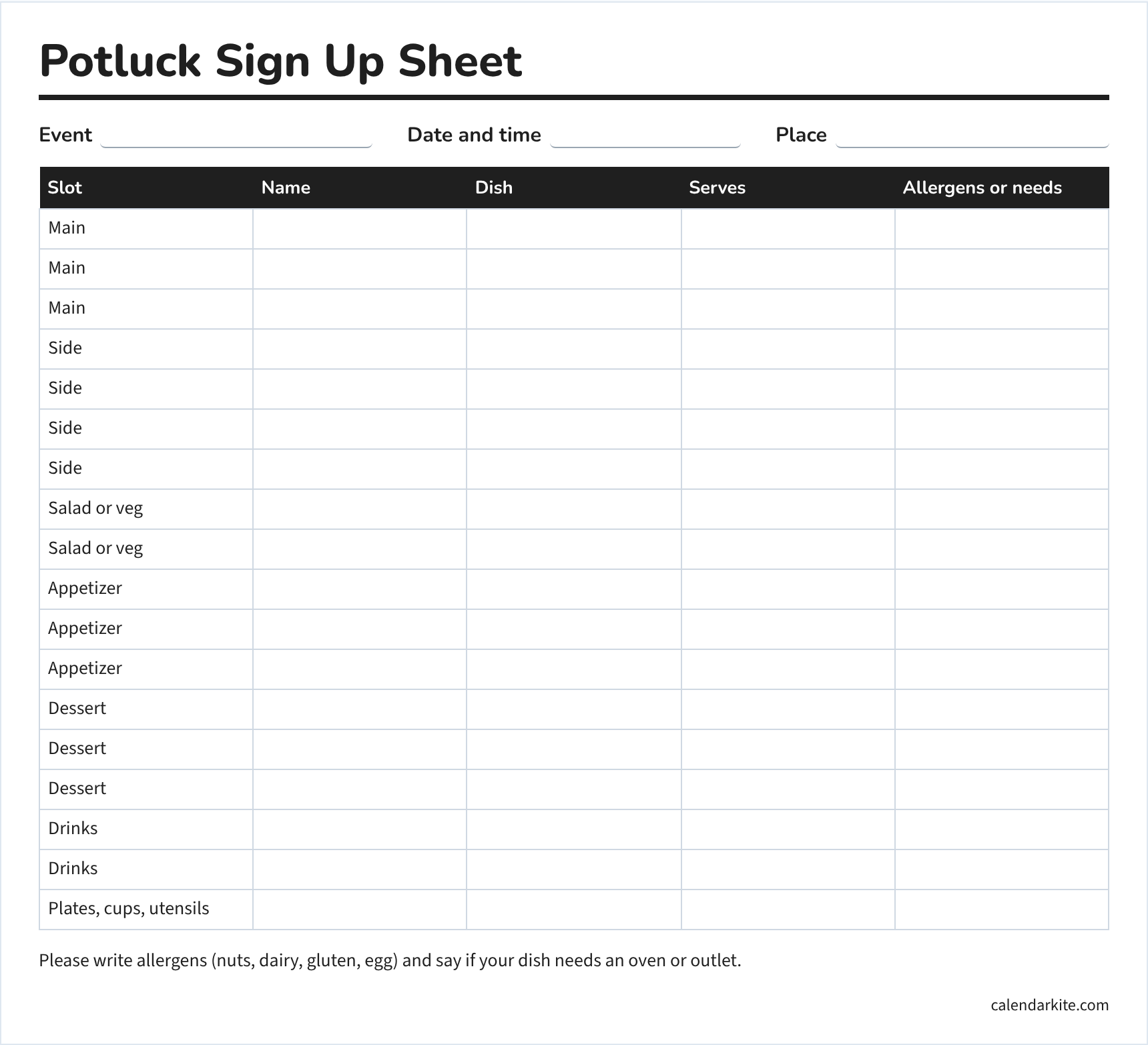
I made this one for office potlucks and church suppers where you're photocopying a stack of sheets. In my office days I learned plain black lines copy cleanly, so every name and dish stays readable even on a tired copier.
Pink Potluck Sign Up Sheet Template
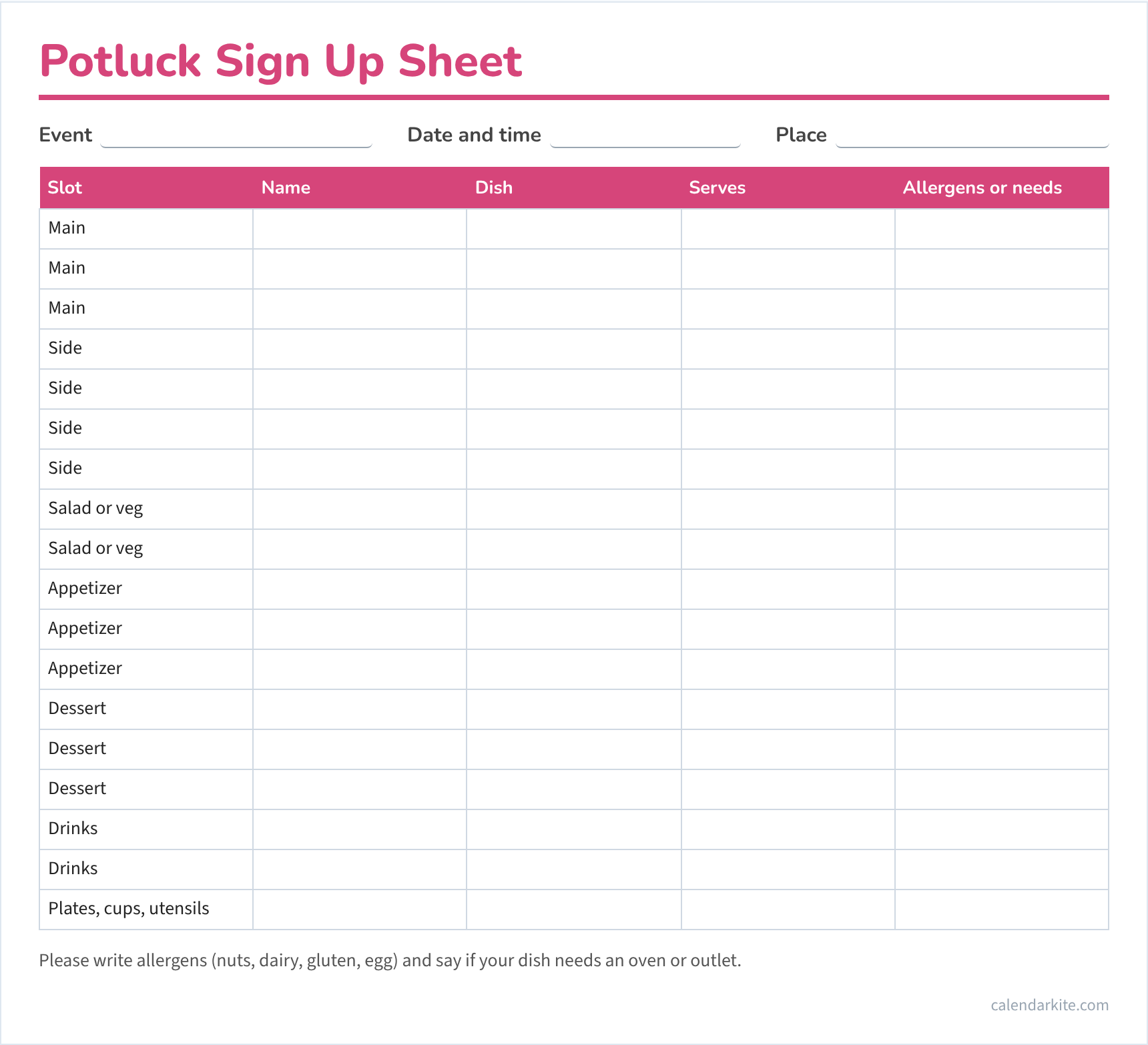
This soft pink sheet suits baby showers, bridal brunches and girls' night dinners where the sign-up is part of the decor. I'd share it early and ask people to claim a dish before you buy anything yourself.
Sage Green Potluck Sign Up Sheet
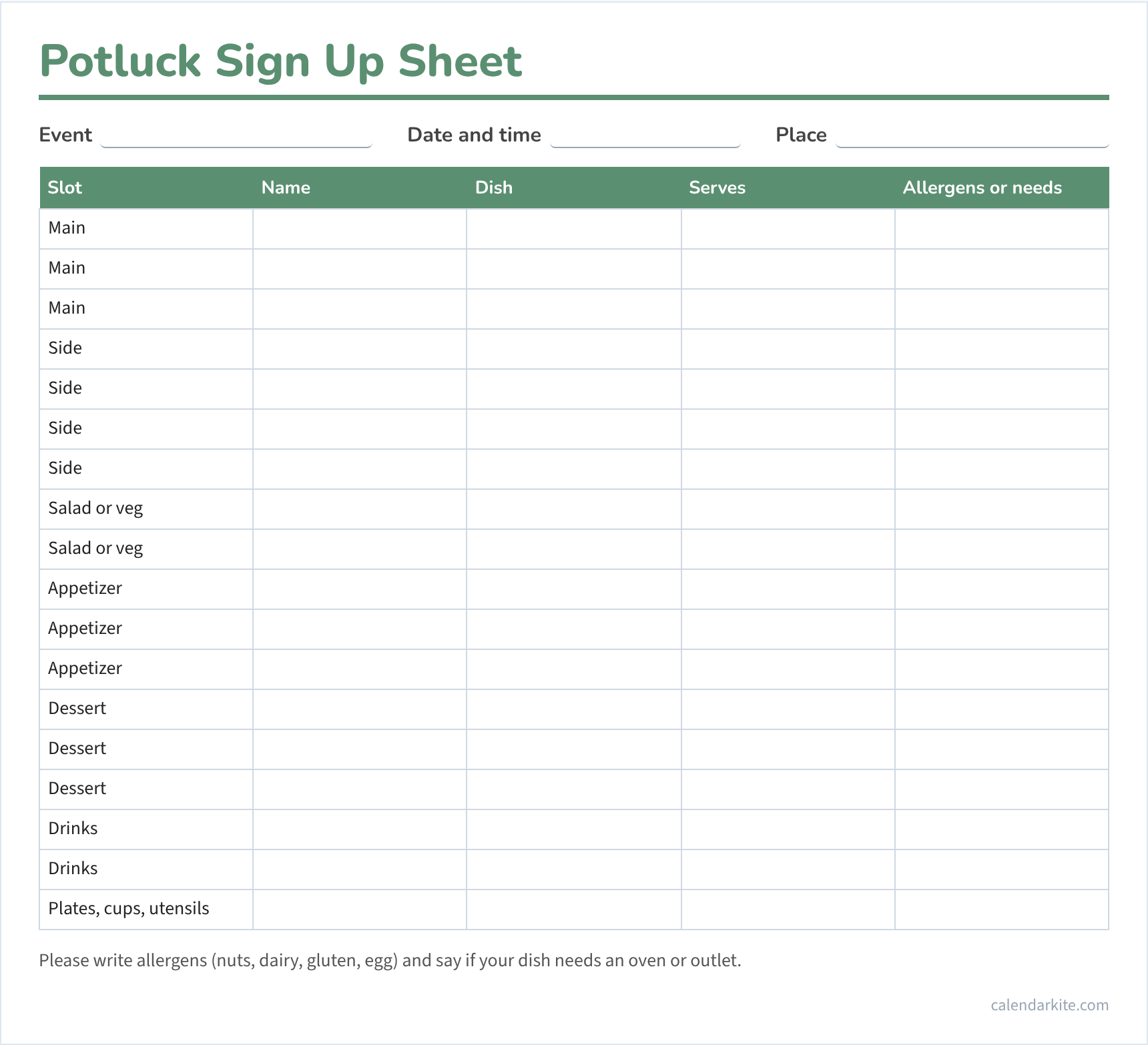
Sage green is calm and works well for school staff lunches, neighborhood gatherings and family reunions. I test-print every sheet on my home inkjet, and this one keeps the green light enough that pen names stay easy to read.
Cute Potluck Sign Up Sheet Template
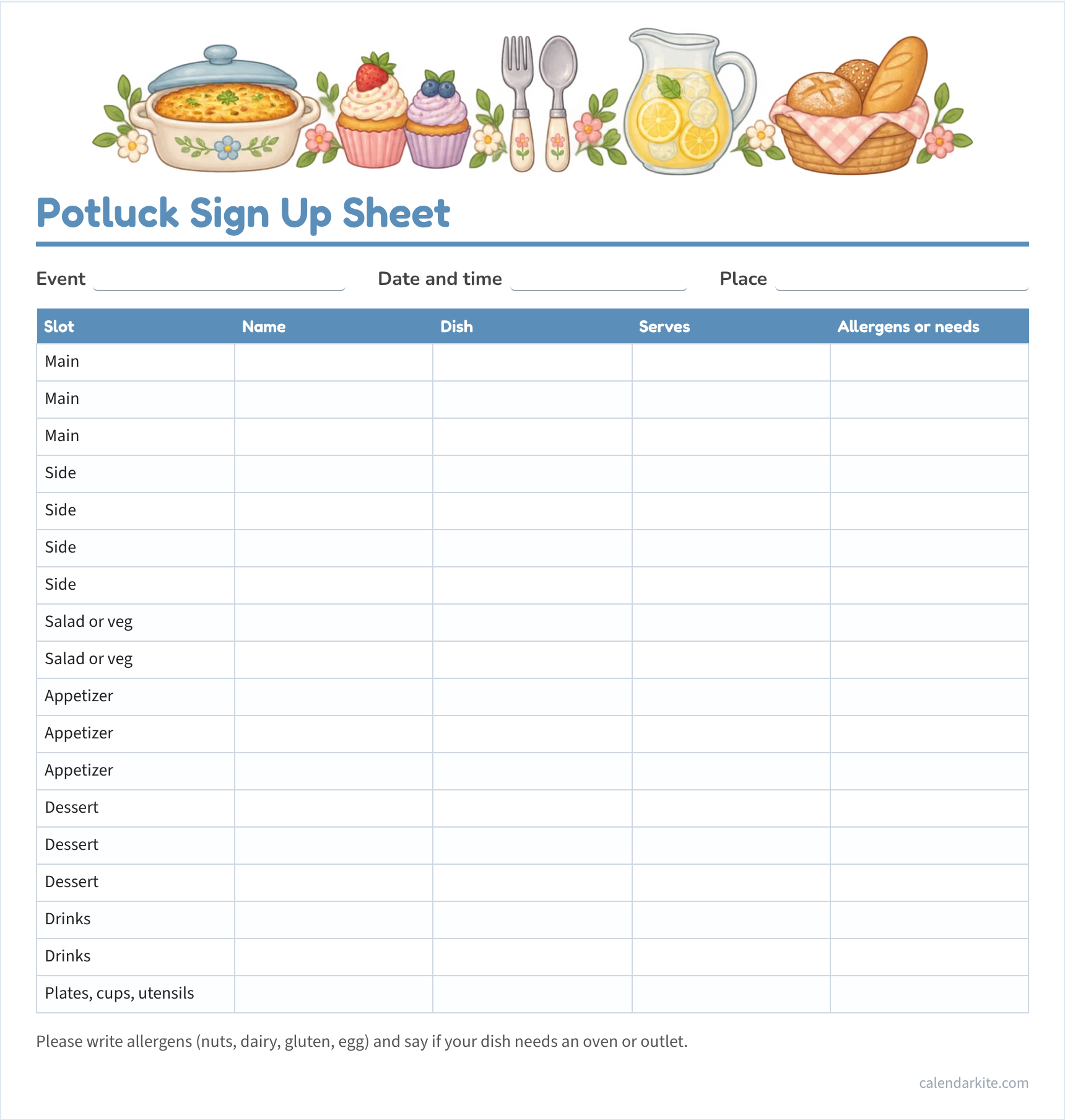
This pastel blue sheet with little hand-drawn food illustrations suits classroom parties, playgroups and kids' birthday lunches. I always ask people to note allergens when I'm organizing for my own kids' friends, so there's a spot for it.
Floral Potluck Sign Up Sheet Template
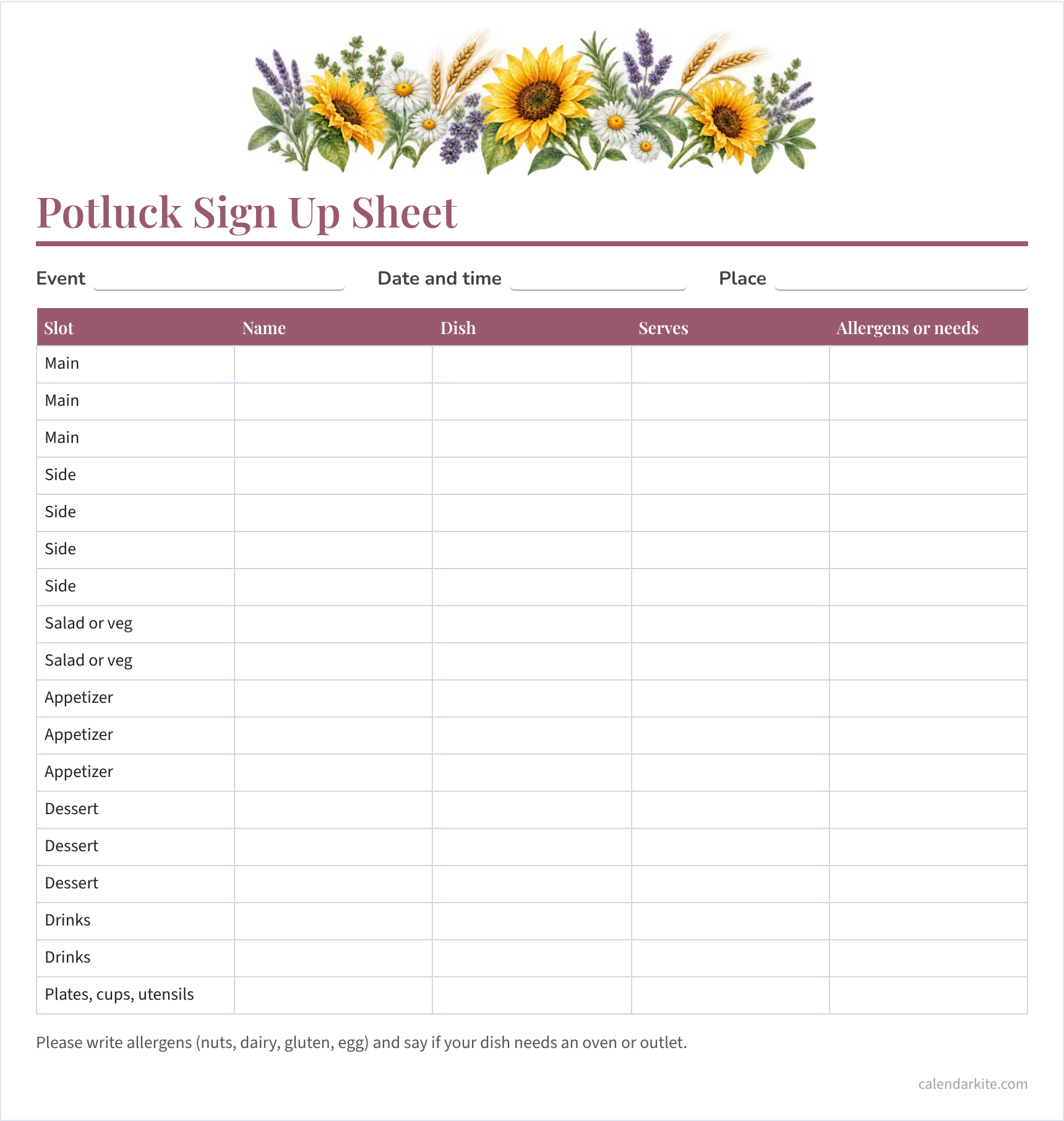
Watercolor flowers and elegant serif headings make this a good fit for garden parties, spring brunches and Mother's Day gatherings. Print it on US Letter or A4 and leave room to add a short note beside each dish.
Fun Potluck Sign Up Sheet Template
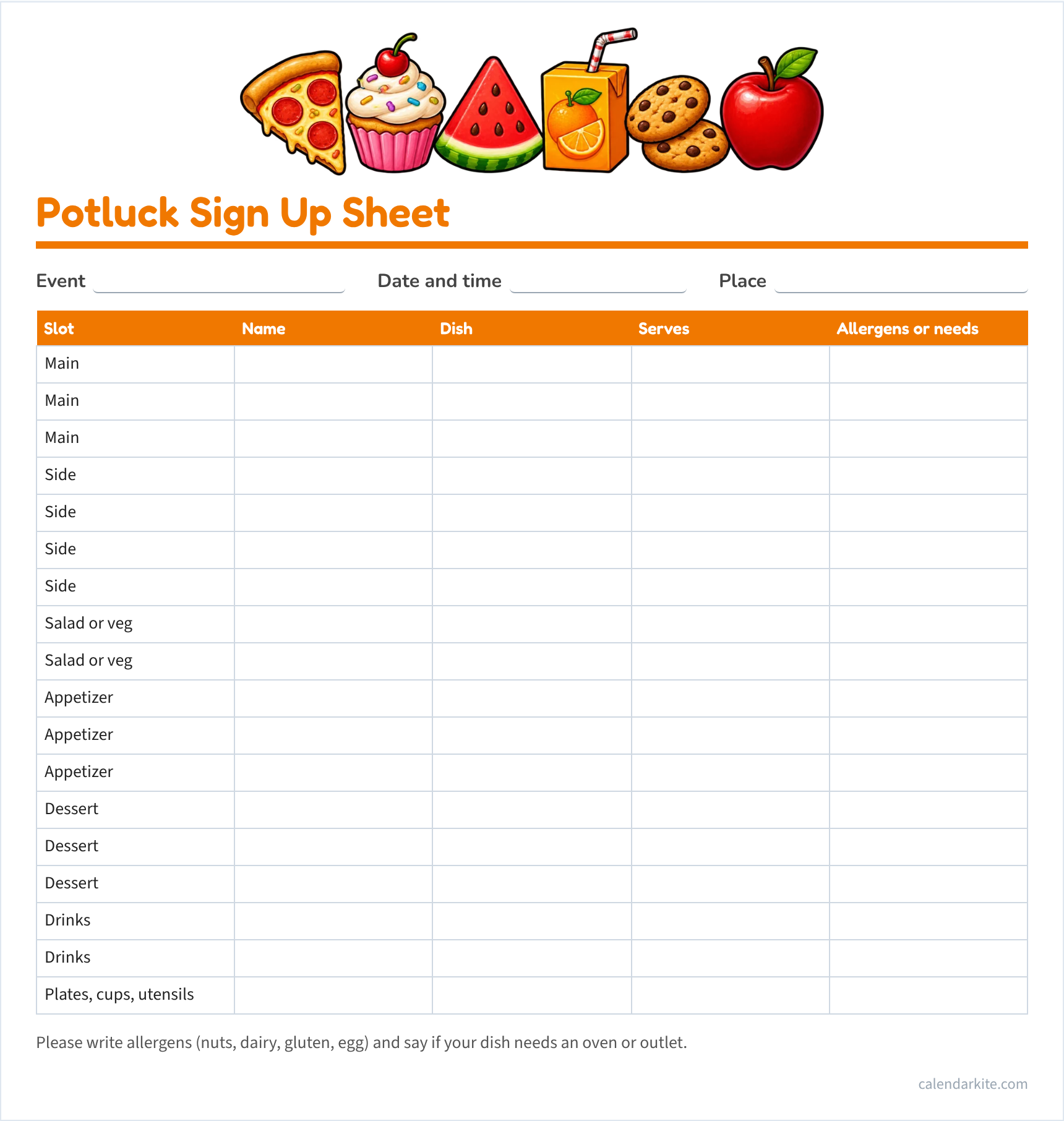
Bright, playful and bold, this one works for class parties, team snack nights and block parties where children help pick the dish. Print it large and post it where everyone passes so the slots fill up fast.
Simple Potluck Sign Up Sheet Template
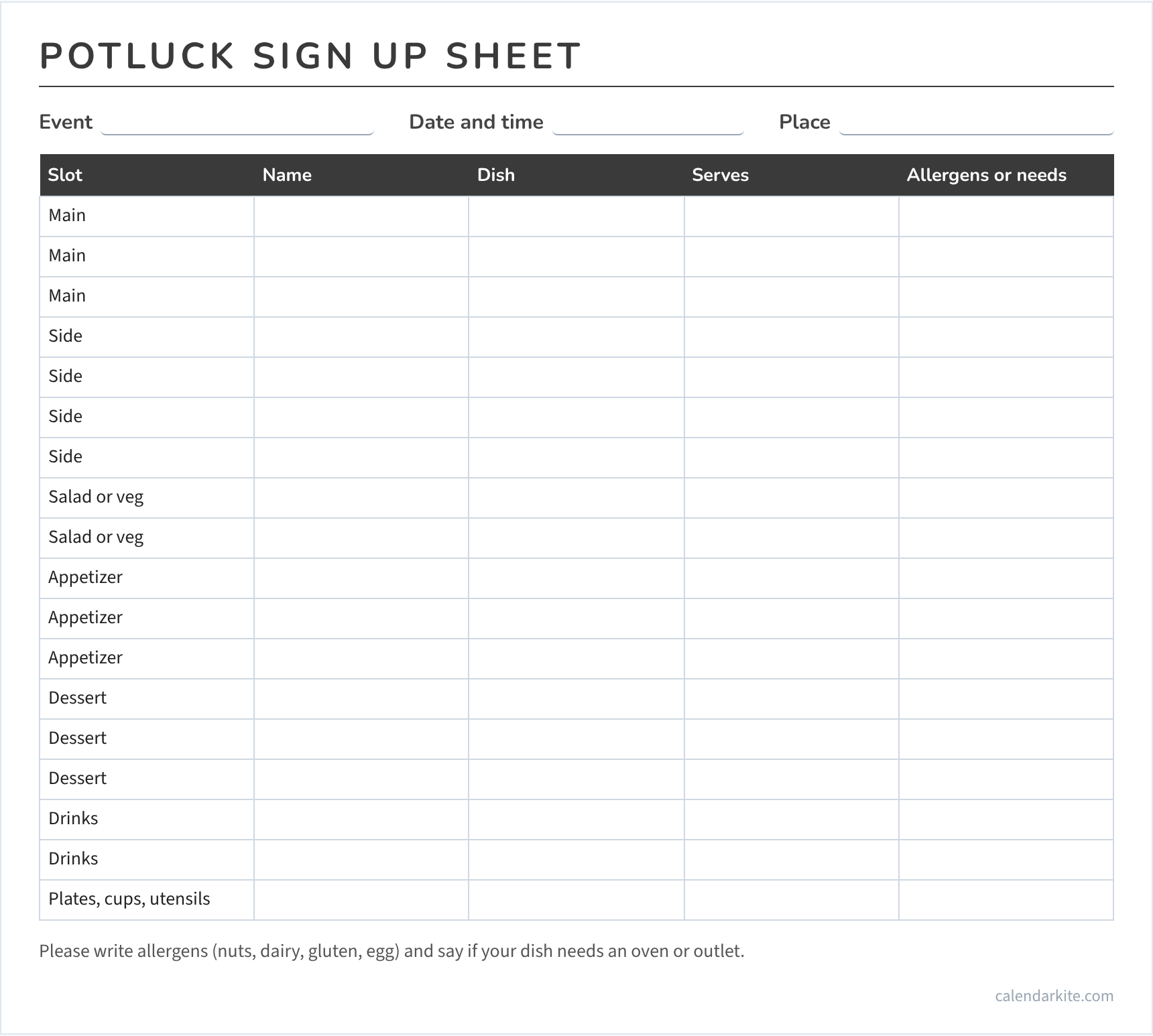
Thin gray lines and a light uppercase heading keep this clean for office lunches and team gatherings. I learned in office admin that fewer decorations means people actually fill in the lines, so I left plenty of room per row.
Aesthetic Potluck Sign Up Sheet Template
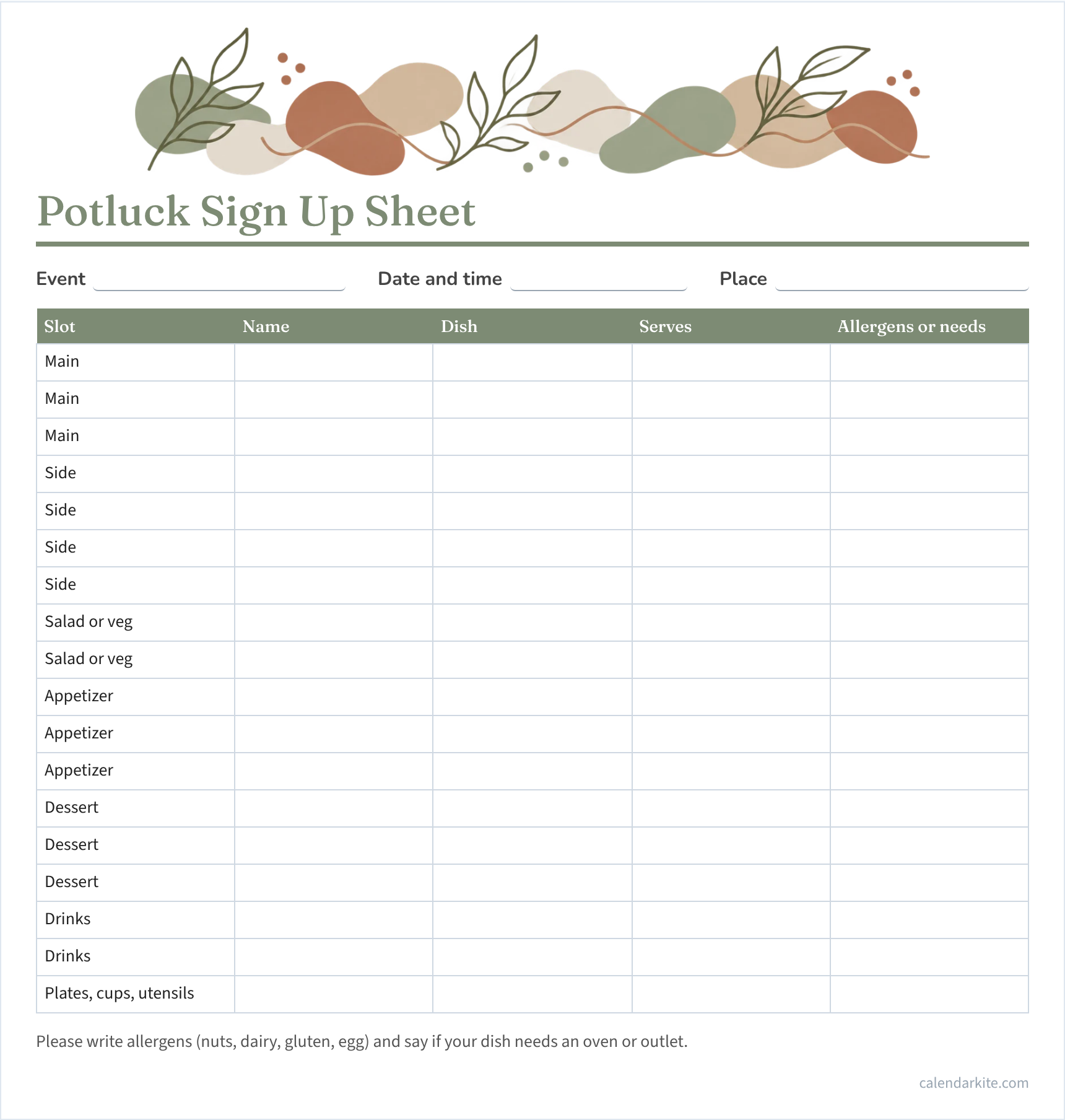
Muted sage, sand and terracotta with soft leaf line art suit Friendsgiving, backyard dinners and book club meals. I widened the dish column on this layout because people tend to squeeze long dish names into small spaces.
Vintage Potluck Sign Up Sheet Template
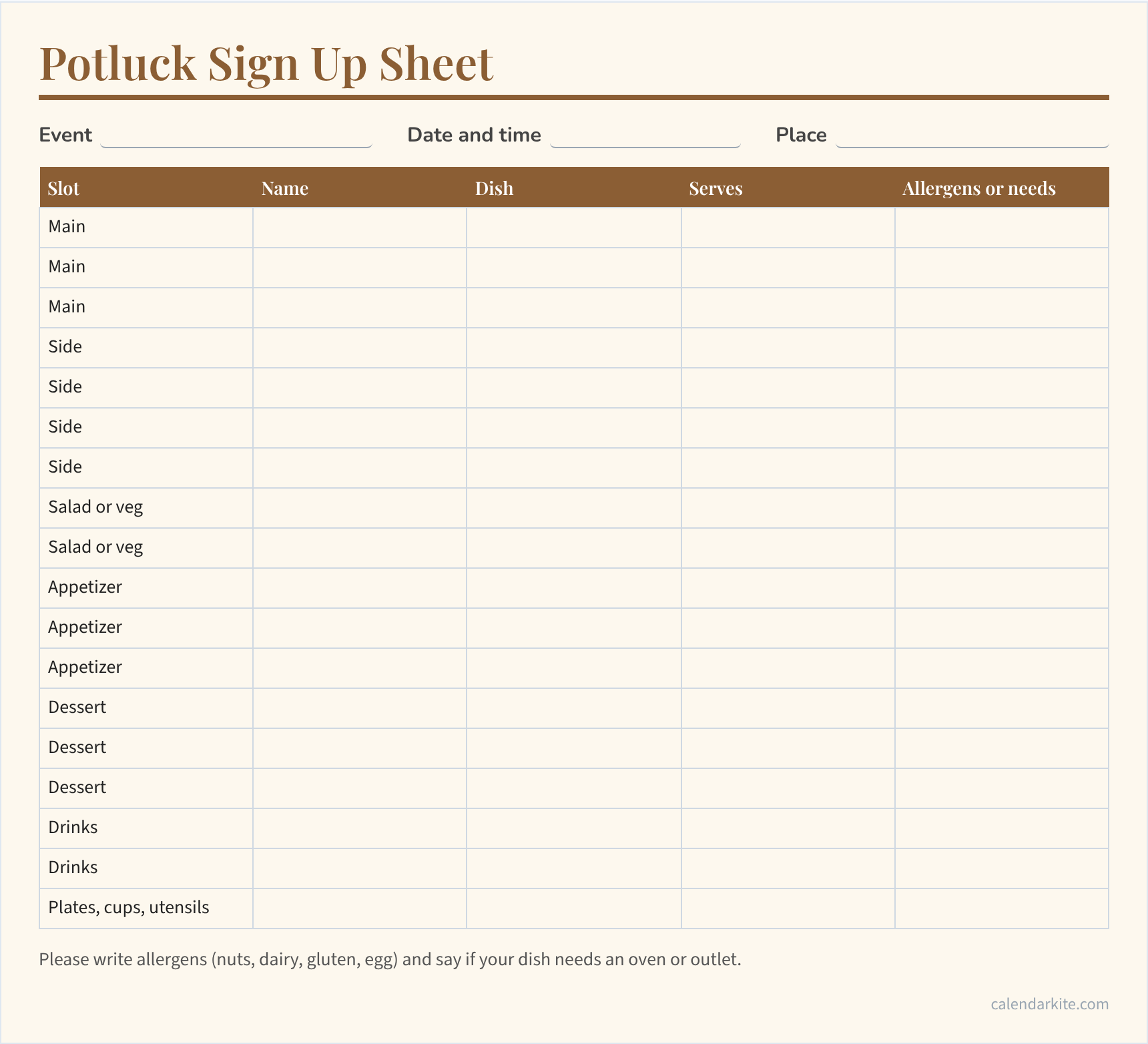
Cream paper and brown serif headings give church suppers, family reunions and holiday dinners a nostalgic feel. I keep a printed copy on the kitchen counter next to my planner, so I can tick off dishes as they're confirmed.
Modern Potluck Sign Up Sheet Template
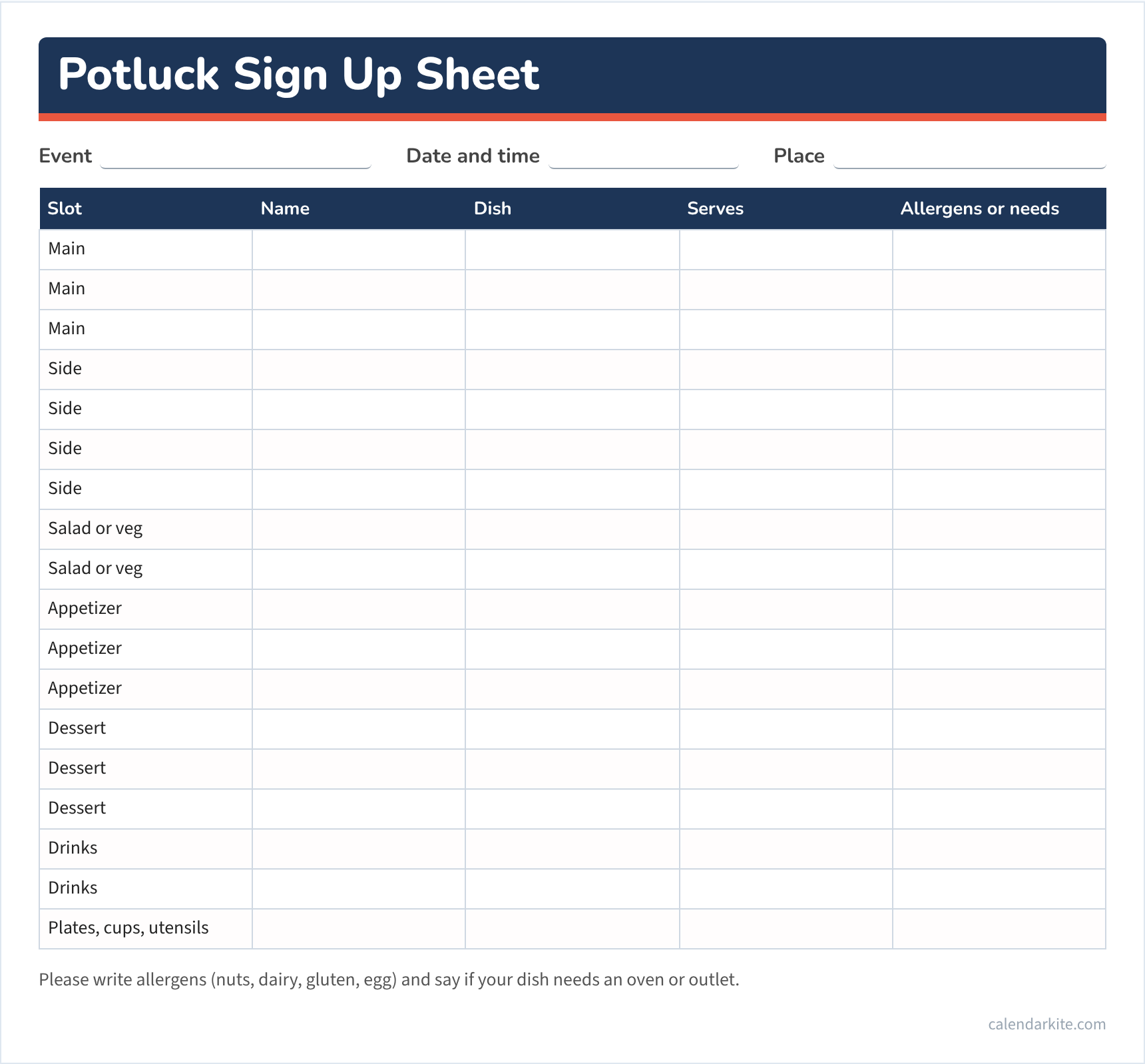
A navy header band with a coral accent gives this a crisp, modern look for workplace potlucks and club events. Print it on US Letter or A4 and pin it in the break room so coworkers can claim a dish quickly.
I keep a paper calendar on the fridge and a planner on the kitchen counter, and a potluck sheet lives somewhere between the two until the day arrives. After ten years of office administration, I know a shared list only works if it is easy to read from three feet away and takes under a minute to complete. That is what I built this one to do.
What a potluck sign up sheet actually does
The job of a sign up sheet is not to collect names. It is to let every guest see, at a glance, what is already covered and what is still missing. When someone can see that three desserts are taken and no sides are, they usually switch without being asked.
A good sheet also saves the host a round of messages. Instead of replying to “what should I bring?” fifteen times, you point to one page. People choose their own dish, which means they pick something they are comfortable cooking or buying, and you spend your energy on the venue and the drinks.
The third job is less obvious: it is a record. After the event you can see who brought what, which helps next time. If the lasagna vanished first and the coleslaw came home untouched, you now know how to set the slots for the next gathering.
What is on this printable sheet
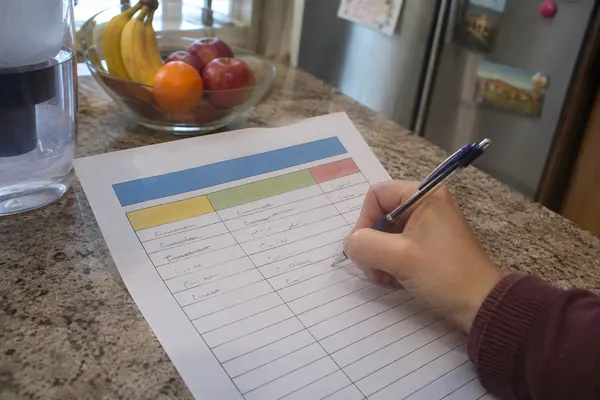
The header has three fill-in fields: the event, the date and time, and the place. Those matter more than they seem. A sheet pinned to a break room corkboard for two weeks needs to say when and where without anyone hunting for the email.
Below that is a table with five columns. Slot is pre-filled with a food category, Name is for the guest, Dish is for what they are bringing, Serves is a rough portion count, and Allergens or needs covers nuts, dairy, gluten, egg, and anything that needs an oven or outlet.
There are 18 rows. They are split into three mains, four sides, two salads or vegetable dishes, three appetizers, three desserts, two drinks and one row for plates, cups and utensils. That mix suits a group of roughly 15 to 25 people, and you can retype any label on screen if your event needs something different.
How to fill in the sheet
Start on the page itself. Click into the event, date and place fields and type them in. Then, before anyone else sees it, fill in the host’s own dish on the first row that fits. A sheet with one line already written gets used far more often than a blank one, because nobody wants to be first.
Guests then work through the table like this:
- Find a slot that is still empty in a category you like.
- Write your name and the dish, in plain words (“baked mac and cheese”, not “family recipe”).
- Add a serving count, even a rough one.
- Note any allergens, and whether the dish needs reheating or a power outlet.
If you are collecting names on paper, ask people to write in pen and print clearly. I have deciphered enough illegible office rotas to know that a name nobody can read is as bad as no name at all.
Try this: Before printing, type your own dish into the first matching row and add its serving count. Then print one copy and ask someone else to fill in a row without any explanation. If they hesitate, rename the slot labels until they do not.
Setting up the slots before you print
The pre-filled labels are the feature I would not give up. A blank “Dish” column invites guests to write whatever they like, which is how potlucks end up with eleven desserts. Fixed slots guide the choice without anyone feeling told what to do.
Because the labels are editable on this page, change them to fit the event. A brunch might swap “Main” for “Egg dish” and “Baked goods”, and a summer cookout might use “Grill item” and “Chips and dips”. A holiday dinner usually needs fewer appetizers and more sides. Edit the labels first, then print.
If you want more slots than 18, print two copies and put “Page 1” and “Page 2” in the event field. I would rather run two clean sheets than squeeze a third column of text into one, because small handwriting is what makes shared lists fail.
How many dishes to ask for
Many hosts underestimate this. A useful starting point is one dish for every three or four guests, with each dish meant to serve eight to twelve small portions. For 20 people, that is about six to eight dishes, though the sheet gives you 18 slots so there is room for people who want to bring two smaller things.
Spread the slots by how people actually eat. Mains and sides disappear first, desserts are always popular, and appetizers matter less if the meal starts soon after people arrive. For a rough balance, I aim for:
- Mains: about a fifth of the dishes
- Sides and salads: about 40 percent
- Appetizers: about a fifth
- Desserts: about a fifth
These are planning guides, not rules. A group that skews young and hungry will clear the table faster than a group of coworkers on a lunch break. If the sheet is nearly full a week out, leave it. If half the mains are empty three days before, send a short nudge to the people who have not signed up.
Preventing doubles and gaps
Duplicates are not really a guest problem. They happen because the list was invisible when people decided. Post the sheet early and keep it where everyone can see it, and doubling mostly takes care of itself.
When two people do bring the same thing, it is not a disaster. Two trays of brownies are fine. Two people each bringing the only main course for 20 is the real risk, which is why the sheet marks mains separately and why I like to fill the main slots first by asking a few reliable friends directly.
For gaps, look at the sheet at the halfway point to the event. Empty slots are your to-do list. Ask someone to cover them, or buy them yourself. In the kitchen at home, I will often grab rolls or a bagged salad on the way back from the store rather than chase anyone, and our grocery list printable helps me remember those last-minute pickups.
Allergens and dietary needs
This is the column most free sheets leave out, and it is the one I added to my own layout. People with allergies, or parents of kids who have them, cannot judge a casserole by looking at it. A short note next to each dish lets them decide in seconds.
Ask guests to write the common ones: nuts, dairy, gluten, egg, shellfish, soy. “Contains walnuts” is far more useful than a blank space. If someone is vegetarian, vegan or avoids pork, put that in the same column, or in the dish name itself (“vegan chili”).
You can also use the column in reverse. If you know a guest has a serious allergy, write a line at the bottom of the sheet or in the event field asking people to label any dish containing that ingredient. Then set out small cards beside each dish on the day so the information travels from the paper to the table.
Try this: Write a one-line note in the event field, such as “Please label nuts and dairy,” then check the sheet two days before. Ask anyone with a blank allergens cell to send you a quick text.
Equipment, outlets and serving gear
A potluck fails quietly when there is nowhere to plug in nine slow cookers. The “needs” part of the last column is there for this reason. Ask guests to write “outlet”, “oven” or “fridge space” if their dish requires it, and you can plan the layout before the first casserole arrives.
Count the surfaces and sockets in your venue ahead of time. A typical office kitchen has one microwave and one fridge, and both fill up quickly at noon. A church hall might have an oven but only a few outlets. Knowing this beforehand lets you steer people toward room-temperature dishes.
The last row on the sheet is for plates, cups and utensils. Do not leave this to chance. Someone has to supply napkins, serving spoons and a ladle for the soup. I usually sign up for serving spoons myself, since I know how many I own, and put “serving spoons for all” in the Dish cell so no one assumes it is covered.
Where to post it and how to collect it
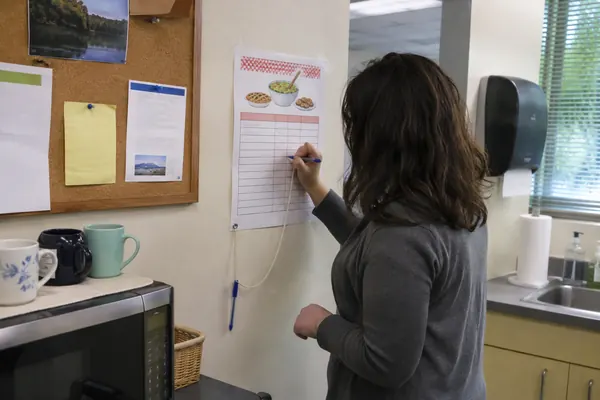
Put the printed sheet where people already walk: the break room door, the church foyer table, the school pickup board, the shared hallway near the mailboxes. Put a pen on a string beside it. Pens vanish from every sign up sheet I have ever posted.
If your group is spread out, take a photo of the filled sheet and send it around once a day, or have people fill in the page on screen and share a printout of the saved version. Some guests will want to claim a slot from their phone, and for them an online poll or form will be simpler. For small groups of friends, a text with a photo of the sheet usually does the job.
Set a sign up deadline, and put it on the sheet. A week before the event is a good default, because it gives you time to fill gaps. A date in writing also removes the awkwardness of chasing people.
Office potluck version
Office potlucks have their own rhythm. Lunchtime is short, fridge space is tight, and people usually bring food in on the morning of the event. Name matters here, since colleagues want to know whose chili they are eating, but dish details matter even more because the allergen column covers shared kitchens.
Ask people to bring dishes that can be served in a few minutes without much reheating. Use the “needs” column to spread microwave use: if three people need it, ask one to bring theirs at room temperature. I learned in the office that the staff member who organizes the potluck is almost always the one stuck washing the serving spoons, so write “cleanup volunteer” in one of the supply slots.
If your team works in shifts, add the time each person will arrive in the “needs” column. For recurring monthly lunches, keep a fresh sheet for each one and file the old ones, or use our sign up sheet template for general events beyond food.
Church, school and neighborhood versions
Larger gatherings need a few small changes. For church suppers and community dinners, print several copies and set a headcount target near the top. Use the “Serves” column more seriously: if you expect 60 people, you want the totals to add up to something close to that, so a quick tally at the bottom is helpful.
School events usually ask for nut-free dishes, so make that the first line in the event field and keep the allergen column strict. Parents tend to prefer store-bought items that come with an ingredients label, so let them write “store-bought” in the Dish cell. It is honest and it helps.
For a neighborhood block party, the sheet can double as a roster of households. Write the house number instead of a full name if neighbors do not all know each other yet. For a themed meal such as a taco night, pair it with a specific list like our taco bar checklist, and for a graduation open house the grad party checklist covers the rest of the planning.
Holiday and themed potlucks
Holiday potlucks often have tradition attached: turkey, ham, a certain green bean dish. The host usually covers the main protein, so relabel the main slots as “Side dish” or “Family recipe” and let the sheet focus on what you actually need. If it is Thanksgiving, our Thanksgiving dinner planner can sit beside the sign up sheet so you can see the full timeline for the day.
For a baby shower or brunch, change the labels to match the menu: “Savory bite”, “Sweet bite”, “Fruit”, “Drinks”. The baby shower planning checklist is useful for the rest of the details, such as games, decorations and who is managing the gift table.
A themed potluck works well when the sheet is specific. “Bring a dish from your family’s tradition” gives people a reason to write something interesting in the Dish column, and the Allergens column turns into a quick ingredients list that people read with real curiosity.
Food safety for shared dishes
Food that sits out is the main safety concern at any potluck. Perishable food should not stay at room temperature for more than two hours, or one hour if the room is hotter than 90°F. Hot dishes should be kept hot (140°F or above) and cold dishes kept cold (40°F or below) until they are served.
The “needs” column helps here. When someone writes “fridge” or “oven”, you can plan where cold dishes go on arrival and where hot ones can be kept warm. Slow cookers on low and chafing dishes work well for hot food. Bowls set in larger bowls of ice help keep salads and dips cold.
At home, I tell guests to bring their dish in a container they can carry out again, with their name on the bottom in tape. It saves any end-of-event confusion over whose casserole dish is whose. Put the leftover plan on the sheet too: a line at the bottom such as “Bring containers for leftovers” is short and kind.
Printing tips
The sheet is built to fit one US Letter page in portrait. I test-print every printable on my home inkjet on both US Letter and A4, and this one prints cleanly on both, with the table rows large enough to write in. Choose “Actual size” or 100 percent in your print dialog, not “Fit to page”, so the lines stay a comfortable height.
Print in black and white to save ink. The pre-filled labels stay readable and the grid lines are dark enough for pens. If you are posting the sheet outdoors or somewhere damp, slide it into a plastic sleeve or tape the corners down.
Print a second copy for yourself and keep it as a master. If you have a clipboard, use it. For a bigger crowd, print the filled-in page, then a blank PDF for people who like to write by hand, and fill in the master later from the posted copy. Dates matter: if you are planning for an event next year, a 2027 calendar is handy for picking a date that avoids clashes.
Paper or online sign up
Paper wins when your guests are in the same place every day, like an office, a school or a church. There is no login, no link to forget, and the physical sheet reminds people each time they pass it. It also works for older guests who prefer a pen.
Online works better when the group is scattered or the event is days away and people need to see changes quickly. A shared spreadsheet or form lets people claim a slot from their phone. The downside is that someone has to manage it, and not everyone will open the link.
My own approach at home is both: the fillable page on this site for planning, a printed copy by the front door or on the fridge, and a photo of it in the group chat when someone asks. Pick whichever your guests will really use, and the sheet will do its job.
Common questions
What should a potluck sign up sheet include?
At minimum it needs the event, date, time and place, a name column and a dish column. The most useful extras are dish categories, a serving count and an allergen or special needs column. This sheet has all of them on one page.
How many people should I plan for per dish?
A common starting point is one dish for every 3 to 4 guests, with each dish serving 8 to 12 small portions. For a group of 20 that means around 6 to 8 dishes, spread across mains, sides, salads, appetizers and desserts.
How do I stop everyone bringing dessert?
Use pre-labeled slots so the categories are already set, and keep the dessert slots few. Guests who arrive late to the list simply take what is left, which tends to be sides and supplies.
Can I fill in the potluck sign up sheet on my computer?
Yes. You can type into every field on this page, tick boxes and edit the slot labels. Your entries save in your browser, then you print the sheet or download the blank PDF.
Should the host bring a dish too?
Most hosts supply the main or the drinks and the serving gear, then leave the rest to guests. Write the host's own dish on the sheet first so everyone can see what is already covered.
How long can potluck food sit out?
Food safety guidance says perishable food should not sit out for more than two hours, or one hour if the room is hotter than 90°F. Keep hot dishes hot and cold dishes cold until serving.
More free planners
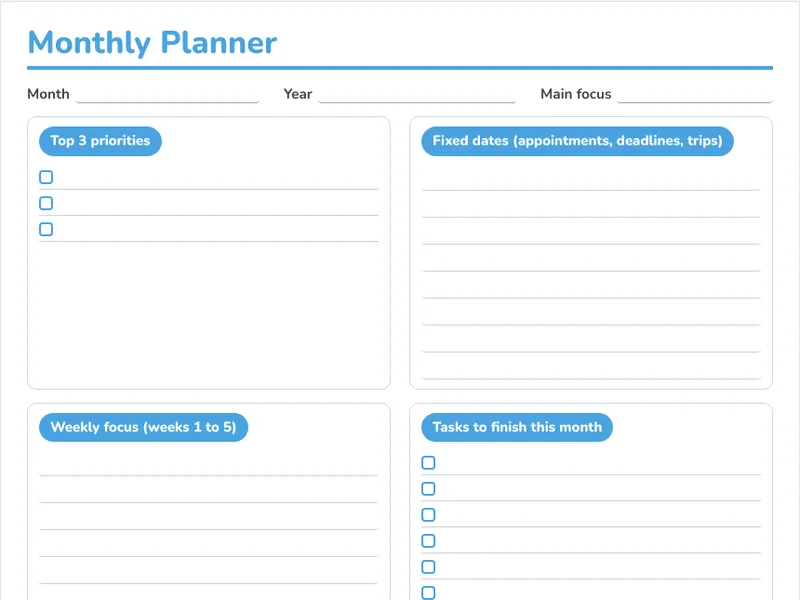 Monthly Planner: Free Printable One-Page Sheet
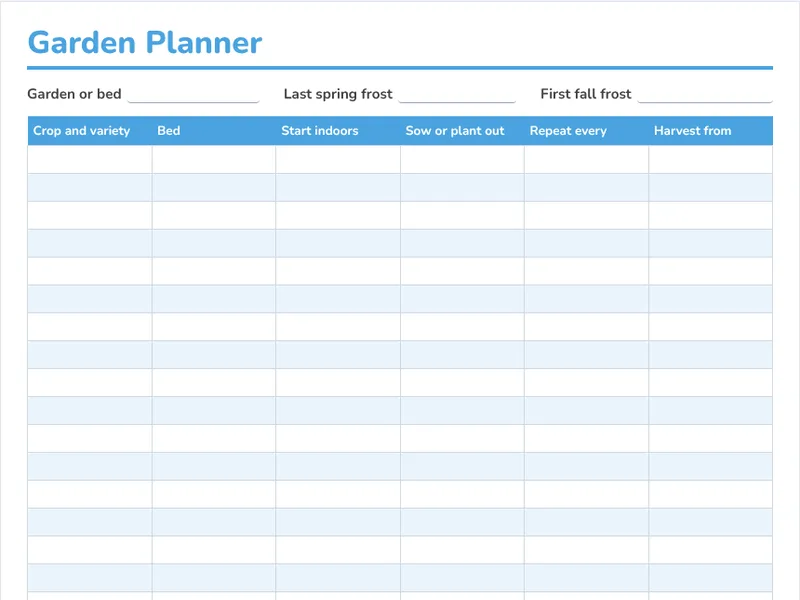 Garden Planner: Free Printable Planting Sheet
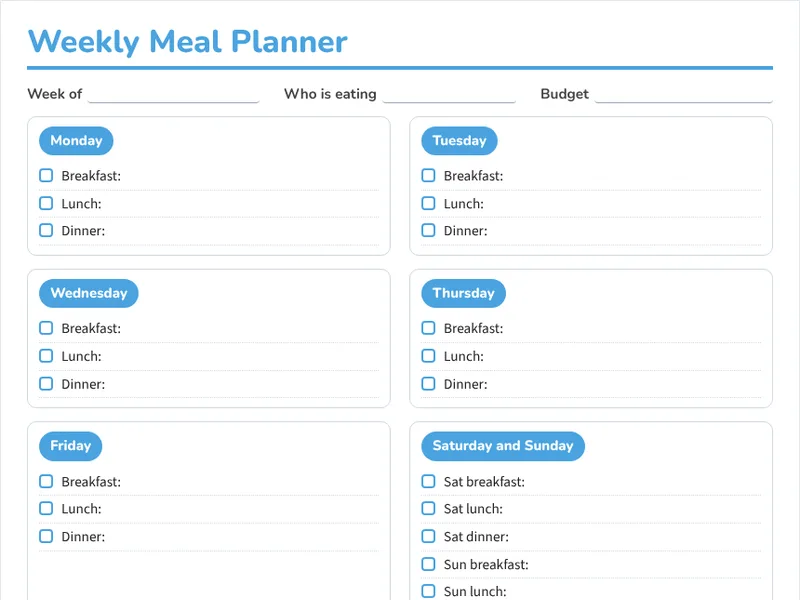 Printable Weekly Meal Planner
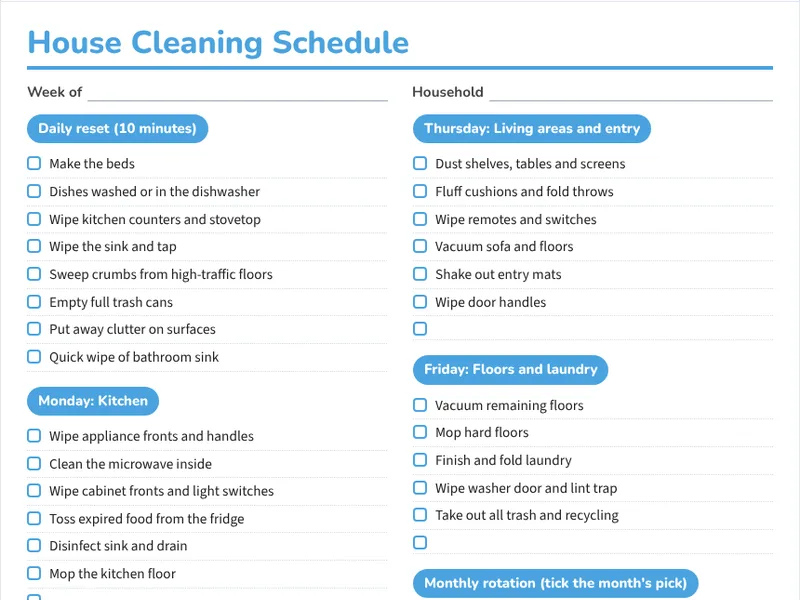 House Cleaning Schedule: Free Printable for Daily, Weekly and Monthly Jobs
 Hourly Schedule Template: Free Printable Weekly Planner
 Daily Planner 2027: Free Printable Page for Every Day