
Wellness Planner: Free Printable Weekly Sheet

A wellness planner is a one-page or multi-page printable where you record the everyday things that shape how you feel: sleep, water, movement, food, mood, energy and a bit of time for yourself. The free sheet on this page covers a full week on a single page, with 14 daily checks you can tick or rate, a space for one weekly focus, and room to rename any row so it matches your life.
| Daily check | 1 | 2 | 3 | 4 | 5 | 6 | 7 |
|---|---|---|---|---|---|---|---|
| Slept 7+ hours | |||||||
| Lights out on time | |||||||
| Water (glasses) | |||||||
| Moved 20+ minutes | |||||||
| Stretch or mobility | |||||||
| Fruit or veg at 2 meals | |||||||
| Time outside | |||||||
| Screens off before bed | |||||||
| Medication or vitamins | |||||||
| One self-care moment | |||||||
| Connected with someone | |||||||
| Gratitude (one line) | |||||||
| Mood (1 to 5) | |||||||
| Energy (1 to 5) |
Tick what happened, write numbers for mood and energy. Aim for most days, not every day.
Free for personal, classroom and office use. Your entries are included in the print, PDF and PNG. Prints on US Letter and fits A4.
Black and White Wellness Planner Printable
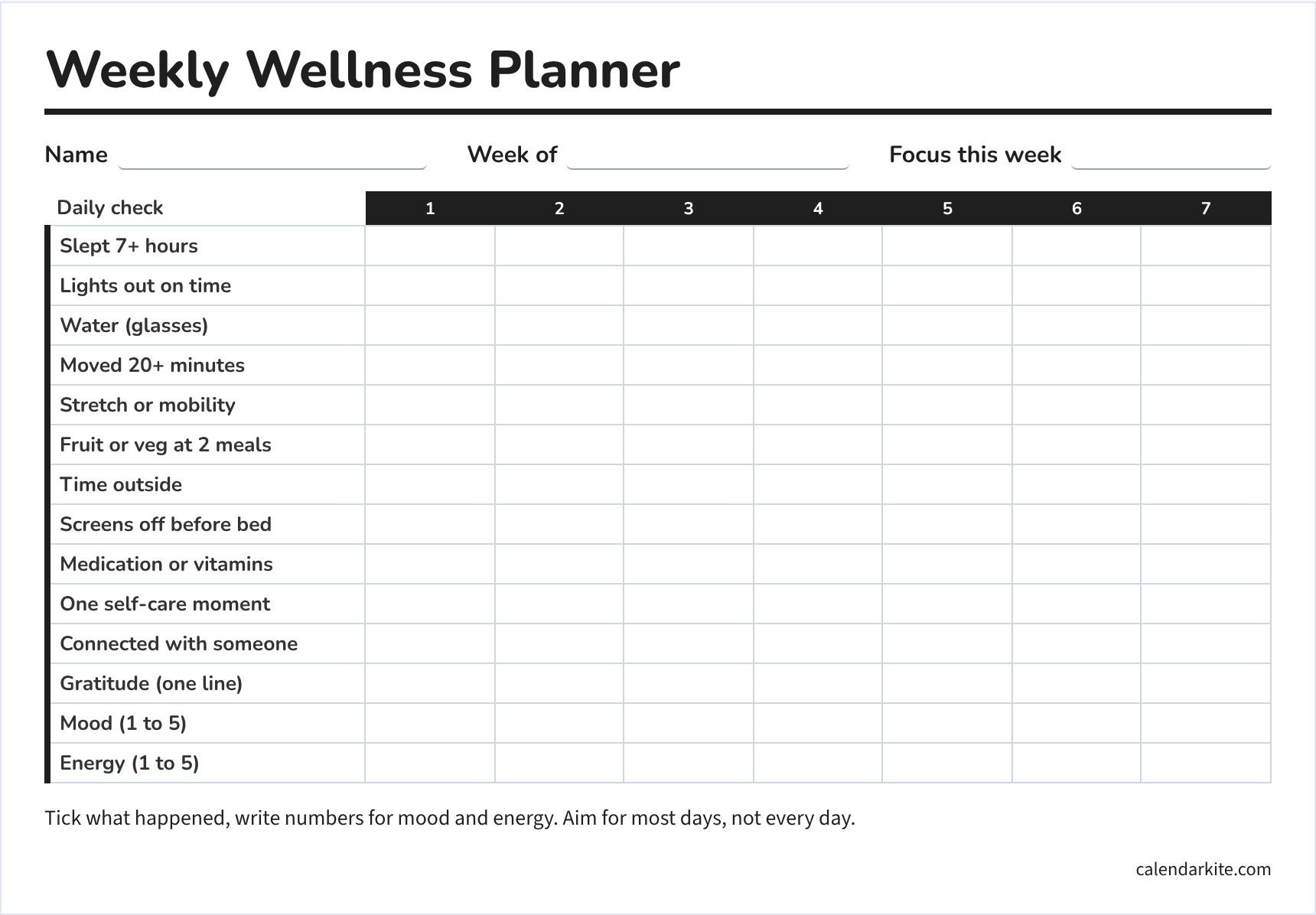
This ink-saving version suits you if you print often and want a clean page for tracking habits, sleep and water. I test-print every page on my home inkjet, and the plain black lines stay crisp even in draft mode.
Pink Wellness Planner
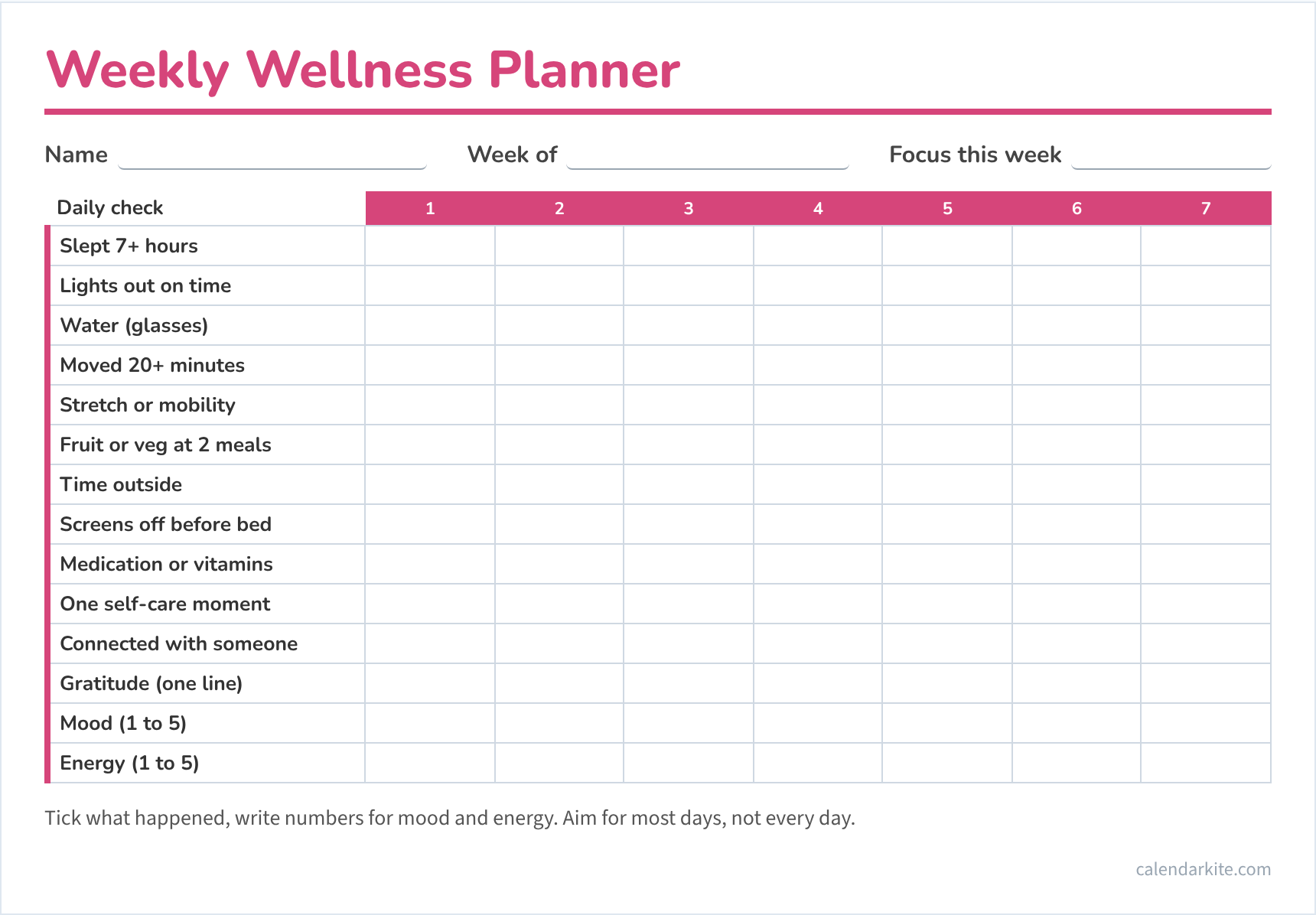
The soft pink palette suits a gentle self-care routine, like tracking mood, movement and bedtime. I keep my own planner on the kitchen counter, so I like a color that looks calm rather than loud.
Sage Green Wellness Planner Printable
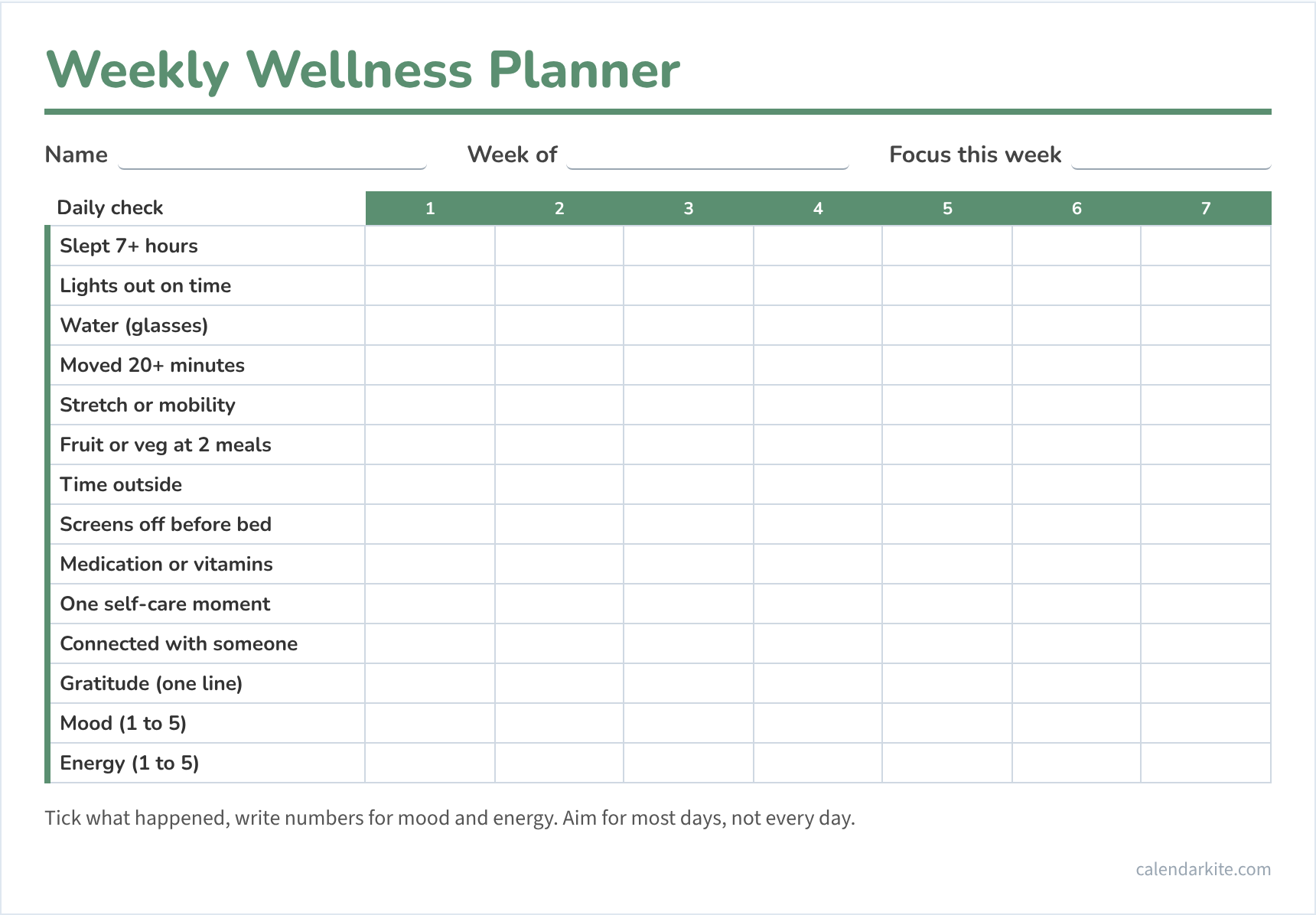
Sage green is a calming choice if you log meals, walks and water through the week. I kept the writing spaces roomy because ten years of office paperwork taught me that tiny boxes get ignored.
Lavender Wellness Planner
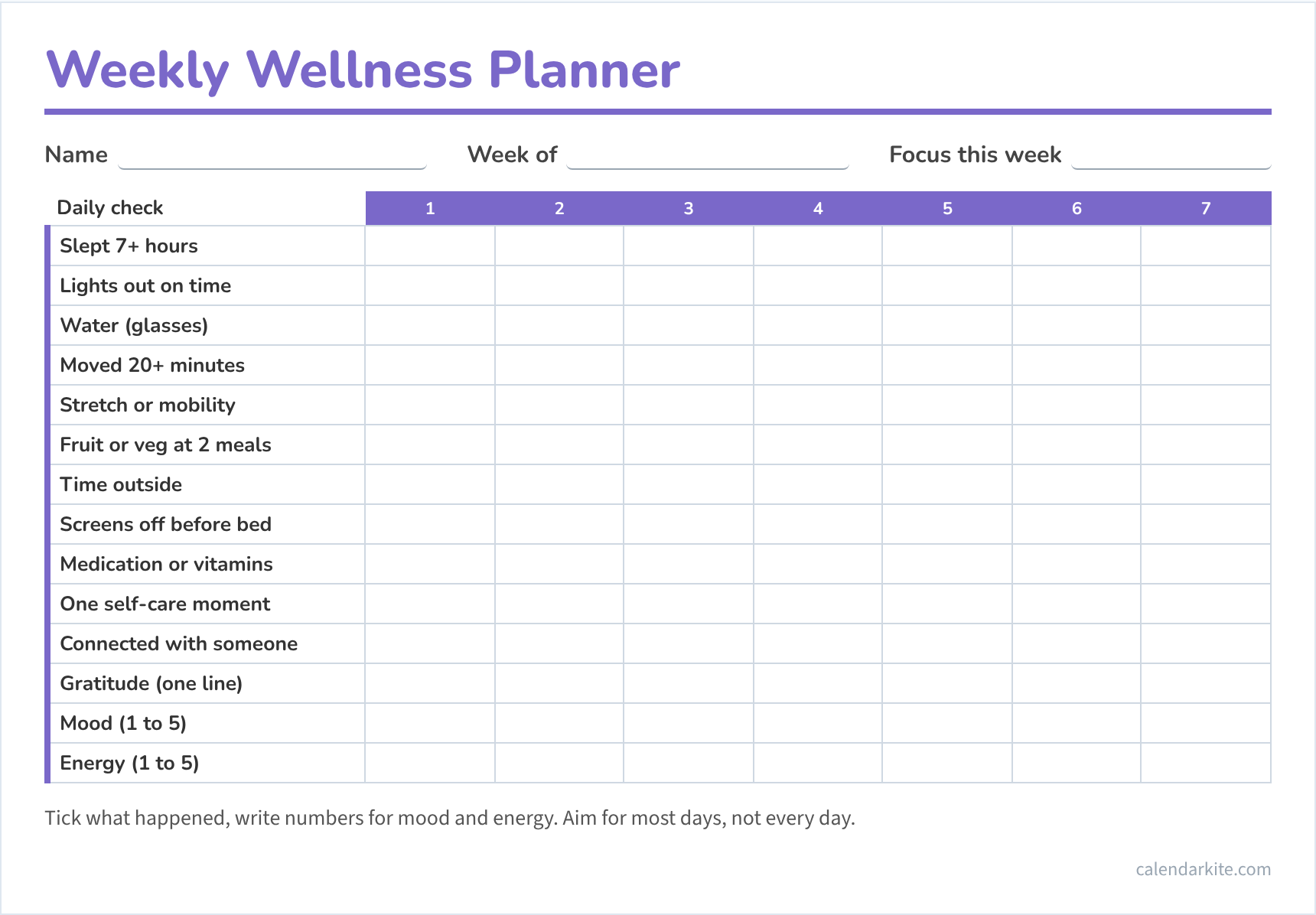
Lavender suits an evening-focused routine, such as sleep tracking, gratitude notes and a short wind-down checklist. Print it on US Letter or A4 and keep it by your bed so you actually fill it in.
Cute Wellness Planner Printable
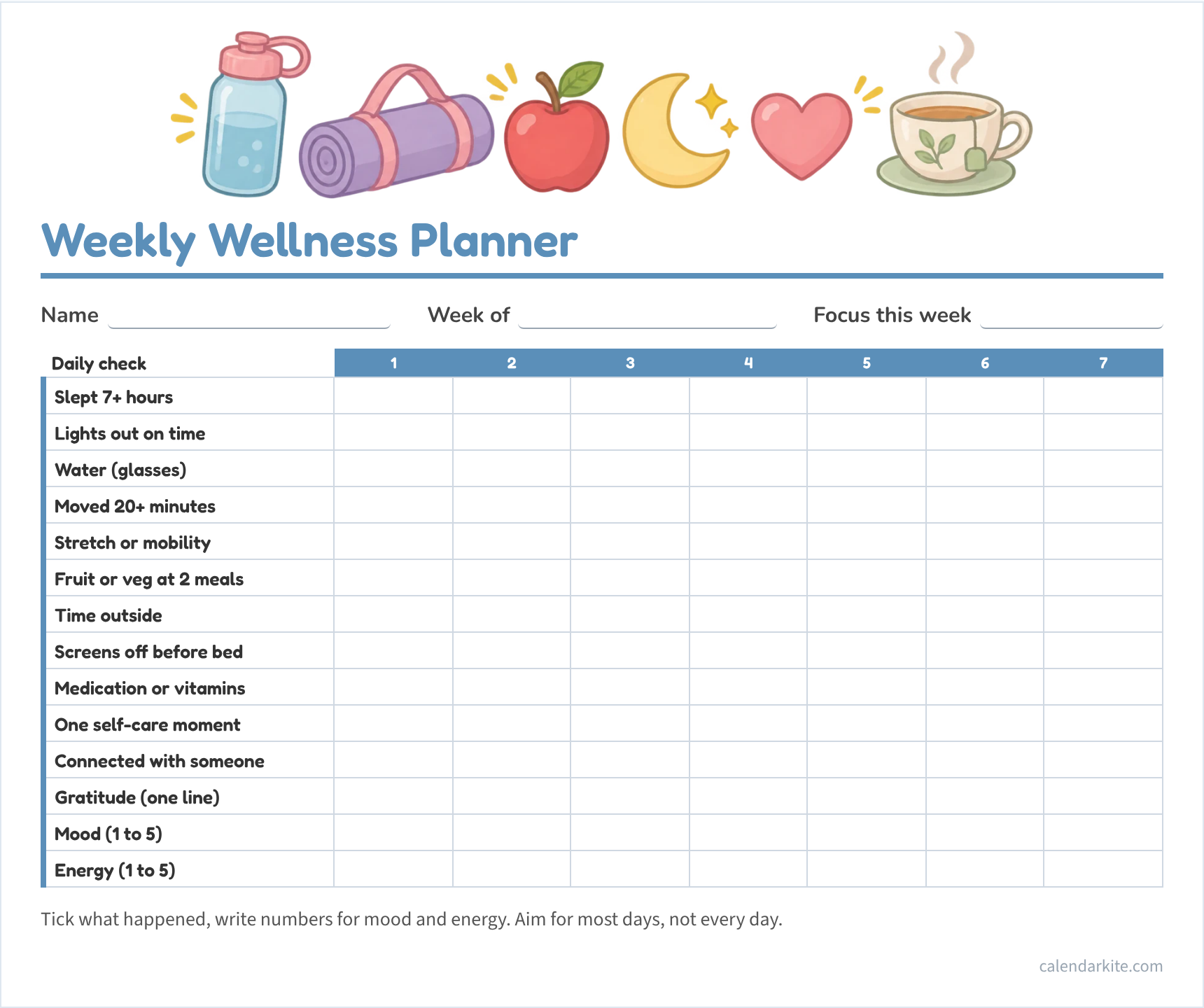
This pastel blue design is a friendly fit if a plain health log feels like homework, especially for tracking water, steps and mood. The small illustrations sit at the top, so the writing area stays fully usable.
Floral Wellness Planner
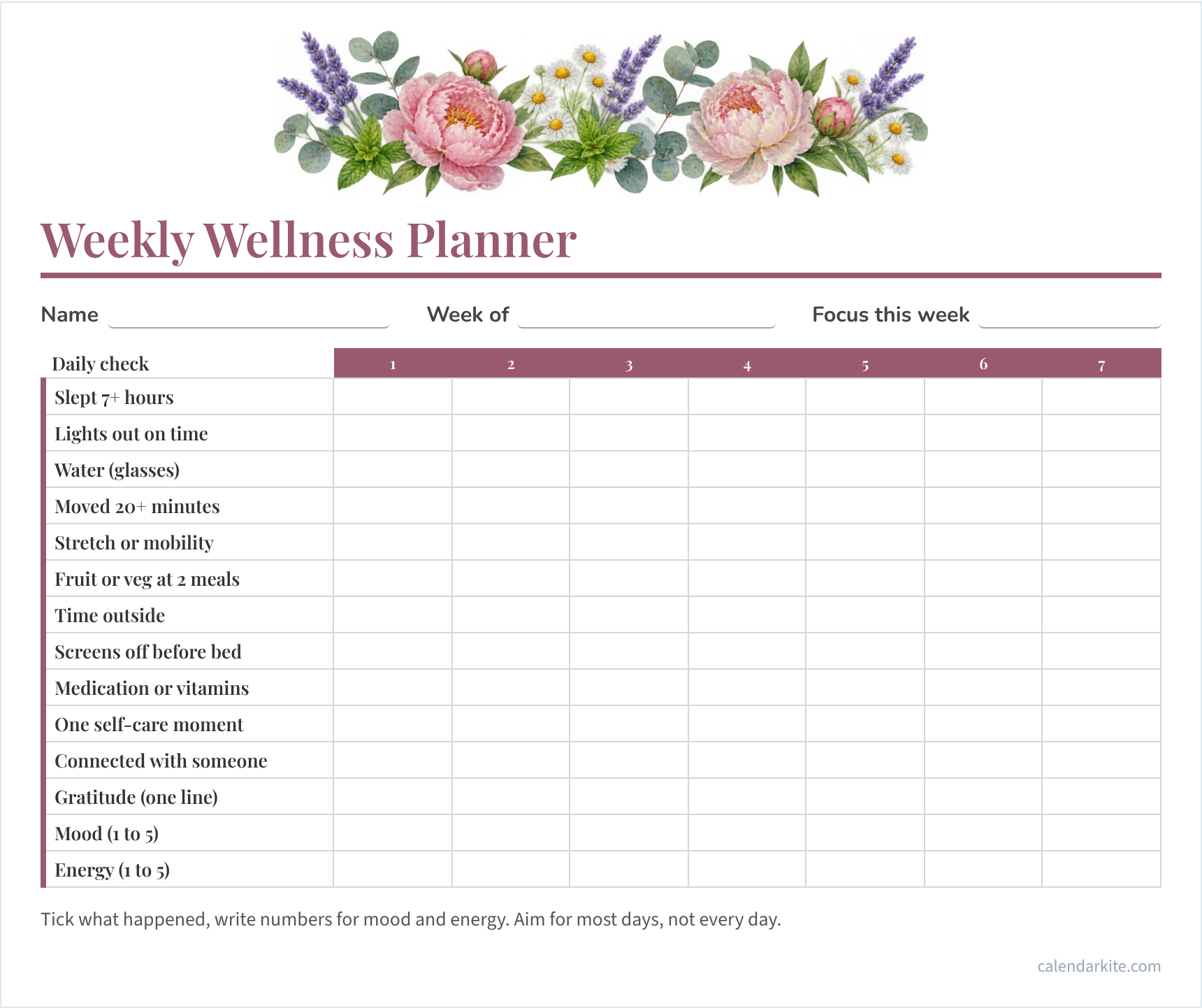
The watercolor flowers and mauve serif headings suit a slower, self-care style of planning. Use it for journaling, gratitude lists and monthly wellness goals.
Colorful Wellness Planner Printable
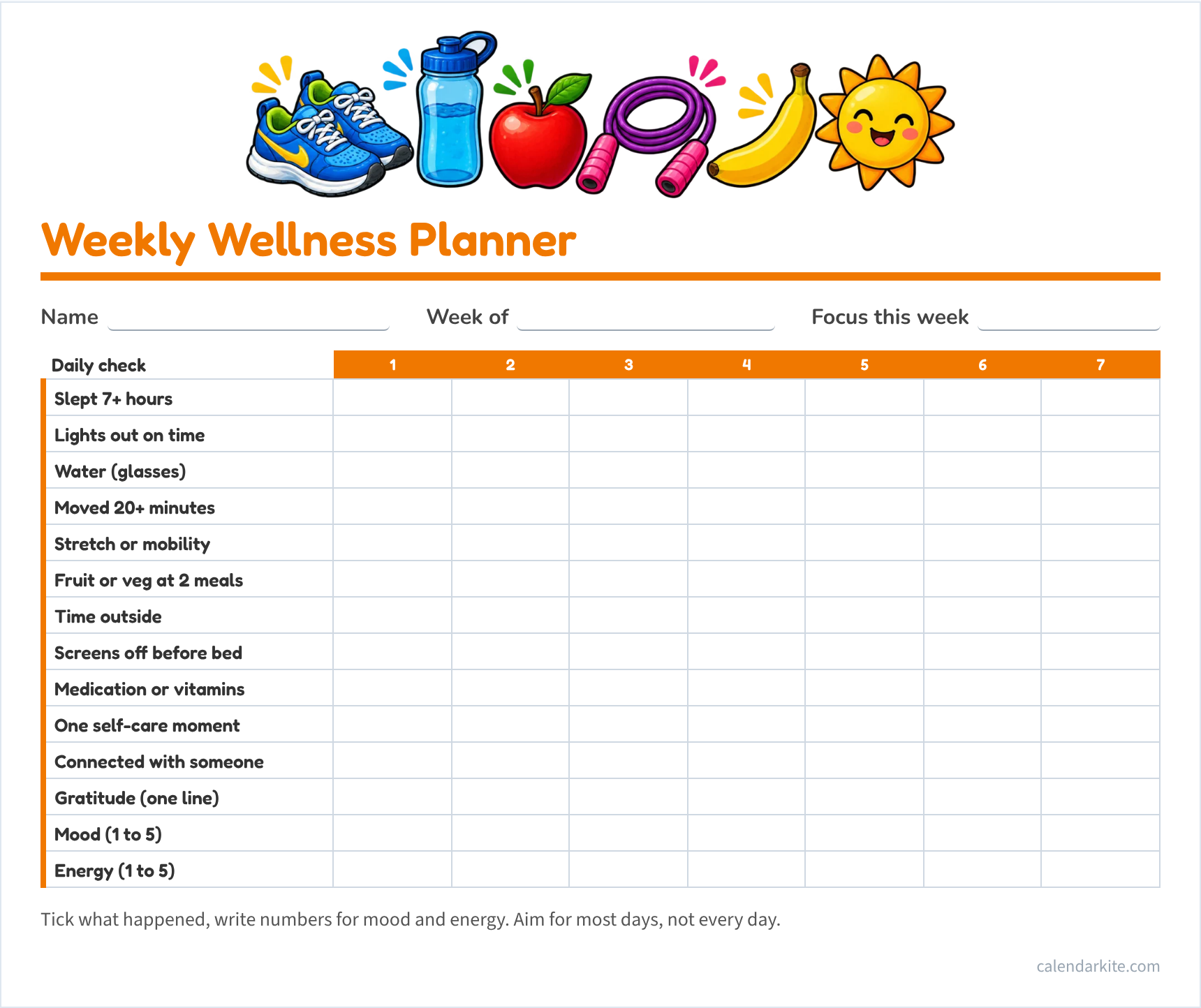
Bright orange and yellow make this a cheerful pick if you need extra motivation for daily habits like stretching, water and sleep. I keep a paper calendar on the fridge, and bold pages like this are the ones my family actually notices.
Simple Minimalist Wellness Planner Printable
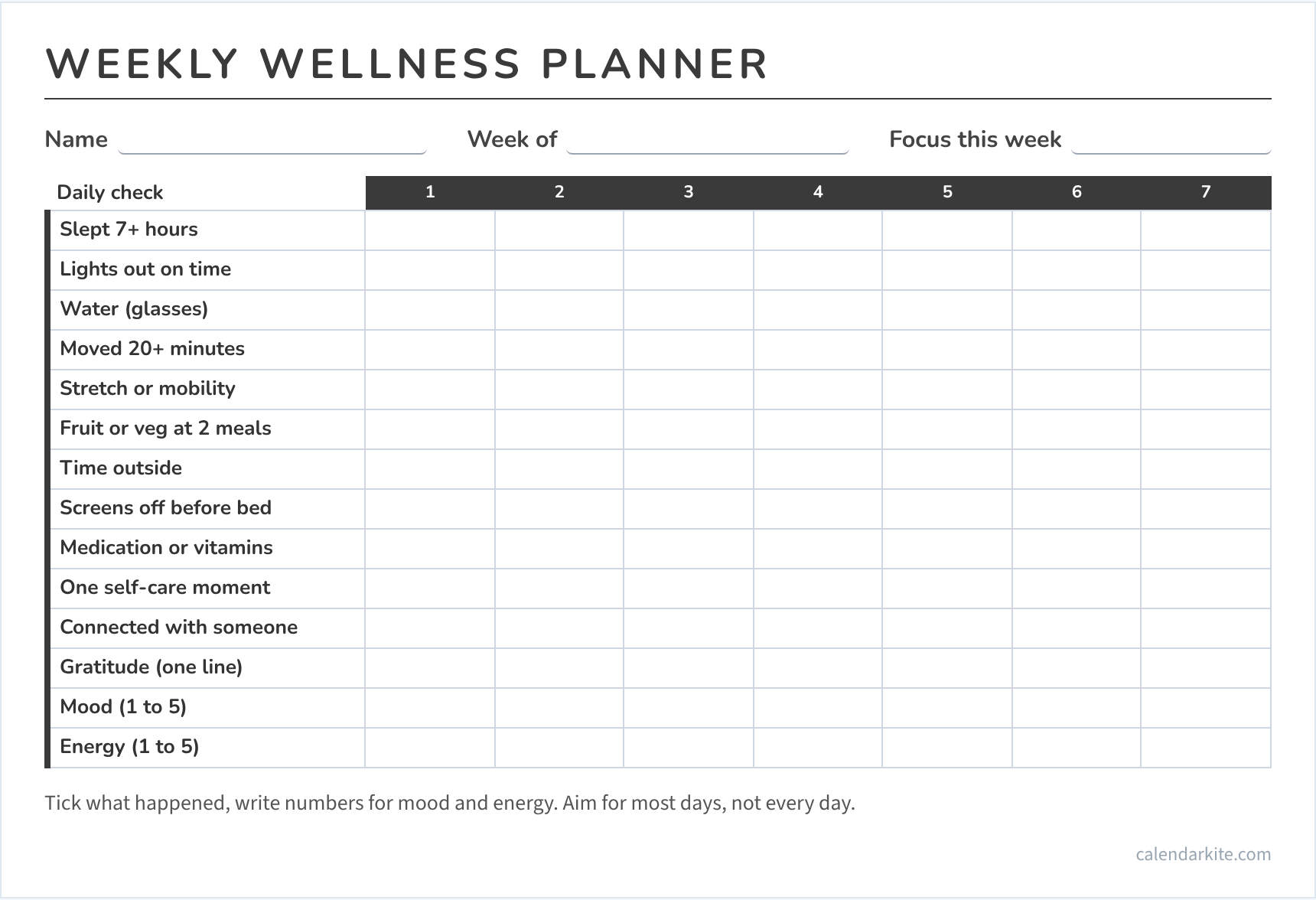
Thin gray lines and a light uppercase heading suit you if you want a wellness planner with no distractions. It works well for a short daily check-in covering sleep, movement and meals.
Aesthetic Wellness Planner
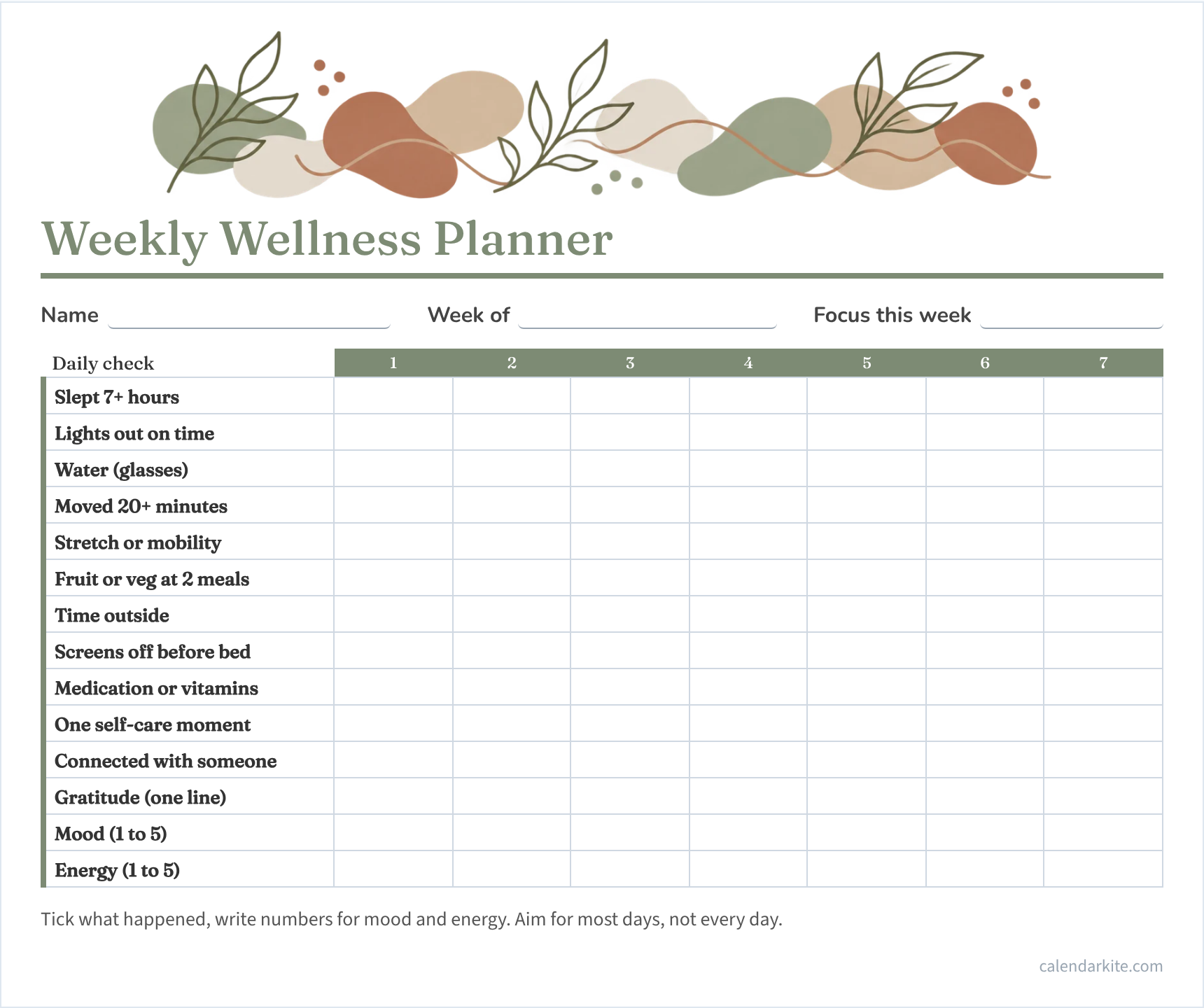
Muted sage, sand and terracotta with soft line-art leaves suit a calm, neutral desk or journaling setup, especially for weekly reviews. I test-print it on US Letter and A4 to confirm the earthy tones stay soft on a home inkjet.
Bold Modern Wellness Planner
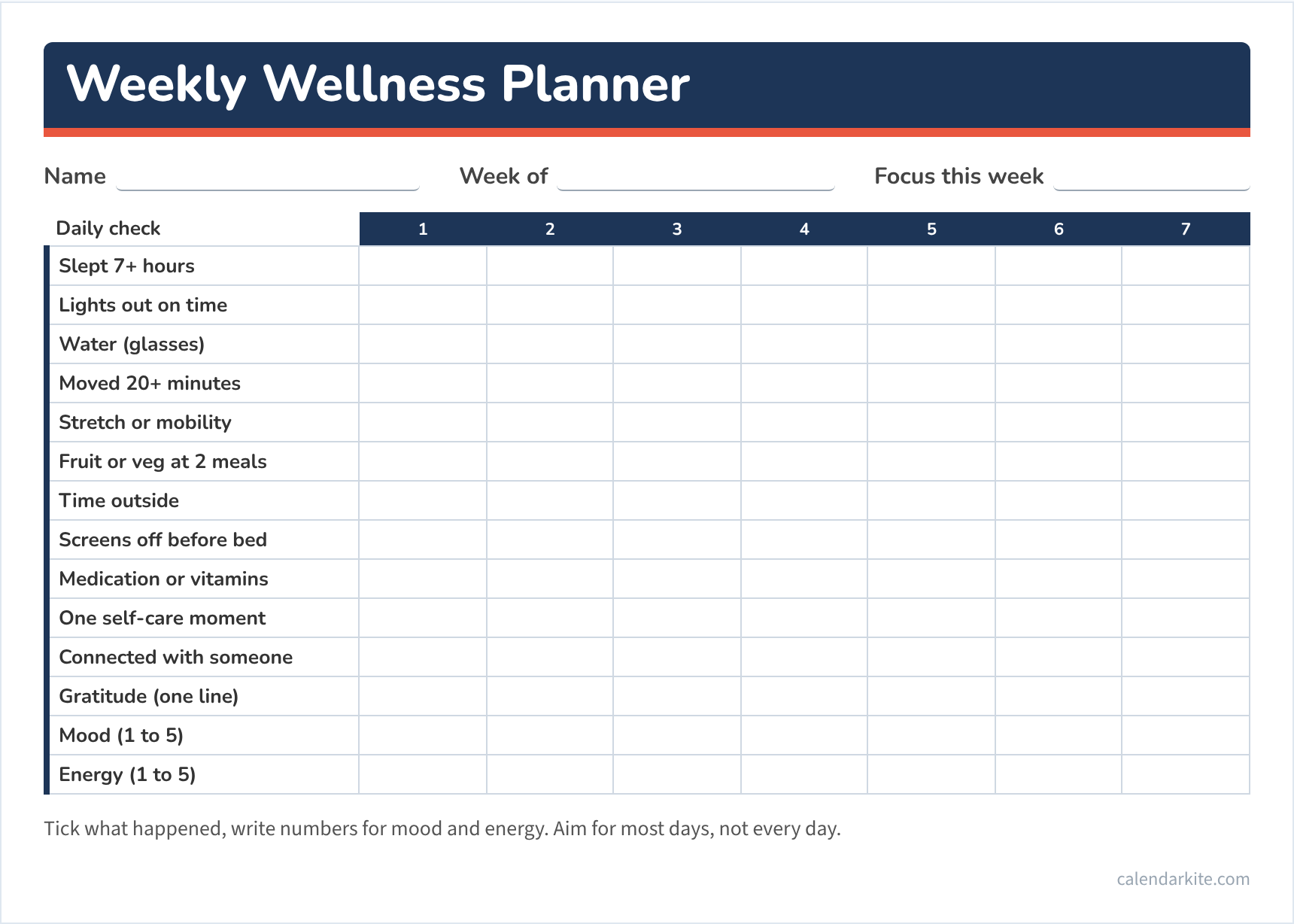
The navy header band and coral accent suit a goal-driven routine, like workout targets, meal prep and habit streaks. In my office years I learned that a strong header makes a page easy to spot in a stack of papers.
I built it the way I would want to use it on a busy Tuesday. In my office years I learned that a schedule only works if it is readable at a glance, and the same is true of a wellness sheet. If it takes more than a minute a day, it will end up in a drawer. So this one is short, tappable on screen, and sits happily next to a planner on the kitchen counter.
What a wellness planner actually tracks
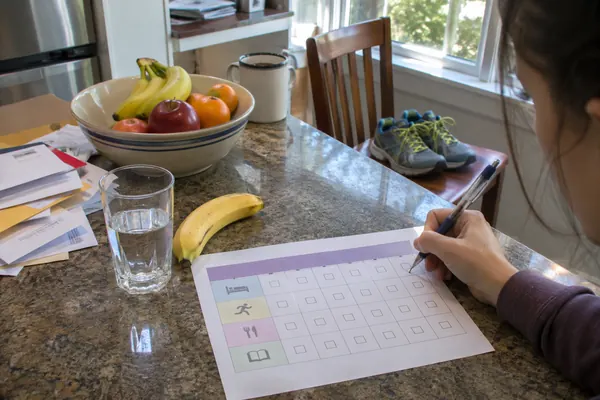
Wellness is a wide word, and that is why many planners feel overwhelming. In practice, most people want to watch five or six areas: sleep, movement, nutrition and hydration, mood and energy, rest or self-care, and relationships. Some planners add spiritual practice, money stress or work balance. You do not need all of it. You need the few things that, when they slip, you feel it.
A wellness planner is not a diet plan, a workout program or a diagnosis. It is a mirror. You write down what happened, and after a couple of weeks you can see what you actually do rather than what you think you do. Many people are surprised to find that their tired days follow late nights, or that their best mood scores land on days they got outside, even briefly.
That is the real value of putting it on paper. A single entry means little, but fourteen days in a row tells you something useful, and you can act on it with small changes.
What is on this printable wellness planner
The sheet is a weekly grid with seven day columns and 14 rows. The rows are: slept 7+ hours, lights out on time, water, moved 20+ minutes, stretch or mobility, fruit or veg at two meals, time outside, screens off before bed, medication or vitamins, one self-care moment, connected with someone, a one-line gratitude, mood, and energy.
I chose those rows to balance body and mind without turning the day into a to-do list. Four rows are about sleep and evening routine, four about movement and food, and the rest cover mood, energy, connection and rest. Mood and energy use a 1 to 5 scale, so you write a number instead of a tick. Everything else is a simple yes or no.
At the top there are three fill-in fields: your name, the week, and a focus for the week. The footer reminds you to aim for most days, not every day, because a planner that demands perfection quietly teaches you to quit. If you need a broader set of pages around it, the printable planner collection has weekly and daily layouts that pair well with this sheet.
How to fill it in, step by step
You can type straight into the sheet on this page, tap cells to tick them and edit any row label. Your entries save in your browser, so you can come back during the week and add to the same sheet. When you are done, print it. If you prefer pen, download the blank PDF instead.
- Write the week’s start date and your name at the top.
- Choose your focus for the week (see the next section) and write it in the third field.
- Rename or replace any rows that do not fit you. Delete the ones you would never tick.
- Fill in the sheet once a day, ideally at the same moment, such as after brushing your teeth.
- At the end of the week, count ticks and look at your mood and energy numbers.
Fill in sleep rows first thing in the morning for the night just gone, and everything else in the evening. That small split matters. Guessing about last night’s sleep at 9 p.m. is far less accurate than recording it while the memory is fresh.
Try this: Before you print, spend two minutes editing the row labels. Replace any row you would not honestly do with one you would, such as “Walked the dog” or “Took lunch break away from desk”.
Pick one weekly focus
The field at the top of the sheet is the part most people skip, and it is the part that makes the rest useful. A weekly focus is one behavior you want to nudge, written as something specific: “In bed by 10:30 on weeknights” or “A ten minute walk after lunch”. It gives the grid a purpose. Without it, you are collecting data with no question attached.
Keep the focus small enough that you could do it on a bad day. If your sleep is poor, aiming for eight hours every night is a recipe for disappointment. Moving your lights-out time earlier by 20 minutes is something you can actually test. Then look at how your energy rows respond.
I keep a planner on the kitchen counter and write my focus in the margin in pen. Having it visible while I make coffee does more than any clever tracking system I have tried. If you like to link weekly aims to bigger plans, the goal setting planner helps you break a larger ambition into weekly steps.
How to rate mood and energy
Mood and energy are the two rows that confuse people, because they are not yes or no. Use a plain 1 to 5 scale: 1 is very low, 3 is ordinary, 5 is very good. Rate the day overall in the evening, not at its best or worst moment. Do not overthink it. Your first instinct is usually right, and consistency matters more than precision.
Keep mood and energy separate. You can feel cheerful but drained after a long social day, or calm and flat after a rest day. Seeing both numbers side by side helps you notice which activities give energy and which take it.
If you want to track feelings in more detail, such as naming emotions or adding triggers, pair this sheet with a mood tracker printable. For most people, though, two numbers a day are enough to spot a pattern.
Who this planner suits
This sheet suits anyone who wants a gentle, honest overview of their week without committing to a full program. It works well for people starting a new routine after a busy season, for parents who have been running on empty, and for desk workers who notice they have gone days without moving much. It also suits people who simply like paper and want a few minutes of reflection at the end of the day.
It is also useful if you are working with a doctor, dietitian, therapist or coach. A week of simple notes on sleep, movement and mood gives them something concrete to discuss. Bring the printed page to the appointment rather than relying on memory.
It is less suited to anyone who needs precise clinical tracking, such as counting grams, blood sugar readings or detailed training loads. For those, use the tools your care team recommends. This sheet is for the broader picture.
Make it fit your life
Every household has a different shape. I live in Ohio with my husband, two kids and a dog, and my “moved 20+ minutes” row is often just the dog walk after dinner. That counts. A wellness planner should record the life you really have, not an idealized version of it.
Here are swaps I suggest for common situations:
- Shift workers: replace “lights out on time” with “slept in a dark room”.
- New parents: change “slept 7+ hours” to “rested once today”.
- Desk workers: add “stood up each hour” or “lunch away from the screen”.
- People with a medication routine: keep that row and move it to the top.
- Anyone feeling overwhelmed: delete half the rows and keep five.
I keep it to 14 rows on purpose. When I tested longer versions on my home printer, the cells shrank to the point where a pen tick was hard to read, and I noticed that I stopped filling them in. Fewer, larger boxes won.
Daily, weekly or monthly: which format
Weekly is the sweet spot for most people. A daily page gives you room to write but takes a sheet a day, which is a lot of paper and a lot of commitment. A monthly page shows the big pattern but has tiny boxes and no space for notes. A week fits on one page, and you can see seven days of sleep and mood at once.
If you want more detail on a specific area, add a dedicated page. A sleep log printable records bedtime, wake time and night waking. A fitness planner printable is better when you follow a training plan with sets and reps. A water tracker printable helps if hydration is your main goal and you want a visual for each glass.
For the long view, you can stack four weekly sheets and look at them together at month’s end. Four pages in a folder tell you more than a single page of cramped boxes.
Try this: Print two copies of the sheet. Use the first for your normal week, then use the second to run a single experiment, like a 10 p.m. screens-off rule, and compare the energy rows side by side.
Ideas for common wellness goals
A planner is only as good as the goal behind it. Here is how I would set up the focus field and the rows for a few common situations:
- Sleep better: focus on a fixed wake time, track lights out, screens off and energy.
- Move more: focus on a daily ten minute walk, track movement, stretch and time outside.
- Eat more regularly: focus on not skipping lunch, track fruit or veg and water, and plan dinners with a printable weekly meal planner.
- Manage stress: focus on a daily five minute pause, track self-care, connection and mood.
- Recover from burnout: focus on rest, track energy and sleep, and drop everything else.
Pick one goal at a time. If you try to improve sleep, diet, exercise and stress in the same week, you will not know what made a difference, and you are likely to give up by Thursday.
Reviewing your week
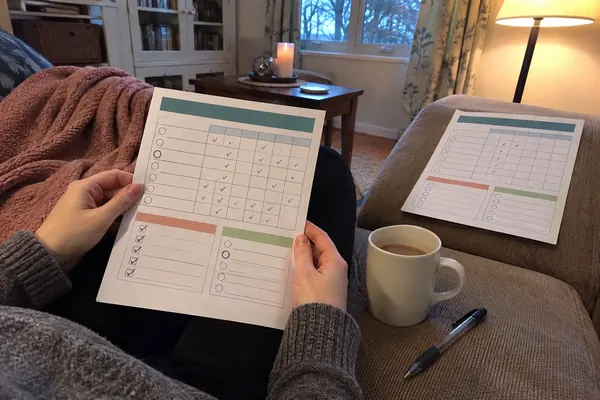
The review is where the planner earns its place. Once a week, ideally on Sunday evening, spend five minutes with the finished sheet and a pen. Count the ticks in each row. Look at the highest and lowest mood and energy days and read across to see what else happened on them.
Ask three plain questions. What helped? What got in the way? What is one change for next week? Write the answers in the margin or on the back of the sheet. Then write next week’s focus on a fresh copy.
In an office, I used to do a similar thing with staff rotas on Friday afternoons: look at what went wrong, change one thing, move on. It works because the change is small and specific. You are not trying to fix your whole life, just adjust one lever and see what moves.
Keeping it going when you miss days
You will miss days. Everyone does. The common mistake I see is treating a blank column as failure, then abandoning the whole sheet. A blank column is just a blank column. Leave it empty, or fill in what you remember, and carry on the next day.
Two things make it easier. First, put the planner where you will see it, not in a drawer. Mine lives on the kitchen counter, beside the pens, and the monthly calendar on the fridge sits a few steps away. Second, attach filling it in to something you already do, like brushing your teeth or switching off the kettle.
If you keep missing the same row, that is information. Either the row is wrong for your life, or the habit needs to be smaller. Change the row rather than blaming yourself. A habit tracker printable can help if you want to build one of those behaviors more intensively over a month.
Printing and binding tips
Print on US Letter at 100 percent, portrait, with scaling set to actual size. If you are in a country that uses A4, choose fit to page and check the preview. I test-print every sheet on my home inkjet on both sizes, and this one comes out clean on standard 20 lb copy paper. If you write with a gel pen or fountain pen and notice bleed-through, use a slightly heavier paper, around 24 lb or 28 lb.
For a binder, use a three-hole punch on the left margin and keep a pocket for finished weeks. For a disc-bound or ring planner, trim to size or print at a reduced scale. Grayscale printing works perfectly, so you do not need to spend color ink.
A clipboard on the fridge or a magnetic sheet holder also works. A planner you can see is a planner you will use. If you prefer to see the whole month alongside it, the monthly planner is a natural partner.
Variations and companion pages
Once the weekly sheet feels comfortable, you may want a variation. A common one is a morning and evening split: three rows for morning routine, three for evening, and a short reflection line. Another is a “minimum viable week”, with only five rows for busy or difficult seasons. Another is a focused month, repeating one theme such as sleep for four weeks in a row.
You can also add pages around the sheet. A one-page monthly overview shows appointments, such as dental visits, check-ups and classes. A simple gratitude or journaling page gives you room for more than one line. A body measurements page suits people who also want to track physical changes, though that is optional and not for everyone.
The point of the planner is to support you, not to add pressure. If any part of it feels like homework, take it out.
A note on health and professional advice
This planner records habits. It does not diagnose, treat or replace care from a qualified professional. General guidance for adults is to aim for seven or more hours of sleep and some regular physical activity each week, but individual needs vary with age, health and circumstances. Use the numbers on the sheet as starting points, not rules.
If you notice ongoing low mood, anxiety, trouble sleeping, unexplained changes in appetite or energy, or pain, please speak to a doctor or other health professional. Bring your printed weeks with you. Clear notes can make a short appointment far more productive.
If you are ever in crisis or worried about your safety, contact local emergency services or a crisis line in your area straight away. No planner can do that for you, and you deserve real support.
Common questions
What should a wellness planner include?
At minimum: sleep, movement, food or water, mood or energy, and one self-care or connection item. Most people also benefit from a single weekly focus and a short review. More than about 15 daily rows tends to become a chore rather than a help.
How is a wellness planner different from a habit tracker?
A habit tracker follows one or two behaviors in depth. A wellness planner covers body, mind and routine together, so you can see how sleep, movement and mood relate to each other across the same week.
How long should I use a wellness planner?
Try four weeks before judging it. By then you will have enough days to see patterns, such as which nights of poor sleep were followed by low energy. After that, keep it, simplify it or swap rows for a new focus.
Can I type into the printable before I print it?
Yes. You can type into the fields, edit the row labels and tap the cells on the page, and your entries are saved in your browser. Print it when you are ready, or download the blank PDF to fill in by hand.
Is a wellness planner a substitute for medical advice?
No. It is a record-keeping tool for your own habits. If you are managing a health condition, or you notice persistent low mood, poor sleep or pain, bring your notes to a doctor or other qualified professional.
What size does it print on?
The sheet is laid out for one US Letter page in portrait. It also prints on A4 if you choose fit to page in your print dialog, and the rows stay large enough to write in with a normal pen.
More free planners
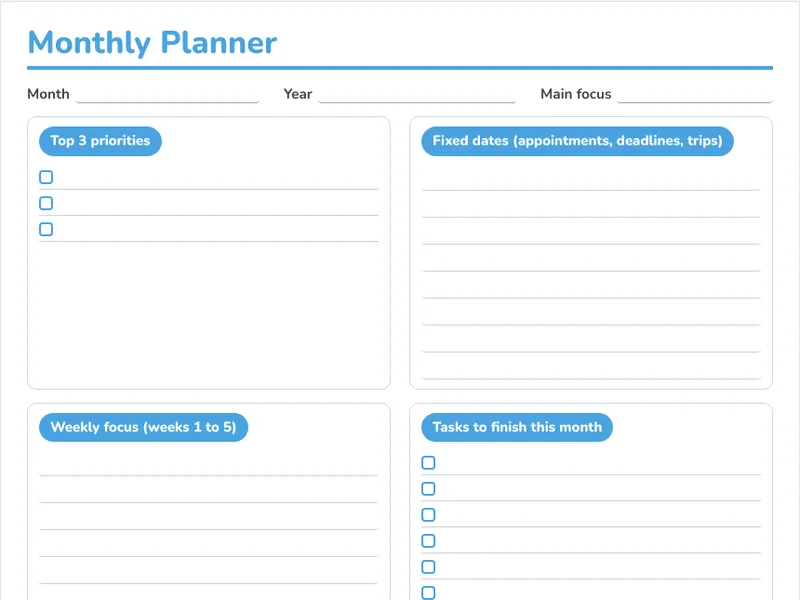 Monthly Planner: Free Printable One-Page Sheet
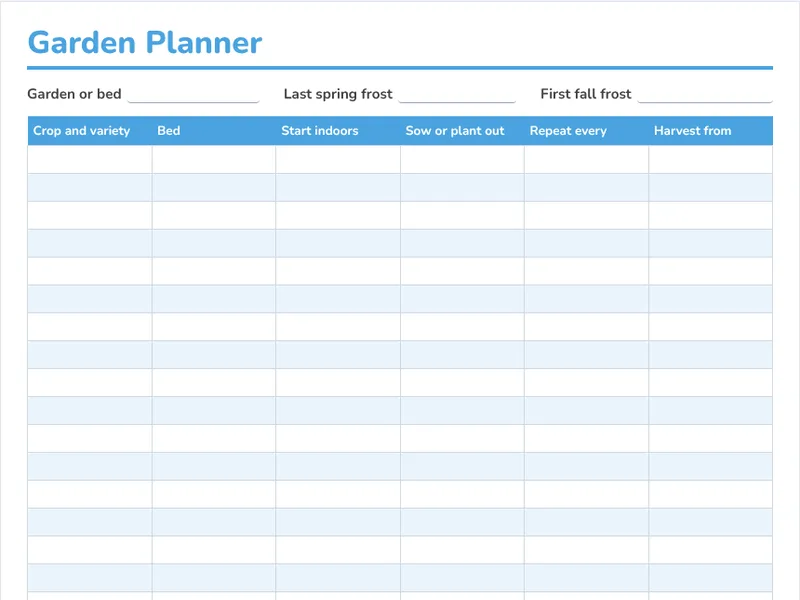 Garden Planner: Free Printable Planting Sheet
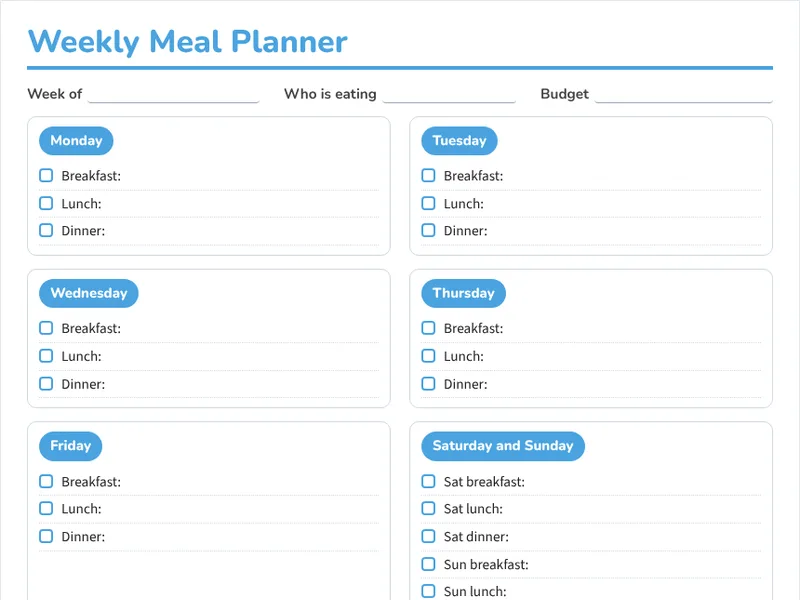 Printable Weekly Meal Planner
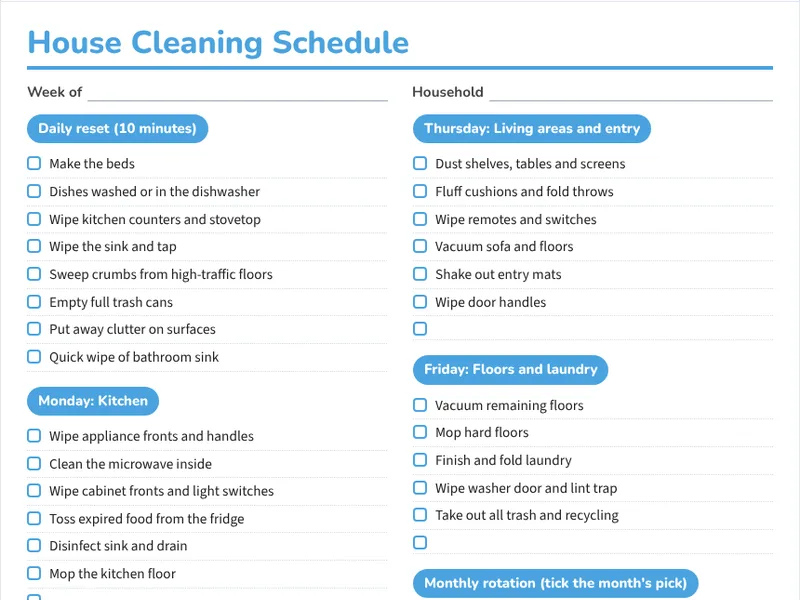 House Cleaning Schedule: Free Printable for Daily, Weekly and Monthly Jobs
 Hourly Schedule Template: Free Printable Weekly Planner
 Daily Planner 2027: Free Printable Page for Every Day