
Blank Weekly Schedule Printable

A blank weekly schedule printable is a one-page grid with Monday to Sunday across the top and hourly time slots down the side, left empty so you can fill in your own week. The one on this page runs from 6 AM to 9 PM, fits a single US Letter sheet, and has Name and Week of lines at the top. You can type into it right here, or print it and use a pen.
| Mon | Tue | Wed | Thu | Fri | Sat | Sun | |
|---|---|---|---|---|---|---|---|
| 6 AM | |||||||
| 7 AM | |||||||
| 8 AM | |||||||
| 9 AM | |||||||
| 10 AM | |||||||
| 11 AM | |||||||
| 12 PM | |||||||
| 1 PM | |||||||
| 2 PM | |||||||
| 3 PM | |||||||
| 4 PM | |||||||
| 5 PM | |||||||
| 6 PM | |||||||
| 7 PM | |||||||
| 8 PM | |||||||
| 9 PM |
Fixed commitments first, flexible tasks second, and leave at least two blank slots a day.
Free for personal, classroom and office use. Your entries are included in the print, PDF and PNG. Prints on US Letter and fits A4.
Black and White Blank Weekly Schedule Printable
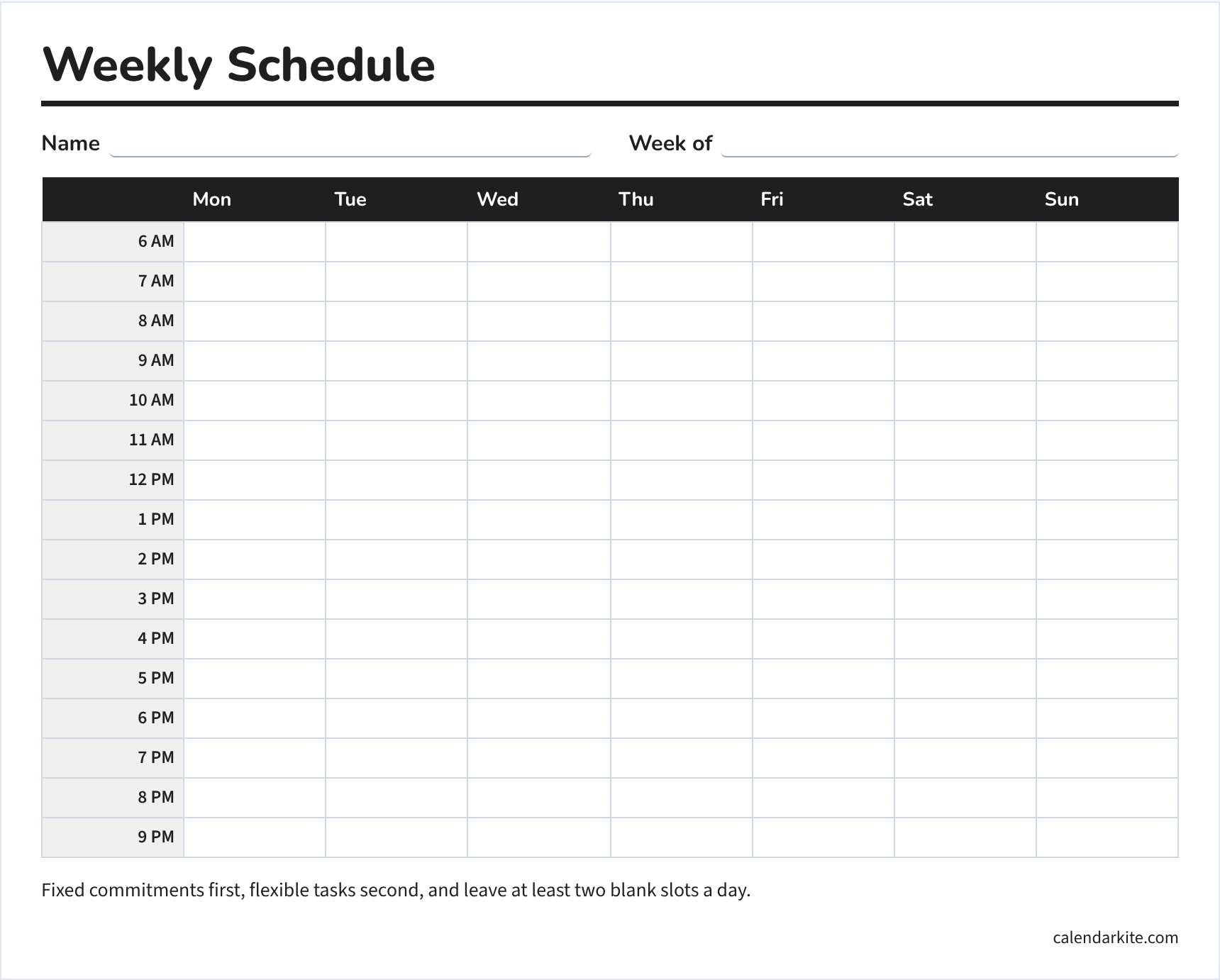
This is the one I print most, because plain black lines save ink and photocopy cleanly. I test-print it on my home inkjet, and it suits anyone who wants a no-fuss weekly grid for work shifts or class times.
Pink Blank Weekly Schedule Printable
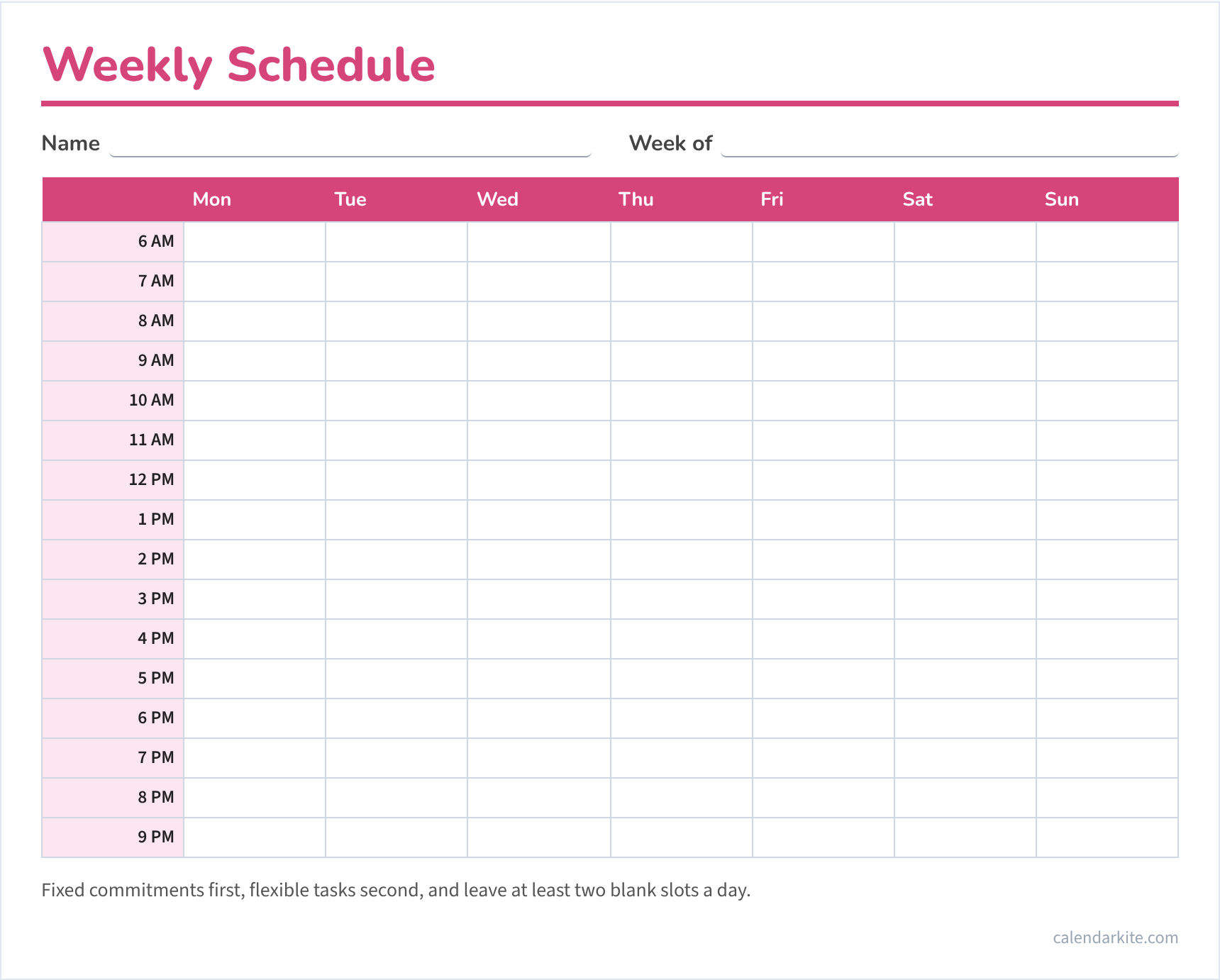
Soft pink gives a gentle look that suits a personal routine or a study timetable you'll want to look at daily. Pin it above your desk and fill in appointments in pencil first, as I learned to do in my office years.
Sage Green Blank Weekly Schedule Template
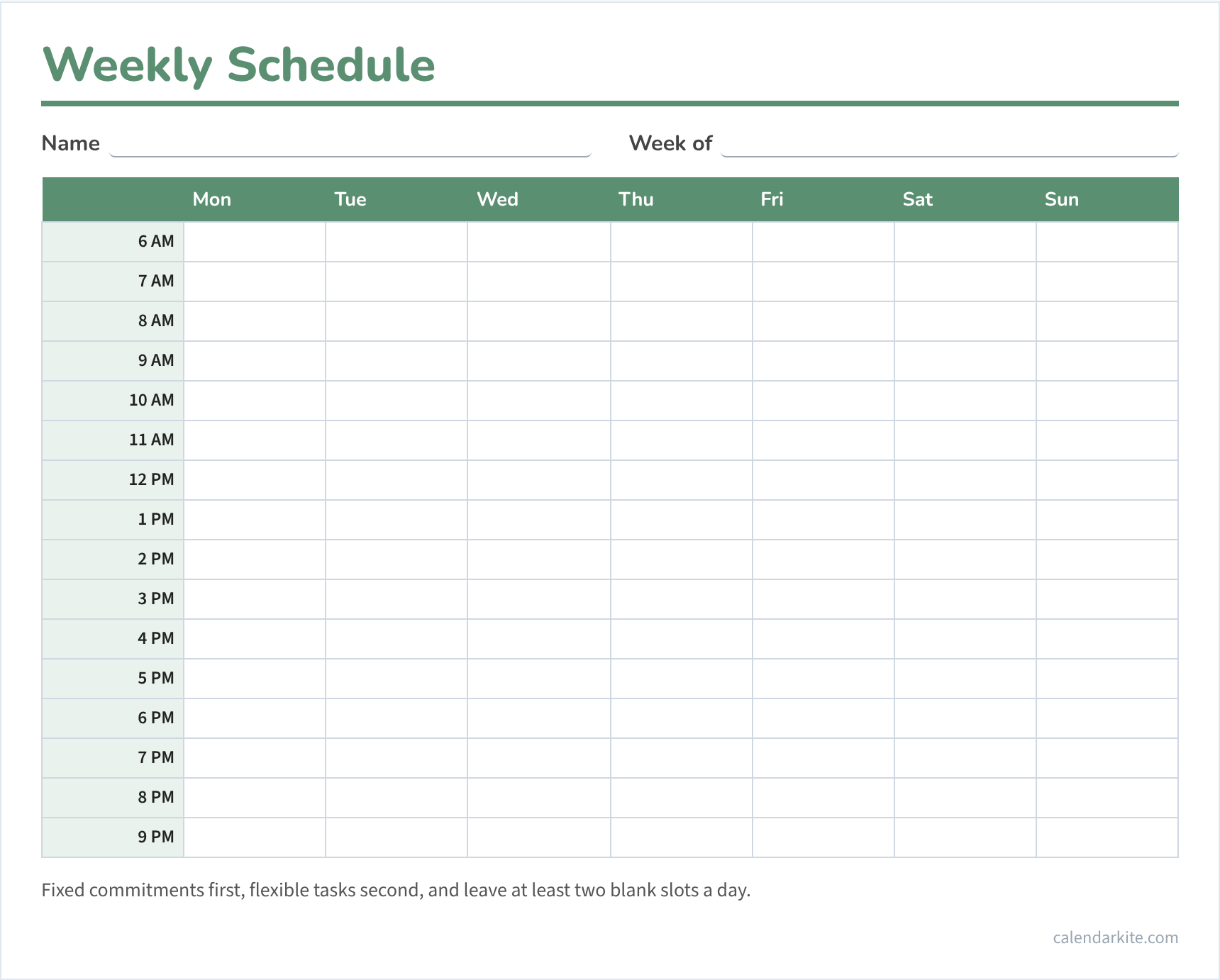
Sage green is calm and easy on the eyes, which makes it a good fit for a home-office week or meal and errand planning. I keep a similar planner on my kitchen counter for exactly that.
Lavender Blank Weekly Schedule Printable
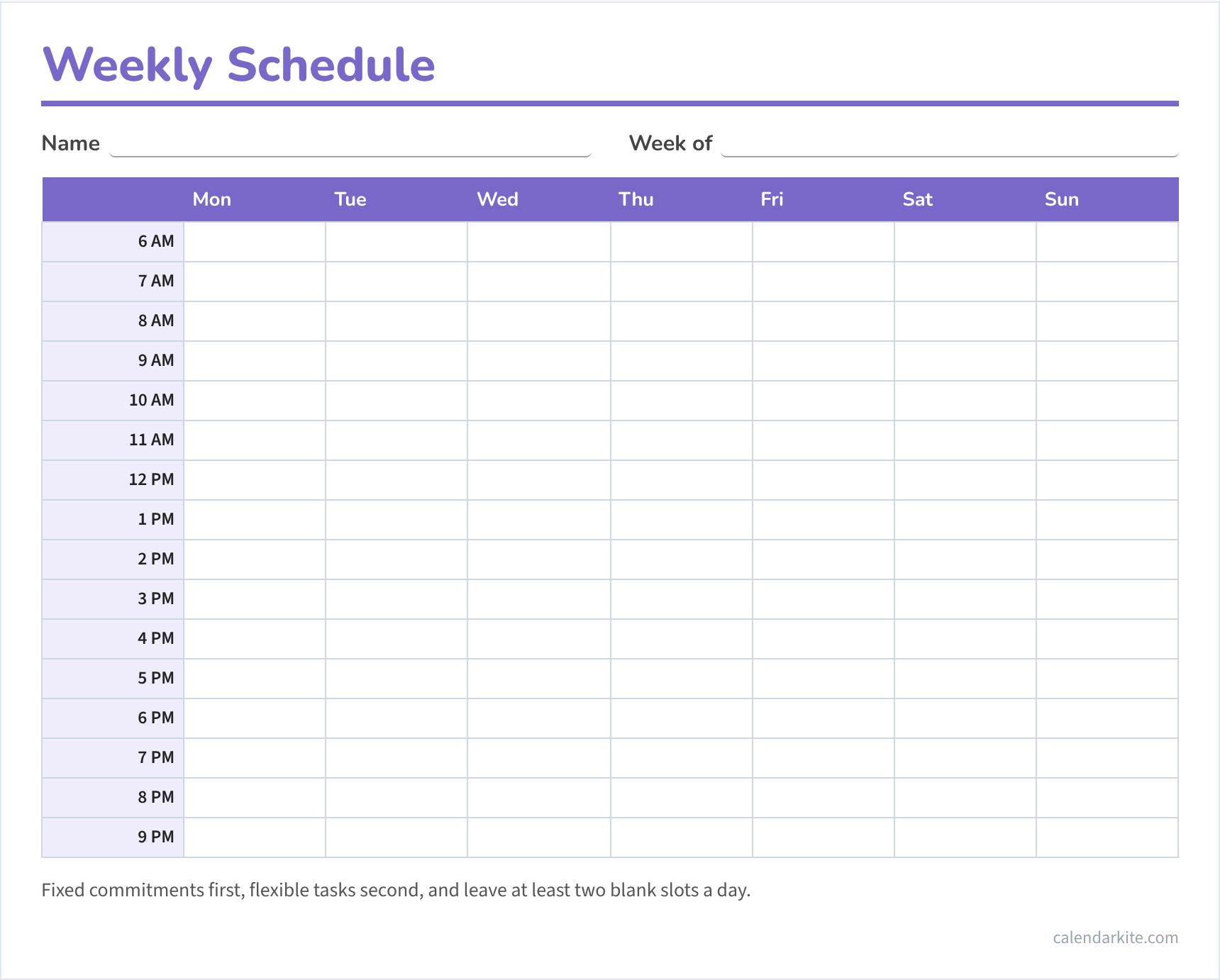
Lavender suits anyone who likes a cool, quiet color for planning focused work blocks or a weekly study plan. I made the time column roomy enough for handwriting, since cramped rows are the mistake I see most.
Cute Blank Weekly Schedule Printable
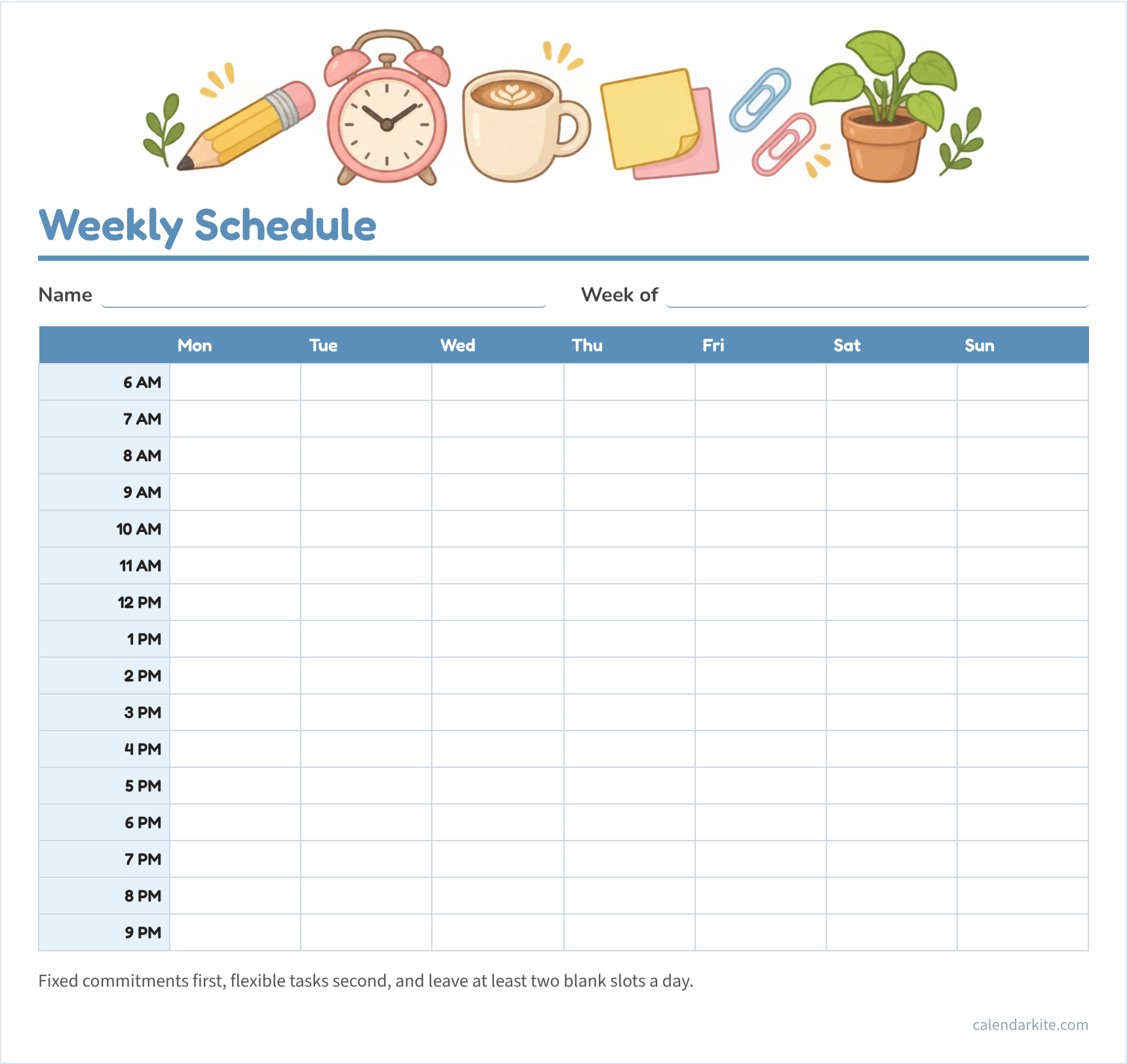
The pastel blue and little hand-drawn illustrations at the top make this a friendly pick for students and busy families. I print it on US Letter or A4 and check the margins so nothing gets clipped.
Floral Blank Weekly Schedule Printable
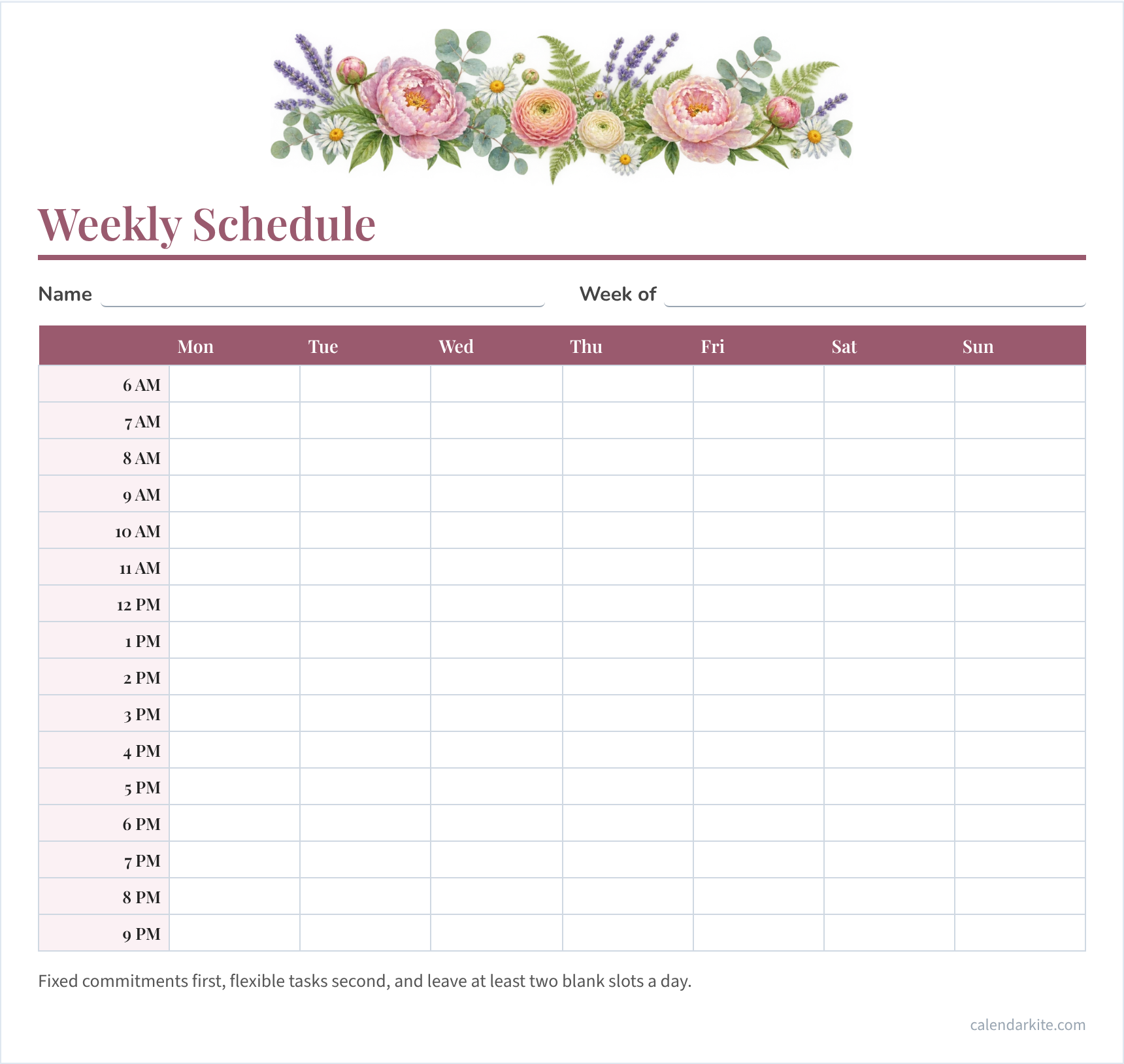
Watercolor flowers and elegant serif headings make this a lovely choice for a weekly planner you'll enjoy opening, such as a wedding-prep or garden week. It prints nicely on my inkjet, though I'd use a heavier paper for the color.
Colorful Blank Weekly Schedule Printable
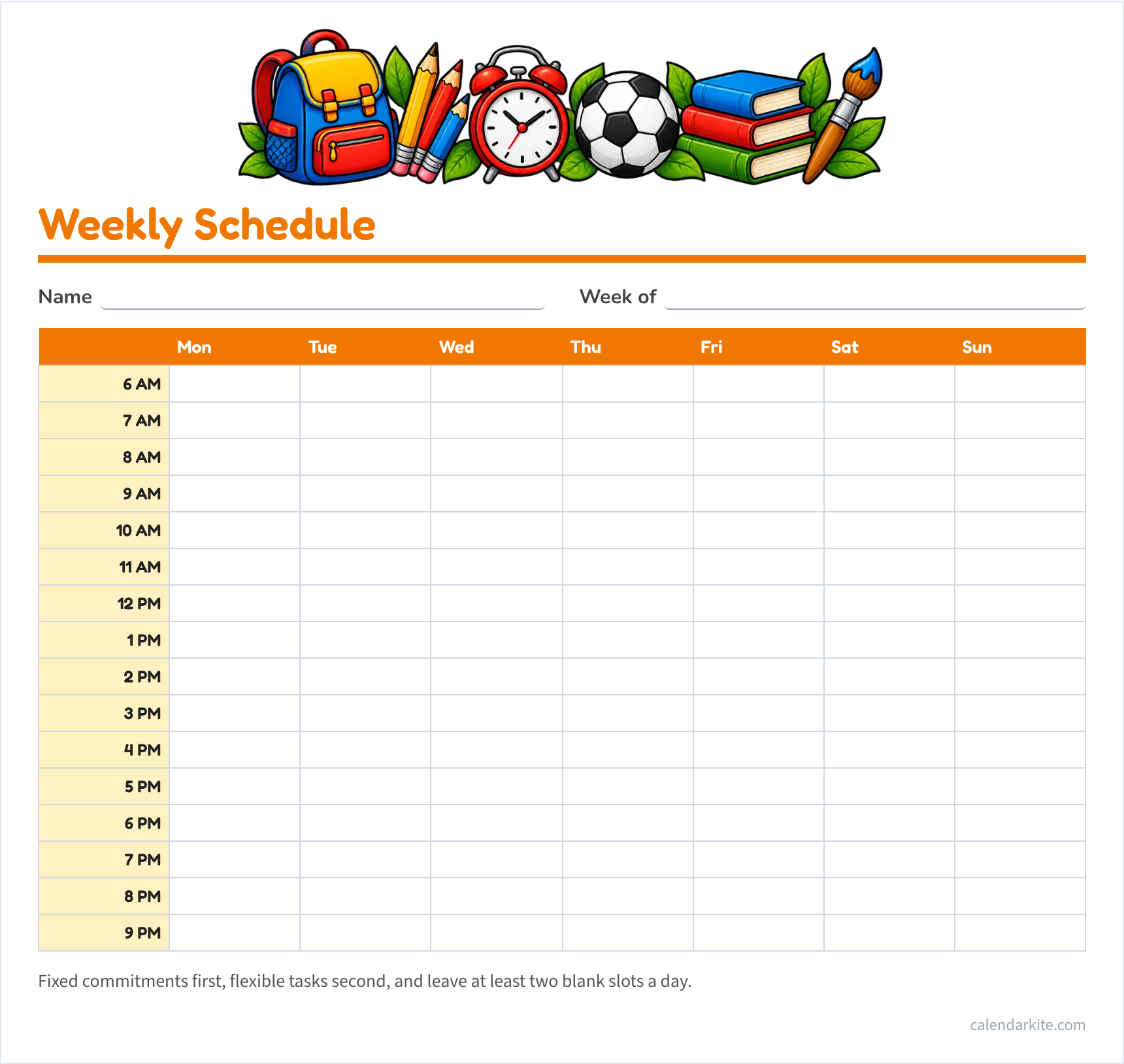
Bright orange and yellow with bold cartoon art turns planning into something kids actually want to fill in. I suggest it for a school-week routine covering homework, practice and chores.
Simple Minimalist Blank Weekly Schedule
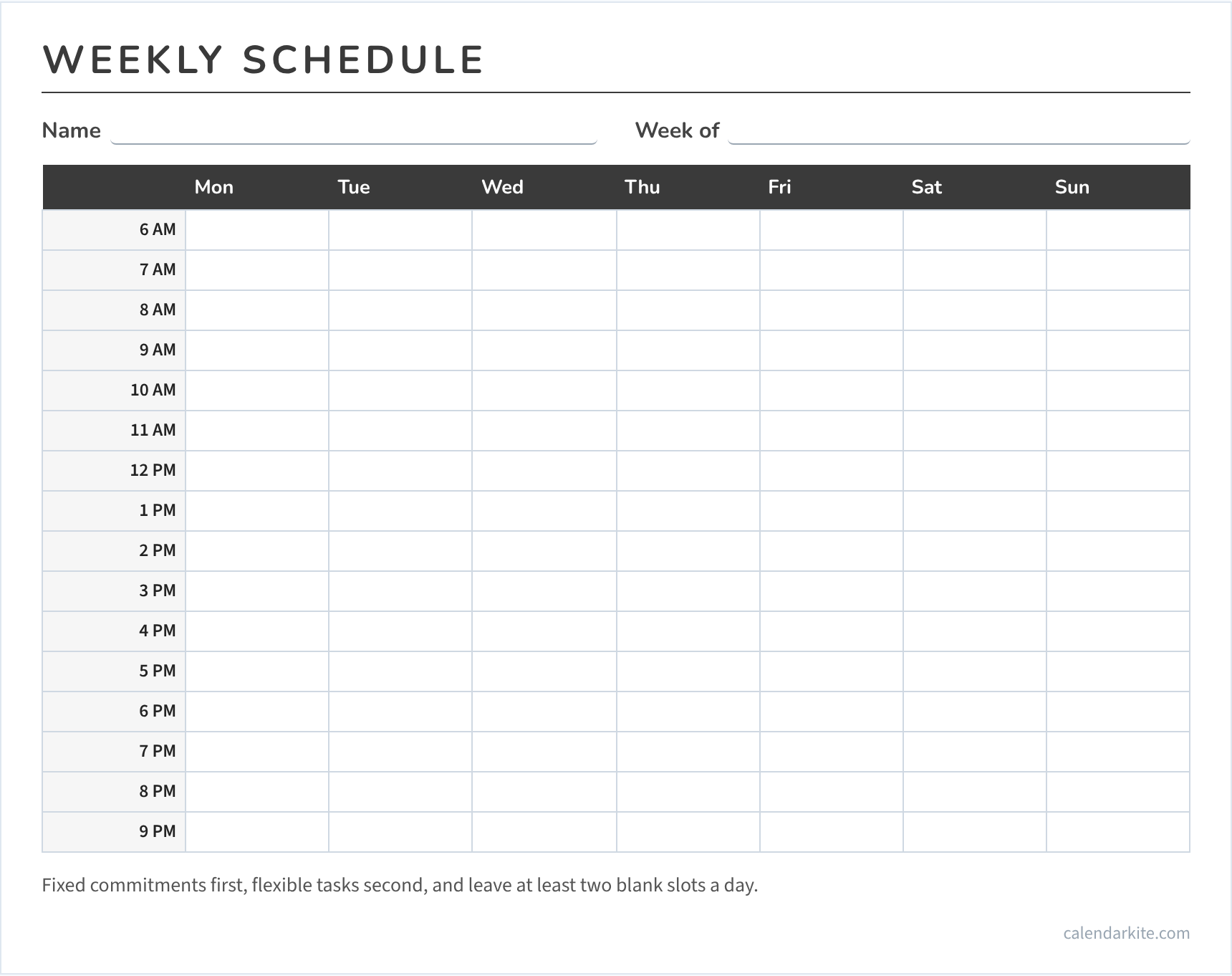
Thin gray lines and a light uppercase heading keep this version quiet and uncluttered. I suggest it for work schedules or anyone who wants to add their own notes, labels and color.
Aesthetic Blank Weekly Schedule Printable
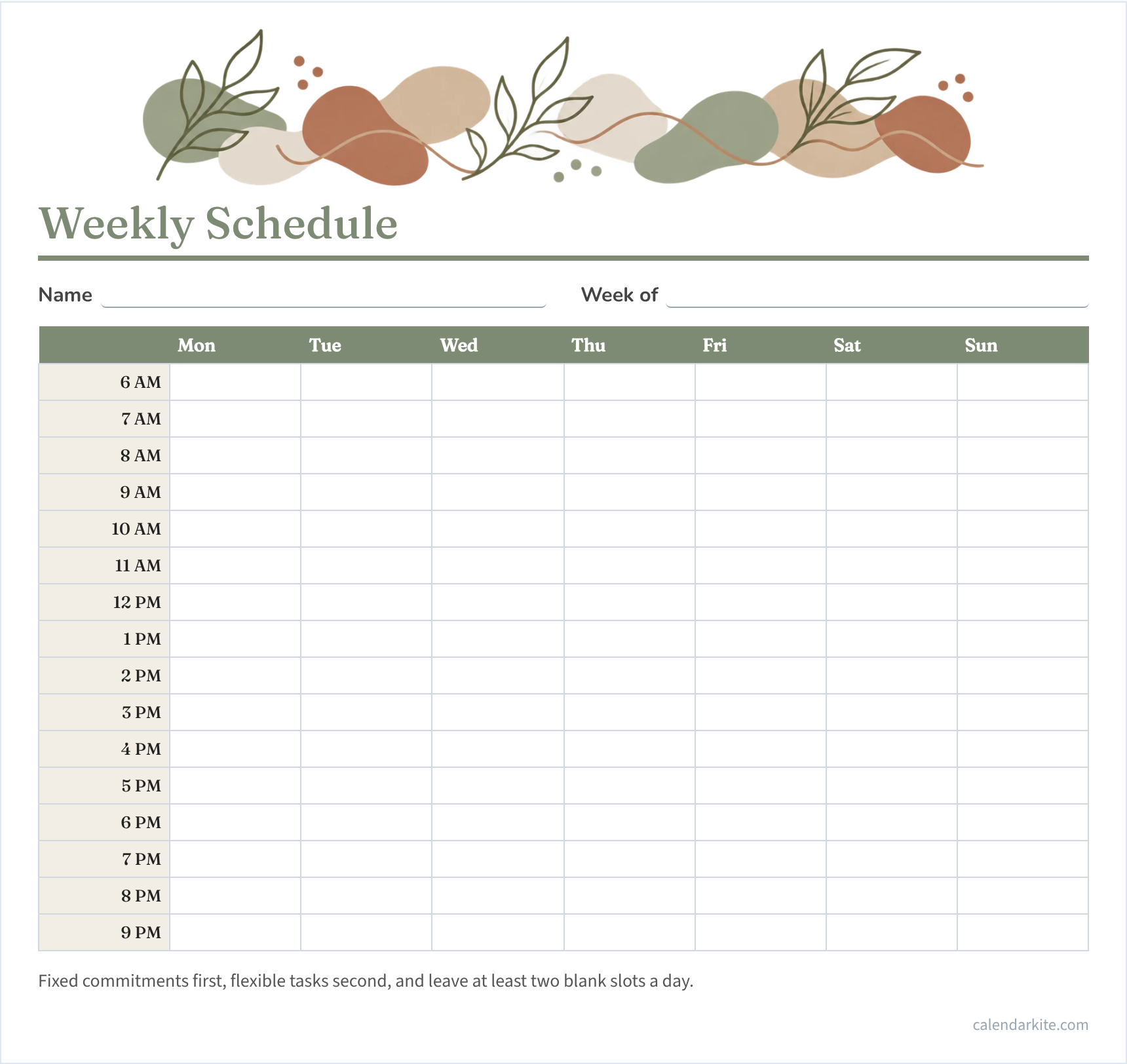
Muted sage, sand and terracotta with soft line-art leaves give this a calm, modern look. I suggest it for a weekly planning session on Sunday evening, printed and tucked into a binder or clipboard.
Modern Blank Weekly Schedule Printable
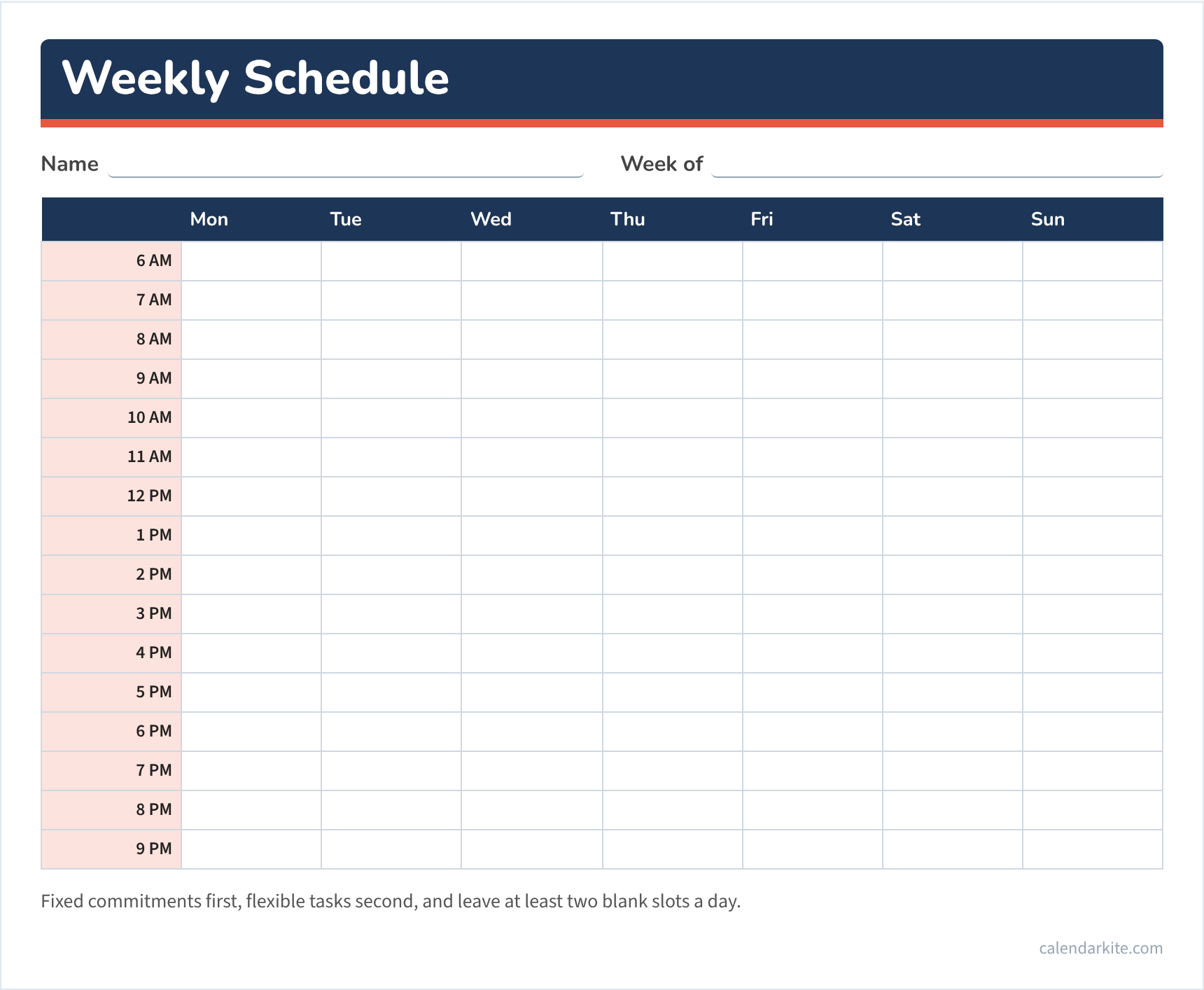
The navy header band with a coral accent gives this a crisp, professional feel. I suggest it for staff rotas, project weeks or appointment-heavy schedules where you need the days to stand out at a glance.
I keep a paper calendar on the fridge for the whole family and a planner on the kitchen counter, but the weekly grid is the sheet I reach for when a week is genuinely tight. It shows where the hours go before the week starts, and that is the point. The rest of this page covers how to fill it in so it stays readable, who gets the most from it, and how to adapt it.
What a blank weekly schedule is for
A monthly calendar tells you what is happening. A weekly schedule tells you whether you can actually do it. Seeing seven days next to each other, with times, is the quickest way to spot that Thursday has three things stacked at 4 PM or that you have no free evening until Saturday.
The sheet is deliberately blank. Pre-printed labels like “Work” or “School” only suit a few people, and they leave you fighting the layout. A truly empty grid works for a nurse on rotating shifts, a student with a class timetable, a parent juggling pickups, or someone building a new routine from scratch.
In ten years of office administration I kept schedules, supply lists and staff rotas readable, and the lesson was always the same. A schedule works when it is quick to read from a few feet away. That shaped this sheet: clear lines, a generous cell height, and nothing printed in the cells to compete with your handwriting.
How to fill in your weekly schedule
Start with the header. Write your name if the sheet will be shared or filed, and the date of the Monday in the “Week of” field. That second field matters more than it looks. Three weeks from now, a stack of unlabeled grids is useless.
Then fill the grid in this order:
- Fixed commitments that cannot move: work hours, school hours, classes, standing appointments.
- Travel and transitions: the drive, the school run, the walk to the bus.
- Meals and sleep anchors, if they shape your day.
- Flexible tasks, placed into the gaps that remain.
- Two or more deliberately empty slots per day.
The order is the whole trick. If you start with flexible tasks, you fill the grid with what you would like to do and then discover the real obligations do not fit. Fixed items go in first, and everything else has to earn its place around them.
Try this: Before you write anything, spend two minutes filling in only the fixed commitments for next week. Then count the empty hour slots left. That number is your real capacity.
Start with the fixed commitments
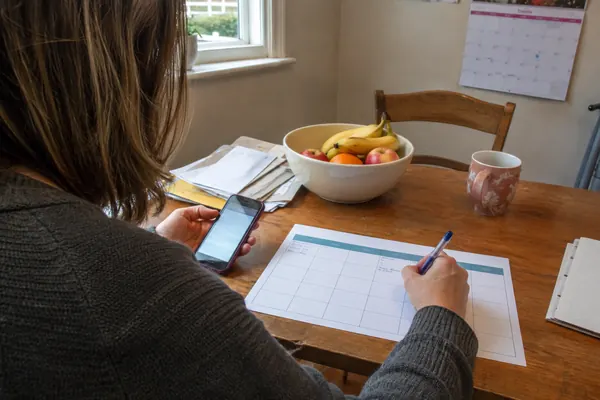
Fixed commitments are anything with someone else’s clock attached: a shift, a lesson, a dentist appointment, a recurring meeting. Pull these from your monthly calendar, your phone, or the fridge calendar. If you use a monthly view, the printable monthly calendar is a handy source to copy from, so nothing gets left behind.
Write the start time inside the cell where it begins, and draw a straight line down to mark how long it lasts. For a 9 to 5 workday, I mark 9 AM, run a line down to 5 PM, and write “Work” once at the top. Repeating the word in every cell makes the page noisy and slow to read.
Include the commitments people forget: the commute, the school pickup, the half hour you reliably spend getting a toddler into shoes. In the office I learned that most missed deadlines came from tasks that had no travel or setup time attached to them, and the same thing happens at home.
Who a blank weekly schedule suits
This format is a good fit for anyone whose week has structure but also variety. Here are the groups who get the most use from it:
- Students building a class and study timetable.
- Parents coordinating school runs, clubs and work.
- Shift workers and part-timers whose hours change every week.
- Freelancers and remote workers who need to protect focus time.
- Anyone starting a routine such as exercise, language study or a side project.
- Caregivers scheduling visits, medication times and appointments.
It is less suited to people who need to plan by task rather than by time, such as someone managing a long project with no fixed hours. If that is you, pair it with a printable to-do list and use the grid only for the time-sensitive items.
It also helps to be honest about how much detail you want. If your week needs only the headline events, a plainer weekly calendar printable with larger day boxes may feel lighter. This sheet is for when the hours themselves matter.
Setting up the time rows
The rows on this sheet are hourly, from 6 AM to 9 PM. That is sixteen rows, which is the most I could fit on a Letter page while keeping each cell tall enough to hold a short handwritten phrase. When I first tested a version with half-hour rows, the cells were so short that nothing legible fit in them, so I went back to hourly.
If your day does not match, change the labels. Type over the time labels on the page, or cross them out on paper. A night-shift worker can label the rows 6 PM to 9 AM. A student whose first class is at 8 AM might drop the 6 AM row and add 10 PM for study time.
For appointments that start at odd times, write the real time in the cell, such as “Vet 2:45”. The row tells you roughly where it sits and the note tells you exactly when. This is faster and cleaner than fighting a grid that does not match reality.
Time blocking on a weekly grid
Time blocking means giving a task a specific slot instead of leaving it on a loose list. A weekly grid is ideal for it, because you can see which hours are already claimed. Work out which tasks need real concentration, then place them in the hours when you tend to be at your best.
Block in this order: the big task, the small recurring tasks, then admin. A 90-minute block for the main job of the day, a 30-minute slot for email and messages, and a short slot for errands tends to work better than a day of scattered fragments. Name the block by what you will do, not by how you hope to feel. “Draft chapter 3” is better than “Be productive.”
Buffer time is the part people skip. Leave a gap after any appointment that involves travel, and leave one open slot per day for whatever unexpectedly takes longer than planned. If you want a finer breakdown of a single day, the hourly schedule template gives you room to go down to smaller increments.
Try this: Choose one task you keep putting off and give it a recurring 45-minute slot on three different days. Write it in pen. Notice by Friday whether the slot survived.
A weekly schedule for work and shifts
For a standard office week, you will mostly use Monday to Friday and leave the weekend columns for personal commitments. Mark your core hours, then block meetings, deadlines and focus time. A good test is to look for any day with no unbroken stretch longer than 90 minutes. That day is unlikely to produce deep work.
For rotating or irregular shifts, the blank format helps a lot because you can reprint it each week as the rota changes. Write each shift as a single vertical bar with the start and end time at the top, then layer in sleep, childcare and appointments around it. If you run a team rather than just your own week, the free work schedule templates are better suited to staff rotas.
In the office, I found that people trusted a schedule far more when the times were written exactly, not rounded. “Start 7:30” was followed. “Early” was not. Use real times for anything that depends on another person, and rounded blocks for everything that depends only on you.
A weekly schedule for students and homeschool
Students can use the grid as a timetable: write each class in its slot, then add study blocks, commute, work shifts and meals. The aim is to see how much unclaimed time you actually have, so assignments are given a real slot rather than “sometime this week.” For degree-level planning across a semester, the college schedule planner goes further, and this weekly sheet works well beside it.
Homeschool families can run the same layout with one column per day and subjects written as blocks. Many families I hear from like to fix the anchor points (math at 9, read-aloud after lunch) and leave the afternoon looser. If you want a structure built specifically for that, take a look at the homeschool schedule template.
For younger children, print a copy per child and use simple words or small drawings you add yourself. Mine like to see “Swim” on Tuesday written in their own words, which seems to make them more willing to turn up.
A weekly schedule for the family
A shared family week is where this sheet earns its keep. Give each person a color of pen and write everyone’s commitments in the same grid. Overlaps jump out immediately: two pickups at the same time, one parent working late on the night of a school concert.
At home, I fill in ours on Sunday evening after checking the fridge calendar, and it takes about ten minutes. The main thing I changed in this layout after trying it at home was leaving Name and Week of as proper writing lines rather than tiny boxes, because with two kids’ versions on the counter I kept mixing them up.
You can link the schedule to other household sheets. Evening meal plans fit well with a printable weekly meal planner, and recurring jobs belong on a weekly cleaning schedule rather than taking up space in the main grid.
Color and symbol coding
Color helps once there are more than three categories in a week. Pick four colors at most, and write the key somewhere on the page. For example: blue for work or school, green for family, orange for health and exercise, and a pencil outline for tentative plans.
If you print in black and white, symbols do the same job. A star for must-do, a circle for flexible, a triangle for travel, and a box for a deadline are easy to draw by hand and still readable on a photocopy.
Keep the system simple enough that you never need to look up the key. When I used to color-code staff rotas, the sheets that worked had two or three colors. The ones with seven were harder to read than plain black ink.
Variations worth trying
The same blank grid can be adapted in many ways, and none of them needs a new template:
- Five-day version: ignore the weekend columns and use them for notes or a mini to-do list.
- Split-day version: label each cell with morning, afternoon and evening bands rather than exact hours.
- Pencil draft, pen final: write the plan in pencil on Sunday, then ink the commitments that become definite.
- Theme days: assign a theme to each day, such as admin on Monday and errands on Thursday, and block to match.
- Two-week spread: print two sheets and tape them side by side for a fortnight view.
If you prefer to see the whole month before zooming in, print the relevant month from the all printable calendars collection and keep it next to this sheet. The month shows the shape and the week shows the detail.
Printing tips for Letter and A4
The sheet is built for US Letter, and it prints well on A4 too if you choose “Fit to page” in your printer dialog. Always print at 100 percent scale first if you can. Scaling down shrinks the cell height, and the cells are the most useful part of the page.
Use plain 20 lb office paper for everyday weeks. A slightly heavier paper, around 24 lb, handles gel pens and highlighters with less bleed-through. If you want to use fine felt-tip pens, test one on the back margin first. I test-print each of my printables on a home inkjet on both Letter and A4, and portrait grids with fine lines show up well even on the draft setting, which saves ink.
For weeks you will reuse, such as a fixed class timetable, slide a printed copy into a clear sleeve and write on it with a dry-erase marker. You can then wipe it clean at the end of the term and keep the original for the next one.
Try this: Print three copies at once. Fill one in right away, keep one blank in a drawer, and use the third as a rough draft for the week after next.
Keeping the schedule visible and useful
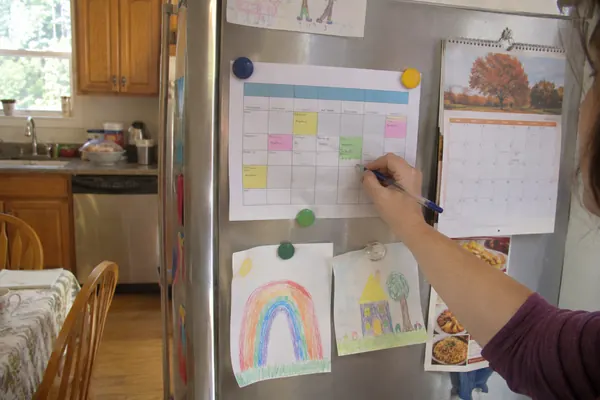
A schedule only works if you see it. Put it where your day naturally passes: on the fridge, next to your desk, inside your planner cover, or on the inside of a cupboard door. Folded in a bag, it is just paper.
Check it at the same two times every day: once in the morning to see what is ahead and once in the evening to prepare for tomorrow. Tick or strike through items as they are done. That small act of crossing out is satisfying, and it makes the leftover items obvious at a glance.
Change it as the week changes. A schedule is a working document, not a promise. If Wednesday collapses, rewrite Thursday rather than abandoning the page. People tend to drop schedules not because they are too detailed, but because the first unexpected change makes the page feel ruined.
Common mistakes to avoid
The most frequent problem I see is overfilling. If every cell is full by Sunday evening, the schedule has no slack and will fail by Tuesday. Aim for about two-thirds full, and treat the empty slots as protected time for the unexpected.
The second is vague entries. “Admin” or “Stuff” tells you nothing at 2 PM on a busy day. Write the real task, even in two words: “Pay invoices”, “Call school”.
The third is ignoring how long things take. A 30-minute errand with a 20-minute drive each way is more than an hour. Add the travel, and your week will match reality much better.
Finally, do not copy someone else’s routine wholesale. A schedule is personal. Use the blank grid to build around your own energy, your own household, and your own commitments, and expect to adjust it a couple of weeks in.
A quick weekly review
Take five minutes at the end of the week, and look at the used sheet before you throw it away. Which blocks did you actually keep? Which kept slipping? Patterns will appear, and they tell you more than any productivity advice.
Move anything unfinished to next week’s sheet rather than leaving it hanging. If the same item moves three weeks in a row, either give it a protected slot or decide it does not belong on the list.
Then start the next sheet. Fill in the Monday date, add the fixed commitments, and leave room for the week to surprise you. For longer-range planning, the weekly planner 2027 pairs a week-by-week view with space for goals and notes.
Common questions
What is a blank weekly schedule?
It is a one-page grid with the seven days of the week across the top and time slots down the side, left empty so you can add your own commitments. You fill it in once a week and see everything at a glance.
How many hours should a weekly schedule cover?
Cover the hours you are actually awake and active. This sheet runs from 6 AM to 9 PM, which suits most households and workplaces. If your day starts earlier or ends later, cross out a label and write your own in the margin.
Should a weekly schedule start on Sunday or Monday?
Start on Monday if you plan around a work or school week, because the weekend then sits together at the end. Sunday starts suit people who plan on Sunday evening for the week ahead. This sheet starts on Monday and ends on Sunday.
Can I type into the printable before printing it?
Yes. You can type into every cell and field on the page, and your entries save in your browser so they are still there when you come back. When you are happy with it, print it, or download the blank PDF to write on by hand.
How do I fit a whole week on one page without it looking crowded?
Use short keywords instead of sentences, such as 'Dentist 3:30' or 'Gym'. Write only fixed commitments in the grid and keep your longer to-do items on a separate list.
What is the difference between a weekly schedule and a weekly planner?
A schedule is organized by time, so it answers 'where do I need to be and when'. A planner is usually organized by task or goal, with more room for notes, lists and priorities. Many people use a schedule for the week's shape and a to-do list for the details.
More free planners
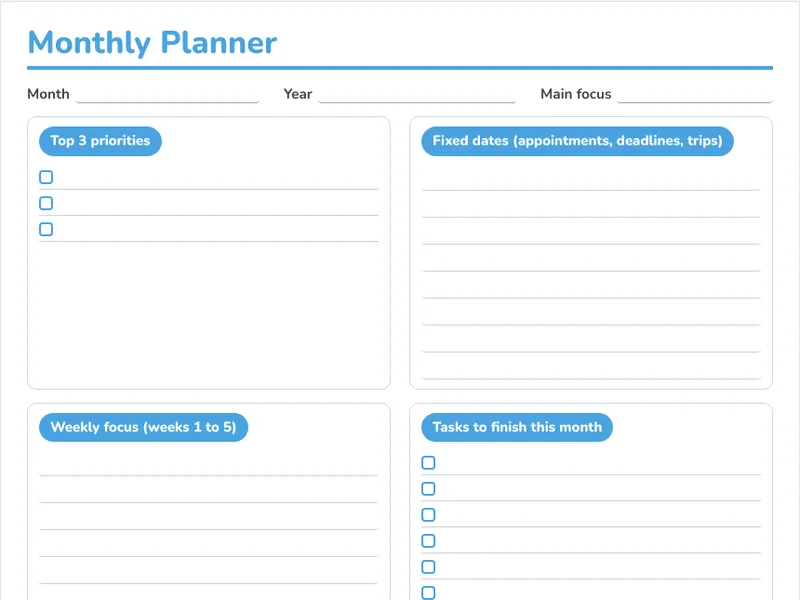 Monthly Planner: Free Printable One-Page Sheet
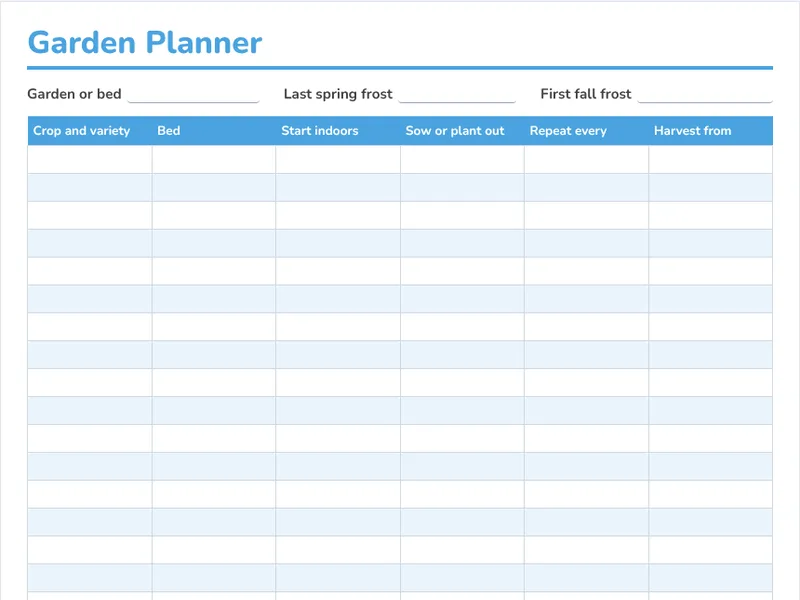 Garden Planner: Free Printable Planting Sheet
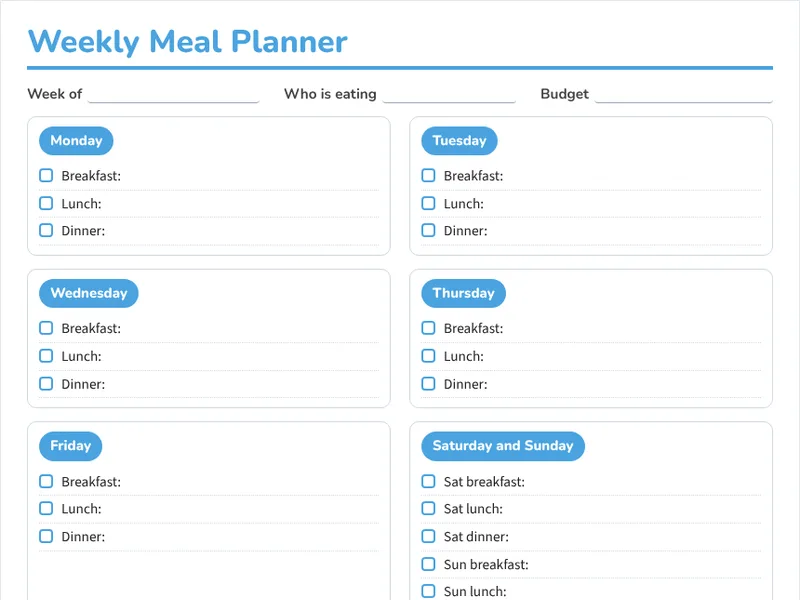 Printable Weekly Meal Planner
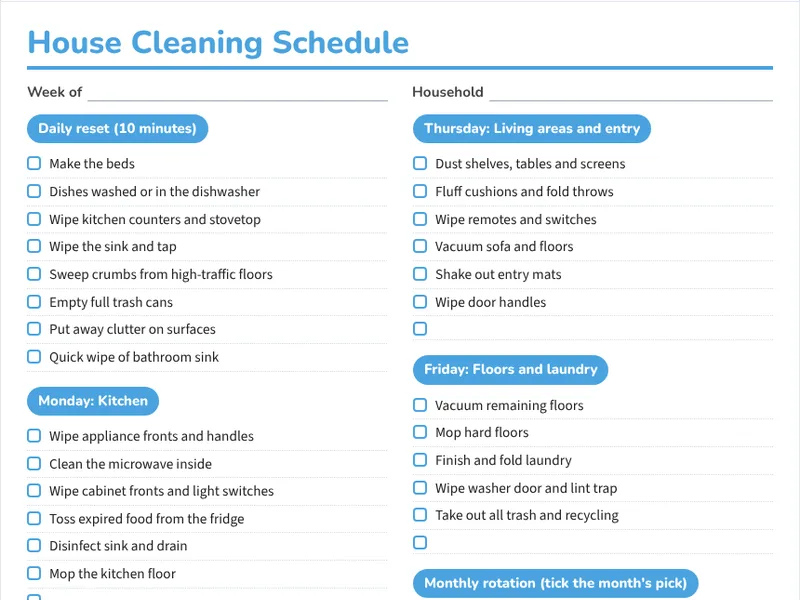 House Cleaning Schedule: Free Printable for Daily, Weekly and Monthly Jobs
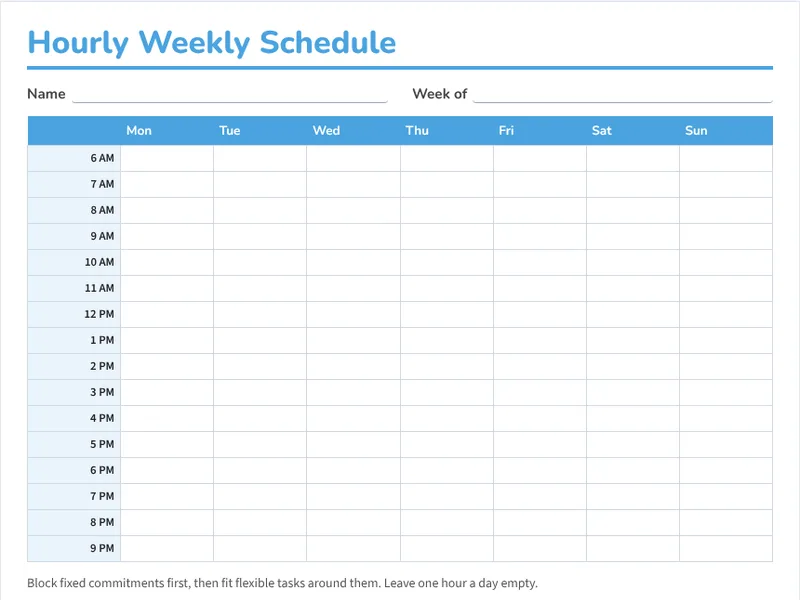 Hourly Schedule Template: Free Printable Weekly Planner
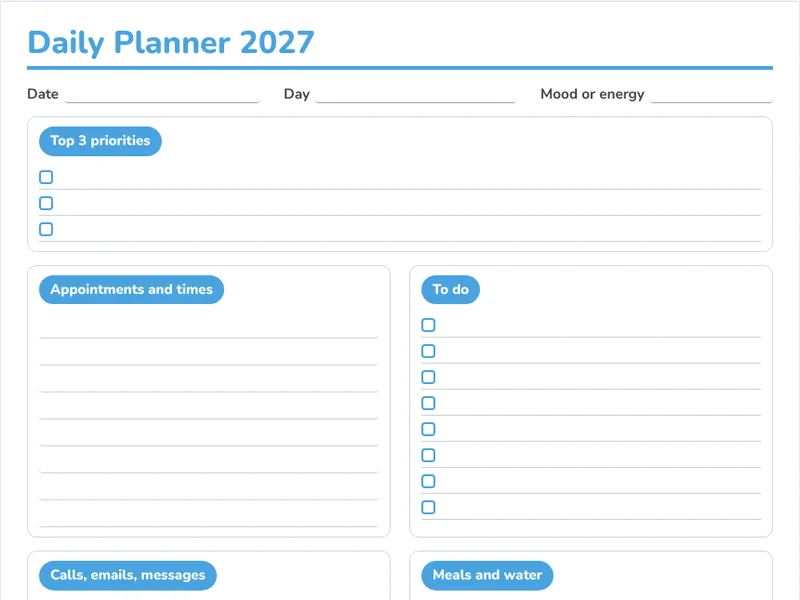 Daily Planner 2027: Free Printable Page for Every Day