
Homeschool Schedule Template: Free Printable Weekly Planner

A homeschool schedule template is a printable grid that lays out the order of your learning day across the week, so everyone knows what comes next without asking. The free one on this page has Monday to Friday across the top and ten blocks down the side, from a shared start to an afternoon or outing slot. Type straight into it, print it, or download the blank PDF and write it by hand.
| Mon | Tue | Wed | Thu | Fri | |
|---|---|---|---|---|---|
| Start together | |||||
| Block 1 | |||||
| Block 2 | |||||
| Snack + move | |||||
| Block 3 | |||||
| Lunch + reset | |||||
| Independent | |||||
| Read-aloud | |||||
| Afternoon | |||||
| Out of house |
Plan the order, not the minute. Anything unfinished moves to tomorrow's first block.
Free for personal, classroom and office use. Your entries are included in the print, PDF and PNG. Prints on US Letter and fits A4.
Black and White Homeschool Schedule Template
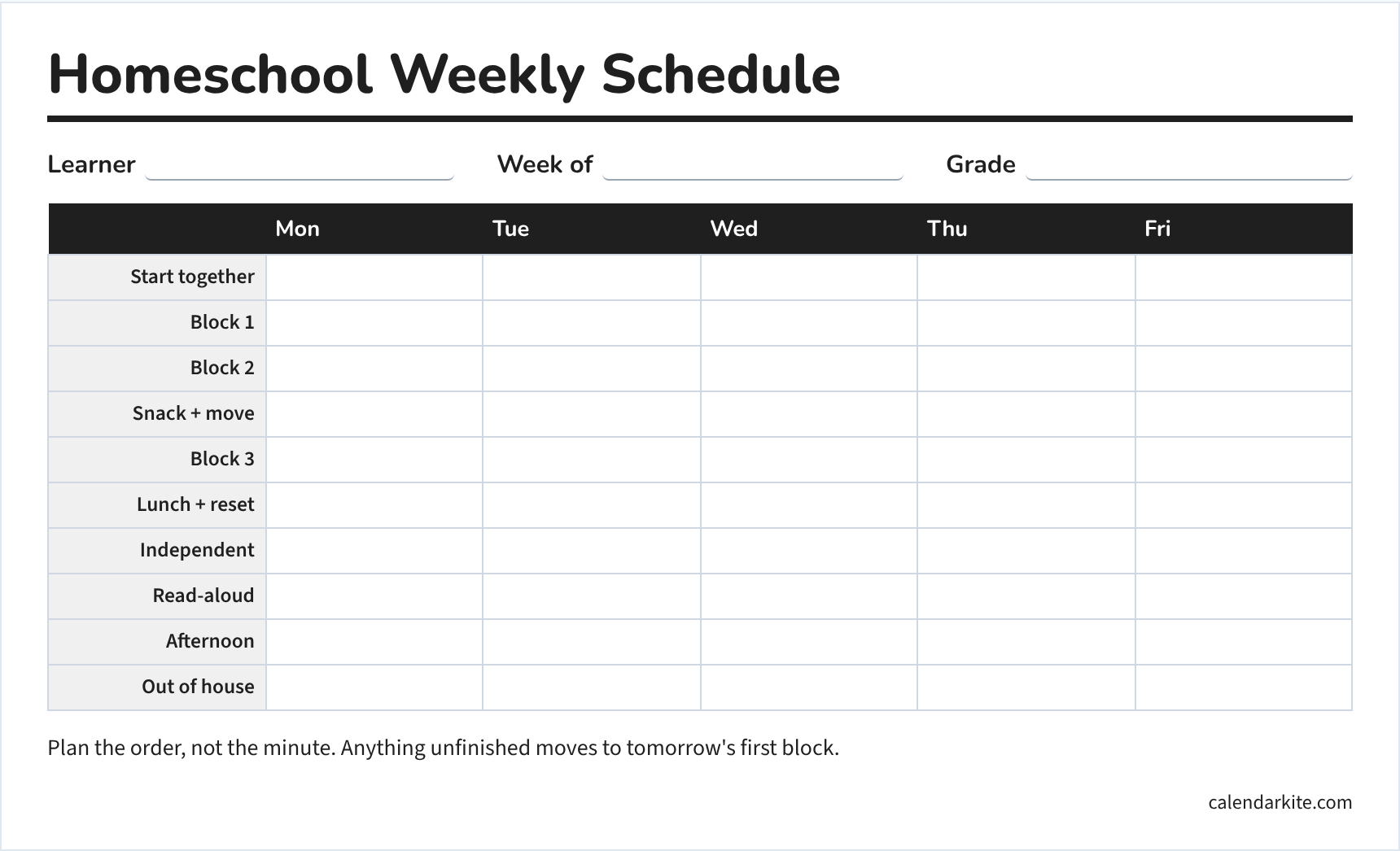
This is the one I'd print most often, since plain black lines go easy on a home inkjet and photocopy cleanly for each child. I test-print every page on my own printer, and this version stays crisp even on the draft setting.
Pink Homeschool Schedule Template
A soft pink layout suits a parent who wants a gentle, friendly look for a weekly routine on the wall. Try it for a morning-to-afternoon block plan, with one row per subject so nothing gets squeezed.
Sage Green Homeschool Schedule Template
Sage green is calm and easy on the eyes, which I like for a schedule you'll look at all day. I'd use it for a daily core-subject plan, and I keep my own planner on the kitchen counter where a quiet color blends in.
Cute Homeschool Schedule Template
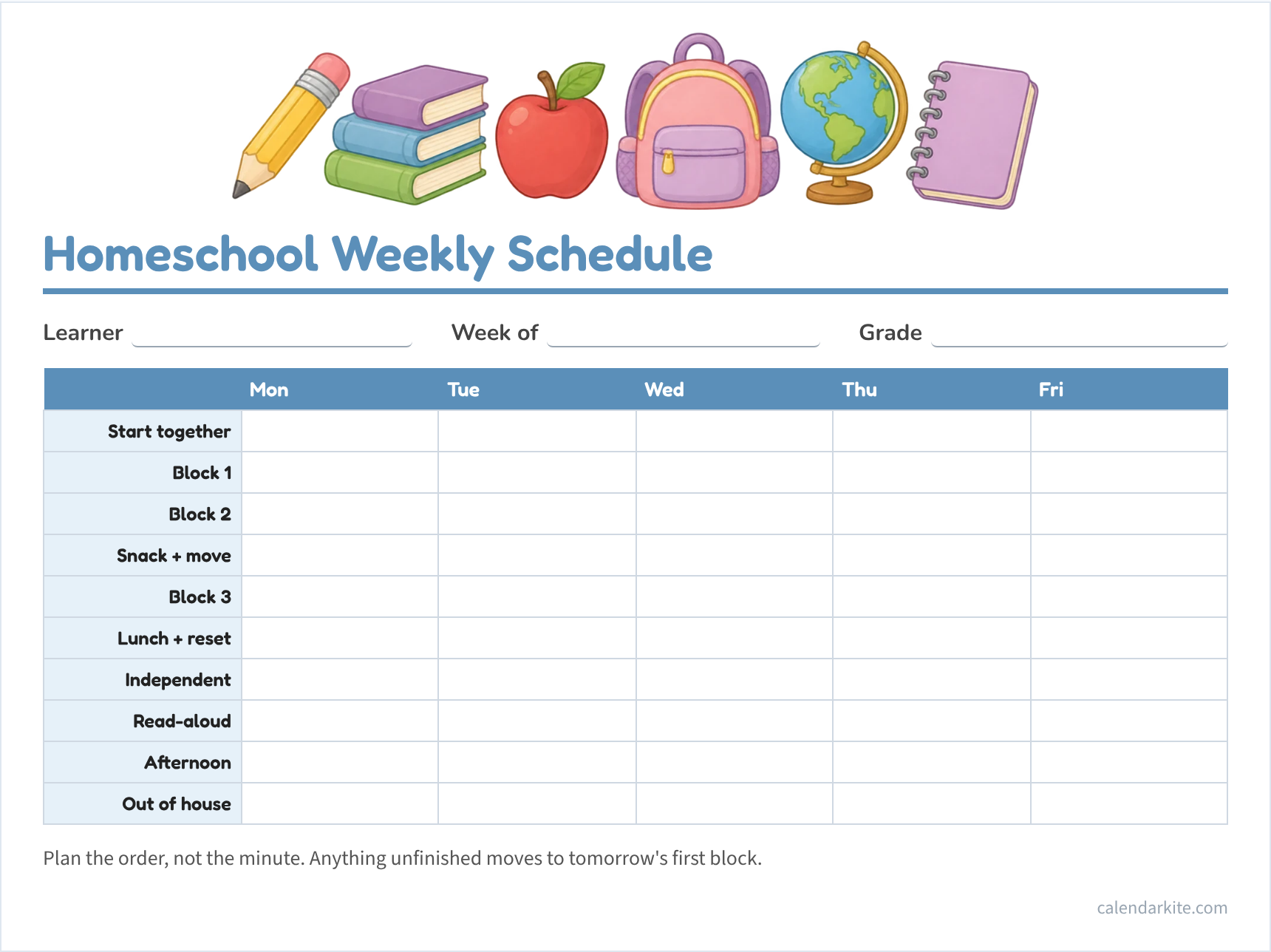
Pastel blue with little hand-drawn illustrations at the top makes this a friendly pick for younger learners who like to check off their own day. Print it for a morning routine of reading, math and snack breaks.
Floral Homeschool Schedule Template
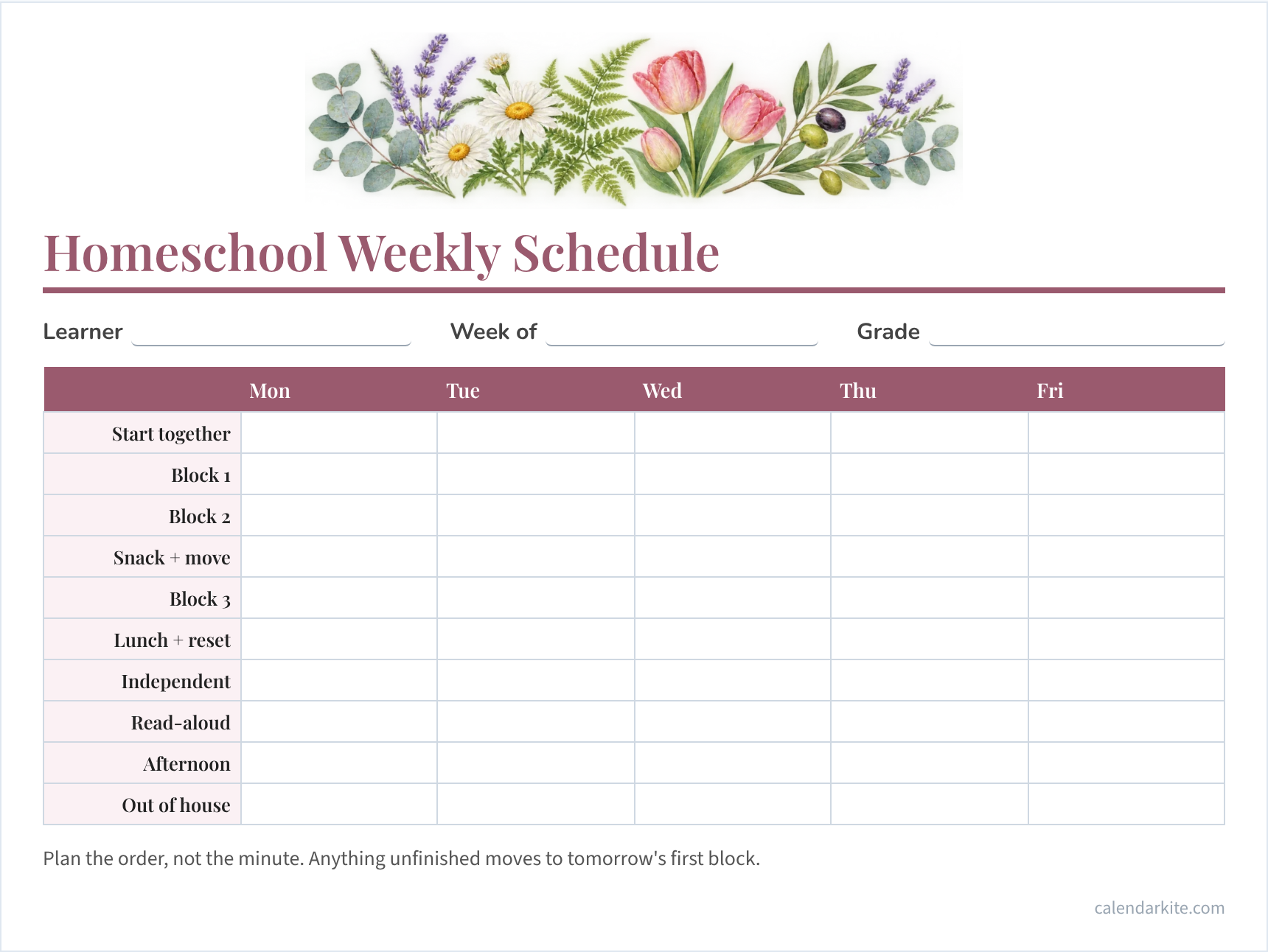
The watercolor flowers and mauve serif headings give this one an elegant feel that suits a parent keeping a tidy binder. I'd use it for a term overview, and I widened the rows so handwriting fits comfortably.
Colorful Homeschool Schedule Template
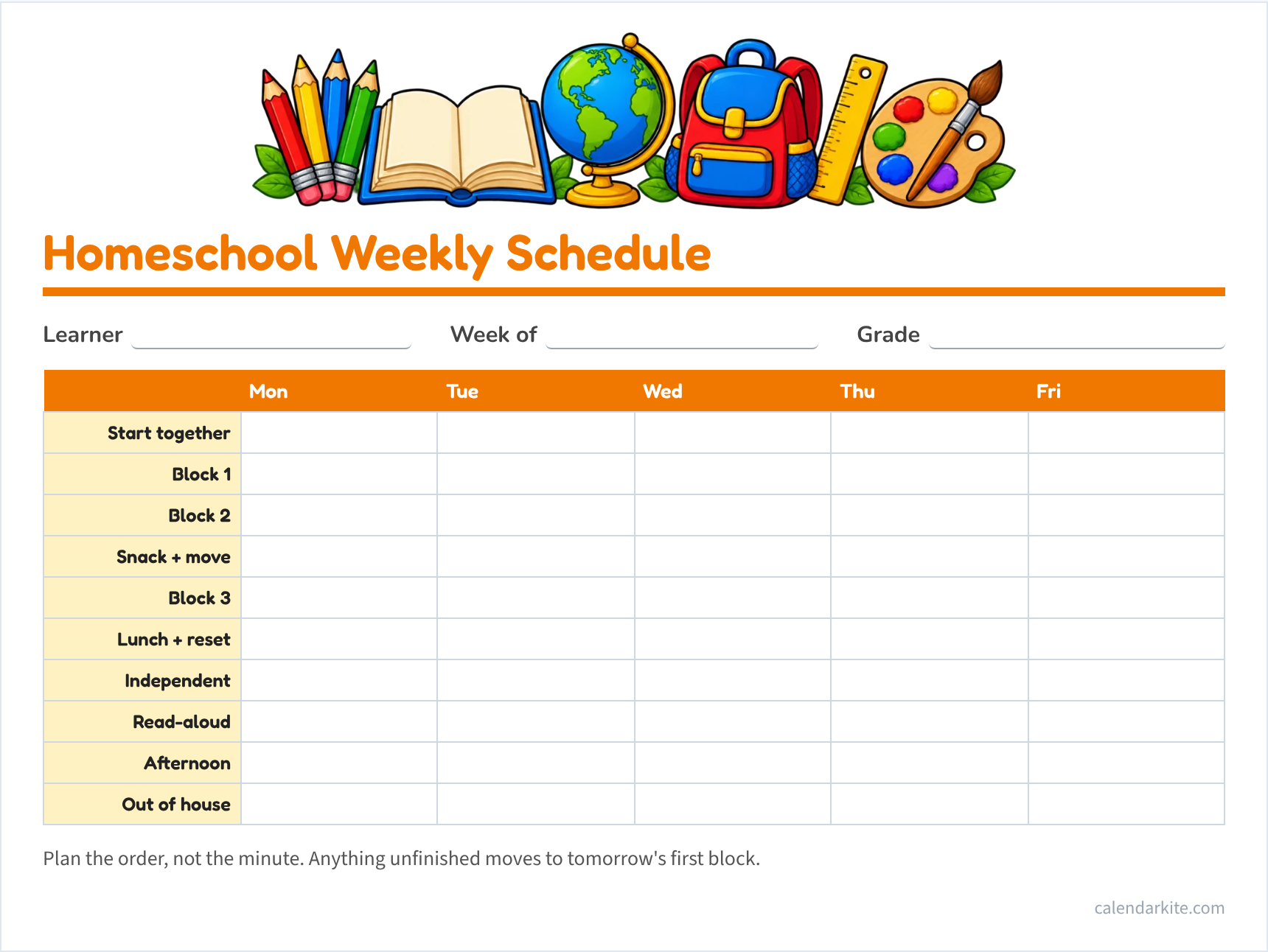
Bright orange and yellow with bold cartoon illustrations makes the day feel like something to look forward to. Hang it at kid height for a visual routine, because I've seen people tuck schedules where children can't read them.
Simple Minimalist Homeschool Schedule Template
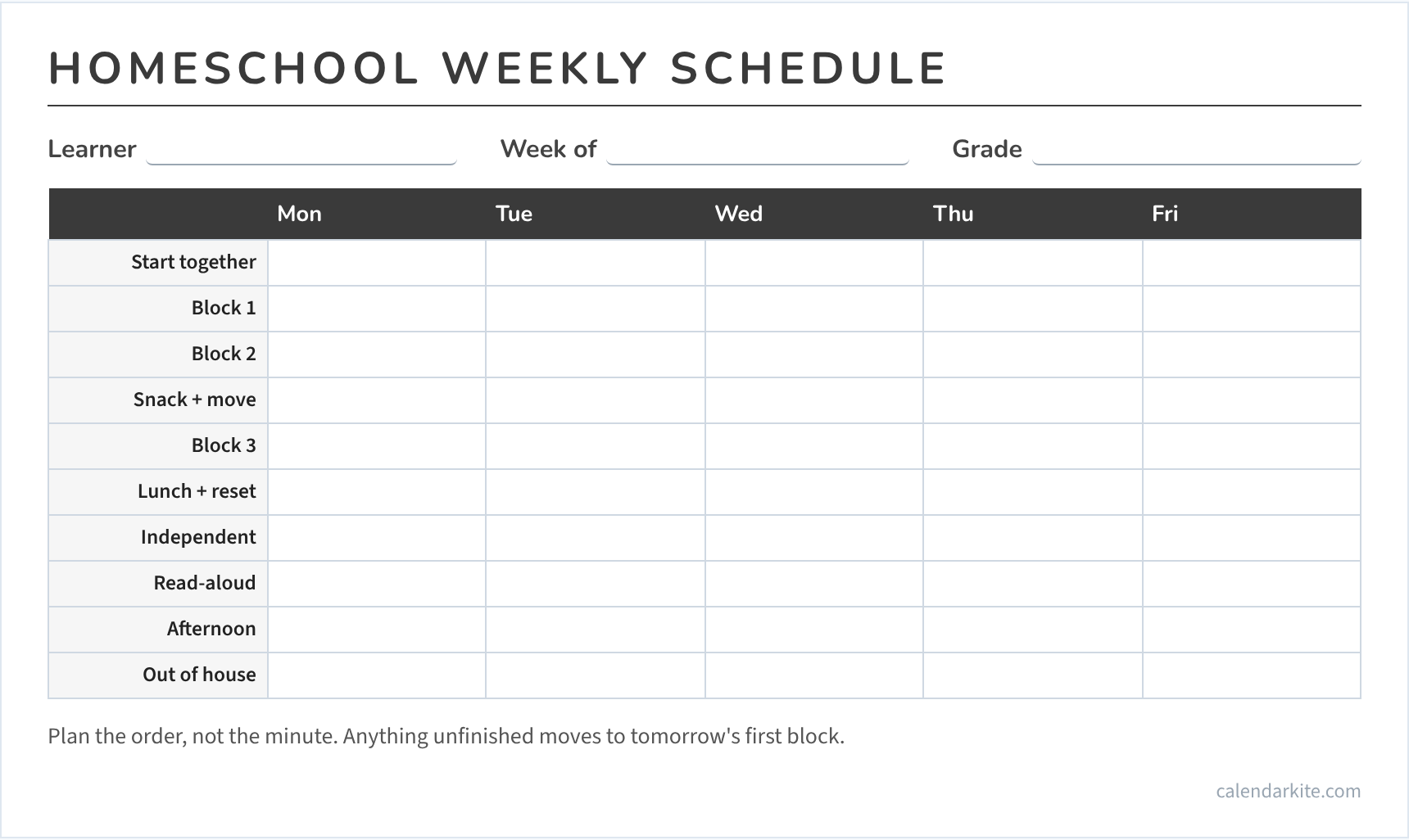
Thin gray lines and a light uppercase heading keep this version quiet, which suits anyone who wants the plan to fade into the background. In my office years I learned that a schedule people read has plenty of white space, and this one does.
Aesthetic Homeschool Schedule Template
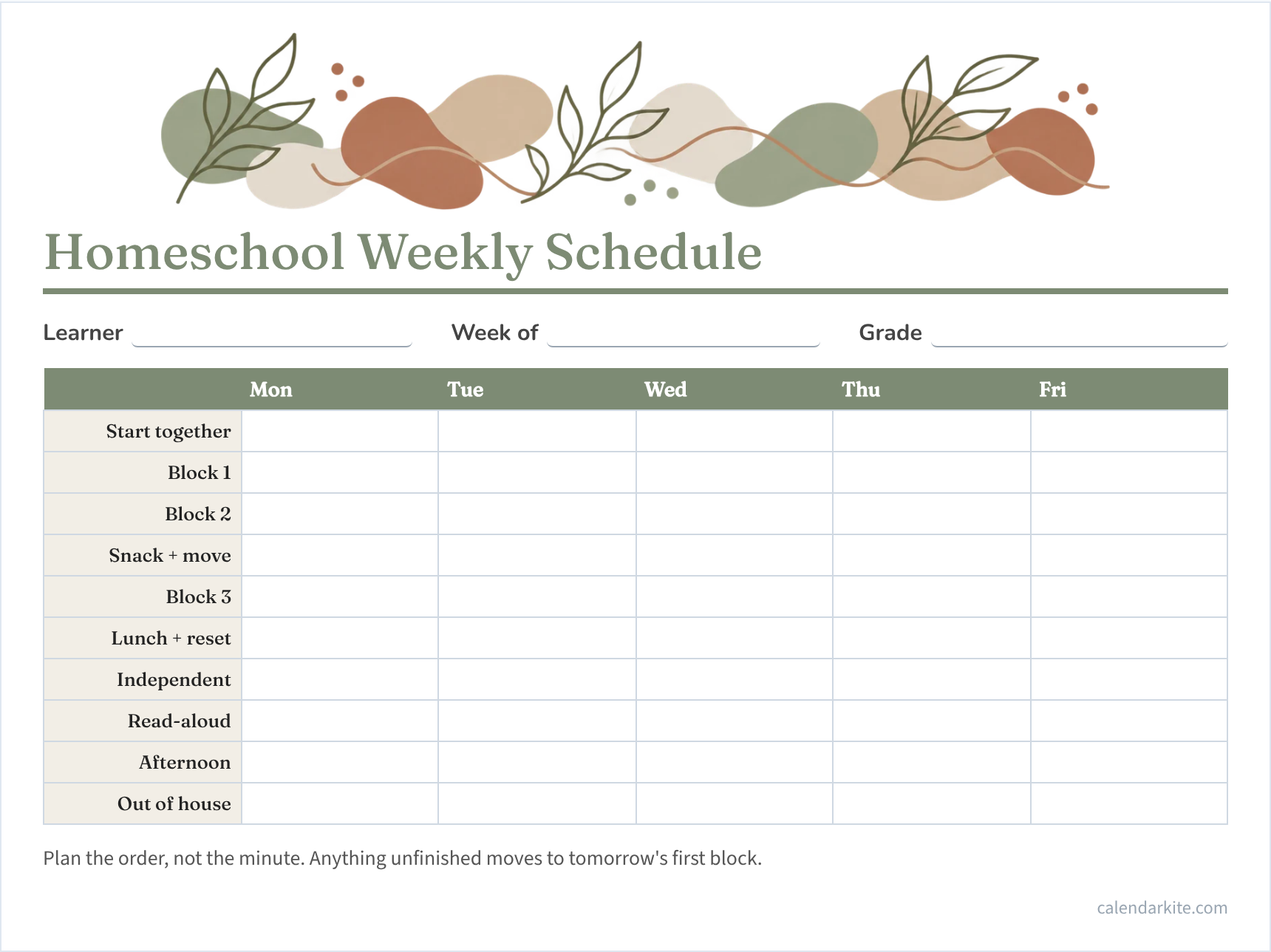
Muted sage, sand and terracotta with soft line-art leaves suit a parent who likes a pretty planner spread. Use it for a weekly rhythm of lessons, field trips and co-op days, and I'd pin it beside the paper calendar on the fridge.
Vintage Homeschool Schedule Template
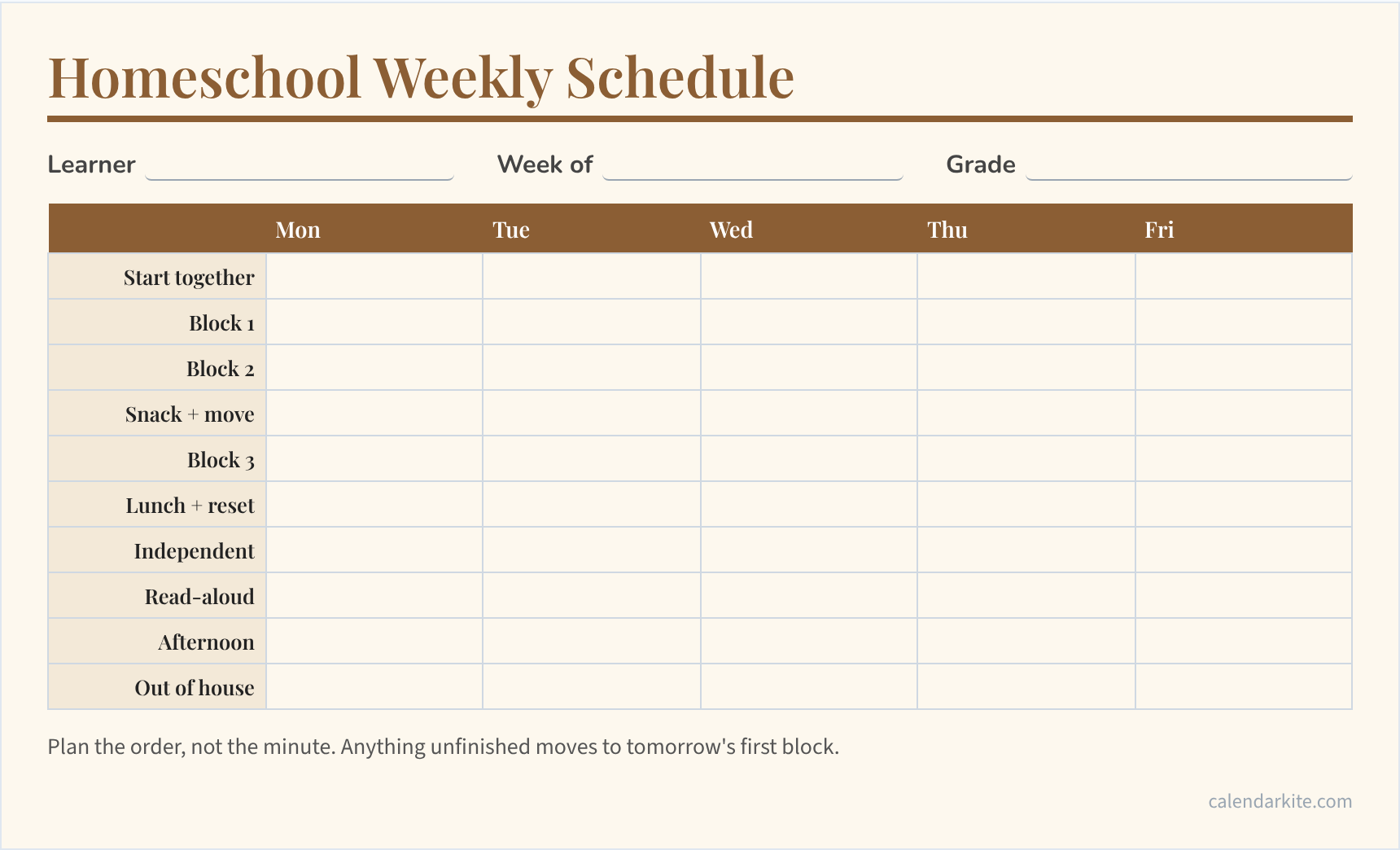
Cream paper and brown serif headings give a classic schoolroom look that suits families who love a traditional feel. I like it for a printed term plan, and I always check the margins so nothing clips on US Letter or A4.
Bold Homeschool Schedule Template
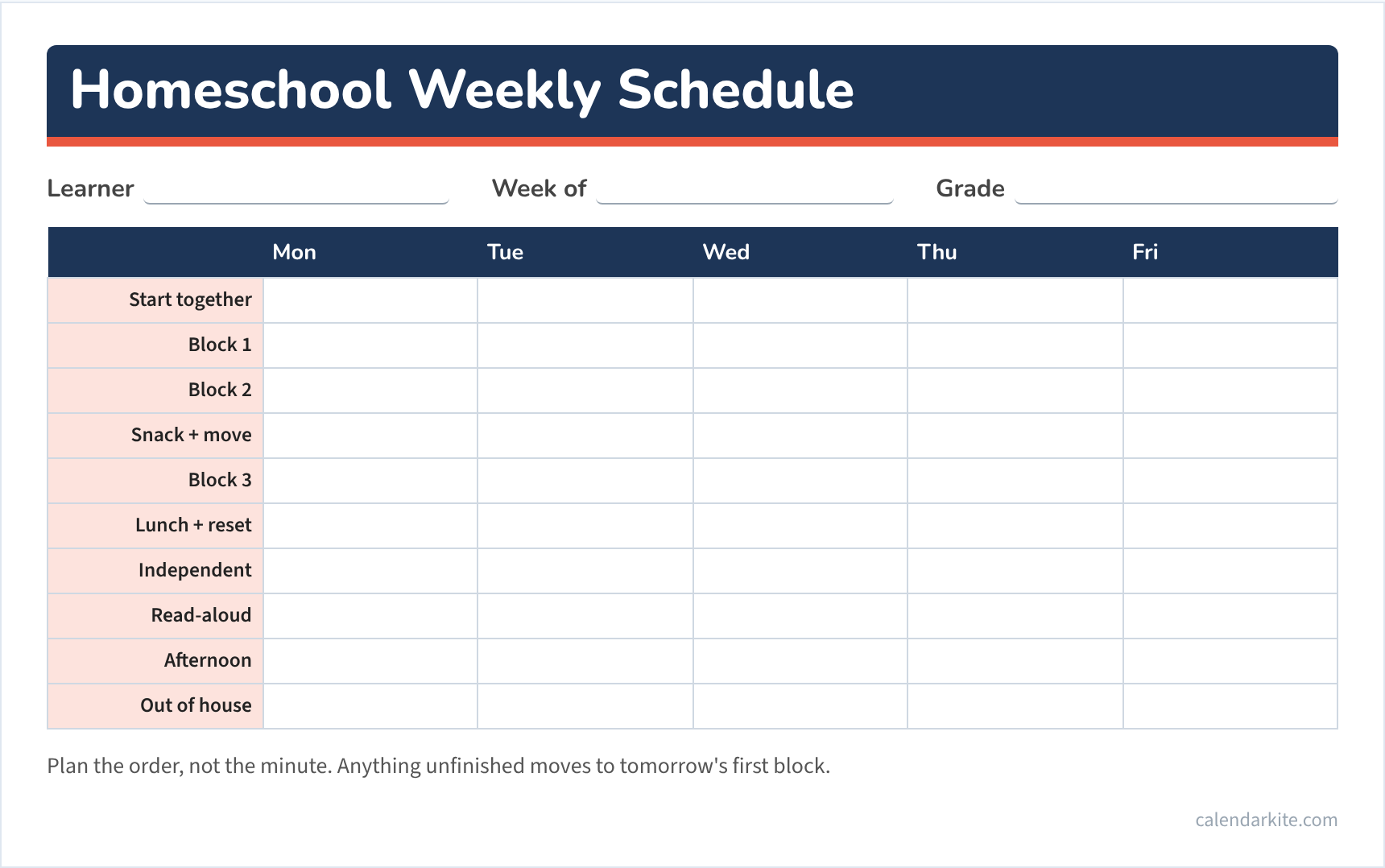
A navy header band with a coral accent gives this a modern, organized look for parents juggling several learners. Use it as a master daily schedule, since the strong header makes it easy to find at a glance across a busy room.
I built the blocks around sequence rather than clock times. In my ten years of office administration I kept staff rotas and schedules readable, and the lesson I took from it is that a schedule people can follow beats a precise one they abandon by Wednesday. Times are the first thing a real day breaks. The order of the work is what holds.
What a good homeschool schedule template should do
A good template answers three questions at a glance: what are we doing now, what is next, and what is fixed this week. If a sheet makes you hunt for any of those, it is too crowded or too rigid. The grid on this page leaves room to write a subject, a book title or a page range in each cell, but not so much that you are tempted to write an essay.
It should also fit more than one kind of family. Some homeschoolers like a morning of lessons and a free afternoon. Others learn in the evening, work around a parent’s shift, or spread school across six days. That is why the rows are named by job (start together, independent work, read-aloud) and not by hour. You decide what each block holds, and you can change it next week without reprinting anything but the sheet.
Finally, it should print cleanly. I test-print every printable on my home inkjet on both US Letter and A4, and a schedule is the sheet that most often goes wrong, because tiny cells and faint lines turn to mush. The cells here are sized for a pencil or a fine pen, and the lines hold up on ordinary printer paper.
How to fill in the template
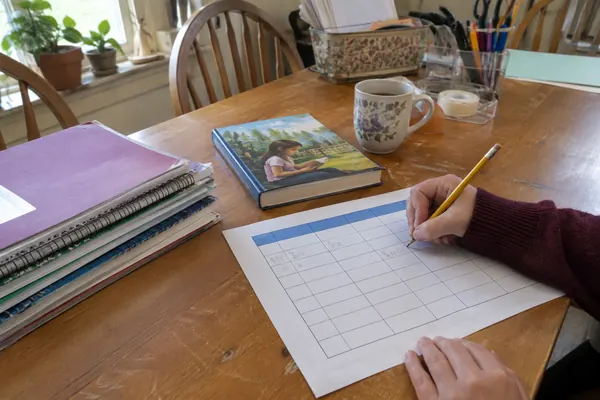
You can fill in the sheet on screen or on paper. On screen, click any cell and type. Your entries save in your browser, so you can build the sheet over a few evenings. When it looks right, print it. If you prefer pen and paper, use the blank PDF download.
- Write the learner’s name, the week of date and the grade in the header fields.
- Fill in the fixed things first: co-op day, a music lesson, swimming, a dentist visit. Put them in the block where they happen, or in “Out of house”.
- Add your anchor subjects, usually maths and reading or language, to Block 1 on the days they run. Do the hardest work while attention is fresh.
- Fill Blocks 2 and 3 with the remaining subjects, rotating the lighter ones (science, history, art, geography) across the week.
- Use “Independent” for work a child can do without you, and “Read-aloud” for the shared book, poem or audiobook.
- Leave at least two cells empty on purpose. Those are your catch-up slots.
Try this: Fill in only the fixed commitments and Block 1 for each day. Live with that half-empty sheet for three days before adding anything else. You will see what your family actually needs.
Who this template suits
It suits parents who are new to homeschooling and want a starting structure without buying a full curriculum plan. It also suits experienced families who are tired of rewriting a weekly plan from scratch and want a reusable frame that holds whatever curriculum is on the table this term. Because the sheet prints no subjects, it works with boxed curricula, library-based learning, unit studies and a mix of all three.
Parents of mixed ages will find it useful, as will anyone coordinating homeschool with work. One sheet per child shows quickly where two children need you at once. Co-op families can use it to see how the in-person day slots into the rest of the week. High schoolers can fill in their own sheets, which is a good habit before college. For that stage, my college schedule planner uses a similar block idea.
It is less suited to anyone who wants a dated, hour-by-hour timetable with bells and period changes. If that is you, the hourly schedule template gives you the clock-based version.
Pick a schedule shape
Before you write anything, decide which shape your week will take. The same sheet works for each, but you fill it differently.
- Time-block: each block has a start time (9:00 maths, 10:00 reading). This suits families with fixed activities or a working parent.
- Routine or rhythm: the order stays fixed, the times float. Breakfast, then Block 1, then Block 2, then a break. This is the most forgiving shape for most households.
- Block scheduling: one or two subjects get a long stretch on certain days (history Monday and Wednesday, science Tuesday and Thursday), which gives deeper focus and fewer switches.
- Loop: a list of lighter subjects that you cycle through whenever there is time, picking up where you left off rather than assigning them to days.
For the loop, use “Block 3” as the loop slot and write the next item in the cycle each day. When a day goes sideways, nothing is “missed”, the loop simply picks up tomorrow.
A sample day you can copy
Here is a rhythm schedule for a primary-age child, using the sheet’s own rows. Treat it as a starting point and change anything that does not fit.
- Start together: calendar, weather, a poem or a short read, ten minutes.
- Block 1: maths, the hardest work of the day.
- Block 2: reading and writing, spelling or copywork.
- Snack and move: outdoors if possible, with no screens.
- Block 3: science, history or geography, two or three days a week each.
- Lunch and reset: a real break, and for you too.
- Independent: puzzles, a workbook page, typing practice or drawing.
- Read-aloud: the shared book, on the sofa.
- Afternoon and out of house: free play, music practice, errands, library, sport or club.
Notice that most of the learning is done before lunch and that the afternoon is mostly light. That is on purpose. Short, focused mornings with a clear finish are easier to keep going than a day with no end point.
Try this: Write tomorrow’s Block 1 and Block 2 on the sheet tonight. Put the page where your child will see it at breakfast, and see whether the morning starts with fewer questions.
Scheduling more than one child
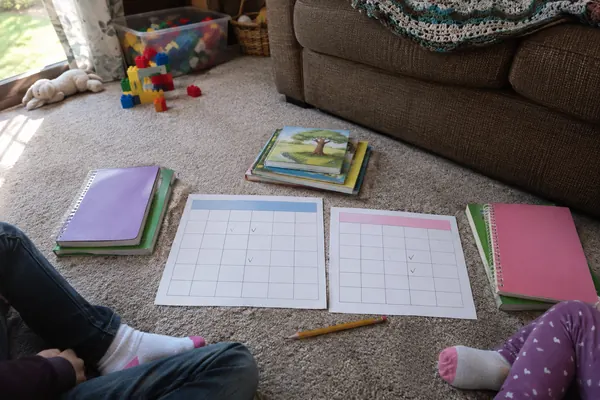
When you have several children, the main trouble is that two of them need you at the same moment. Print one sheet per child and lay them side by side. Look down each column for clashes: if two children need your direct teaching in Block 1 on Tuesday, move one of them to Block 2 or make that block independent for the older one.
A useful trick is a shared start and a shared read-aloud. Whole-family time at the top and bottom of the day covers history, literature, poetry and science talk for everyone at once, and it lets you stagger the individual blocks in the middle. Keep block names identical across sheets so the day has the same shape for everyone, even when the content is different.
At home I keep one big paper calendar on the fridge for the whole family, and a planner on the kitchen counter for the details. With two kids and a dog in the house, I learned that the fridge sheet is the one people actually read. If you have several learners, pin their weekly sheets next to your family calendar, not in a binder. A schedule that lives in a drawer rarely gets looked at.
How long lessons really take
Many new homeschoolers overschedule because they copy the length of a school day. At home you skip the waiting, the line-ups and the whole-class pacing, so the same learning takes less time. These are rough guides, not rules, and your child’s attention is the real measure.
- Preschool and kindergarten: short bursts of ten to twenty minutes, mostly play, stories and hands-on work.
- Early primary: one to two hours of focused lessons, split into short sessions.
- Upper primary and middle years: two to four hours, including independent reading and projects.
- High school: three to six hours, with more of it self-directed, and some of it outside the home.
Plan the time a block takes, then add a margin. If maths takes forty minutes, give the block an hour. Blocks that always finish early feel like wins, and blocks that always overrun feel like failures, so schedule with room to spare.
Build the week around co-op, appointments and trips
Put the fixed things in first, then arrange the learning around them. If co-op takes Thursday, that day’s blocks may be nearly empty, so write “co-op” across the Block 1 cell and plan only a short read-aloud in the evening. A day with an outing planned should hold your lightest work, or be an all-day field-trip day.
I used to do the same with office rotas: lock in the shifts that could not move, then build everything else around them. For homeschool, the “Out of house” row is where those commitments go. When you can see two outings stacked on Tuesday, you can fix the week before it turns stressful, not on Tuesday morning at 8:45.
For anything that spans more than one week, such as a unit that runs three weeks or a term with a break in the middle, step back to a monthly view. The homeschool calendar page is made for that, and it pairs well with the weekly sheet: the calendar shows the term, the schedule shows the week.
Where the schedule fits with your other planning
The schedule is one tool among several, and it works best when it does only its own job. It shows when learning happens. It does not record what you covered, how many days you taught or what each child read. Those belong on other sheets.
A weekly lesson plan lives in a homeschool planner, where you list the pages, chapters and goals behind each block. Days of instruction go on an attendance chart, useful if your state asks for a record of days or hours. Reading goes in a reading log, which turns the read-aloud block into a record your child can see growing.
Keeping these separate has a practical benefit: the schedule stays stable for weeks, so you can print several copies in advance, while the planner changes each week. If you merge everything onto one sheet, you end up reprinting the whole thing every Sunday.
Variations to try
The template works as a weekly sheet, but a few small changes cover other needs. For a daily view, copy one column into a notebook and add times beside the blocks. For a four-day week, leave Friday as a flex day: catch-up, a project, field trips or nature study. For a year-round schedule with shorter terms, print the sheet for each term and switch the blocks at the break.
For teens, rename Block 1 to Block 3 into course names (Algebra, Lit, Biology) and let the student fill in their own cells. Seeing the week themselves helps them take ownership. For very young children, add pictures or a simple colour code beside each block, such as blue for reading and green for outdoor time. For a child who struggles with transitions, pair this sheet with a morning routine chart so the start of the day has its own small checklist.
Families that school through summer can use the same sheet with fewer blocks and more outings. Cross out the rows you will not use rather than deleting them, so you can bring them back in September.
Mistakes that break a homeschool schedule
The most common one I see is planning a full school day for week one. It looks impressive and lasts about four days. Start with two blocks a day, add a third once the first two feel easy, and keep the rest for read-alouds and play.
The second is scheduling every minute. When one lesson overruns, everything after it is late and the whole sheet feels like a failure. Blocks in order, with no times, avoid that, as do deliberate empty cells. The third is leaving yourself out. If you need a break at lunch, write it in. If you have to start the washing at 10, put that in too, because the sheet should describe the day you really live.
A final mistake is never reviewing it. A schedule is a draft. If the same block is skipped three weeks running, the problem is the block, not the child. Move it, shorten it or drop it.
Try this: Next Friday, spend five minutes with a pen and your finished sheet. Circle anything that did not happen, then move or remove it for next week.
Printing tips
Print at 100 percent, with “fit to page” or “scale to fit” switched off if you can, so the cells keep their size. Choose US Letter or A4 to match your paper. Black and white is fine, and a draft mode saves ink. A light grey print is still easy to write over.
If you will fill the sheet in with pencil, print on slightly heavier paper, around 24 lb or 90 gsm. It handles erasing better. For a sheet you reuse all term, slide it into a sheet protector or a clear folder and write on it with a dry-erase marker. Then you can change a block as often as you like.
Print a few copies at once and keep a stack of blanks. When your plans change in the middle of the week, a fresh sheet takes a minute to fill and keeps the old one as a record. If you want your weekly schedule to sit with the meal plan, a dinner calendar on the same wall means the evening is covered too.
Make the schedule yours
No schedule is right until you have used it for two weeks. Expect to change the first version. Move the hard subject earlier, shorten a block that drags, or add a break where everyone melts down. The template is cheap to reprint, which is the point.
Begin with the fixed things, add a small number of blocks, and let the order of the day carry the rest. A schedule that holds when a Tuesday goes wrong is the one worth keeping on the fridge.
Common questions
How many hours a day should a homeschool schedule have?
Most homeschool days need far fewer hours than a school day, because there is no waiting, line-ups or whole-class pacing. Young children often need one to two hours of focused lessons, and teens may work four to six. Check your state's rules, since some ask for a set number of days or hours.
Should a homeschool schedule use clock times?
It can, but a sequence of blocks tends to survive real days better. Clock times only for fixed things such as co-op, a class or an appointment, and let everything else follow in order.
Can I use one template for several children?
Yes. Print one copy per child, or fill in one sheet for a shared family day and add a second sheet for individual work. Use the same block names on every sheet so the days line up.
Is the homeschool schedule template editable?
Yes. You can type into every cell and field on the page, and it saves in your browser so your plan is still there when you come back. You can also download a blank PDF and fill it in by hand.
What is the difference between a homeschool schedule and a homeschool planner?
A schedule decides when and in what order learning happens. A planner records what you will cover, such as lessons, pages and goals. Many families use both: the schedule stays the same for weeks, and the planner changes each week.
More free planners
 Monthly Planner: Free Printable One-Page Sheet
 Garden Planner: Free Printable Planting Sheet
 Printable Weekly Meal Planner
 House Cleaning Schedule: Free Printable for Daily, Weekly and Monthly Jobs
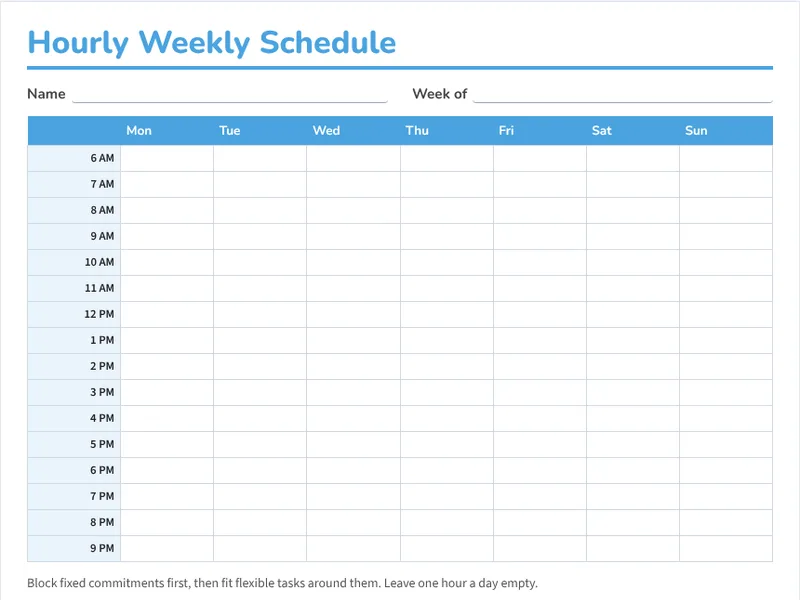 Hourly Schedule Template: Free Printable Weekly Planner
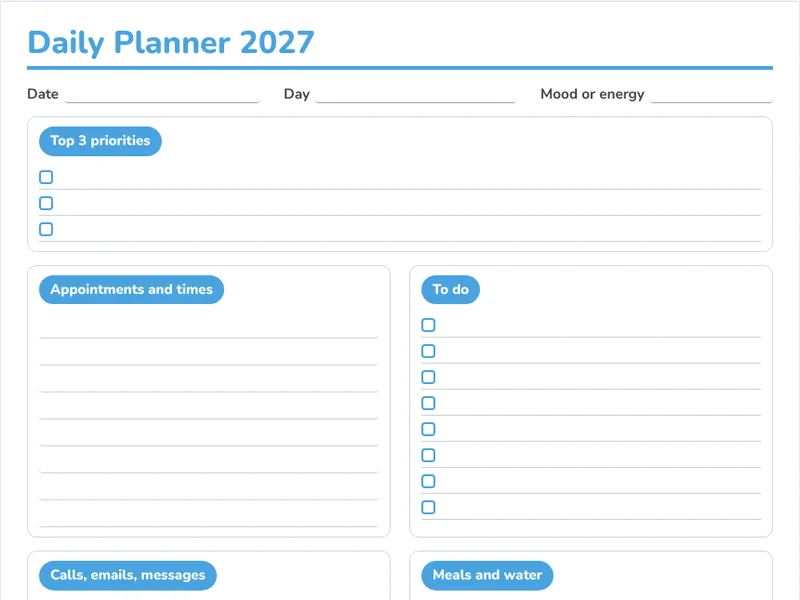 Daily Planner 2027: Free Printable Page for Every Day