
Moving In Together Checklist

A moving in together checklist is a single sheet that tracks four things: the conversations you need to have, the paperwork and money, the practical work of merging and moving your belongings, and the first month in the new place. Free to print and fill in, the one on this page covers all four, with a name beside each task so you both know who is doing what.
Talk first
- Why now, and what each of us expects
- Where we live: yours, mine or somewhere new
- Rent ceiling we are both comfortable with
- How we split rent and bills (even or by income)
- Who does which chores, and how often
- Sleep, noise, guest and overnight rules
- Pets: who feeds, walks and pays the vet
- Time alone and time apart each week
Lease, money and insurance
- Both names on the lease
- Security deposit: who paid what, in writing
- Notice given to current landlord(s)
- Current lease end dates lined up
- Renters insurance with both names listed
- Shared bills method chosen (app, account or sheet)
- Who holds each utility account
- Internet plan and install date booked
- Rent due date and payment method agreed
Address and accounts
- USPS change of address, one each
- Driver's license and vehicle registration
- Banks and credit cards
- Employer and payroll
- Health insurance and doctors
- Voter registration
- Phone plan, subscriptions and deliveries
- Landlord, school and vet records
Merging belongings
- Room-by-room list of what each of us owns
- Measure rooms, doorways and big furniture
- Pick the better one of each duplicate
- Sell or donate the doubles
- Decide who keeps the bed, sofa and TV
- Agree on decor for shared rooms
- One space each that is fully ours
- Storage plan for sentimental boxes
Packing and moving day
- Movers or truck booked
- Elevator or parking reserved
- Boxes labeled by room and by owner
- Essentials box packed per person
- Photos of meter readings at both places
- Photo walk-through of the new place
- Keys and garage openers collected
- Old place cleaned for deposit return
- Water, snacks and cash for helpers
First 30 days
- Bed and kitchen unpacked first
- Chore chart on the fridge
- Shared calendar set up
- Weekly 15 minute check-in booked
- Meal plan and grocery list started
- Spare keys and smoke alarms checked
- Emergency contacts swapped
- Review the bill split at day 30
Write the owner's initials beside every item so nothing belongs to nobody.
Free for personal, classroom and office use. Your entries are included in the print, PDF and PNG. Prints on US Letter and fits A4.
Black and White Moving In Together Checklist
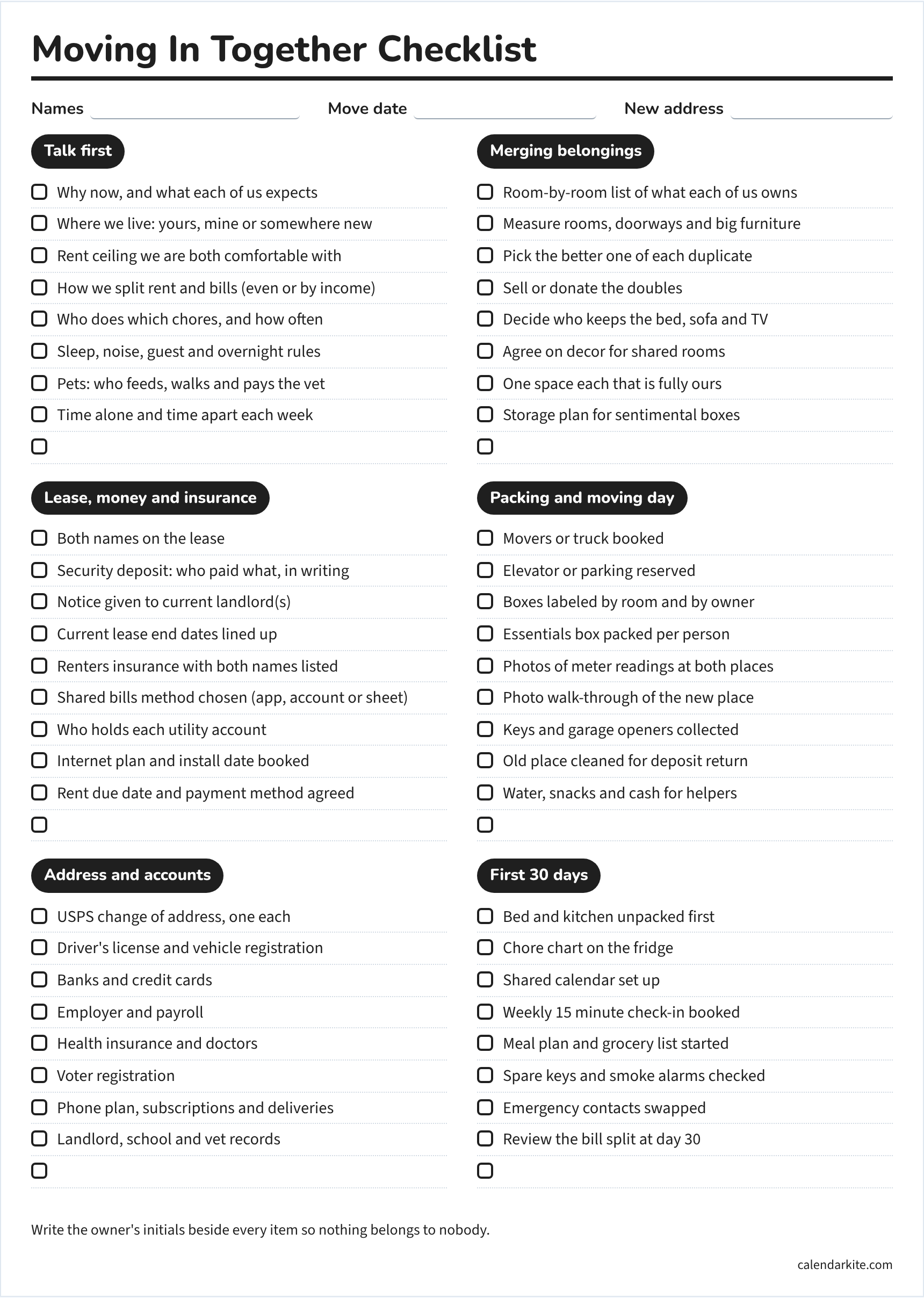
This plain black-line version suits couples who want to print several copies without draining the ink. I test-print every page on my home inkjet, and I'd hand one copy to each of you so you can split tasks like utility transfers and address changes.
Pink Moving In Together Checklist
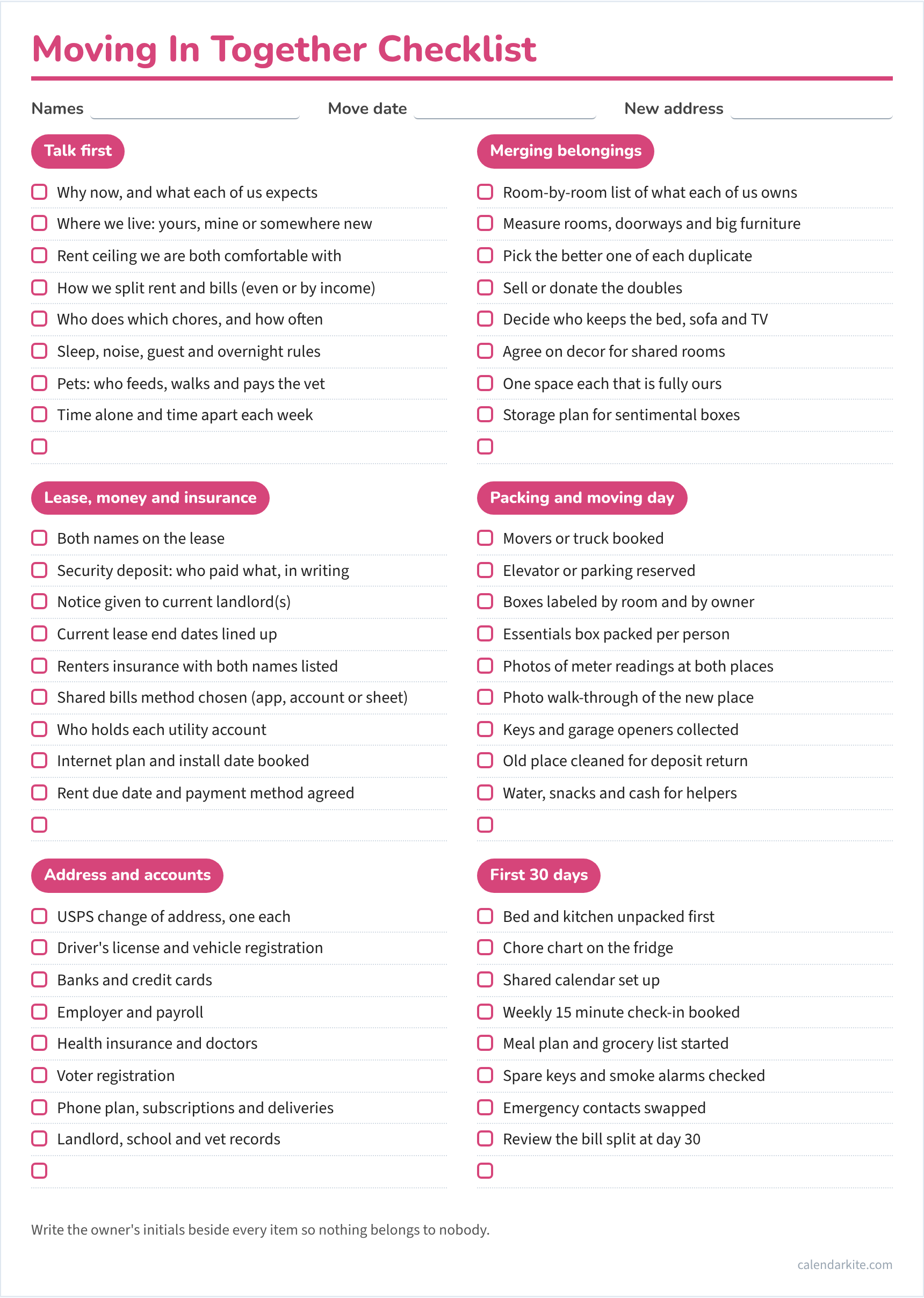
The soft pink palette works for a couple who want the move to feel a little celebratory. Tape it inside a cupboard door and tick off jobs like measuring furniture and agreeing on a shared budget.
Sage Green Moving In Together Checklist
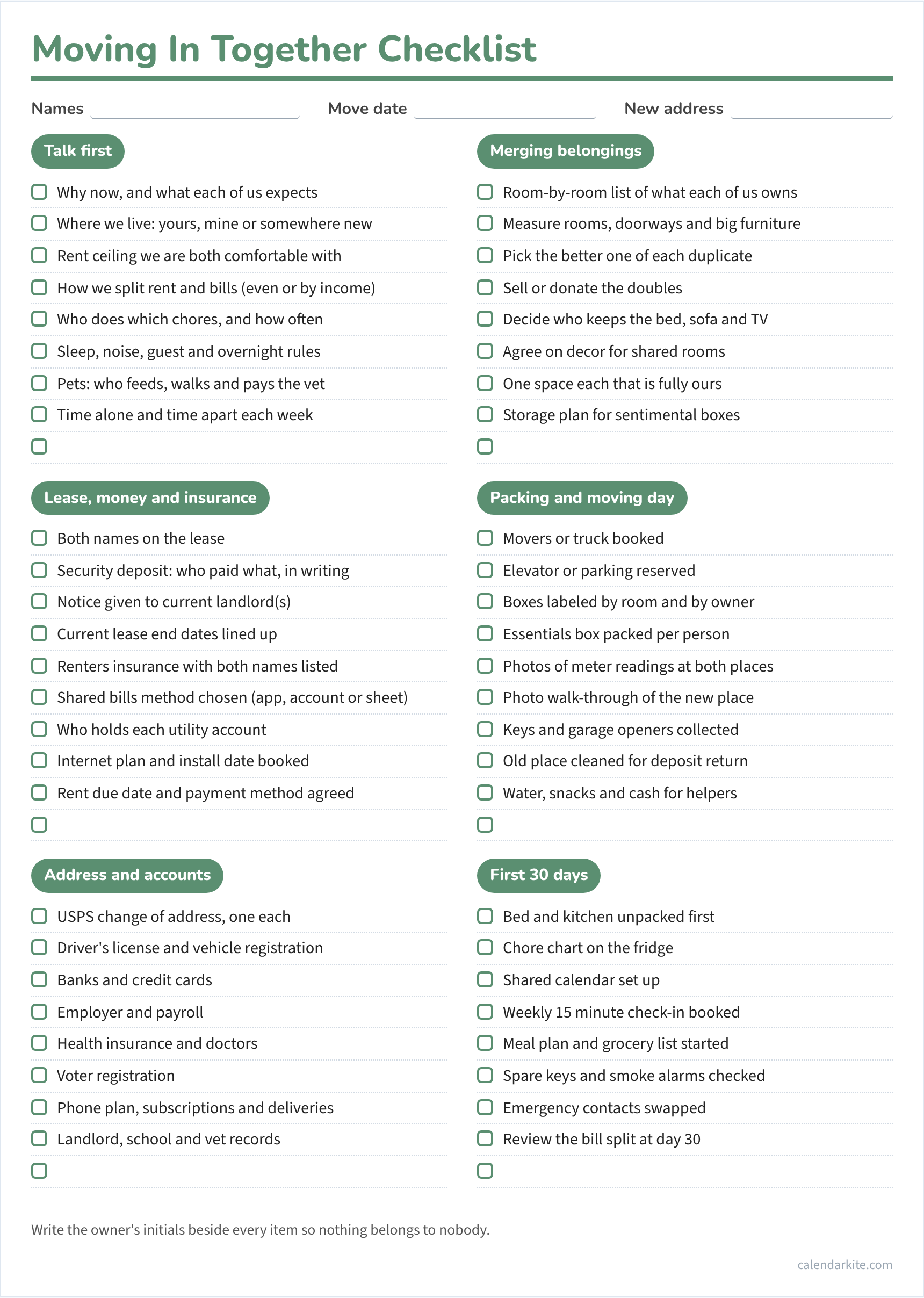
I like this calm sage green for anyone feeling overwhelmed by the sheer number of tasks. In my office years I learned that a calm, uncluttered list gets used, so keep it on the counter next to your planner for daily check-offs.
Cute Moving In Together Checklist
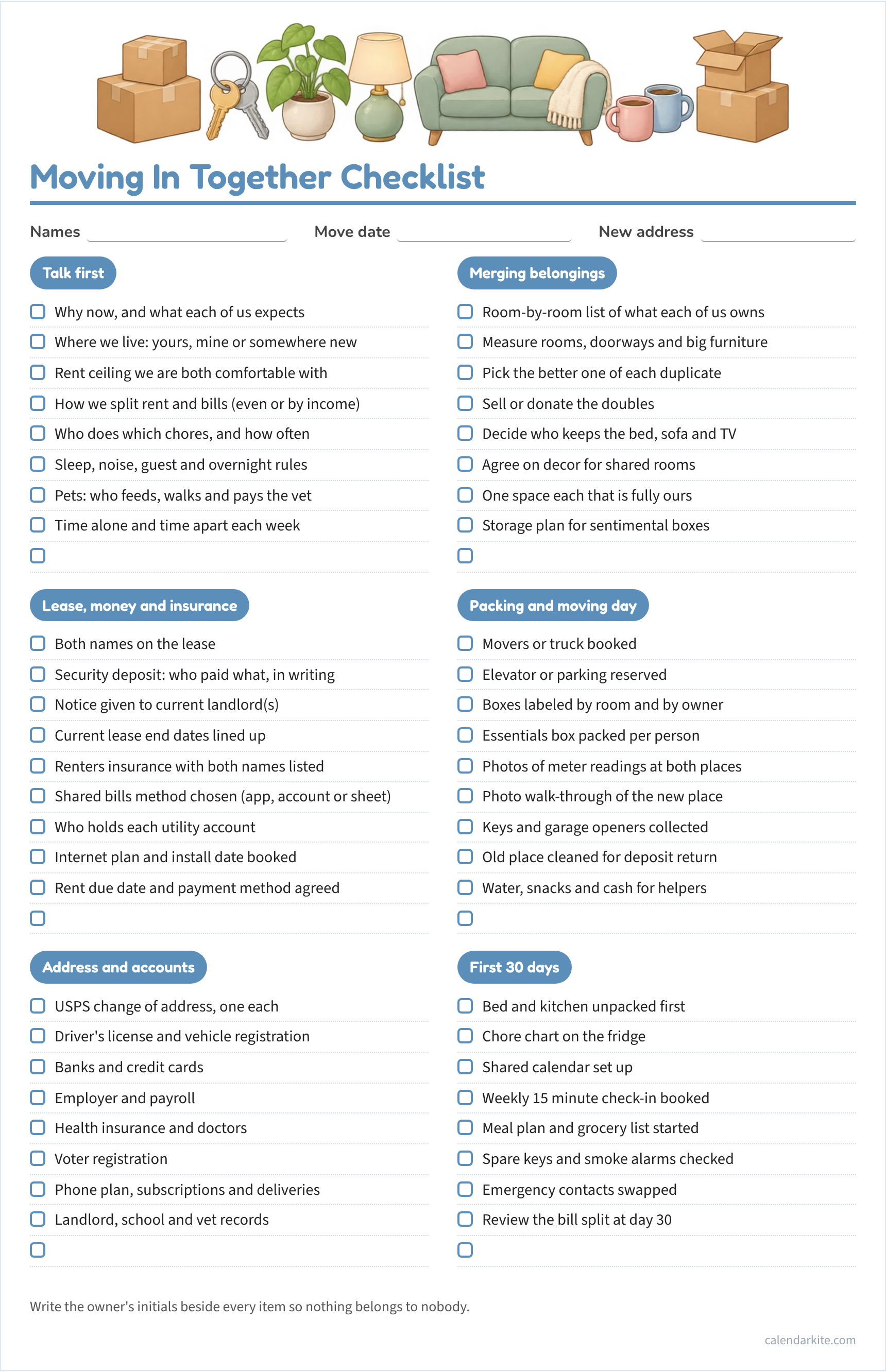
This pastel blue page with little hand-drawn illustrations suits couples moving into their first place together. Print it for the fridge, where I keep my own paper calendar, so you can both see what's left, like switching the internet over and swapping spare keys.
Floral Moving In Together Checklist Printable
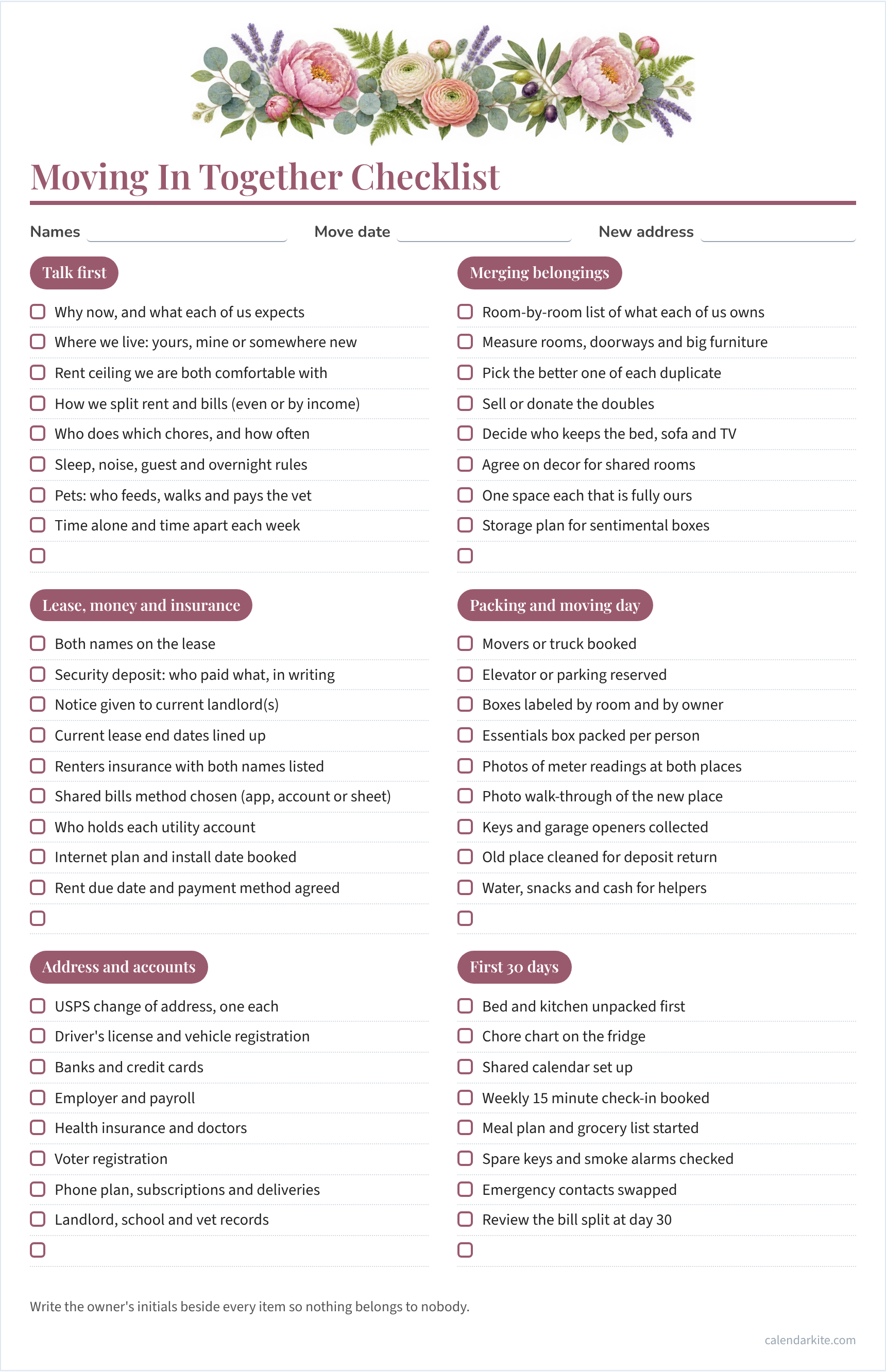
Watercolor flowers and elegant serif headings suit a couple who want a keepsake-worthy planning page. I changed my layouts to leave generous writing space, so you can jot down measurements, landlord contacts and move-in dates.
Colorful Moving In Together Checklist
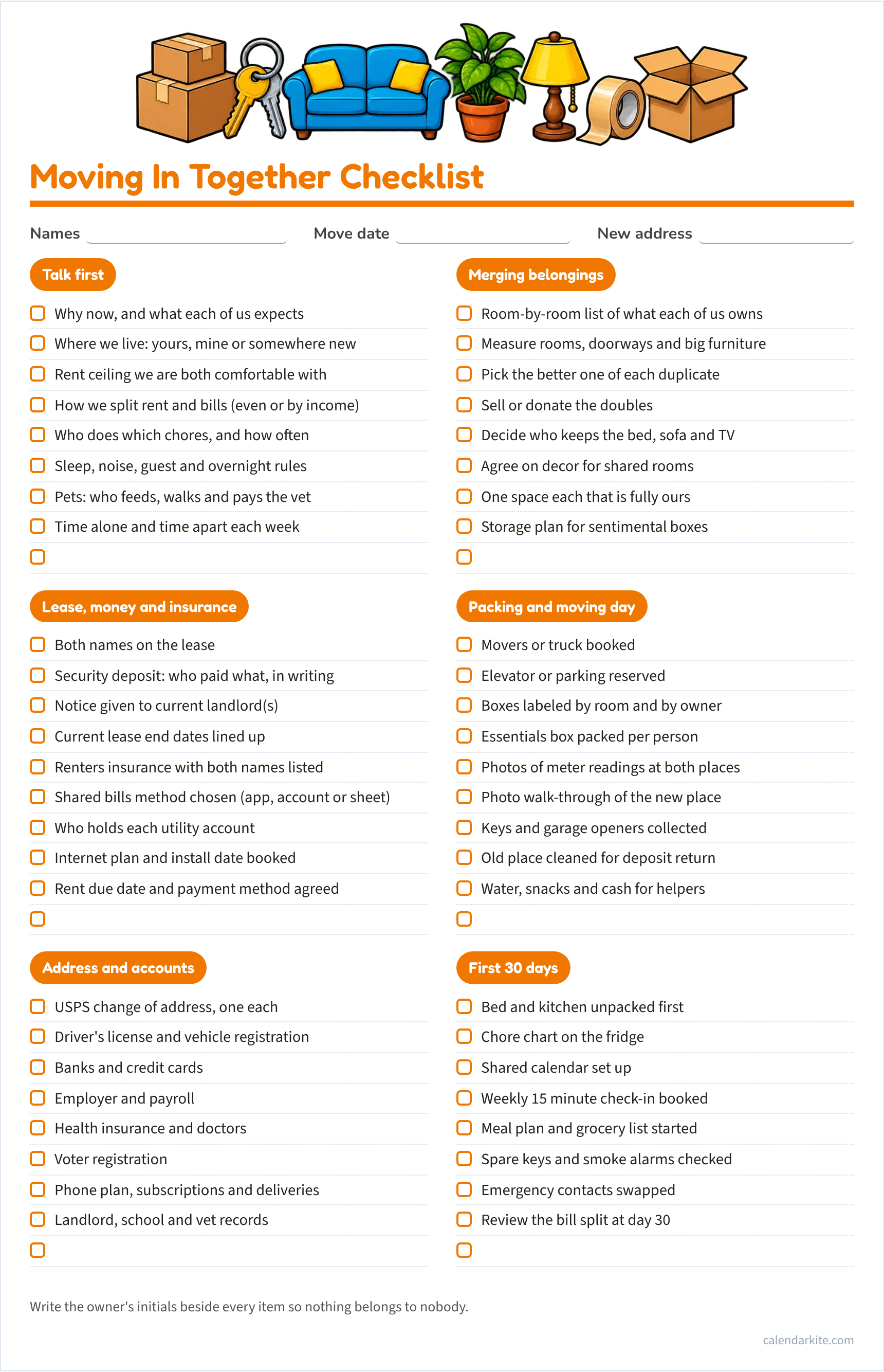
Bright orange and yellow make this a fun, high-energy pick for couples who like a playful approach to a stressful job. Use it for a packing-weekend plan, and tick off boxes labeled by room as you go.
Simple Moving In Together Checklist
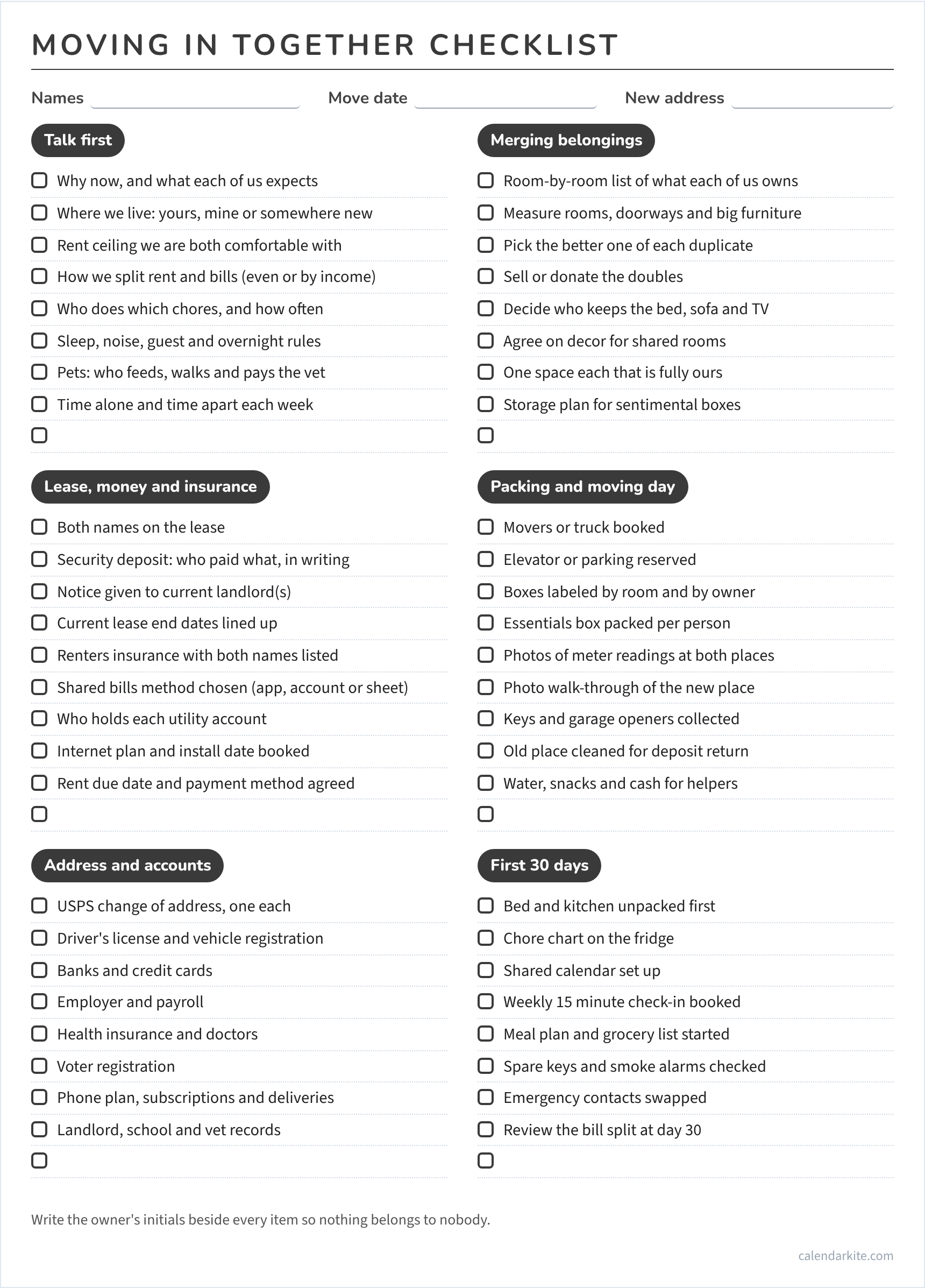
Thin gray lines and no color make this the easiest version to scan, ideal for couples who prefer a clean, no-fuss list. In the office I saw crowded checklists get ignored, so I kept the spacing open and test-printed it on Letter and A4.
Aesthetic Moving In Together Checklist
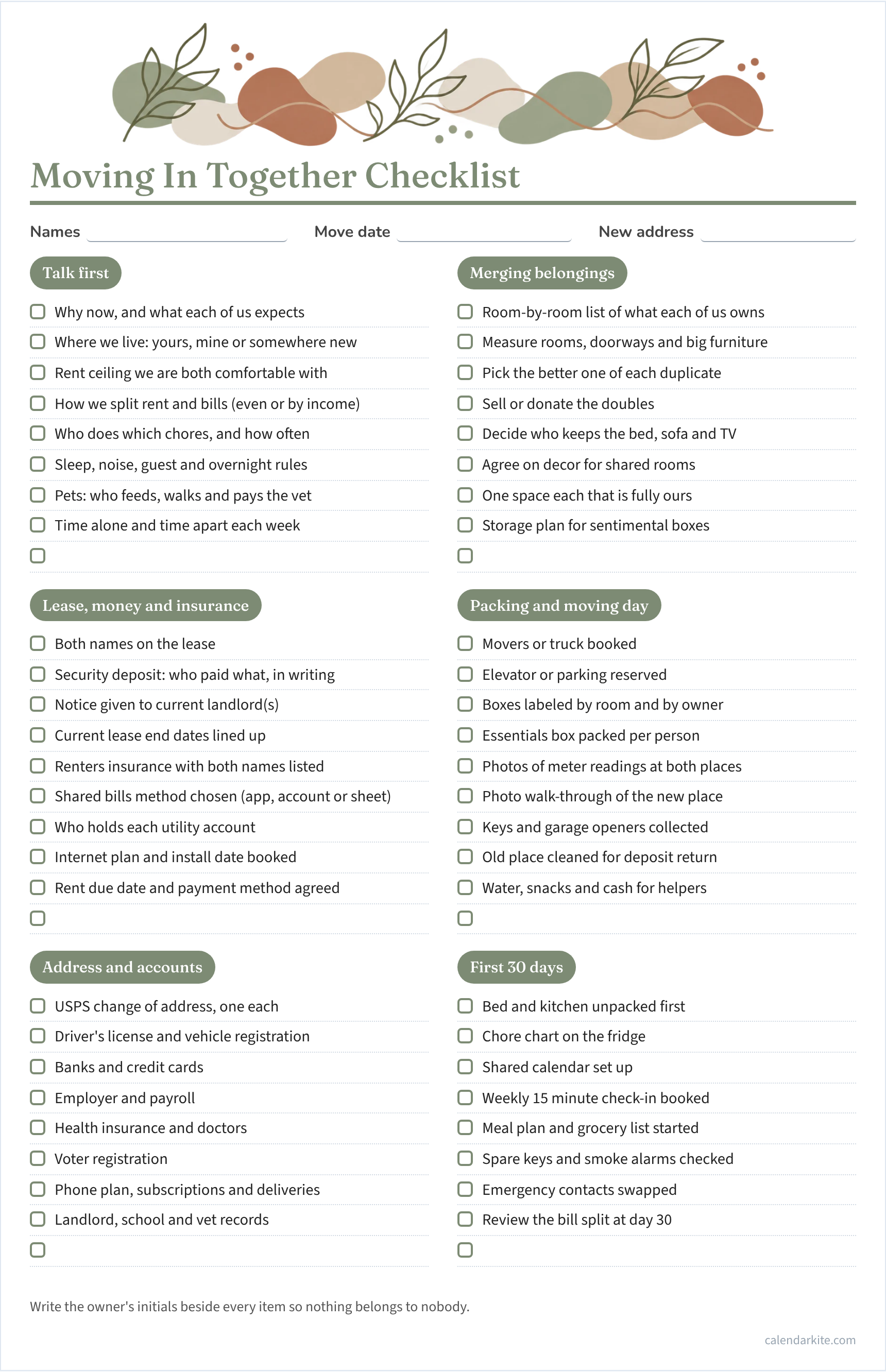
Muted sage, sand and terracotta with soft leaf line art suit couples who are already thinking about how the new place will look. Use it alongside your decor ideas, and I'd add a line for who owns which furniture before anything gets moved.
Vintage Moving In Together Checklist Printable
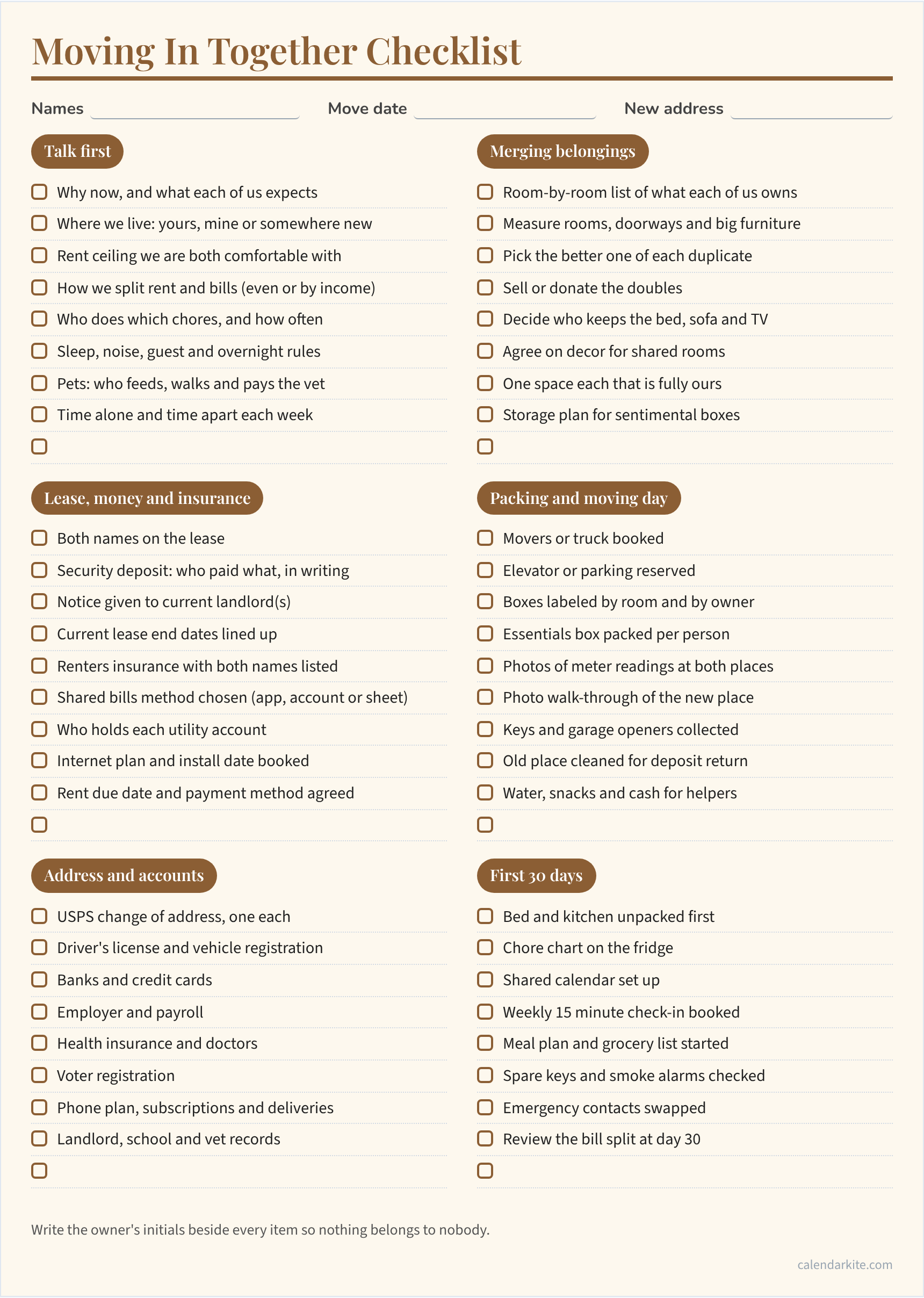
Cream paper and brown serif headings give this a warm, old-fashioned feel for couples who love a keepsake. I keep a planner on my kitchen counter, and a page like this sits well beside it for tracking deposits and move-in dates.
Modern Moving In Together Checklist
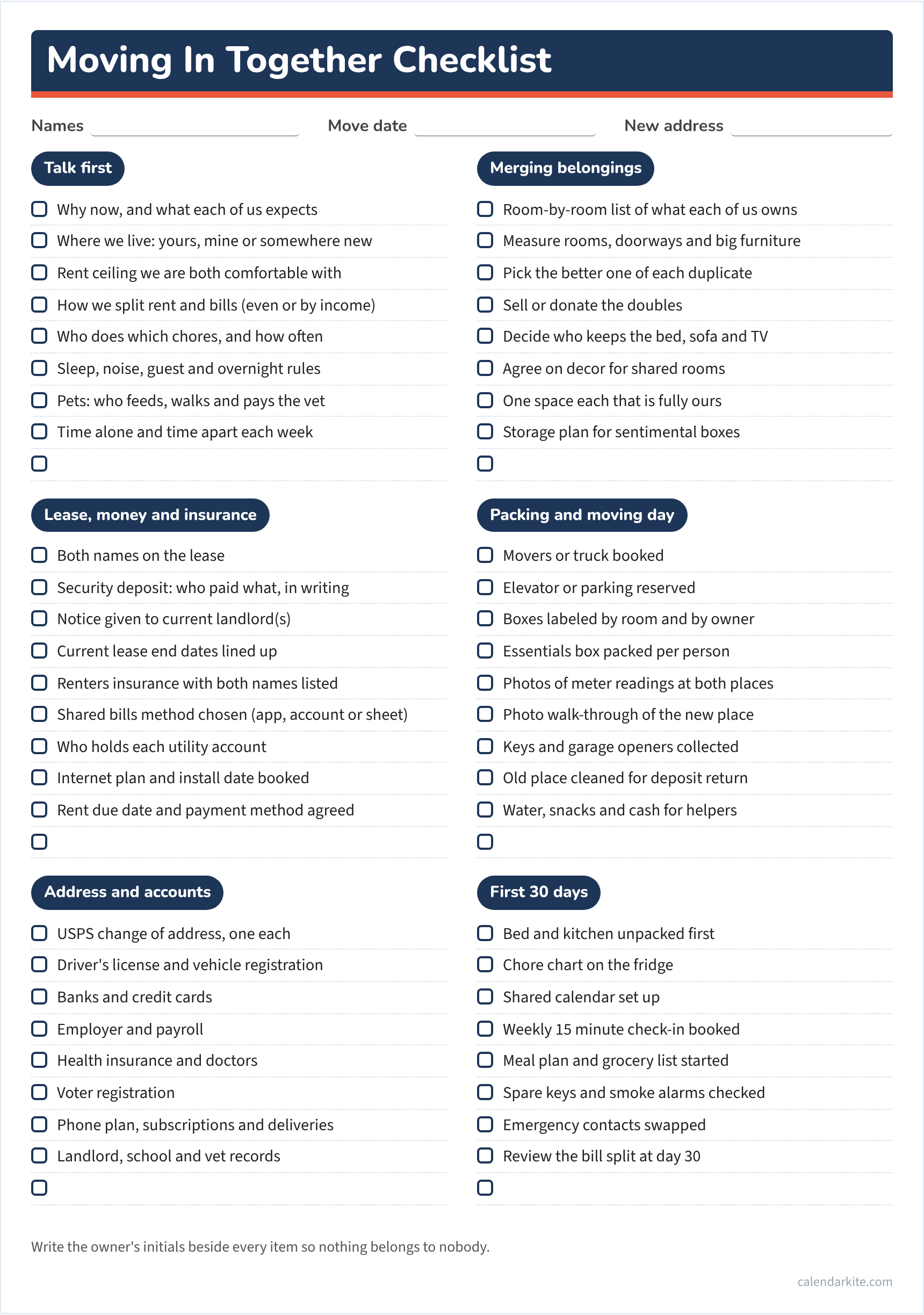
The navy header band and coral accent give this a modern, businesslike look for couples who want clear ownership of tasks. Having kept staff rotas readable for about ten years, I'd write each person's initials beside every job, from utilities to renter's insurance.
Most moving lists are built for one person with one household. Moving in with a partner is different because two sets of habits, accounts and furniture have to become one home. I have kept schedules, supply lists and staff rotas readable for about ten years, and the lesson from all of them is the same: a list only works when every item has an owner and a date.
What a moving in together checklist should cover
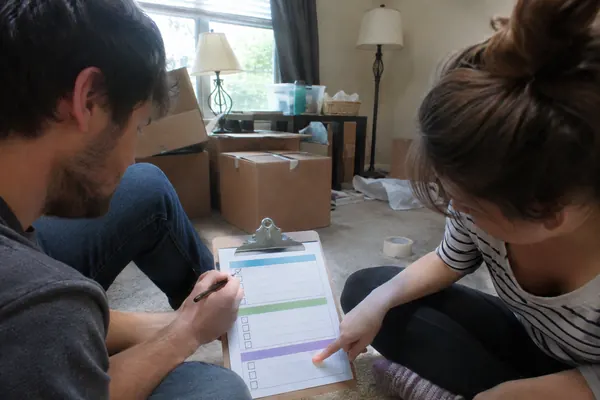
A standard moving checklist handles boxes, trucks and address changes. A couples version adds the parts that decide whether the first six months feel easy or tense. That means agreeing on a rent ceiling, deciding whose name goes on which account, working out what happens to two sofas, and settling who takes out the bins before anyone actually has to do it.
The printable on this page is split into six groups: talk first, lease and money, address and accounts, merging belongings, packing and moving day, and the first 30 days. I put the conversations at the top on purpose. When I first drafted the sheet, they sat in the middle, and they kept being skipped until a week before the move. Putting them first makes them the easiest thing to start and the hardest to avoid.
If you only need the logistics of a general move, my moving checklist template is a better fit. This one is for two people combining their lives.
Who this checklist suits
It suits couples moving into a new rental together, one partner moving into the other’s place, and couples buying a first home. It also works for people moving in with a fiancé or spouse after a long-distance stretch, and for anyone merging households later in life, when both people already own full sets of everything.
It also helps if you are the organized one in the relationship and want a gentler way to share the load. A sheet with two sets of initials on it is much easier to hand over than a list of reminders in your head. Nobody has to feel managed, because the sheet is doing the asking.
It is less useful for a roommate situation with friends, where the money and chore items matter but the “yours, mine or ours” conversations do not. For that, my roommate chore chart covers the day-to-day better.
How to fill in the printable
You can fill the sheet in on the page before you print it. Type your names, the move date and the new address into the fields at the top, tick items as they are done, and edit any line that does not fit your situation. It saves in your browser, so you can come back to it. When you are ready, print it, or download the blank PDF and write on it by hand.
Next to each item, add the initials of whoever owns it. This is the single change that makes the sheet work. In an office, a shared task list with no names on it is a list of things everyone assumes someone else is doing. The same thing happens at home, just with more feelings attached.
Each group ends with a blank line. Every move has one or two jobs I cannot predict, such as “ask the downstairs neighbor about parking” or “return the cable box.” The blank row is there so you do not need a second sheet.
Try this: Before you tick anything, sit down together with two pens in different colors. Go through the sheet once and put your own initials beside every item you will take. Leftovers get discussed, not assumed.
Talk first: the conversations that come before boxes
The first group on the sheet is conversation prompts, not tasks. Ask each other why you want to move in now and what each of you expects day to day. One person may picture quiet evenings at home, while the other pictures hosting friends twice a week. Neither is wrong, but finding out in week two is harder than finding out in week zero.
Then cover the small, specific things. What temperature do you keep the house? Do you sleep with the door open or closed? How often are overnight guests fine? Does laundry get folded straight away or live in a basket for days? These feel trivial, and they are the things that cause the most friction because nobody thought to ask.
Do not try to settle everything in one evening. I suggest three short conversations: space and habits, money, then chores. Each one fits on a walk or over a meal, and you can tick the item as you finish it.
Money and who pays for what
Money is the conversation most couples put off, and it is the one that benefits most from being written down. Start with your honest budget: what you can each afford for housing, what debts or obligations you carry, and what you want to keep separate. Then choose how to split shared costs. The usual options are:
- An even split of rent and bills
- A split in proportion to income
- A joint account that you each fund with a fixed monthly amount
- One person paying rent and the other covering groceries and utilities
Whichever you pick, write it on the sheet and put a date next to it to review the split at day 30. People often find the first plan needs a small adjustment once they see real bills. A bill tracker printable makes that review easy, because you can see who paid what over the first few months.
Also decide on a ceiling for rent that you are both comfortable with before you start viewing places. It is far easier to say no to a flat that is too expensive when you already agreed the number. It also protects the person with the lower income from feeling pressured to stretch.
Lease, deposits and insurance
Landlords generally prefer every adult living in the home to sign the lease, so that each is accountable for the rent. Generally speaking, landlords prefer to have all the tenants in an apartment sign the lease or rental agreement so that they can be held accountable for rent and other costs. That is also better for you, because both names on the lease gives you both equal rights to the home.
Record the security deposit in writing: who paid what, on what date and by what method. If one of you pays more, say so on the sheet and agree how it is returned. This sounds formal, but it takes two minutes and removes a possible disagreement years later.
Check your current lease end dates and give proper notice. If your leases do not line up, you may need to cover a month of overlap, so put the dates on the sheet early. Finally, get renters insurance with both names listed. Your belongings are now combined, and so is your risk.
Try this: Take a photo of your signed lease, the deposit receipt and your insurance policy, and save them in one shared folder both of you can open. Tick the item only when both of you can find the folder.
Utilities, address changes and accounts
Decide who holds each utility account. Utility companies often prefer one account holder who takes responsibility for the bill, so split the accounts between you if that feels fairer: one holds electric and gas, the other holds internet and water, and you settle up monthly. Book the internet install early, because it is the item most likely to have a waiting list.
Address changes are the long tail of any move. The sheet lists the ones people forget: driver’s license and vehicle registration, banks and credit cards, employer and payroll, health insurance and doctors, voter registration, phone plan, subscriptions and delivery services. Each person needs their own USPS change of address, filed separately.
I do these in one sitting with a cup of tea, one person reading the list while the other types. It goes faster with two, and you only need to do it once per person. Do it the week of the move, not before, so your mail does not go to a place you have not reached yet.
Merging two households of stuff
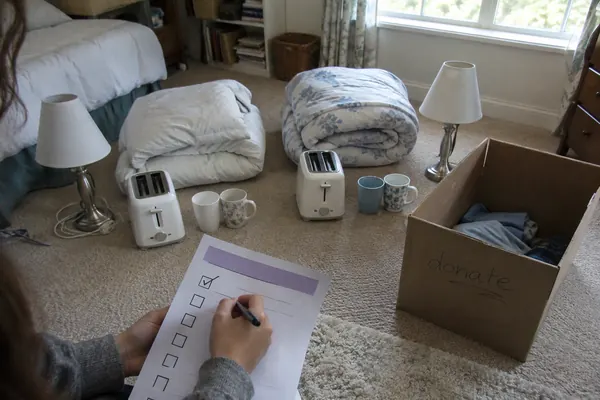
Two people moving in together usually own two of nearly everything. Before you pack, make a room-by-room list of what each of you has. Then choose the better or newer version of each duplicate, and sell or donate the other. If one of you has a sofa you love, the other might have a better dining table. Trade-offs feel fairer when you can see the whole list.
Measure first. Doorways, hallways and the floor space of the new rooms decide what actually fits, and it is much easier to decide on a spreadsheet than at the foot of the stairs with a sofa. I learned this the unglamorous way, by watching other people carry furniture back out of a building.
Give each person one space that is fully theirs, even if it is a desk corner, a shelf or half a closet. Also agree a place for sentimental boxes. Without that, they tend to end up in the hall, and they are exactly the kind of item that should never be a source of tension.
A timeline from eight weeks out
Eight weeks is a comfortable runway. If you have less time, compress the steps but keep the order.
- Eight weeks out: Have the three conversations, agree a budget and start looking at places or planning the merge.
- Six weeks out: Sign the lease, give notice on current places, and book movers or a truck.
- Four weeks out: Make the room-by-room list, sell or donate duplicates, and start packing rooms you rarely use.
- Two weeks out: Book the internet install, set up utility accounts, buy renters insurance and order packing supplies.
- Final week: Pack an essentials box each, photograph meter readings, and file your address changes.
I keep a paper calendar on the fridge, and during any big event I write the key dates on it in one color so the household can see them at a glance. A weekly calendar works well for the last two weeks, when the days fill up quickly.
Packing and moving day
Label every box by room and by owner. A small colored sticker for each person is quicker than writing names, and it tells the movers which half of the bedroom a box belongs in. Pack an essentials box each, with chargers, toiletries, a change of clothes, medications and a few snacks, and keep it with you rather than on the truck.
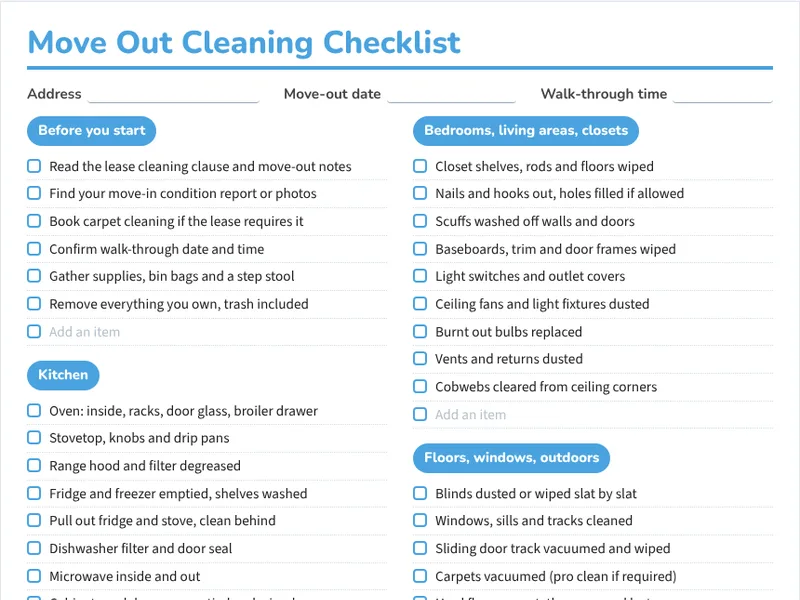
Photograph the meter readings at both places, and do a quick photo walk-through of the new home to record any existing damage. If you are leaving a rental, a clean place gives you the best chance of your deposit coming back. My move out cleaning checklist covers every room if you want a thorough run.
Plan for the practical things people forget: a reserved elevator or parking space, water and snacks for helpers, and a bit of cash for a tip. Moving day goes better when the only decisions left are where each box goes.
The first 30 days
The move is not finished when the last box is in. Unpack the bed and the kitchen first, so you can sleep and eat. After that, take your time with the rest, and resist the urge to have everything perfect by Sunday. I test-print every sheet I publish on my home inkjet, and the first-30-days group is the one I keep returning to, because it is where real life starts.
Start a weekly check-in of about fifteen minutes. Ask what is working, what is annoying and what needs to change. It sounds formal, but it keeps small irritations from becoming big ones. Put it on a shared calendar so it does not get skipped.
Set up meals early. A grocery list printable on the fridge helps the two of you add items as you run out, which saves the “did you buy milk” text. At day 30, review the bill split, the chore split and the space you each have, and adjust anything that is not working.
Splitting chores without a fight
Chores are rarely about the chores. They are about fairness, and fairness is easier when it is visible. Write down every recurring job, from bins and dishes to bathroom cleaning and watering plants, and sort them by what each person minds least. Swap the ones nobody wants, and rotate those every month.
A chart on the fridge settles disputes before they start. My chore chart for adults is designed for exactly this, with room for each task, who owns it and how often it happens. Agree what “done” means for each job, too, because one person’s clean bathroom is another’s quick wipe.
In the office, I saw rotas go wrong when one person quietly absorbed the jobs nobody claimed. At home the same thing happens. If you notice one person doing more, say so early and kindly, and move a task across rather than waiting for resentment to build.
Variations for different situations
If you are moving into one partner’s existing place, the sheet still applies, but change the focus. The person already living there should clear space before the move, and the group “merging belongings” becomes about making the home feel shared, not just fitting items in. Consider repainting, swapping some furniture or rearranging, so it does not feel like a guest moving into someone else’s home.
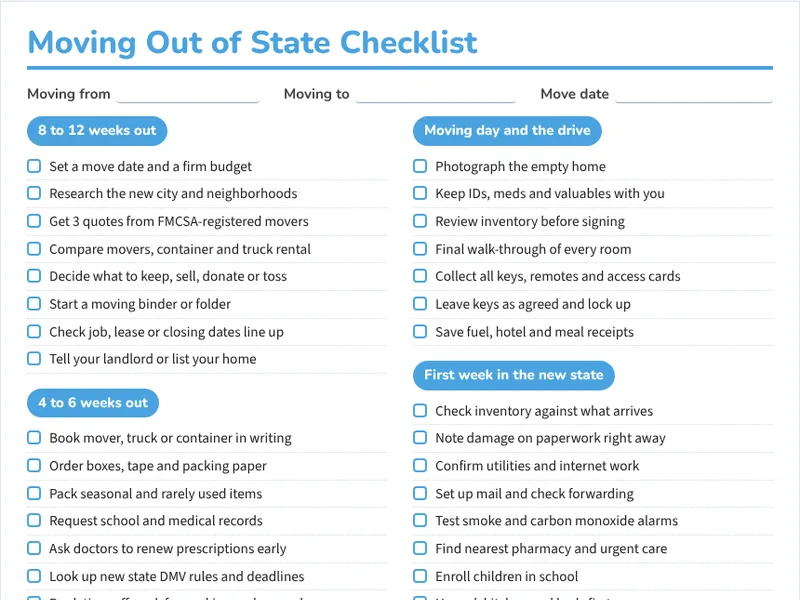
If you are buying a home together, add the legal and financial steps: ownership structure, a written agreement about what happens if you separate, and a plan for the down payment. You can edit any line on the page directly and add your own in the blank rows. If one of you is relocating across state lines, my moving out of state checklist covers licenses, registration and taxes in more depth.
If kids or pets are part of the household, add items for school records, vet records, and a plan for the first night in the new place. Keep their routines as steady as you can on moving day, because they take their cues from you.
Common mistakes to avoid
The biggest mistake is skipping the conversations because the move feels exciting. Couples often assume they agree on money, cleanliness and space, and then find out otherwise after the lease is signed. The second is leaving one person’s name off the lease or accounts, which can create awkward questions later.
Another common mistake is waiting until the last week to deal with duplicates. Two weeks is not enough time to sell furniture, and what does not sell ends up in the new home by default. Start the room-by-room list early.
Finally, many people treat the checklist as one person’s job. Even if one of you is more organized, hand over some of the sheet. A shared sheet with both sets of initials on it tells you both that this is a joint project.
Printing and keeping the sheet
The sheet is built to fit one US Letter page, and it prints cleanly on A4 using “fit to page.” I check each printable on my home inkjet on both sizes before publishing, so you should not need to adjust margins. Print in black and white to save ink, since the layout does not depend on color.
Keep the printed copy somewhere you both see it daily, such as the fridge, or on the counter next to the planner. I keep mine on the kitchen counter during any big project. If you filled it in on screen, it stays saved in your browser, so you can print a fresh copy as items get ticked.
After the move, keep the sheet in your home folder with the lease and insurance papers. It is a handy record of who handled which accounts and when, and it makes a good starting point if you ever move again.
Try this: Print two copies. Each of you fills in your own initials on one copy without looking at the other. Then compare. Where the two copies disagree about who owns a task, you have found your first conversation.
Common questions
What should be on a moving in together checklist?
It should cover the conversations (money, chores, space), the paperwork (lease, deposit, insurance, utilities), merging your belongings, packing and moving day, and the first month in the new place. Most lists skip the conversations and the first month, which is where couples tend to hit trouble.
How long before moving in together should we start planning?
About eight weeks is comfortable. That gives you time to talk through money, give proper notice on any current lease, sort your belongings and book movers without rushing.
Who should be on the lease when a couple moves in together?
Usually both of you, because landlords generally want every adult resident to be responsible for the rent. If only one name is on it, agree in writing how you will split costs and what happens if you separate.
How do couples split rent and bills fairly?
The common options are a 50/50 split, a split in proportion to income, or a joint account that each person funds with an agreed amount. Pick one, write it down, and review it after the first month.
What do you do with duplicate belongings?
Go room by room, keep the better or newer item, and sell or donate the other. Where you truly cannot choose, agree on a deadline and a place to store the extra, so it does not drift into the hallway.
Can I fill in the checklist on screen and print it later?
Yes. You can type into the lines and fields, tick boxes and edit items directly on the page, and it saves in your browser. When you are ready, print it, or download the blank PDF to write on by hand.
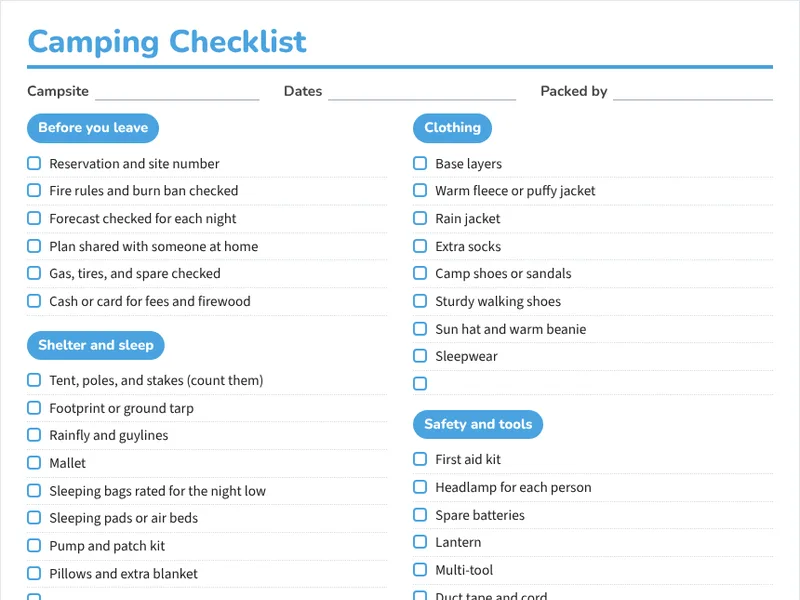 Camping Checklist Printable: Free One-Page Packing List
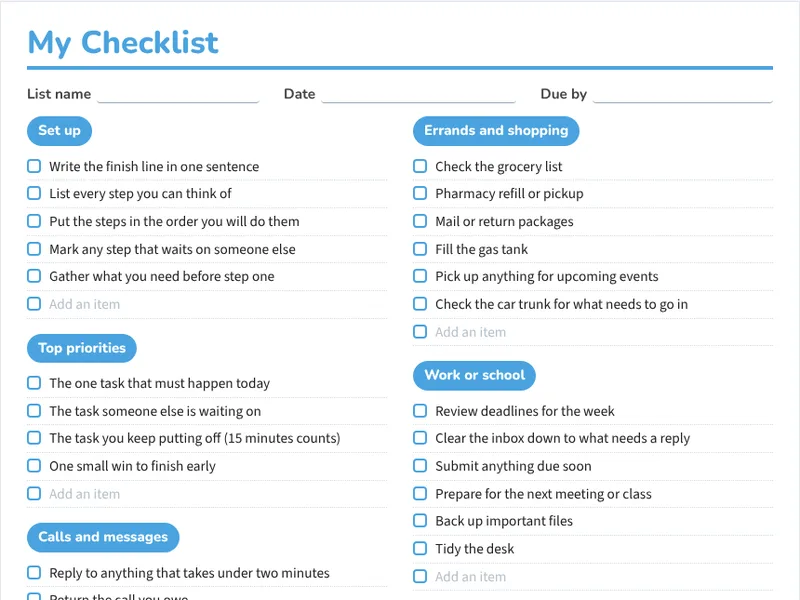 Checklist: A Free Printable You Can Fill In, Edit and Print
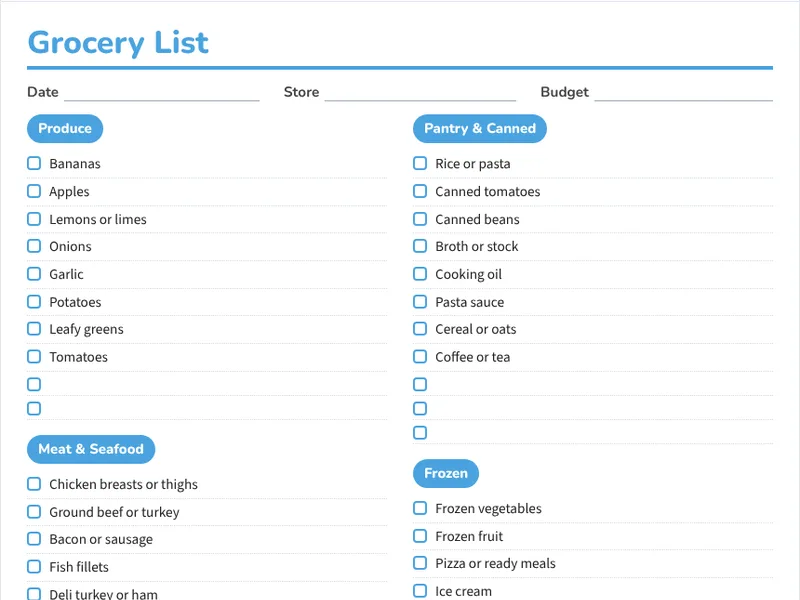 Grocery List Printable
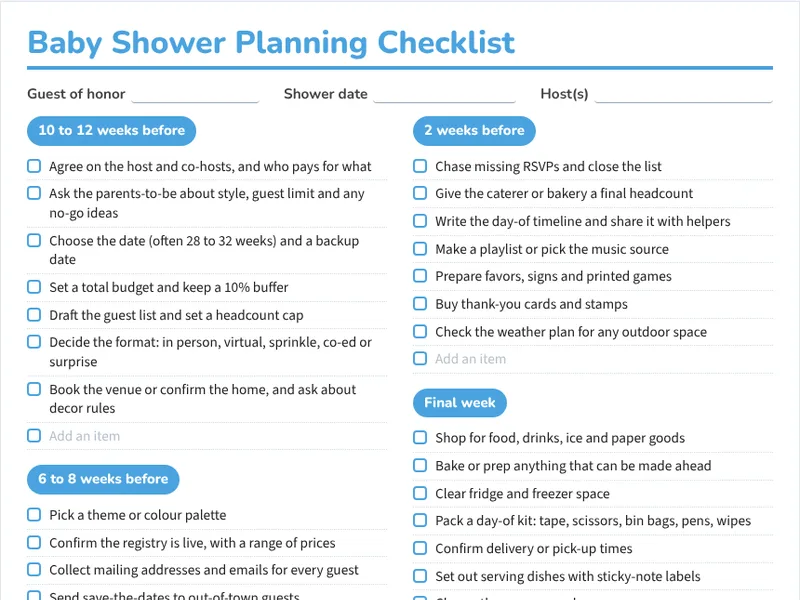 Baby Shower Planning Checklist (Free Printable)
 Moving Out of State Checklist
 Move Out Cleaning Checklist (Free Printable)