
Moving Out of State Checklist

A moving out of state checklist should walk you through three phases: the weeks before the move (budget, movers, packing, address changes), moving day itself, and the first 90 days in your new state (driver’s license, car registration, voter registration, insurance, doctors). The printable on this page puts all of that on one US Letter sheet, in time order, so you can see what to do now and what can wait.
8 to 12 weeks out
- Set a move date and a firm budget
- Research the new city and neighborhoods
- Get 3 quotes from FMCSA-registered movers
- Compare movers, container and truck rental
- Decide what to keep, sell, donate or toss
- Start a moving binder or folder
- Check job, lease or closing dates line up
- Tell your landlord or list your home
4 to 6 weeks out
- Book mover, truck or container in writing
- Order boxes, tape and packing paper
- Pack seasonal and rarely used items
- Request school and medical records
- Ask doctors to renew prescriptions early
- Look up new state DMV rules and deadlines
- Book time off work for packing and move day
- Plan travel: drive, fly or ship the car
2 to 3 weeks out
- File USPS mail forwarding
- Update address with bank, cards and employer
- Schedule utilities off at old, on at new
- Cancel or transfer gym and subscriptions
- Get car serviced before the long drive
- Arrange pet travel and vet records
- Confirm quote, dates and inventory with mover
- Get new-state auto insurance quote
Final week
- Use up fridge, freezer and pantry food
- Defrost freezer 48 hours before loading
- Pack a first-night essentials box
- Withdraw some cash for tips and fuel
- Finish packing 2 days before the truck
- Charge phones and pack chargers
- Say goodbyes to favorite local places
- Fill the car with gas and check tires
Moving day and the drive
- Photograph the empty home
- Keep IDs, meds and valuables with you
- Review inventory before signing
- Final walk-through of every room
- Collect all keys, remotes and access cards
- Leave keys as agreed and lock up
- Save fuel, hotel and meal receipts
First week in the new state
- Check inventory against what arrives
- Note damage on paperwork right away
- Confirm utilities and internet work
- Set up mail and check forwarding
- Test smoke and carbon monoxide alarms
- Find nearest pharmacy and urgent care
- Enroll children in school
- Unpack kitchen and beds first
First 30 to 90 days
- Get new driver's license
- Register and title the car
- Register to vote
- Switch auto, renters or home insurance
- Choose new doctor, dentist and vet
- Check state tax rules for the move year
- Update professional licenses if needed
- Cancel old-state services still billing you
Deadlines vary by state. Check your new state's DMV and election office websites for exact dates.
Free for personal, classroom and office use. Your entries are included in the print, PDF and PNG. Prints on US Letter and fits A4.
Black and White Moving Out of State Checklist Printable
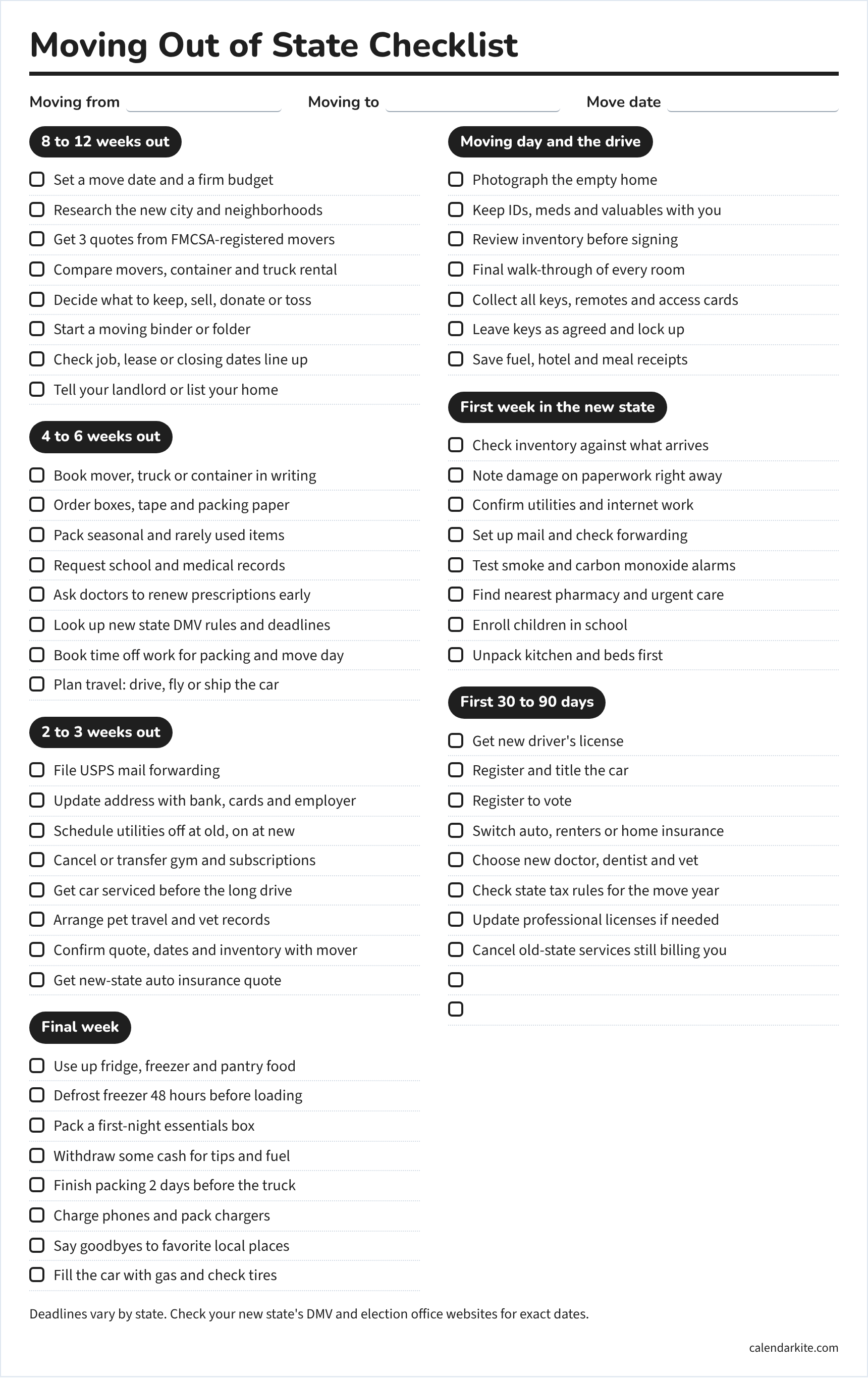
I made this one for anyone who wants a plain checklist that barely uses any ink. I test-print every page on my home inkjet, and this one stays crisp on US Letter and A4 for taping inside a cabinet door.
Pink Moving Out of State Checklist
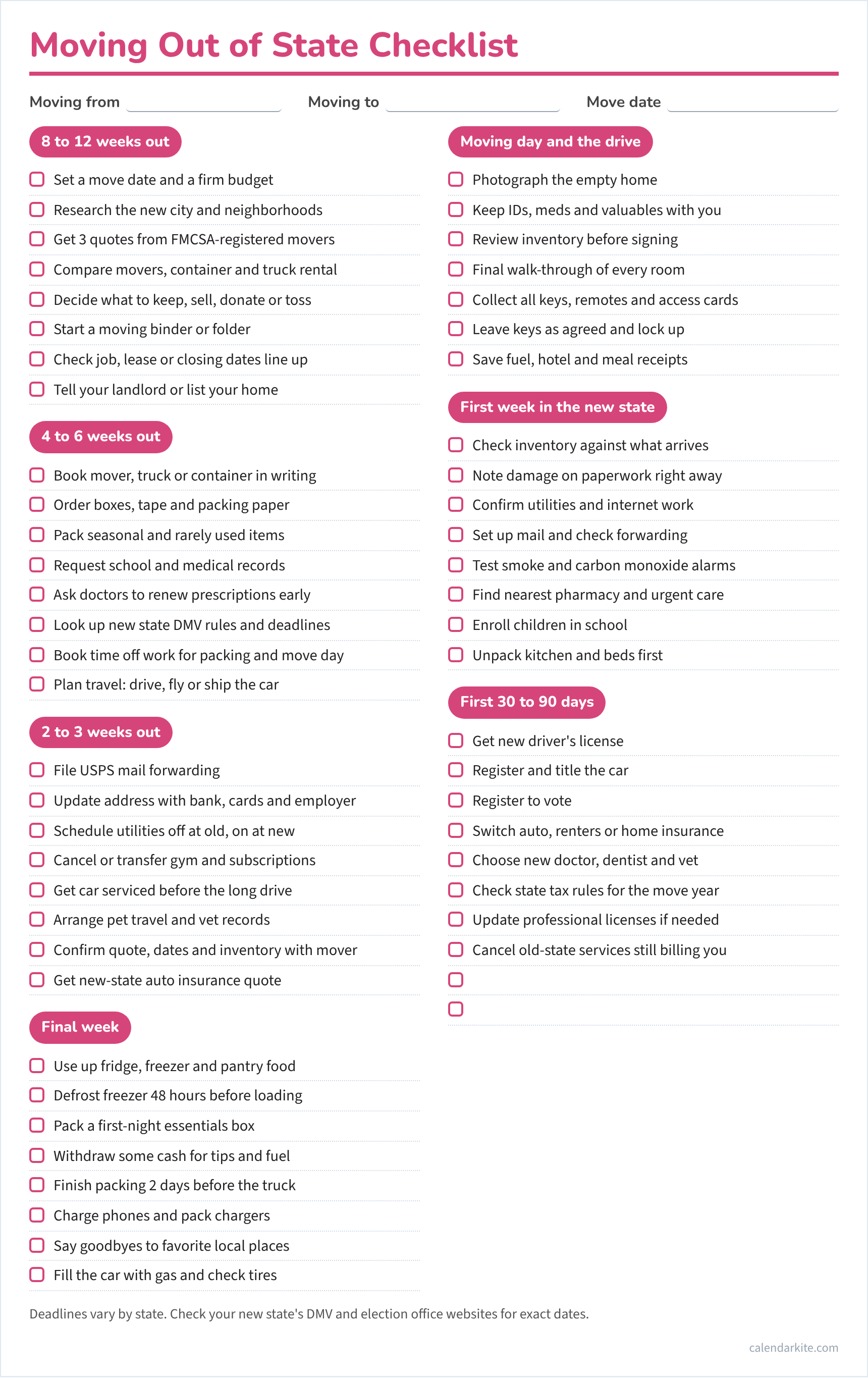
This soft pink version suits anyone who likes a gentle, friendly look on a stressful project. I'd put it on the fridge like my own paper calendar and tick off address changes, utility transfers and the new driver's license as you go.
Sage Green Moving Out of State Checklist
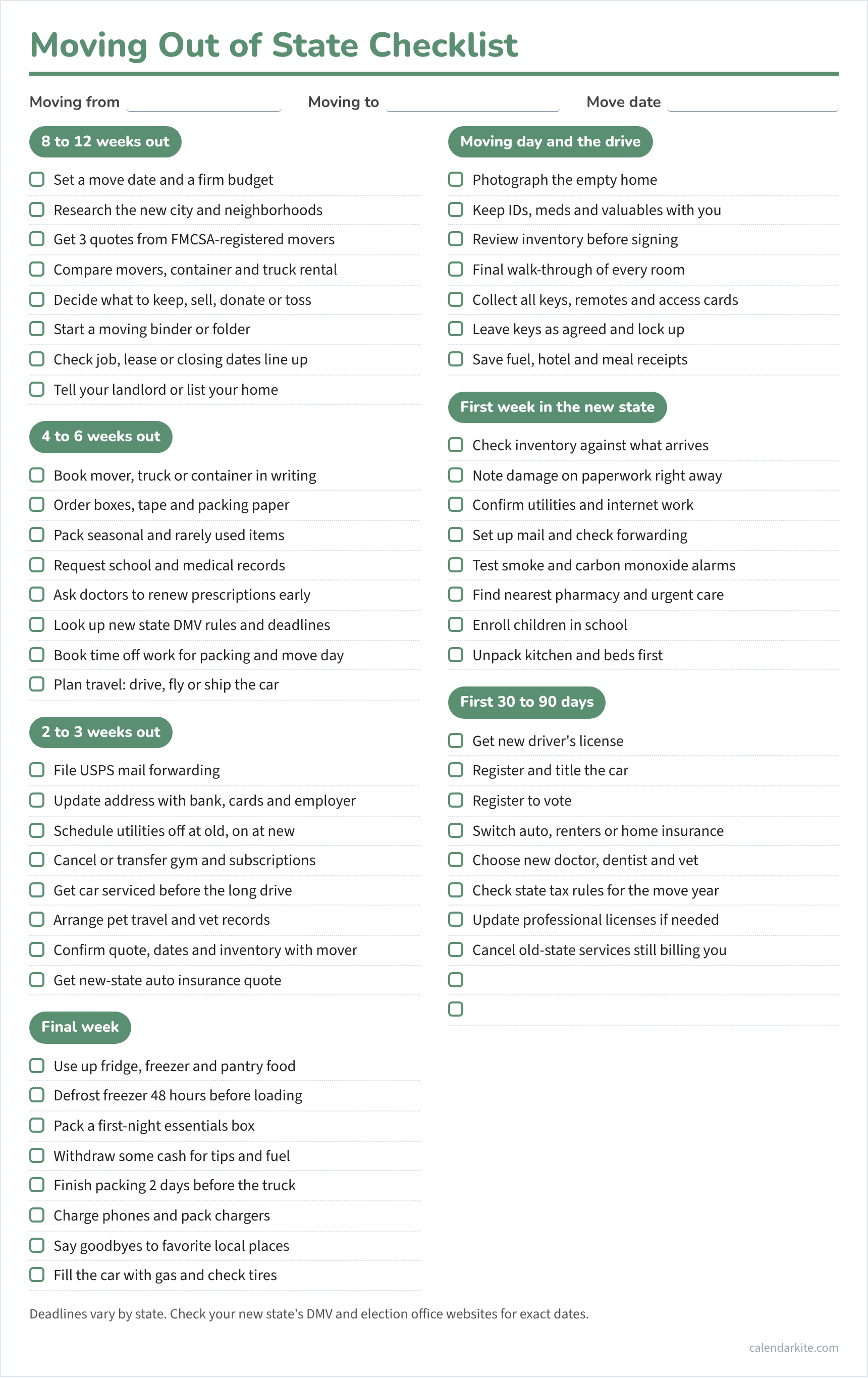
Sage green is calm, which helps if you're juggling a job transfer, a lease and a moving truck at once. In my office years I learned that a checklist split by timeline beats one long list, so I kept the sections in date order.
Lavender Moving Out of State Checklist
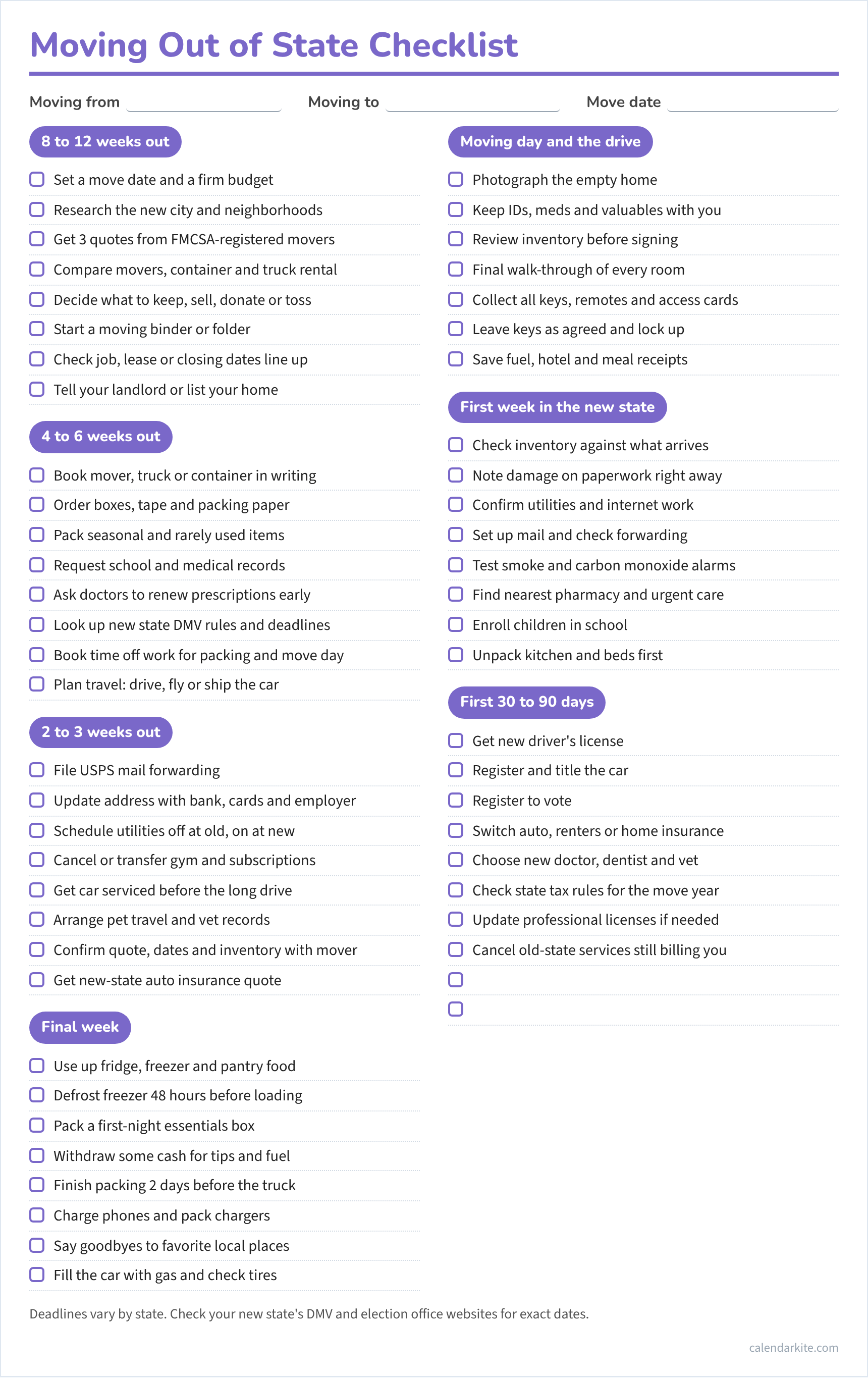
Lavender works well for a planner-style binder or a clipboard you carry between rooms. I use something similar on my kitchen counter, and I'd use it to track quotes from movers, deposit dates and what's left to pack.
Cute Moving Out of State Checklist
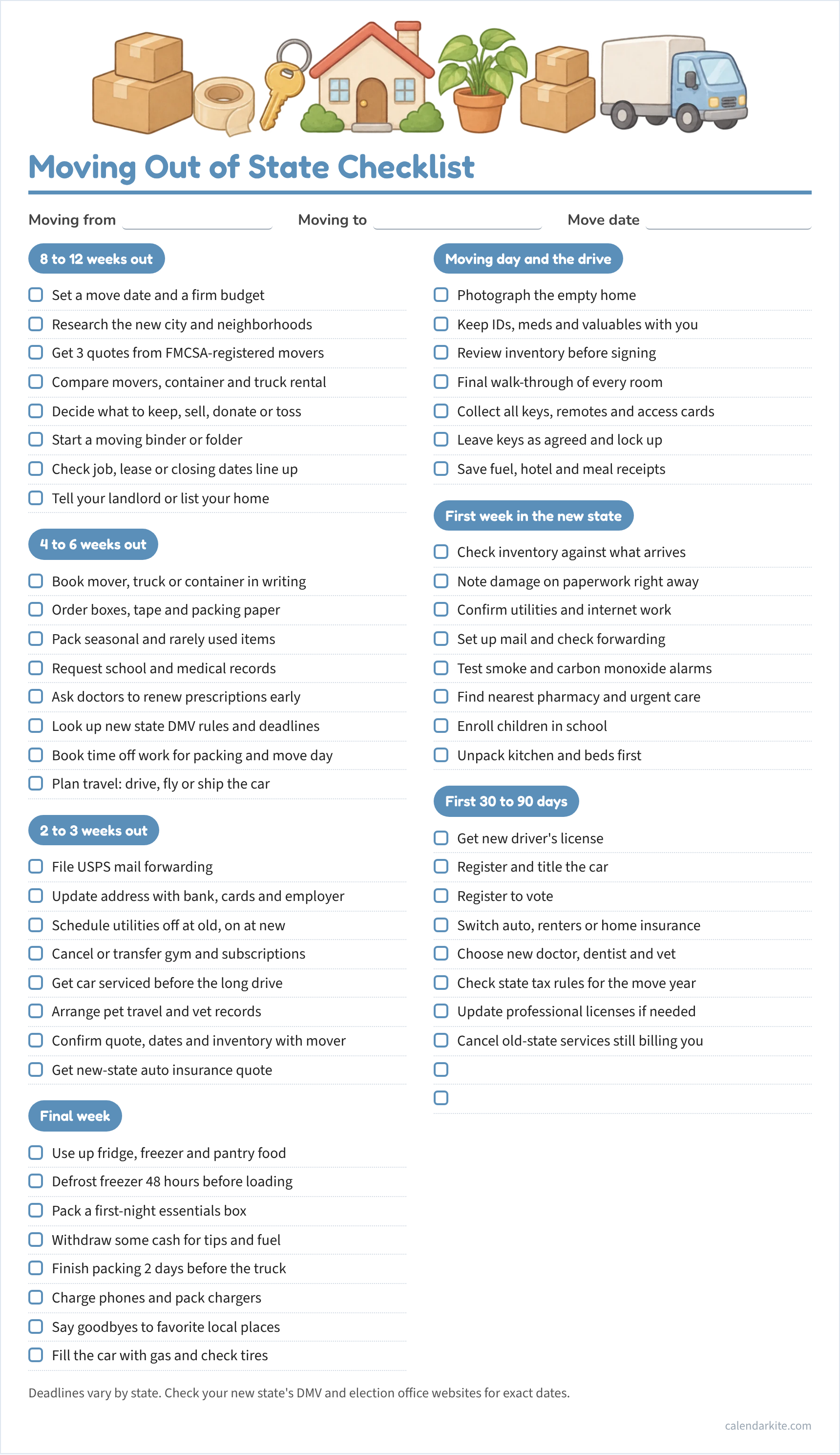
The pastel blue design with little hand-drawn illustrations is for anyone who wants moving to feel a bit lighter. It's handy for a household with kids and a dog like mine, where the checklist ends up on the fridge for everyone to see.
Floral Moving Out of State Checklist
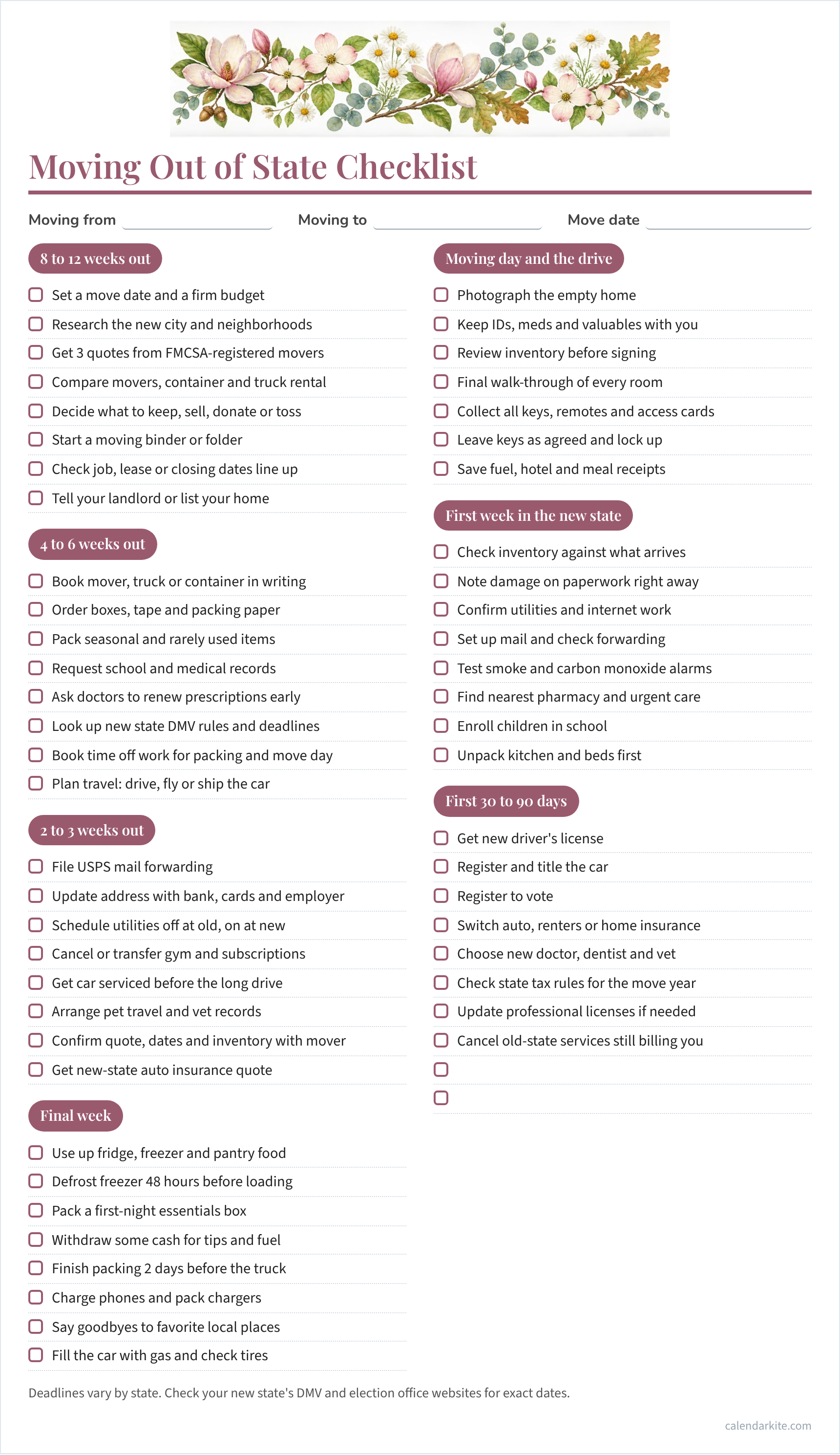
This elegant mauve design with watercolor flowers suits anyone sending change-of-address notes and wanting a pretty checklist to match. It prints well on US Letter, and I'd keep it in a folder with your lease, mover contract and utility confirmations.
Colorful Moving Out of State Checklist
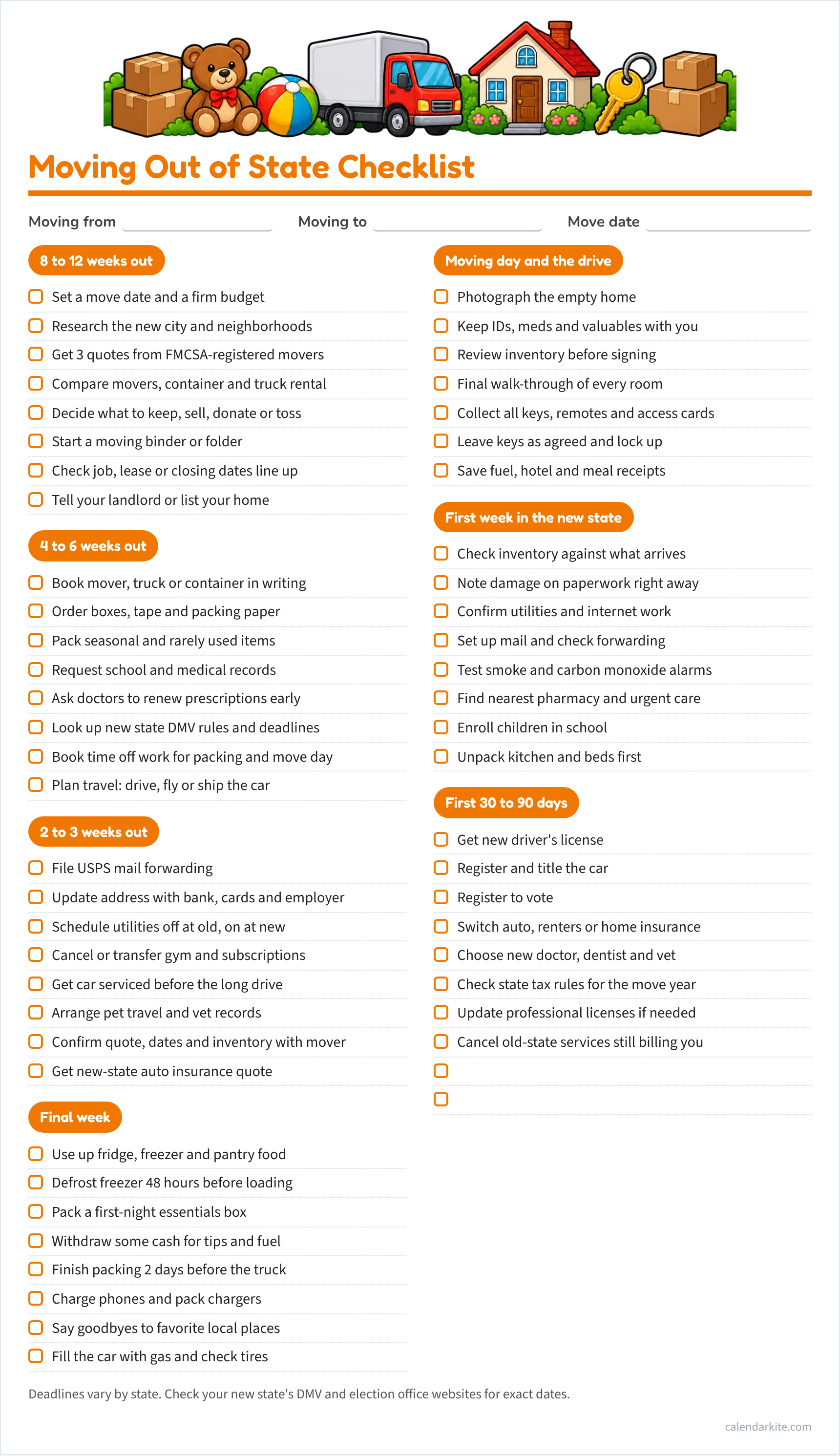
Bright, bold and playful, this colorful version is great for families who want everyone to pitch in. I'd hand the kids the pack-your-own-room items while you handle the paperwork like school records and transfers.
Simple Minimalist Moving Out of State Checklist
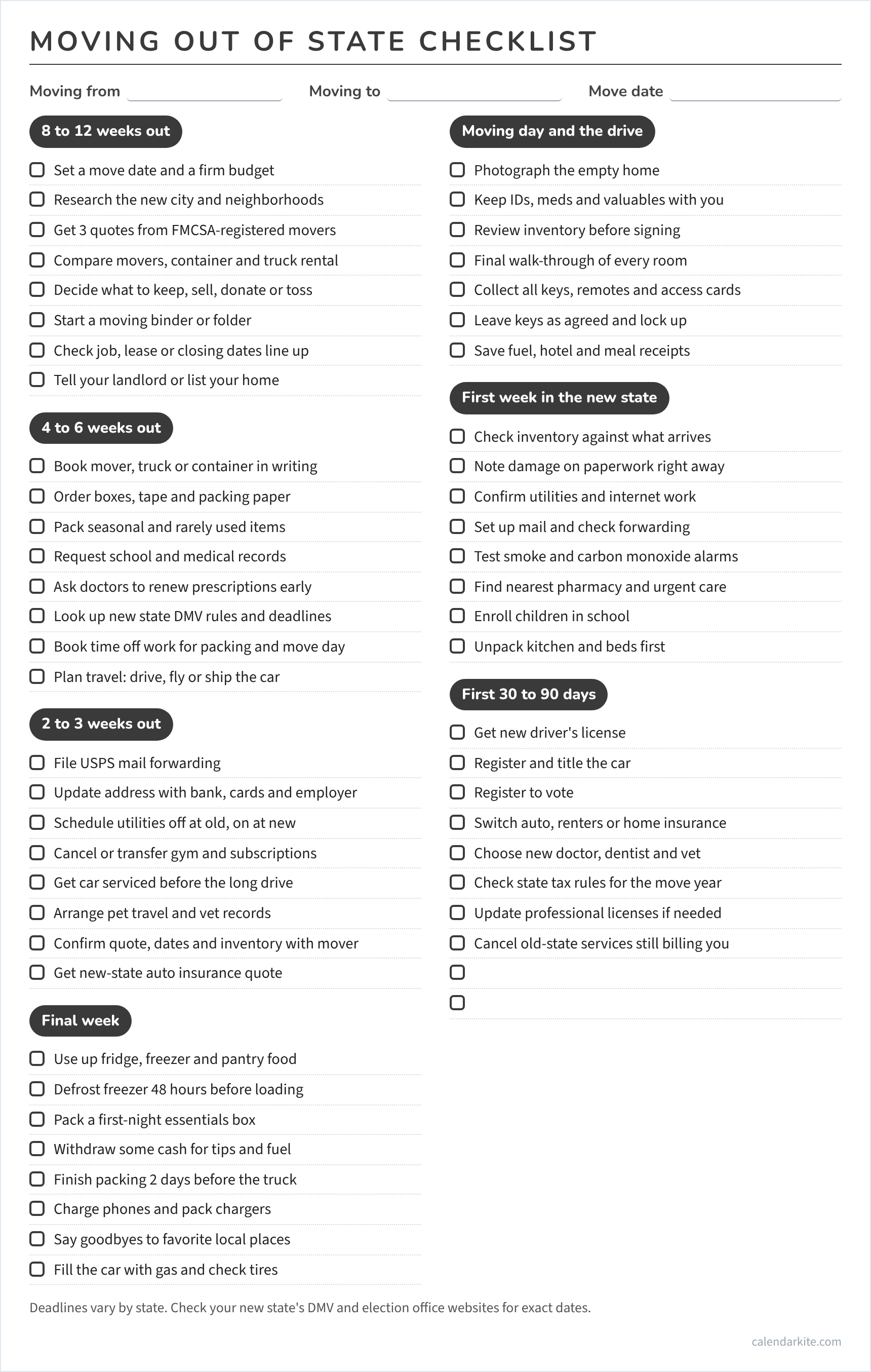
Thin gray lines and a light uppercase heading make this the one for people who like a clean, no-fuss list. One mistake I see is cramming every task onto one page, so I left generous space to write dates and confirmation numbers.
Aesthetic Moving Out of State Checklist
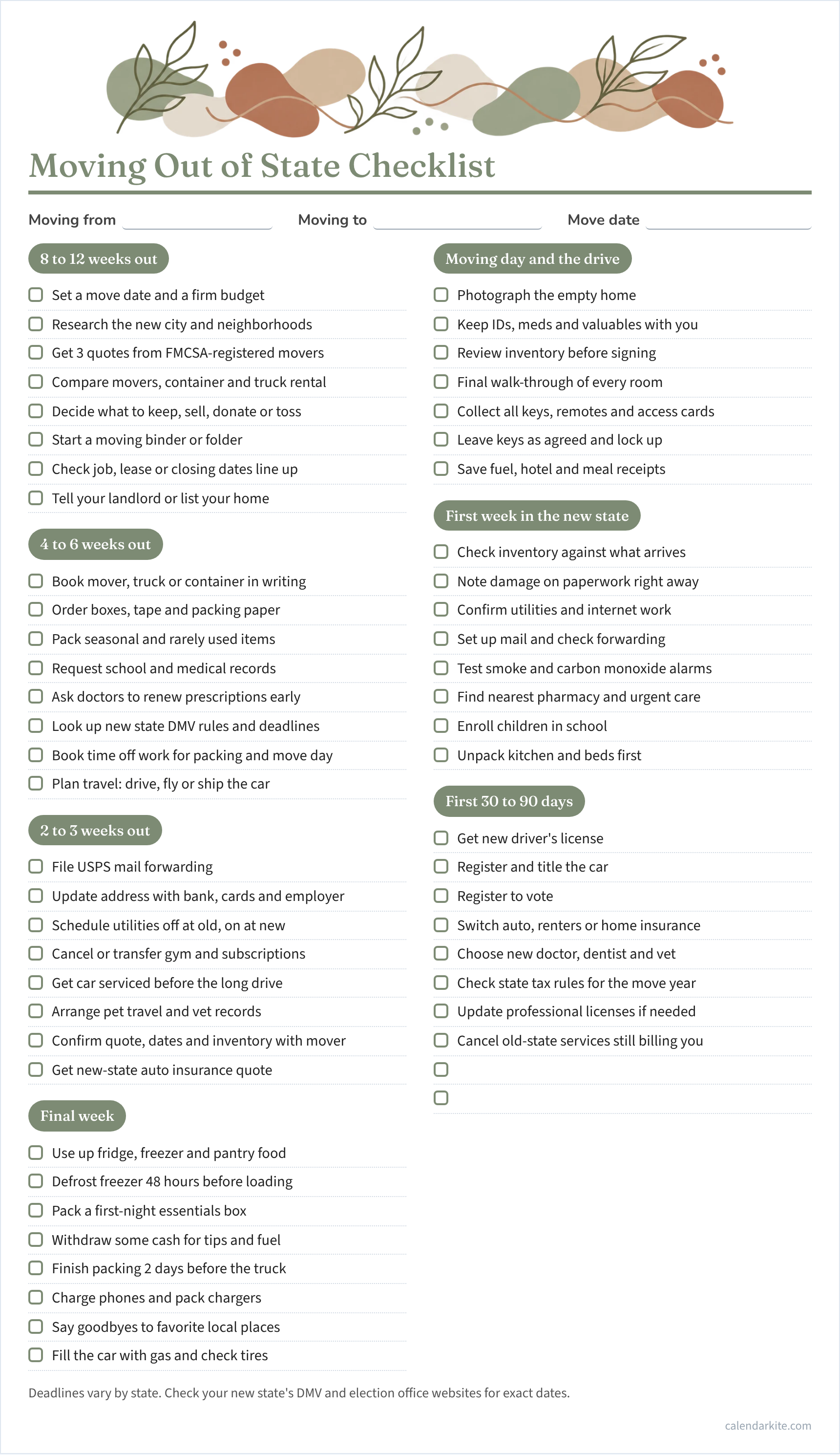
Muted sage, sand and terracotta with soft leaf line-art suit a calm, styled planner setup. I'd use it in the weeks before your move to track cancellations, mail forwarding and the walk-through of your new place.
Modern Moving Out of State Checklist Printable
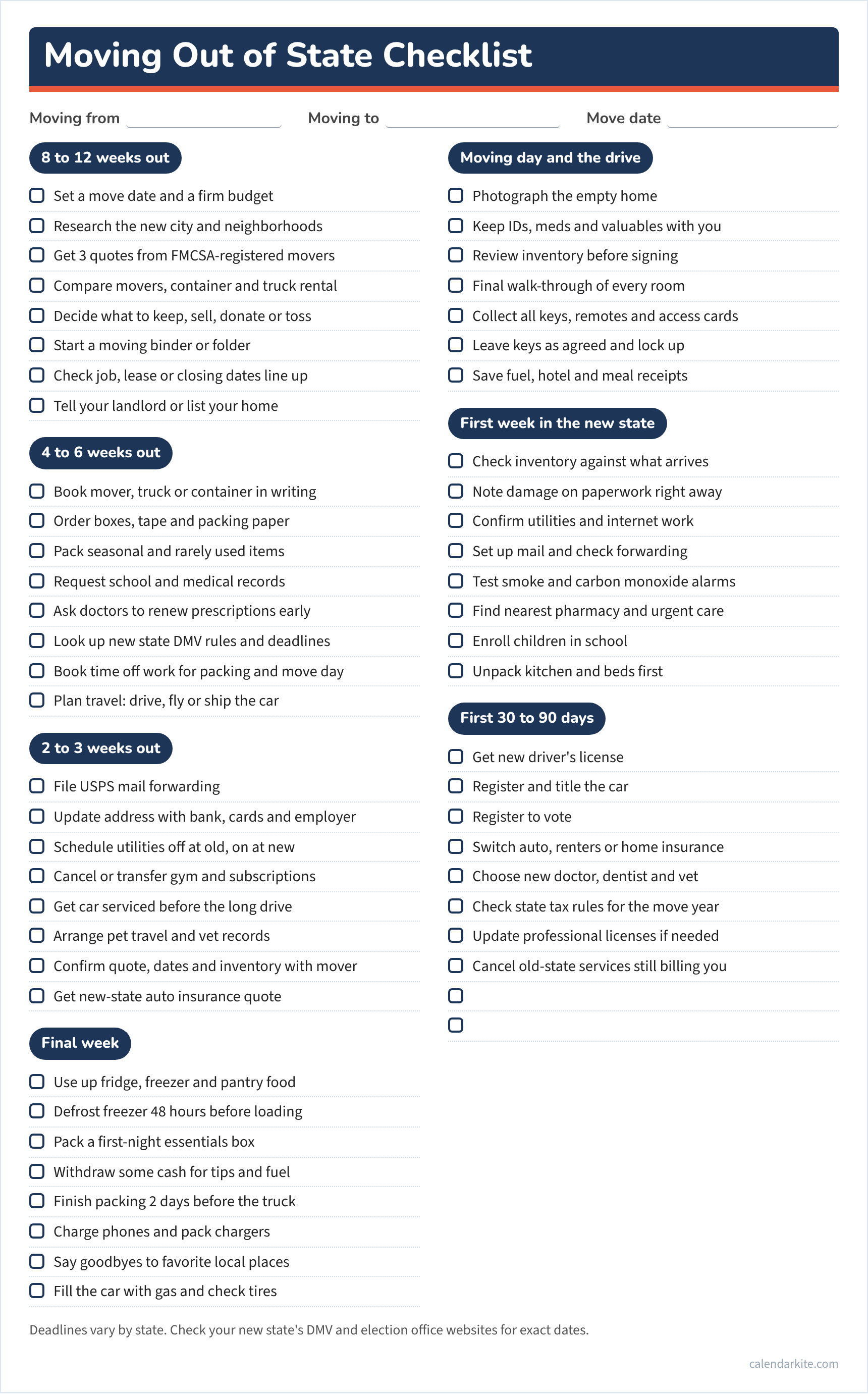
The navy header band and coral accent stand out on a busy desk, which helps if you're moving for work. It suits final-week tasks like confirming the truck, scheduling utility shutoffs and packing an essentials box.
I built it the way I used to build schedules in office administration: grouped by when something is due, not by topic. A move has too many moving parts to sort by category, and a list in time order tells you what to do this week. You can type straight into the sheet, tick items off, edit the wording, and it saves in your browser. When you are happy with it, print it, or download the blank PDF.
What a moving out of state checklist should cover
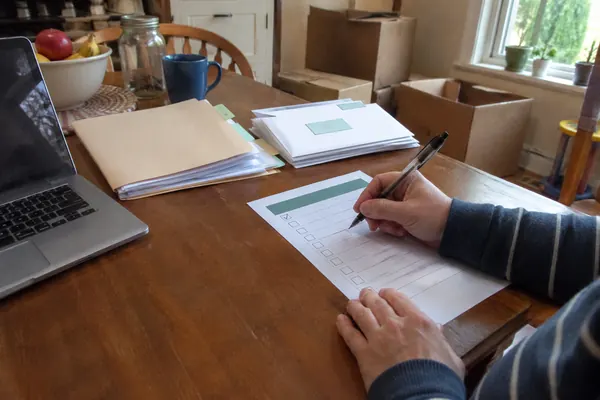
A move across state lines is not just a long local move. You are changing legal residence, so there are things a local move never asks of you. That means a new driver’s license, new plates and registration, new voter registration, possibly new insurance, and a tax situation that may span two states.
The practical side is also different. Interstate movers price by weight and distance rather than a flat local rate. They also need to be registered to cross state lines. Interstate moves mean weight-and-distance pricing and a mover who is FMCSA-registered, so vetting takes longer than for a local job. Then there is the drive or flight, which sits right between two rounds of heavy physical work.
The printable covers seven stages: 8 to 12 weeks out, 4 to 6 weeks out, 2 to 3 weeks out, the final week, moving day and the drive, the first week in the new state, and the first 30 to 90 days. If you only need a general packing and moving list, my moving checklist template is a lighter version. This one is built for the state-line extras.
Who this printable suits
It suits anyone moving to a different state, whether you rent or own, move alone or with a family, hire movers or rent a truck. It is especially useful for job relocations, where the start date is fixed and the timeline is tight, and for families who need to line up school records and enrollment.
It is also handy for the person in a household who ends up holding everything in their head. In an office, that was usually me, and I learned that a shared written list beats a good memory every time. Print one copy for the fridge and keep the editable version on your phone so a partner can see what is done.
If you are combining two households into one while you move, pair this with the moving in together checklist, which covers the conversations and shared-space decisions this sheet does not.
How to fill in the printable
Start with the three fields at the top: where you are moving from, where you are moving to, and your move date. Everything else is counted back from that date, so write it in first. If the date is not set yet, leave it blank and come back to it.
Then work through the first two groups on the sheet. Tick what you have already done (you may be surprised how much counts) and edit any item that does not fit. Change “Get 3 quotes from movers” to “Get truck rental quote” if you are driving it yourself. Delete what does not apply. The blank rows at the bottom of the last group are for your own items, such as a professional license or a boat registration.
I test-print every sheet on my home inkjet on both US Letter and A4, and I kept the type big enough to write in with a pen. Many people type the list, print it, and then tick by hand on paper. That works well because paper is easy to carry through a house full of boxes.
Try this: Write your move date in the header, then write a real calendar date next to each of the seven group headings. Seeing “March 3” instead of “4 to 6 weeks out” turns the list into a schedule.
The timeline: 8 to 12 weeks out
The earliest tasks decide how stressful the rest will be. Set a budget, set a date, and decide how you are moving: full-service movers, a container, a rental truck, or a mix. If you want a sense of how a first-year budget fits together, my budget planner printable gives you room to list the one-off moving costs alongside the new monthly ones.
This is also the time to sort belongings. Every item you sell or donate is weight you do not pay to move. Go room by room and make four piles: keep, sell, donate, toss. Selling takes the longest, so start there.
Open a moving binder or a single folder (paper or digital) now. It will hold quotes, lease or closing paperwork, receipts and contact numbers. Putting it together early means nothing is scattered by week six. Keeping your quotes and expense receipts in one place also helps at tax time, since tracking moving expenses in a folder means you can find them when tax time rolls around.
Choosing movers and booking in writing
Get at least three quotes and compare more than price. Ask whether the quote is binding or an estimate, what is covered if something breaks, whether storage is available if your dates do not line up, and how long delivery takes. You can verify that a mover is legally registered through the federal site protectyourmove.gov.
Once you choose, confirm everything in writing: pickup window, delivery window, price and inventory. A phone call is not enough. Confirming move details with your mover in writing, including pickup and delivery windows, binding price and inventory is a good habit to repeat two weeks before the move.
If you are driving a rental truck or using a container, book earlier than you think you need to, especially for end-of-month dates and summer. Those are the busy times everywhere. If you have flexibility, a mid-month, midweek date is often easier to book and cheaper.
Four to six weeks out: paperwork and packing
By now the big decisions are made and you are in the paper-and-boxes phase. Order supplies, start packing things you will not miss (off-season clothes, books, spare linens), and request records: school files for children, medical and dental records, and vet records for pets. Ask your doctor to renew prescriptions early, and request that they be filled at a pharmacy in your new city if you can.
Look up your new state’s DMV and election office websites and note the deadlines on your sheet. Deadlines vary, so do not rely on a number from a blog post, including this one. A five-minute check now saves a fine later.
I keep a paper calendar on our fridge, and for a move I would give it its own color for move-related items: mover visits, utility appointments, last day at work. If you want a month grid to go with the checklist, the monthly planner works well for that.
Two to three weeks out: addresses, utilities and the car
This is the stretch where small admin tasks pile up. File your USPS mail forwarding, then update your address with your bank, credit cards, employer, insurers, subscriptions and anyone who sends you a bill. Forwarding catches stragglers, but it is not a substitute for updating each account, and your mail, banking and voter registration do not update automatically.
Schedule utilities carefully. Services at your old home should end after you finish moving out, and services at the new home should start by the time you arrive. A gap of a day at each end is cheap insurance. If you want to track who you called and what they promised, a simple communication log keeps names, dates and confirmation numbers in one spot.
Get the car serviced before a long drive: oil, tires, brakes and fluids. Also get a quote from your insurer for your new address, because moving out of state can also mean a change of laws, and what you need to carry may differ.
Try this: Set a 20-minute timer and update your address with just five accounts: your bank, your main credit card, your employer, your car insurer and your phone provider. Tick them off the sheet and do five more tomorrow.
The final week
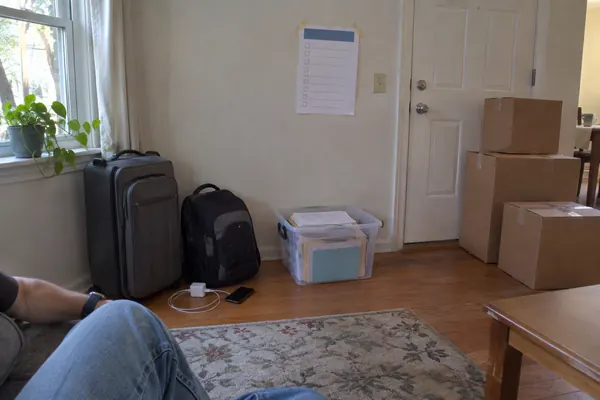
Eat down the freezer and pantry. It is easier to clear out a nearly empty fridge than a full one, and you waste less food. Defrost the freezer at least 48 hours before loading so there is no water damage. Pack a first-night essentials box with toiletries, a change of clothes, chargers, basic tools, paper towels, a shower curtain, and anything you would need before you find the rest of the boxes.
Finish packing about two days before the truck arrives, so there is a buffer for the things you forgot and the cupboards you thought were empty. Withdraw some cash for tips, fuel and tolls, and fill the gas tank the night before.
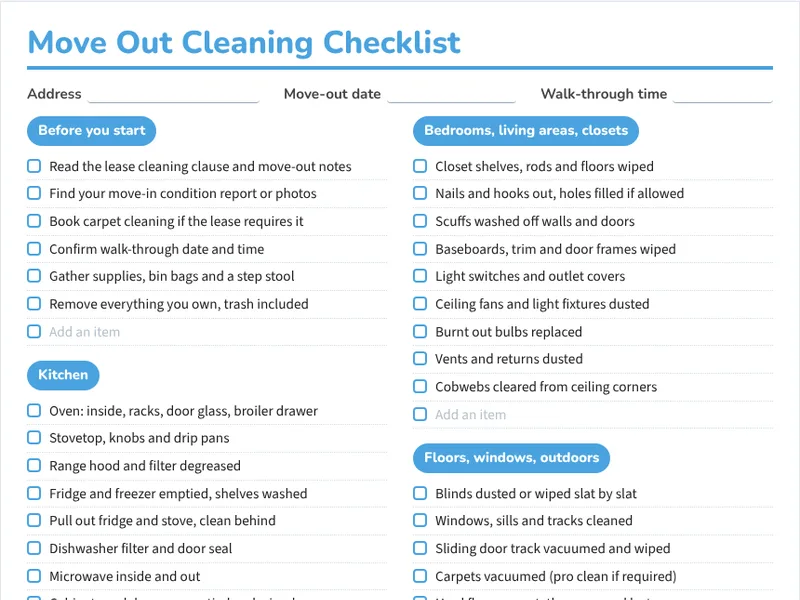
Cleaning is part of the final week too, especially if you rent. A quick read of my move-out cleaning checklist will tell you what a landlord inspection typically looks at, so you can get your deposit back rather than a bill.
What stays with you, not on the truck
This is the one part of a long-distance move that I would tape to the door. Keep birth certificates, Social Security cards, passports, titles, medications, jewelry, cash and electronics with you. Your essential documents and valuables go in your car, never on the moving truck.
The reason is simple. A truck can be delayed for days, and some papers cannot be replaced quickly. You need ID to get your license, a lease or deed to set up utilities, and records to enroll a child in school. If they are in box 47 on a truck still in another state, you wait.
Pack these in one bag or a small box with a lid, and put it where you can see it on moving day. In an office, anything critical went in a clearly labeled folder on the desk, never in a general pile. A move is no different.
Moving day and the drive
Before the movers arrive, photograph the empty rooms. When loading finishes, do one last walk-through of every room, closet, garage and attic. Review the inventory together before you sign. Check and sign the inventory list and bill of lading only after a final walk-through.
Collect all keys, garage remotes and access cards, and leave them as agreed with your landlord or buyer. Keep receipts for fuel, hotels and meals in an envelope or snap photos of them as you go, so tax time is easier.
If you are driving a long distance, plan overnight stops ahead and pack the car with the pet supplies, snacks and chargers within reach. Some families find it easier to fly and have the car shipped, particularly across many states, though that is a budget call you can make during the early planning.
Driver’s license and car registration
These are the legal tasks most likely to bite you if you forget. Every state expects new residents to get a local license within a set window, and the windows vary widely. Most are in the range of 30 to 90 days. As examples, Texas allows 90 days, Virginia 60 days and New York 30 days. Your state may be shorter or longer, so check the DMV site, and do not guess.
Bring the documents the DMV asks for. These usually include your current license, proof of identity, proof of residency (a lease or utility bill), Social Security number and, for the car, your title or lienholder details and proof of insurance valid in the new state. Many DMVs now require appointments, so book one early.
Also note that the vehicle deadline can differ from the license one. In some states the deadline to register your vehicle is shorter than the one for a new license, so do not assume the order. If your new state requires an inspection or emissions test, get that on the sheet as well.
Voter registration, taxes and insurance
Register to vote in your new state once you are a resident, and check the registration deadline before the next election. Many states let you register online, at the DMV or at your local election office. Your old registration is usually cancelled when you register in the new place, but verify this with your old county, and ask them if you have any doubt.
Taxes depend on timing. If you move partway through the year, you may need to file in both states, and rules for part-year residents differ. I am not a tax professional, so I would check both states’ revenue department websites or ask someone who is. Keep your moving receipts together while you do.
Insurance deserves a second look: auto, renters or homeowners, and health. Some states have different minimum coverage rules, and health plans may have limited networks outside the old state. If your health insurance is employer-based, ask HR what happens to coverage after the move. Keep a note of start dates so there is no gap and cancel the old policy only after the new one is active. A bill tracker printable helps in these first months, when due dates shift and old and new bills overlap.
Healthcare, school and pets
Find a new doctor, dentist and pharmacy early, before you need one. Check that providers are in network for your plan. Transfer records or carry copies. Note a nearby urgent care and a vet on your sheet in the first week, so you have a number when something happens at 9 p.m.
For children, request school records weeks ahead and learn the enrollment process for your new district. Many districts want proof of address, immunization records and a birth certificate, and some have deadlines or a waiting period for popular schools. Bring copies, not just originals.
For pets, check any health certificate requirements for travel, update microchip contact information, and look up local licensing rules in your new city. Pets travel better when you pack a bag with food, bowls, medications and a familiar bed that stays with you, not in the truck.
Variations: renters, owners, solo movers and families
The sheet is a general plan, and these small changes fit it to your situation.
- Renters: add lease end date, notice to landlord, deposit return, and the move-out walk-through.
- Homeowners: add listing or closing dates, the utility final reads, a change of address with the county, and a homestead exemption in the new state, where one exists.
- Solo movers: add “ask two friends for moving day” early, and book help in advance.
- Families: add school enrollment, sports and activity sign-ups, and a plan for the kids on moving day.
- Job relocations: add the start date, relocation benefit paperwork and the tax treatment of any payments.
If a new job is part of the reason for the move, a job application tracker can be a good way to keep applications and follow-ups straight while you sort out a new employer in the new state.
Common mistakes to avoid
The most common mistake I see is leaving the paperwork until after the boxes are unpacked. Deadlines for licenses and registration start on the day you become a resident, not the day you finish unpacking. Put the DMV appointment on the calendar in your first week.
The second is mixing up what travels with you. People put medications and documents in “just one more box” and regret it. The third is booking movers on a verbal quote and discovering the price changed on the day. Get everything in writing.
Last, many people use a list once and abandon it. A moving list works only if you open it often. Keep the printed sheet in a spot you pass every day, and tick as you go.
Try this: Tape the printed sheet to the inside of a kitchen cabinet door or the fridge. Each evening, tick one thing off and write one new task on the blank lines.
Printing tips
Print at 100 percent scale on US Letter, or choose “fit to page” if you use A4. Use plain white paper, since the sheet is built to be written on with a pen. Black-and-white works fine, and it will keep your ink for the rest of the move.
If you want a spare, print two copies: one for the fridge and one for the folder or car. Edit items on screen first, so you do not scribble over text. For the closing weeks, a second printed copy that you mark only for the final week and moving day helps you carry the short list in your pocket.
When the move is done, keep the sheet with your records. It shows when you registered the car, got the license and changed addresses, and that is useful if a state ever asks when you became a resident. For more lists in the same style, see the full set of printable checklists.
Common questions
How far ahead should I start a moving out of state checklist?
Aim for eight to twelve weeks before the move. That gives you time to compare movers, sort belongings and book a date without paying rush prices. If you have less time, start with the mover booking and the paperwork, and trim the rest.
How long do I have to get a driver's license after moving to a new state?
It depends on the state. Most set a window somewhere between 30 and 90 days after you become a resident, and some are shorter. Check your new state's DMV website before you move so you know your exact deadline.
Do I need to cancel my voter registration in my old state?
Usually your old registration is cancelled when you register in the new state, but it is worth confirming with your old county election office. Register in your new state as soon as you are eligible, and check its registration deadline before any election.
What should not go on the moving truck?
Keep IDs, birth certificates, Social Security cards, passports, medications, cash, jewelry, laptops, chargers and your first-night box with you. Anything you could not replace in a day should travel in your own car.
Do I have to file taxes in two states if I move mid-year?
Possibly. A move partway through the year can mean part-year returns in both states, and rules differ. A tax professional or the revenue department websites of both states can tell you what applies to you.
Can I use this checklist if I am moving with kids and pets?
Yes. The sheet includes school records, enrollment, pet travel and vet records, and it has blank lines at the bottom for anything specific to your family. Add your own items right on the page before you print.
 Camping Checklist Printable: Free One-Page Packing List
 Checklist: A Free Printable You Can Fill In, Edit and Print
 Grocery List Printable
 Baby Shower Planning Checklist (Free Printable)
 Move Out Cleaning Checklist (Free Printable)
 Printable To Do List: Free Sheet You Can Fill In and Print