
Moving Checklist Template: Free Printable You Can Fill In

A moving checklist template is a single page that lists every task in your move in the order you need to do it, from getting quotes eight weeks out to testing the smoke alarms in your first week. The one on this page is free, fits on one US Letter page, and you can type into it, tick things off and edit the items before you print.
8 weeks out
- Set a moving date and a backup date
- Set a budget with a 10% cushion
- Get 3 written mover quotes or price a truck
- Read your lease or contract for notice rules
- Sort keep, sell, donate, toss
- Start a documents folder
- Look up school records and enrolment
4 weeks out
- Book movers or truck in writing
- Order boxes, tape, paper, markers
- Give notice to landlord or confirm closing
- Schedule utility stop and start dates
- File USPS change of address
- Request medical, dental and vet records
- Book time off for moving day
2 weeks out
- Confirm movers, date and arrival window
- Pack books, decor and spare rooms
- Reserve elevator, dock or parking
- Move prescriptions to a new pharmacy
- Pause or move subscriptions
- Arrange kid and pet care for moving day
- Use up freezer and pantry food
Final week
- Pack the kitchen except daily basics
- Label every box with room and number
- Defrost and dry the fridge and freezer
- Photograph electronics wiring
- Pack the essentials box
- Charge phones, pack chargers
- Set aside cash for tips and snacks
Moving day
- Film a walkthrough of the empty home
- Photograph meter readings
- Check the inventory before signing
- Lock windows, turn off lights
- Hand over or leave keys as agreed
- Keep documents folder with you
- Count boxes on arrival
Change of address
- Bank and credit cards
- Employer and payroll
- Insurance (home, car, health)
- Phone, internet and streaming
- Doctor, dentist, pharmacy
- Driver's license and registration
- Friends, family and online shops
First week in the new place
- Note any damage the same day
- Set up beds and bathroom first
- Test smoke and CO alarms
- Check locks and garage codes
- Unpack the kitchen basics
- Register to vote at the new address
- Meet the neighbours, find the trash day
Tick as you go. Keep this sheet in your documents folder, not on the truck.
Free for personal, classroom and office use. Your entries are included in the print, PDF and PNG. Prints on US Letter and fits A4.
Black and White Moving Checklist Template
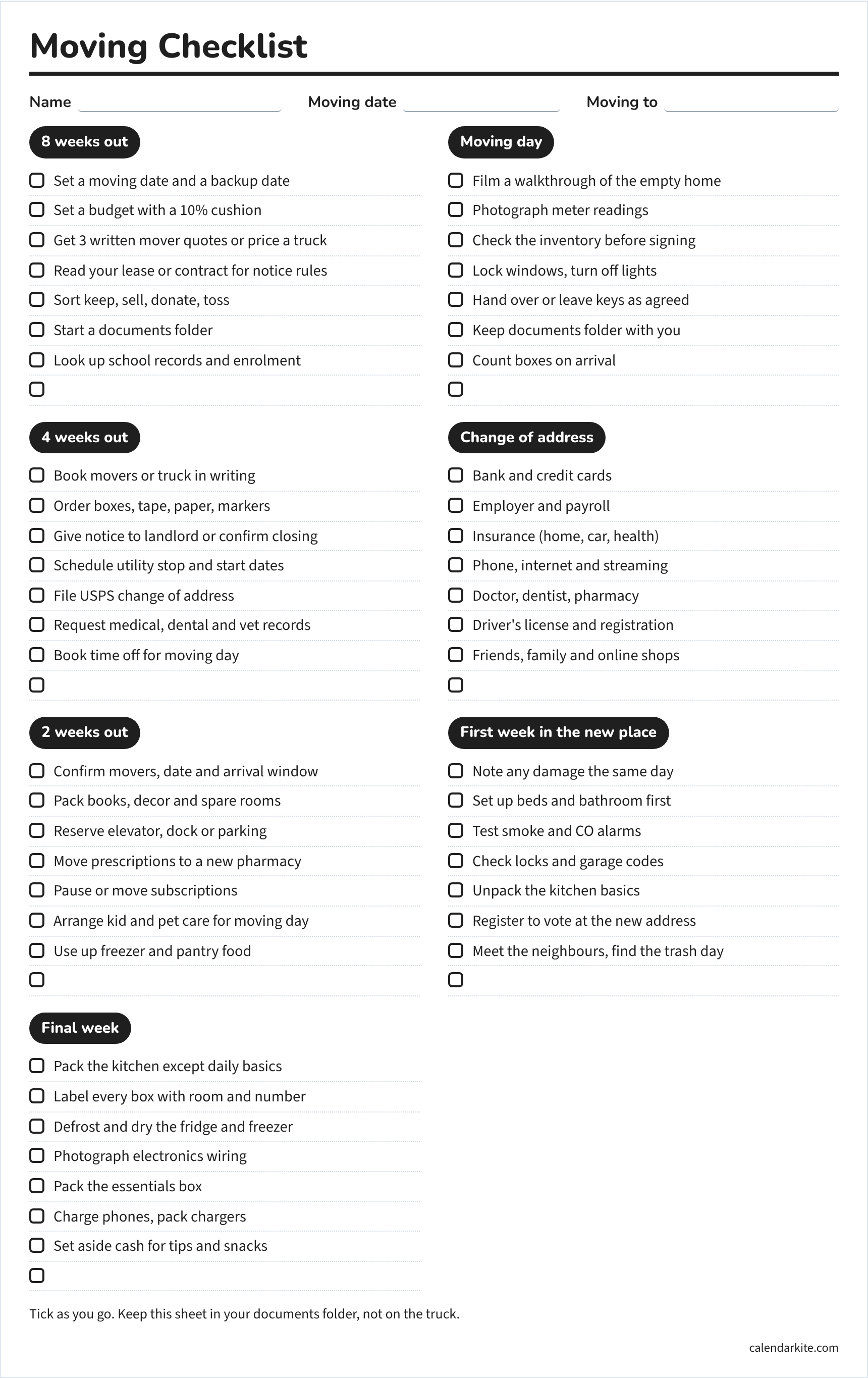
This is the version I print most because it uses very little ink and photocopies cleanly for everyone helping on moving day. I test-print it on my home inkjet, and the plain lines stay readable even in draft mode.
Pink Moving Checklist Template
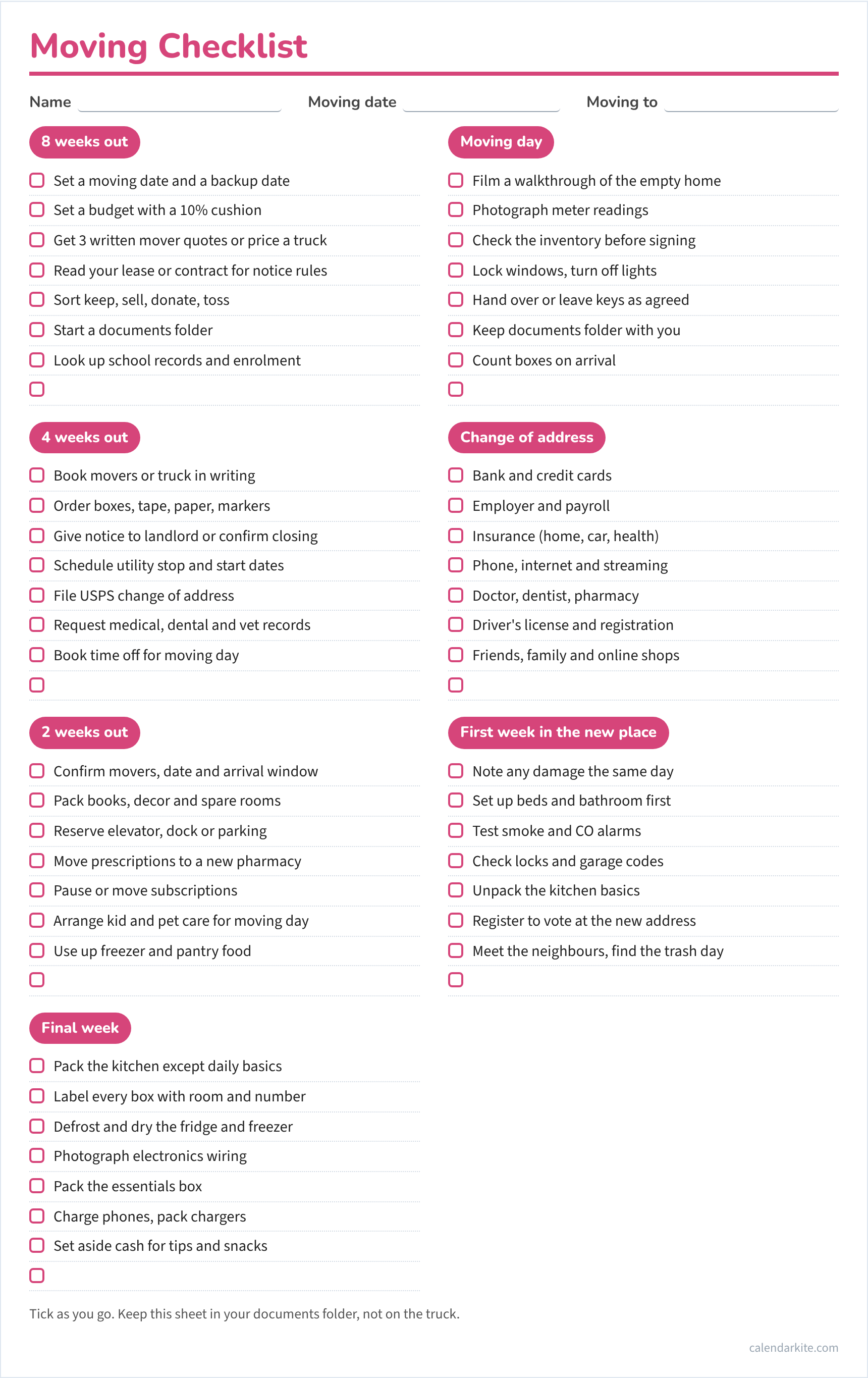
Soft pink suits anyone who wants a cheerful packing plan for a first apartment or a move across town. Print one copy per room and tape it to the door, which is how I keep boxes from getting mixed up.
Sage Green Moving Checklist Template
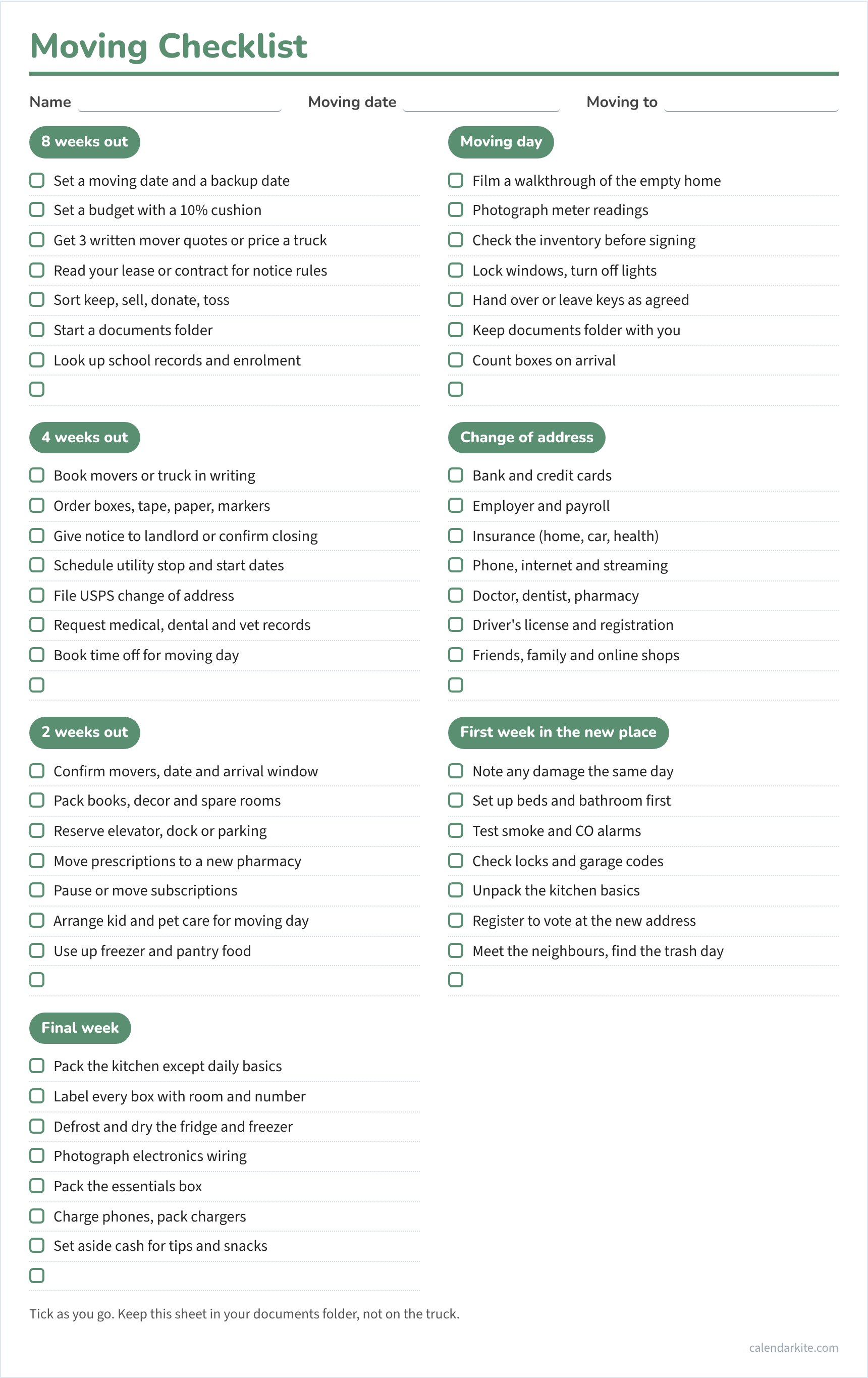
I like this calm green palette for a whole-house family move, where the list gets long and you need something easy on the eyes. Use it to track utilities, address changes and packing by room over several weeks.
Lavender Moving Checklist Template
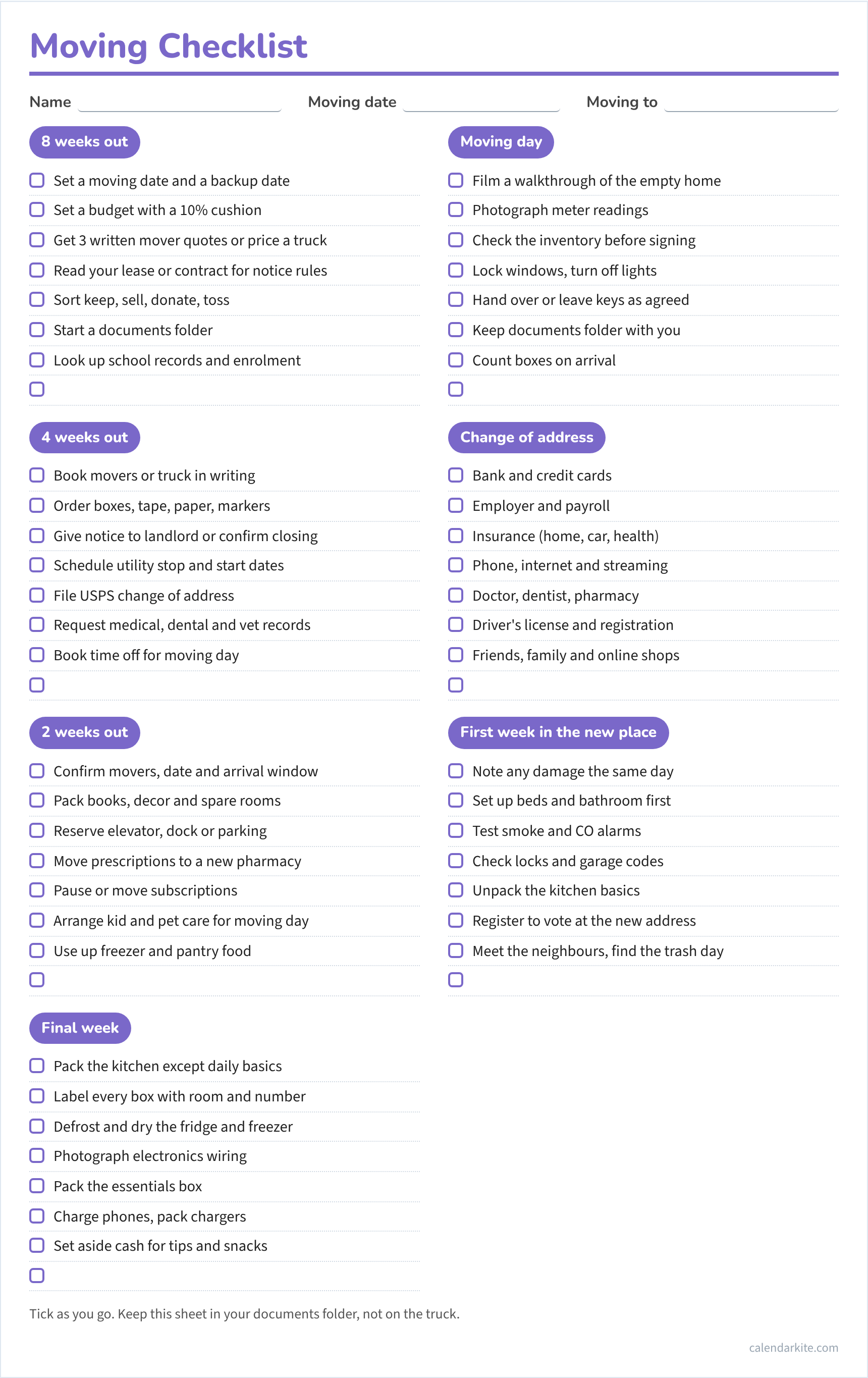
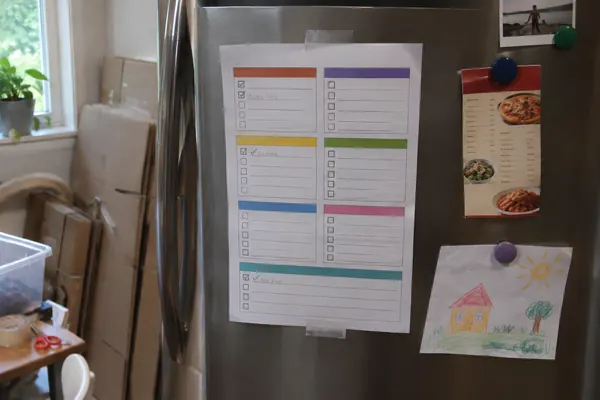
Lavender gives a soft, organized look for anyone planning a move week by week. Pin it beside your paper calendar, as I do on our fridge, so packing deadlines sit right next to the real dates.
Cute Moving Checklist Template
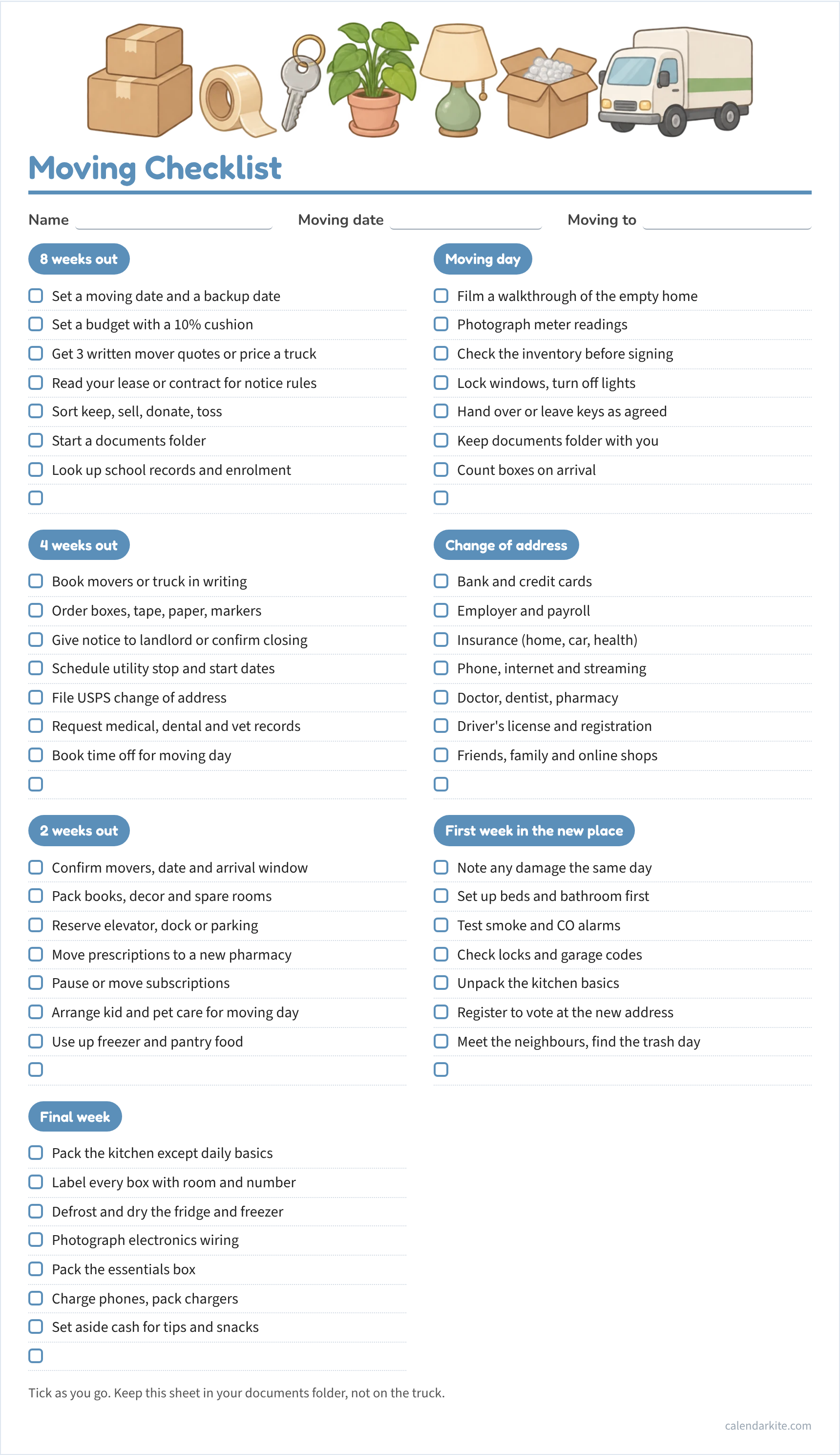
The pastel blue and little hand-drawn style illustrations make a long to-do list feel lighter, which works well for students and first-time renters. I'd use it for your final-week tasks, like returning keys and cleaning.
Floral Moving Checklist Template
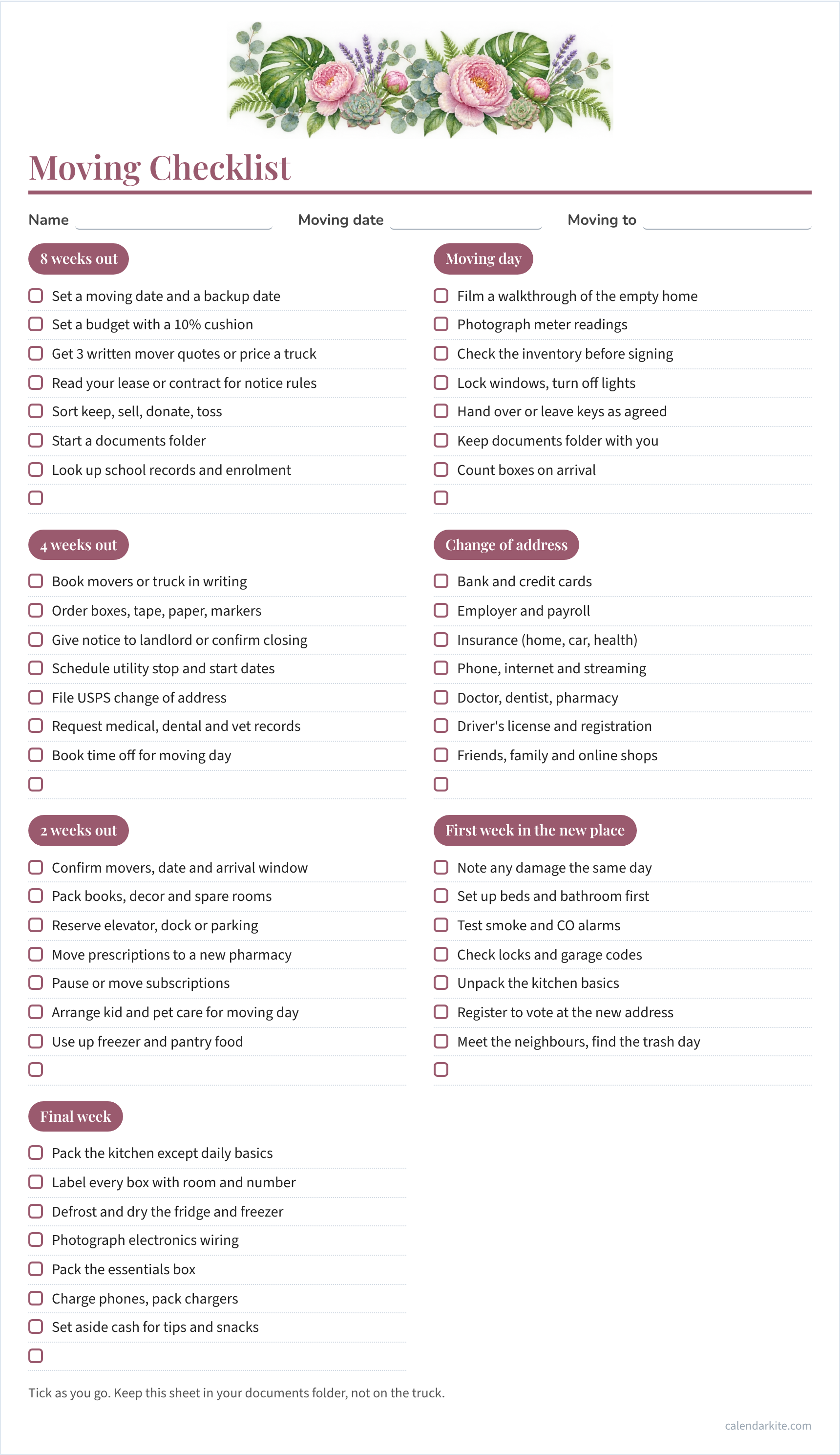
Watercolor flowers and a mauve serif heading suit anyone who wants a pretty binder for their new home. I recommend it for the paperwork side of a move, such as closing dates, lease notices and utility transfers.
Colorful Moving Checklist Template
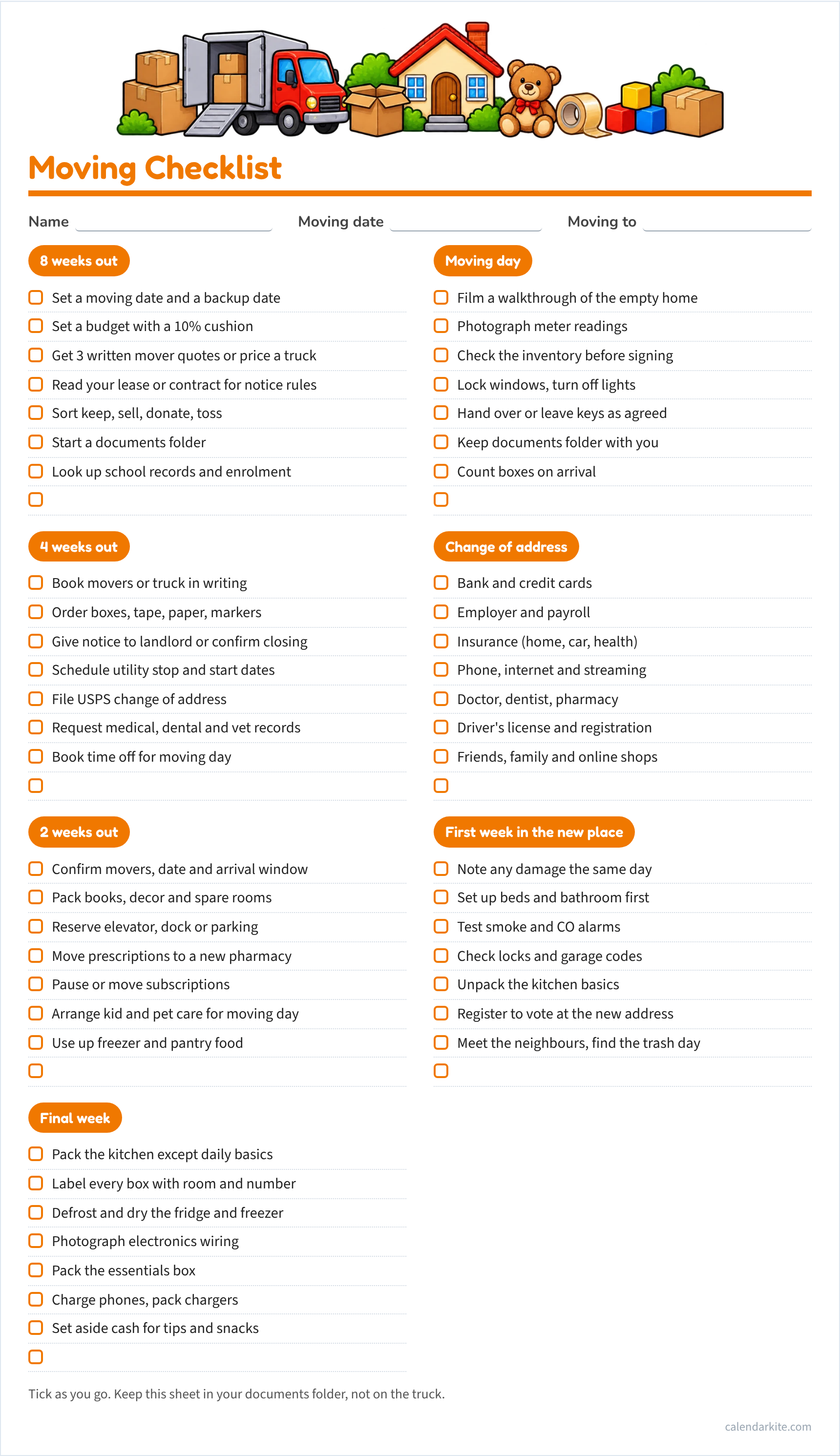
Bright orange and yellow with bold cartoons make this a fun pick for families who want everyone involved in the move. Let children tick off their own jobs, such as packing toys and labeling their boxes.
Simple Moving Checklist Template
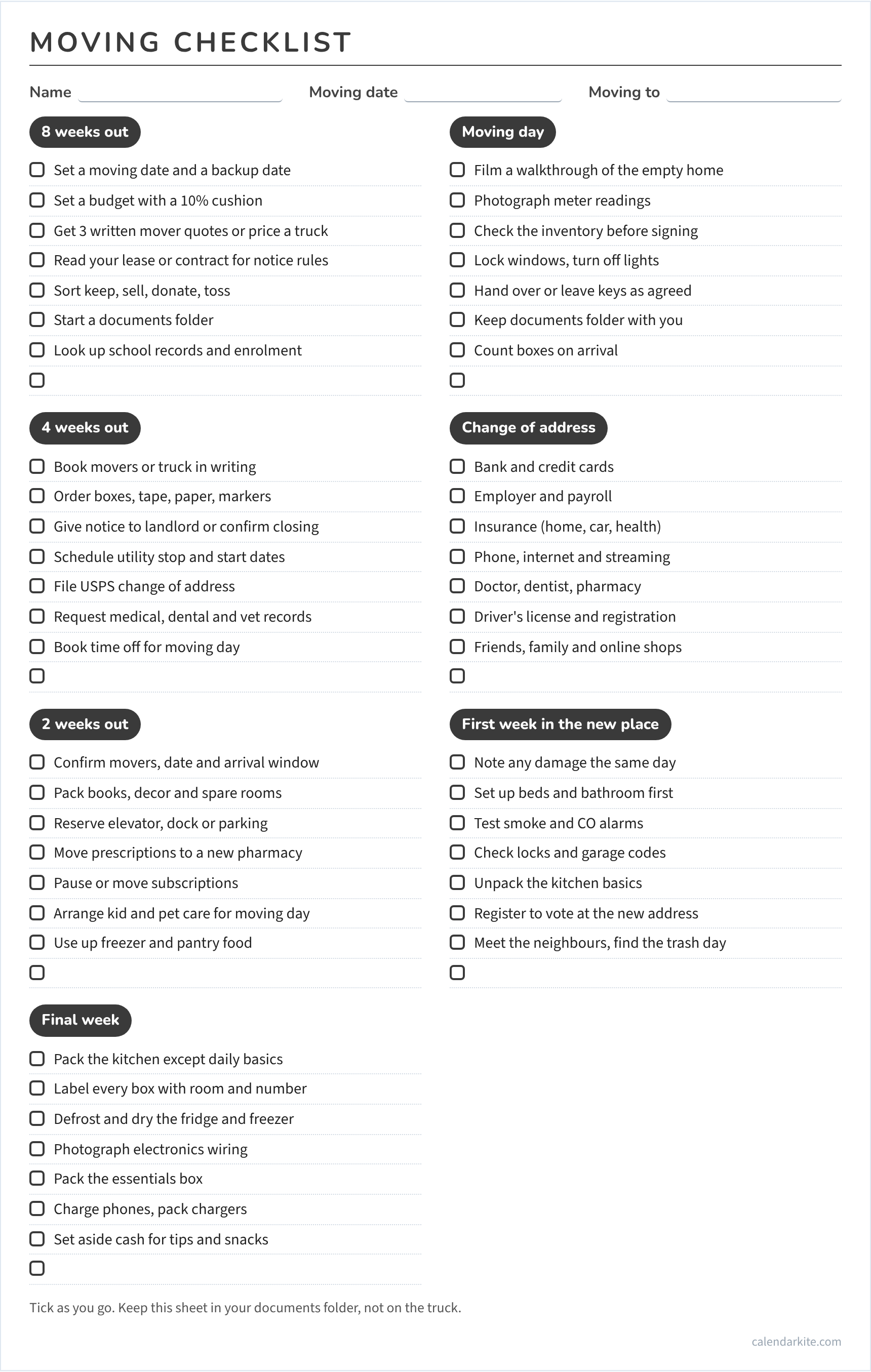
Thin gray lines and a light uppercase heading keep this clean for people who like a no-fuss list. I left generous writing space beside each task, because cramped checkboxes are the mistake I see most often.
Aesthetic Moving Checklist Template
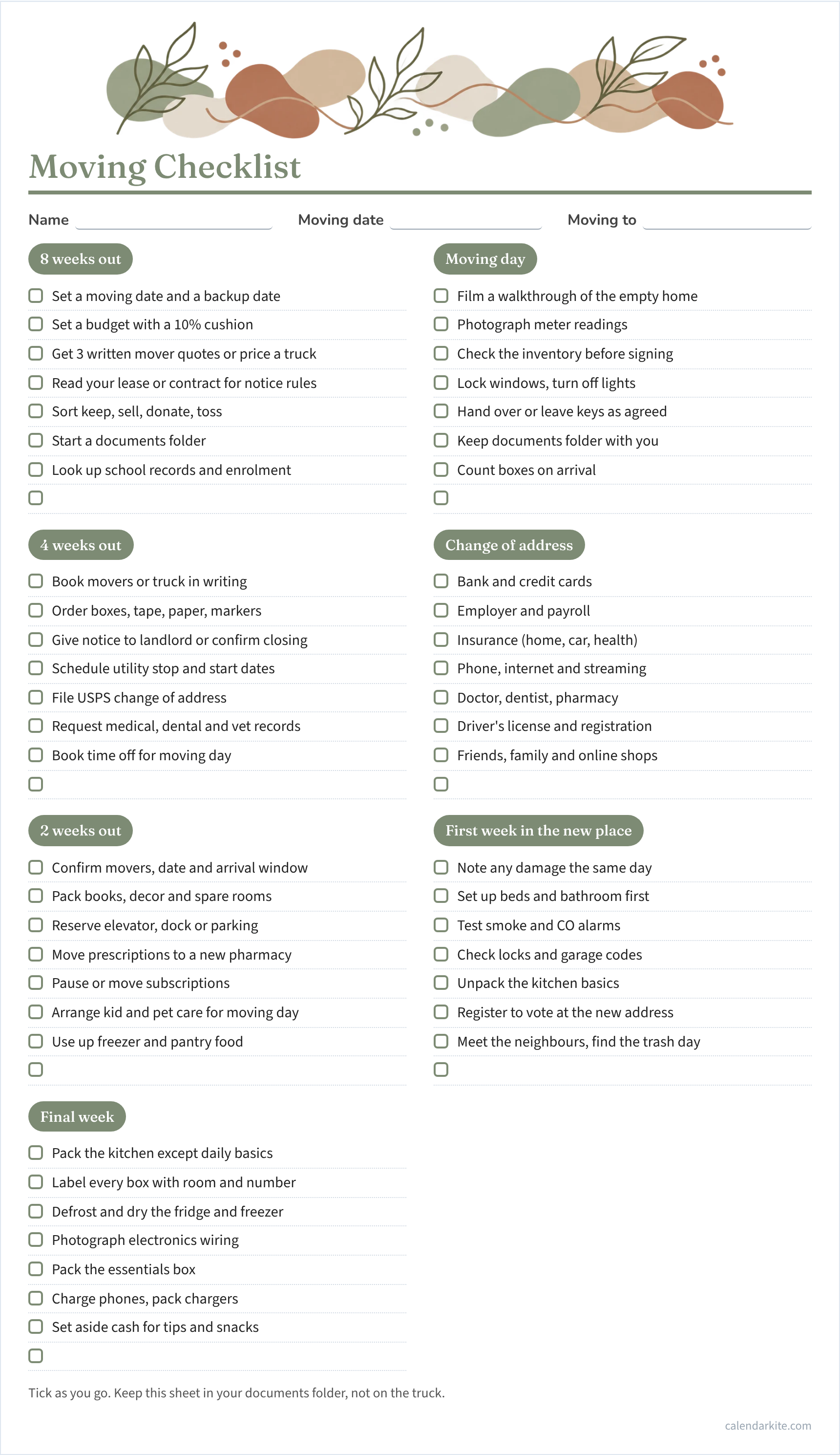
Muted sage, sand and terracotta with soft leaf line art suit anyone setting up a calm, modern new home. It works nicely in a planner or on a clipboard for tracking room-by-room packing and setup tasks.
Modern Moving Checklist Template
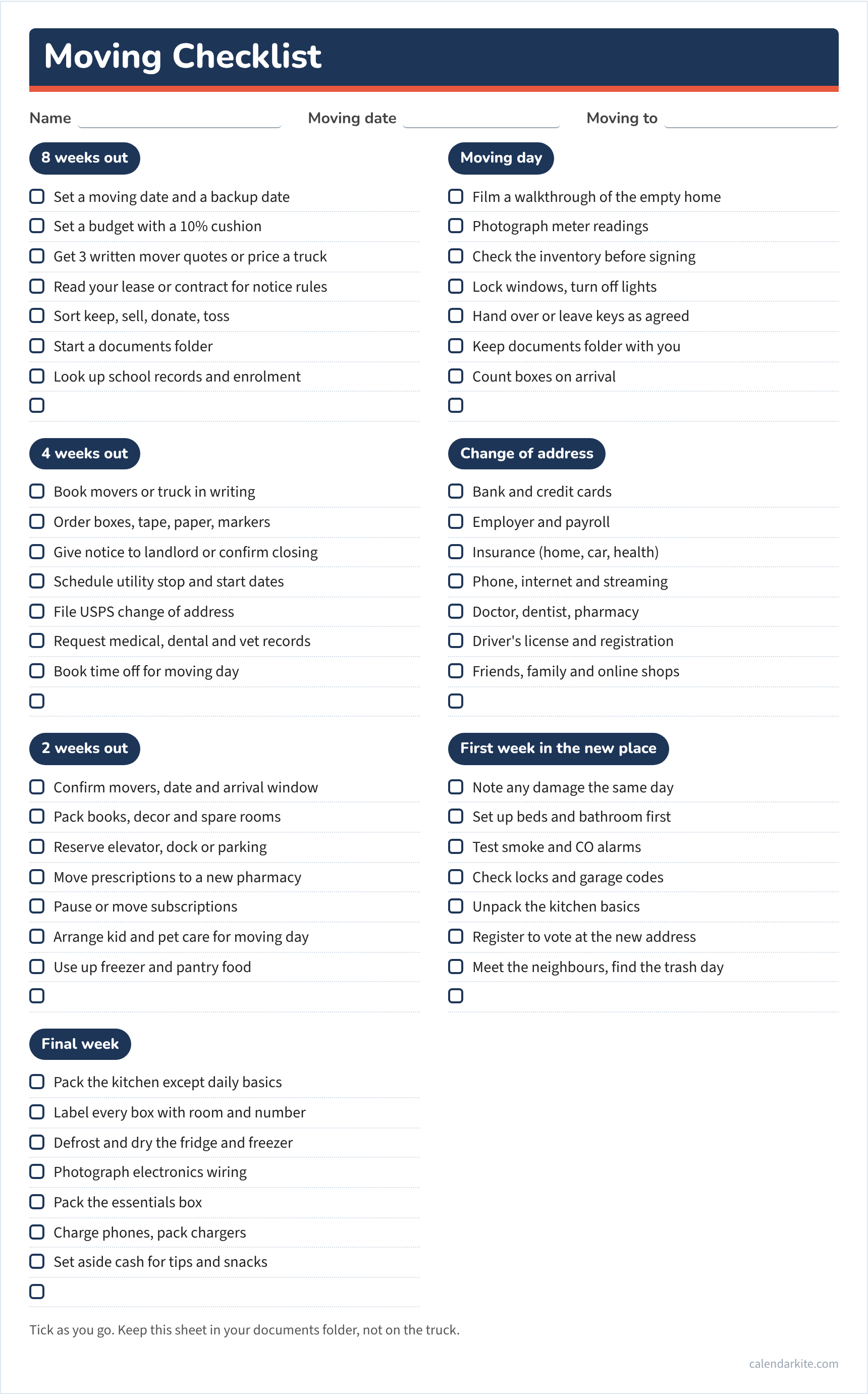
The navy header band and coral accent make this easy to spot on a crowded counter, handy when you are juggling a landlord, movers and utilities. In my office years I learned that a list you can find quickly is a list you actually use.
I built it the way I used to build rotas in my office job: grouped by when things happen, short lines, a blank line or two in each group for the things only you know about. I test-print every sheet on my home inkjet on both US Letter and A4, and this one is meant to be printed, stuck on the fridge and scribbled on.
What a moving checklist template should include
Most moving lists fail in one of two ways. Either they are so short they only say “pack boxes” and “call movers”, or they run to five pages and nobody reads past the second. The sweet spot is about 50 real tasks, grouped by timing, so you can glance at the page and know what belongs to this week.
This sheet has seven groups: eight weeks out, four weeks out, two weeks out, the final week, moving day, change of address, and the first week in the new place. The change of address group sits on its own because it is the part people forget to finish. It does not belong to one week, so it gets its own box that you tick through as you go.
I also left blank lines under every group. Your move has details a template cannot know: the elevator that only works on weekdays, the piano, the landlord who wants notice in writing. Those lines are where the sheet becomes yours.
How to fill in the printable
Start at the top and type your name, your moving date and where you are moving to. Then work down the first group. The tasks are written as plain actions, so you can tick them off without interpreting them. If a line does not apply to you (no school records if you have no kids, no truck booking if you hire full-service movers), edit it to something that does or clear it.
You can type into the blank lines directly on the page. I use them for the facts I would otherwise hunt for later: the mover’s phone number, the truck booking reference, the utility company’s account number, the day the cable technician is coming. Your entries save in your browser, so you can add to the sheet over several evenings without losing anything.
When you are ready, print it. If you want a clean copy to hand to a partner, a friend helping on the day or a mover, download the blank PDF and write on it by hand. I recommend printing two copies near the end: one for the fridge, one for your documents folder.
Try this: Before you tick a single box, write your move date in the header and add the dates for each group on the blank lines (for example, “4 weeks out = March 3”). A checklist without dates is just a wish list.
Who this moving checklist suits
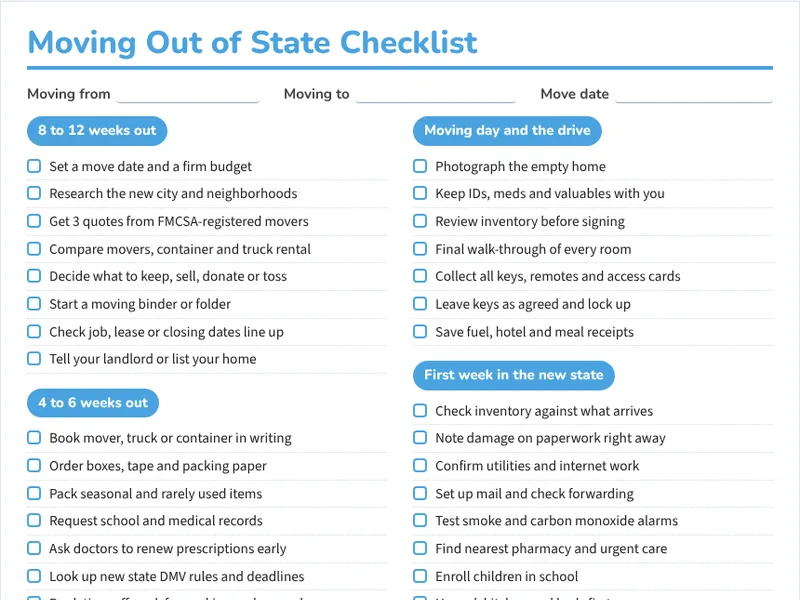
It works for a local move across town, a rented apartment, a first home, a family house and a move across the country. The groups scale: a studio move might have six tasks ticked in the final week, a family move might use every line and the blank ones too. If you are moving a long way, the moving out of state checklist adds the tasks that change when you cross a state line, such as registration, licensing and insurance rules.
It also suits people who are moving for a reason other than buying a house: a new job, a divorce, a student move, a downsizing move for a parent. For those, the template is a starting frame, and the blank lines carry the situation-specific tasks.
If you are combining two households, the tasks are the same but the decisions are harder. I would pair this sheet with the moving in together checklist, which covers the splitting and merging side of things.
The timeline, week by week
Eight weeks is a comfortable runway, not a rule. If you only have three weeks, do the “8 weeks out” and “4 weeks out” groups together on day one, because that is where the bookings and the paperwork live. Movers, trucks, notice periods and utility appointments all have lead times, so they come first.
Here is how I think about each stage.
- Eight weeks out: decisions and quotes. Fix the date, set the budget, read your lease or contract, and start sorting what you own.
- Four weeks out: bookings and supplies. Lock in movers or the truck, order boxes, schedule utilities, file your forwarding with USPS.
- Two weeks out: confirmations and the first heavy packing. Confirm every booking, and pack what you will not need.
- Final week: the kitchen, the labels, the essentials box and the practical prep for the day itself.
The point of the structure is that you only ever look at one box at a time. Looking at 50 tasks at once is how people freeze up.
Eight weeks out: dates, budget and quotes
The first group is mostly thinking, not lifting. Choose your moving date and a backup date either side of it, because things slip: a closing moves, a lease handover shifts, a truck is delayed. Knowing your fallback in advance stops a small delay from turning into a scramble.
Next comes money. Add a cushion of about 10% to whatever you expect to spend, because moves reliably cost more than the first number. Then get at least three written quotes from movers, or price a rental truck plus help if you are doing it yourself. Compare what each one includes (stairs, long carries, packing materials, insurance) and not just the total. I keep quotes on the blank lines, one per line, with the company name, price and the person I spoke to.
Read your lease or sale contract for the rules that affect timing: notice periods, cleaning requirements, key return, the deposit process. This is where most surprises hide. Start the keep, sell, donate and toss sort now. Every box you do not pack is money and a Saturday saved.
Four weeks out: bookings, boxes and utilities
This is the group where things get real. Book your movers or truck in writing, and keep the confirmation with the checklist. If you have to give notice to a landlord, do it now, in the form the lease requires. Order boxes, paper, tape and markers early, and then buy slightly more than you think. Running out of tape on packing day is a very specific kind of misery.
Call your utility companies and schedule the stop date at the old place and the start date at the new one. You want the new place to have power and internet on the day you arrive, and you want the old place to stay on until after your final walkthrough, in case you need lights to clean. Put each account number on a blank line so you are not hunting for a bill later. A bill tracker printable is handy here, because moving is the moment recurring bills most often get lost or doubled.
File your USPS change of address now. First-class mail is generally forwarded for about a year, which gives you time to update everyone else.
Try this: Stand in each room with a pen and write the number of boxes you expect on a blank line. Add them up and order that many boxes plus 15%. You will end up much closer to the real number than a guess.
Two weeks out and the final week
Two weeks out is for confirming. Call the movers, check the date, the arrival window and what is included. Book the elevator or loading dock if you live in a building with one, and sort parking for the truck. Move your prescriptions to a pharmacy near the new place and arrange care for children and pets on moving day, because both are a lot easier when they are not underfoot.
Now pack what you will not need: books, decor, the guest room, off-season clothes. In my own house, the first things to disappear into boxes would be the things on the shelves nobody looks at. Use up what is in the freezer and pantry instead of packing it, and your grocery list for those two weeks gets very short and very creative. The grocery list printable is handy for planning those leftover-only meals.
In the final week, pack the kitchen except daily basics, label every box with the room and a number, and defrost and dry the fridge and freezer. Photograph the wiring behind the TV and desk before you unplug, and charge your phones. Set aside cash for tips and snacks, and tuck the essentials box and documents folder where you will see them.
Moving day
On the day, the page earns its keep. Film a walkthrough of the empty home on your phone, take photos of the meter readings, and check the mover’s inventory before you sign it. Lock windows, switch off lights, and hand over the keys the way your lease or contract says.
Keep the documents folder with you, not on the truck. It holds your IDs, lease or closing papers, mover contract, and this checklist. When you arrive, count the boxes against the number on the inventory. The label-with-a-number habit is what makes this fast: you are checking a count, not hunting for things.
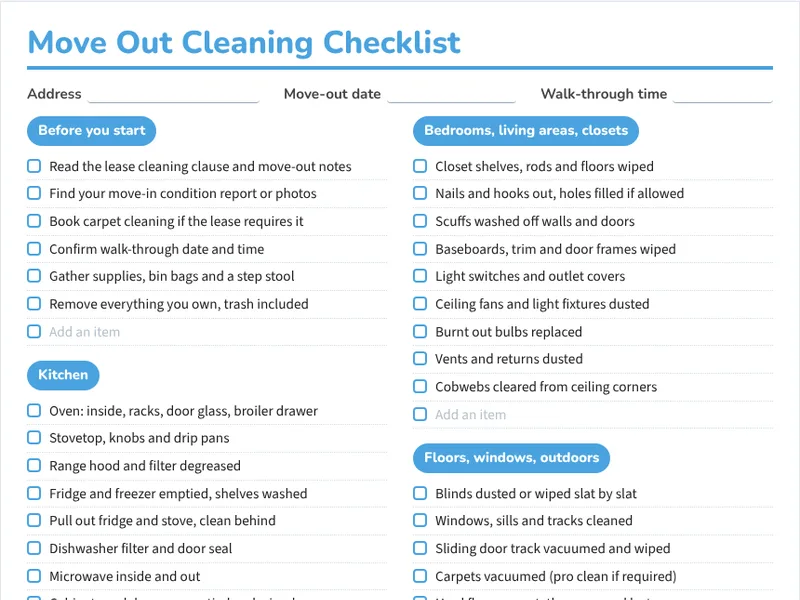
If you are leaving a rental, the deposit often depends on how clean you leave it. The move out cleaning checklist gives you a room-by-room list so the walkthrough goes smoothly.
Who to tell about your new address
The change of address group is a mix of urgent and slow tasks, and it is where I see the most loose ends. USPS forwarding is a safety net, not a plan. Some companies will not deliver to a forwarded address, and some mail, such as certain bank cards, is returned to sender rather than forwarded.
The sheet lists the main groups: banks and credit cards, your employer and payroll, insurance, phone and internet, medical providers, driver’s license and registration, and friends, family and online shops. Tick them as you do them and use the blank line for the one you always forget. For most people that is a tax or benefits office, a gym membership or a prescription delivery service.
Deadlines for updating a driver’s license, vehicle registration and voter registration vary by state, and many ask for it within a few weeks of moving. Check your state’s motor vehicle site for the exact rule rather than guessing. If you are moving for work, ask your employer whether any moving costs are reimbursed. Most people cannot deduct moving expenses on their taxes, though there are exceptions, so a quick check with a tax professional is worthwhile.
The essentials box and documents folder
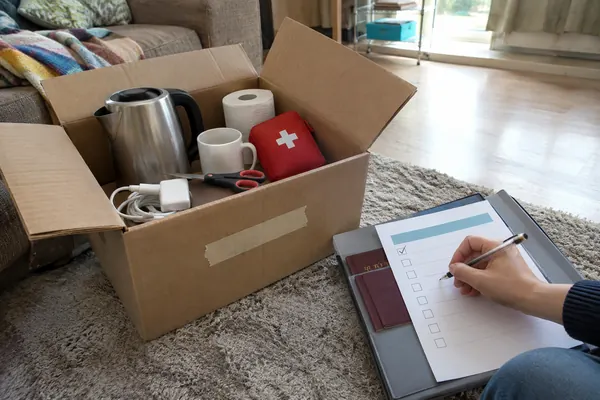
Two things never go on the truck. The first is the documents folder: IDs, passports, lease or closing papers, mover contract, insurance papers, this checklist, and a few spare copies of important numbers. The second is the essentials box, packed last and loaded last, so it comes off first.
What goes in the essentials box is what you need on the first night: toilet paper, soap, a towel, a change of clothes, phone chargers, basic tools, scissors or a box cutter, trash bags, a kettle or coffee maker, a few plates and cutlery, bedding if you want to sleep, and any medication. If you have children, add a favorite toy and a snack stash. If you have a dog, add a bowl, leash and food.
I would label it “OPEN FIRST” in thick marker on two sides, and tell everyone helping, including the movers, where it is. In my own house the essentials box would sit by the back door next to the dog’s bowl, because those are the things I would be most annoyed to search for.
Try this: Pack your essentials box one week early as a dry run. Live out of it for one evening. Whatever you reach for and miss goes on the blank line to add.
Tracking quotes, costs and who is doing what
Competing lists tend to skip the part that keeps a move from drifting: a record of who has been promised what. Use the blank lines to log the mover’s name and number, the quoted price, the deposit paid and the date, and the arrival window. Add the same for the truck rental, storage unit and any cleaning service.
If friends or family are helping, write their names and the time you asked them for. This sounds fussy until the day, when six people arrive at six different times. A simple list of names with arrival times saves you from answering the same text six times.
For money, a cheap trick is to keep every receipt in the documents folder and jot the running total on a blank line. Moving costs add up in small pieces: boxes, tape, tips, food, the extra night in a hotel. If you want a broader view of what the move does to your month, the budget planner 2027 gives you a place to see it all next to your regular bills.
Variations for different kinds of moves
The sheet is designed to be edited, so you can reshape it for the move you actually have. Because you can type into any item, these changes take a minute.
- Apartment or rental: add the lease end date, the elevator booking and the deposit walkthrough. Delete the closing and home inspection tasks.
- Buying a home: add the closing date, the final walkthrough with the agent, the key handover and any repair requests.
- Moving with kids: add school records, a new school start date and a plan for their favorite things on day one.
- Moving with pets: add vet records, a new tag with the new address, and a quiet room on moving day.
- Student move: swap most of the groups for a shorter list and pair it with a dorm room planner.
For a move out of the state or country, the lead times are longer and the paperwork is heavier, so start earlier and move the change of address group up the page. Whatever the variation, keep the structure: timing groups, short lines, blank space.
Mistakes I see most often
The first is starting the checklist and then not looking at it again. A list in a drawer does nothing. Put the printed page where you pass it every day, which for me is the fridge, next to the paper calendar.
The second is leaving the booking tasks until the last month. Movers, trucks and utility appointments run on lead times, and the cheapest slots go first. The third is packing everything the same way, with no labels. A box marked only “kitchen” costs you an hour at the other end. Room plus number is the habit that makes unpacking quick.
The fourth, and the one I saw most in the office, is a list with no dates and no owners. If two people share the move, write initials next to each task. Without that, every job is “someone’s” and no one’s.
Printing and keeping your checklist
The sheet is laid out for a single US Letter page and prints cleanly on A4 as well. Use “fit to page” if your printer adds margins. Black and white works fine; the tick boxes are drawn with a solid line so they survive a low-ink cartridge. If you have a printer that is running low, increase the print quality setting rather than the size.
Print two copies. One goes on the fridge or a wall where you see it, and one goes in the documents folder, where it travels with you. Staple a few sheets of lined paper behind it for the notes you will inevitably need on the day.
When the move is done, keep the filled-in sheet. It is a record of quotes, account numbers and dates, and it is a head start if you ever move again. If you like to keep your printables in one place, the rest of the printable checklists are on the site.
Pair it with a calendar
A checklist tells you what to do, and a calendar tells you when. I put the move date on the fridge calendar the day I decide it, then write each group’s start date backward from it. If you want to do the same, use a printable monthly calendar, mark the move date in a bright color and add each deadline.
That gives you two views of the same plan: the sheet for the tasks, the calendar for the dates. Between them, you will rarely be surprised, and that is the whole point of planning a move.
Common questions
When should I start a moving checklist?
Eight weeks before your move is a comfortable start for most households. If you have less time, start today and work through the sheet from the top, skipping anything that does not apply. Movers book up fast near the end of the month and in summer, so quotes and bookings should come first.
What should be on a moving checklist?
A good one covers the timeline (quotes, packing, utilities), address changes, moving day tasks and the first week in the new place. It should also have a spot for your move date, addresses and mover details so everything lives on one page.
How far ahead should I book movers?
Four to eight weeks ahead is a sensible target, and earlier for a summer, weekend or end-of-month move. Get at least three quotes in writing and compare what is included, not only the price.
Can I type into the printable before I print it?
Yes. You can type into every line and field, tick boxes, and edit the items to suit your move. It saves in your browser, so you can come back and add to it, then print it when you are ready. A blank PDF is also available.
What do I do with the checklist on moving day?
Print a fresh copy and keep it in your documents folder, which travels with you and not on the truck. Tick off the moving day group as you go and use the blank lines for mover names, phone numbers and your box count.
Is this checklist suitable for an apartment move?
Yes. Cross out anything that only applies to homeowners and add apartment specifics on the blank lines, such as the elevator booking, the lease end date and the deposit walkthrough.
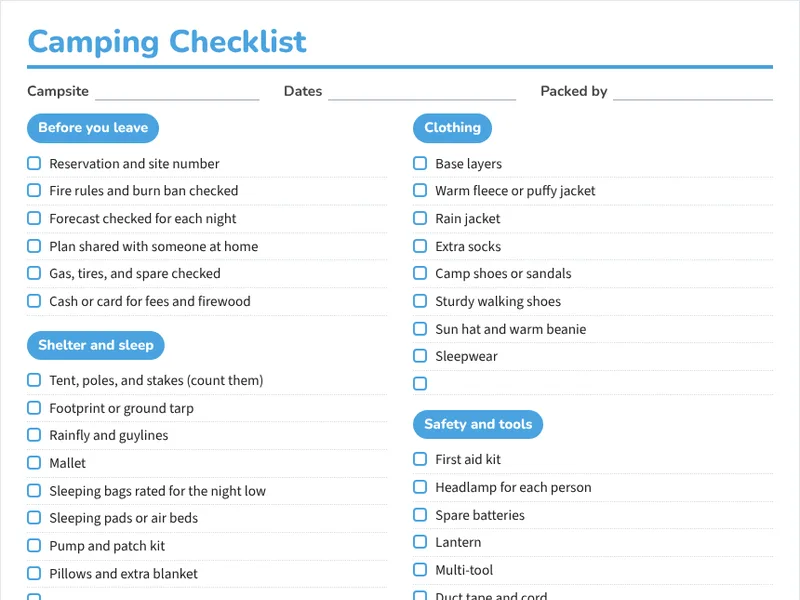 Camping Checklist Printable: Free One-Page Packing List
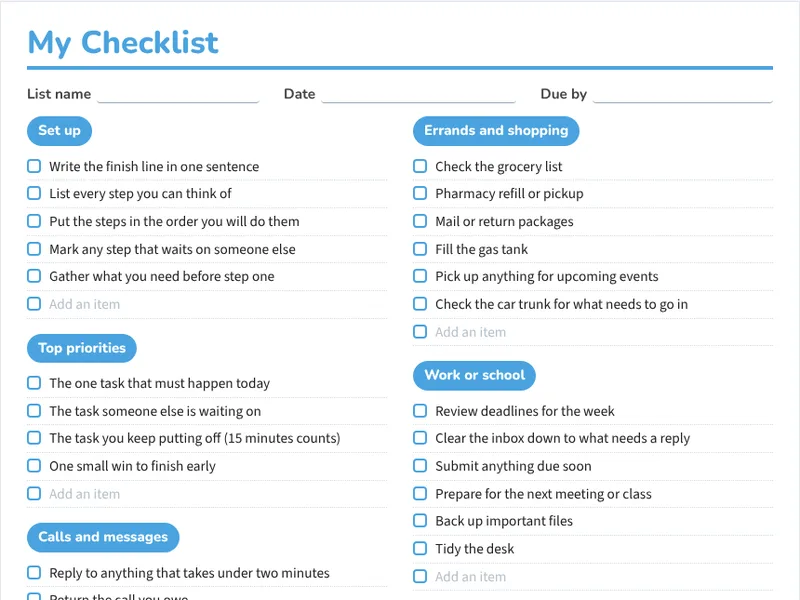 Checklist: A Free Printable You Can Fill In, Edit and Print
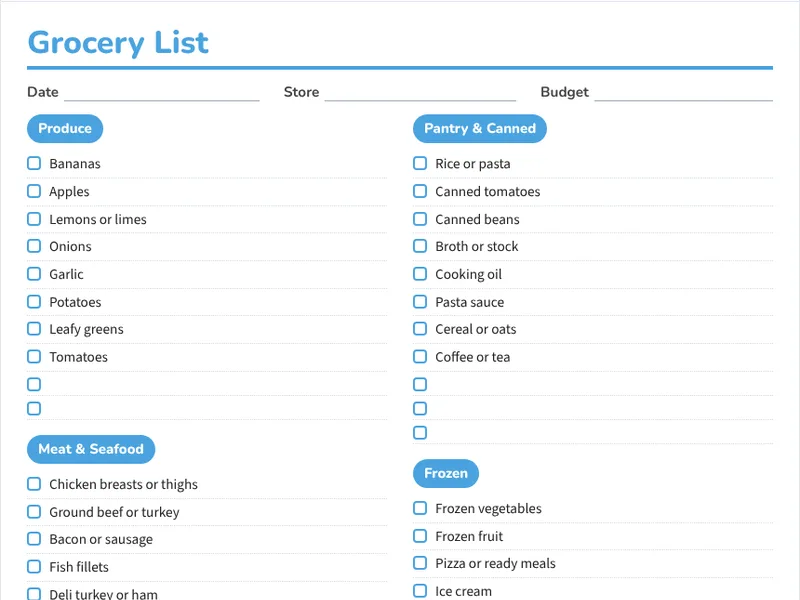 Grocery List Printable
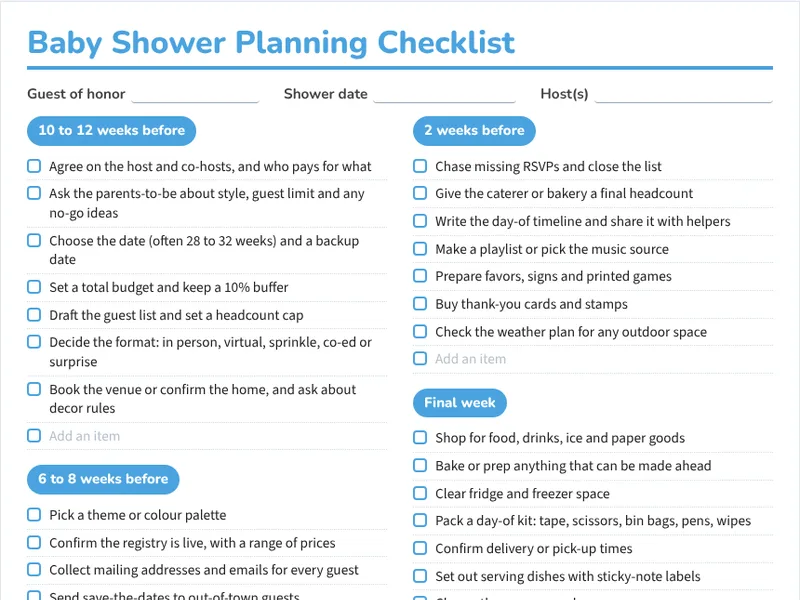 Baby Shower Planning Checklist (Free Printable)
 Moving Out of State Checklist
 Move Out Cleaning Checklist (Free Printable)