
Taco Bar Checklist (Free Printable)

A taco bar checklist is a single page that lists everything you need to buy, prepare and set out for a build-your-own taco meal: shells, fillings, toppings, sauces, sides, drinks and serving gear. The printable on this page groups those items in the order your guests will meet them at the table, so you can shop from it, prep from it and do a last check against it before the doorbell rings.
Plan first
- Headcount set (adults, teens, kids)
- Dietary needs asked and written down
- Menu chosen: 2 proteins plus 1 veggie
- Budget per person decided
- Quantities worked out
- Shopping list made
Shells and bases
- Small soft flour tortillas
- Soft corn tortillas
- Hard taco shells
- Gluten-free option
- Lettuce cups or bowls
- Tortilla chips
- Extra 10 to 15 percent for breakage
Proteins and hot fillings
- Seasoned ground beef
- Shredded chicken
- Carnitas or pulled pork
- Steak or fajita strips
- Black bean or veggie filling
- Refried or black beans
- Rice
- Queso
Cold toppings
- Shredded lettuce or cabbage
- Diced tomatoes or pico
- Diced white onion
- Shredded cheese
- Sour cream or crema
- Guacamole or sliced avocado
- Sliced jalapeños
- Chopped cilantro
- Lime wedges
- Pickled red onions
Salsas and sauces
- Mild salsa
- Hot salsa
- Salsa verde
- Taco sauce
- Bottles of hot sauce
Sides and drinks
- Chips and salsa for the wait
- Spanish rice or street corn
- Fruit or a cool dessert
- Water and ice
- Agua fresca, soda or margaritas
- Kid drinks
Setup and gear
- Slow cookers or warming trays
- Serving spoon for every dish
- Tongs for tortillas
- Small bowls and ladles
- Label cards with allergens
- Sturdy plates and extra napkins
- Tortilla warmer or foil
- Ice for cold toppings
- Trash bin and leftover containers
- Meat reheated, cold items chilled
- Line set up in build order
Rule of thumb: 2 to 3 tacos per adult, count kids as half, add 10 to 15 percent.
Free for personal, classroom and office use. Your entries are included in the print, PDF and PNG. Prints on US Letter and fits A4.
Black and White Taco Bar Checklist Printable
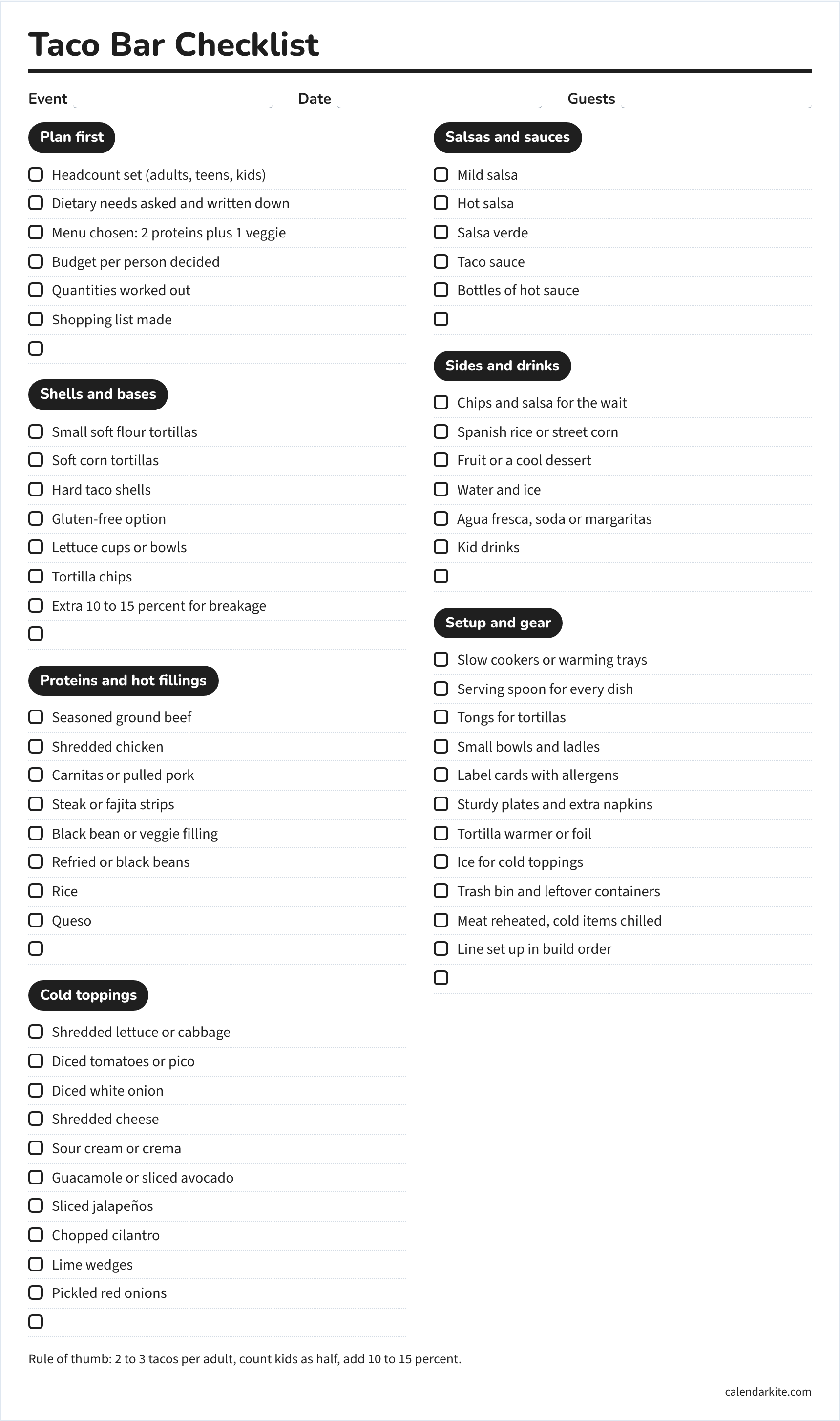
I made this one for anyone printing a party checklist in bulk, since plain black lines use very little ink. I test-print on my home inkjet and tape a copy inside the cupboard door on taco night.
Pink Taco Bar Checklist
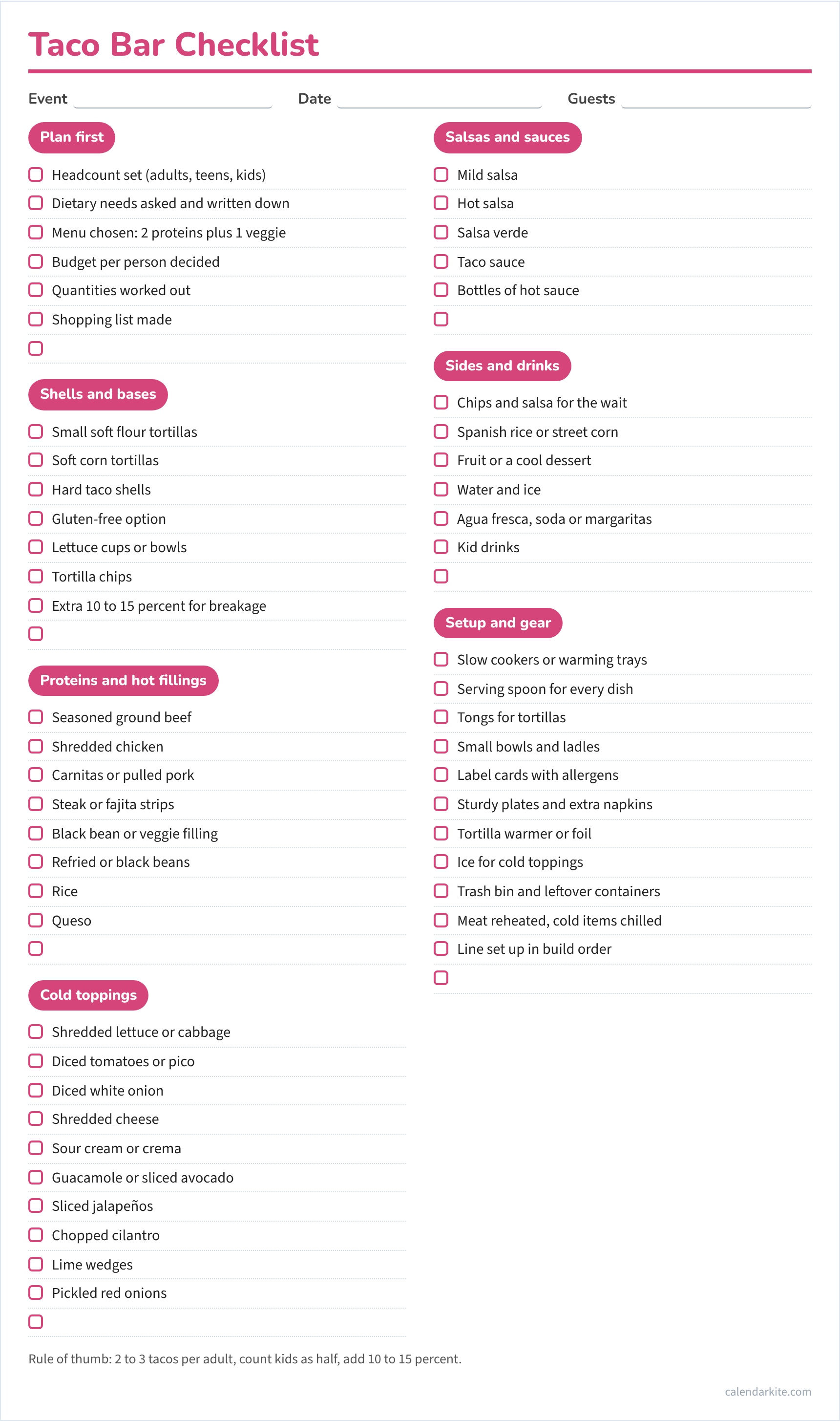
This soft pink version suits a birthday, shower or girls' night where the taco bar is part of the decor. I use a checklist like this to confirm the small things people forget, like serving spoons and napkins, before guests arrive.
Sage Green Taco Bar Checklist
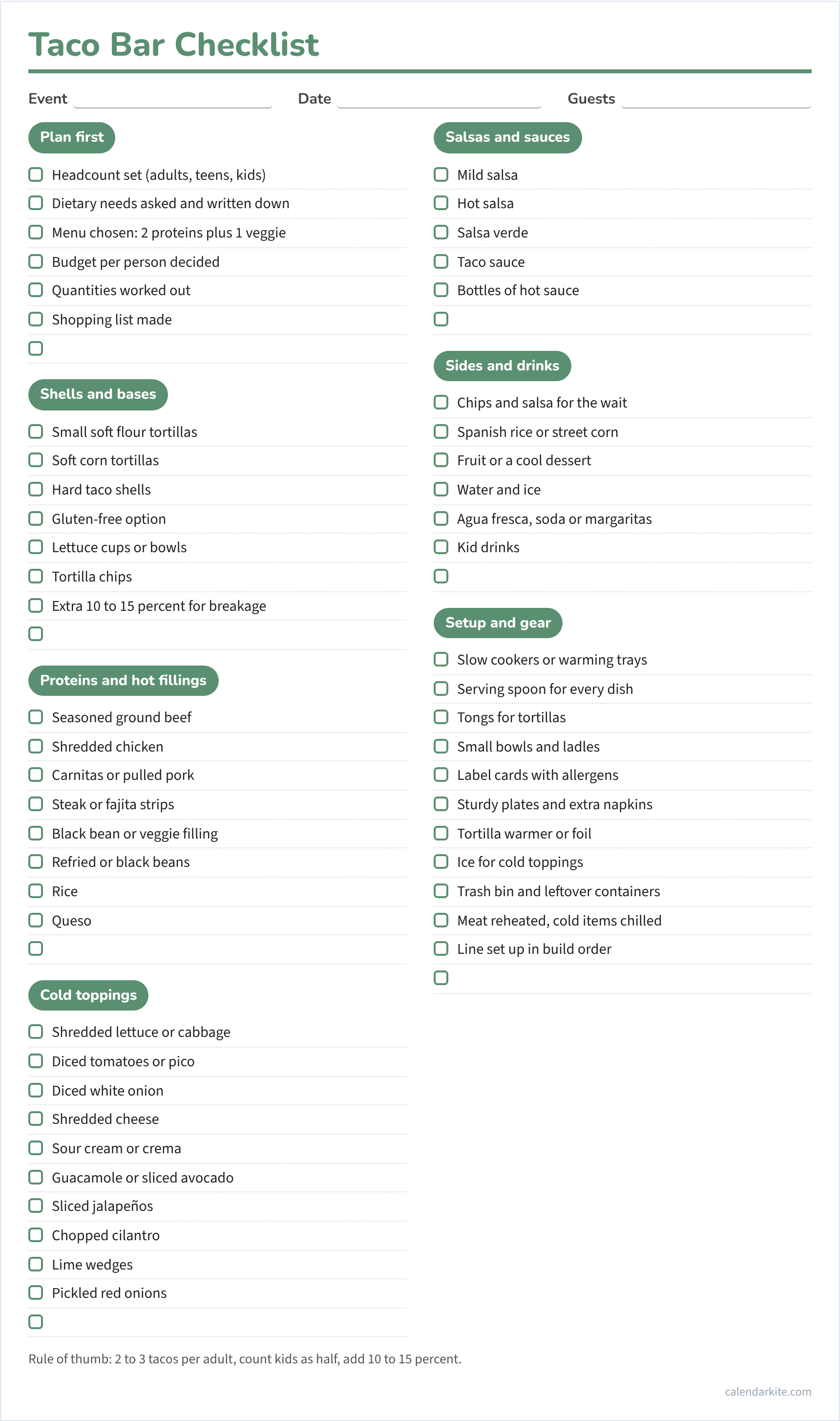
The sage green layout works for backyard dinners and casual get-togethers where you want something calm on the fridge. In my office years I learned to group lists by category, so I kept proteins, toppings and sauces in separate blocks.
Cute Taco Bar Checklist
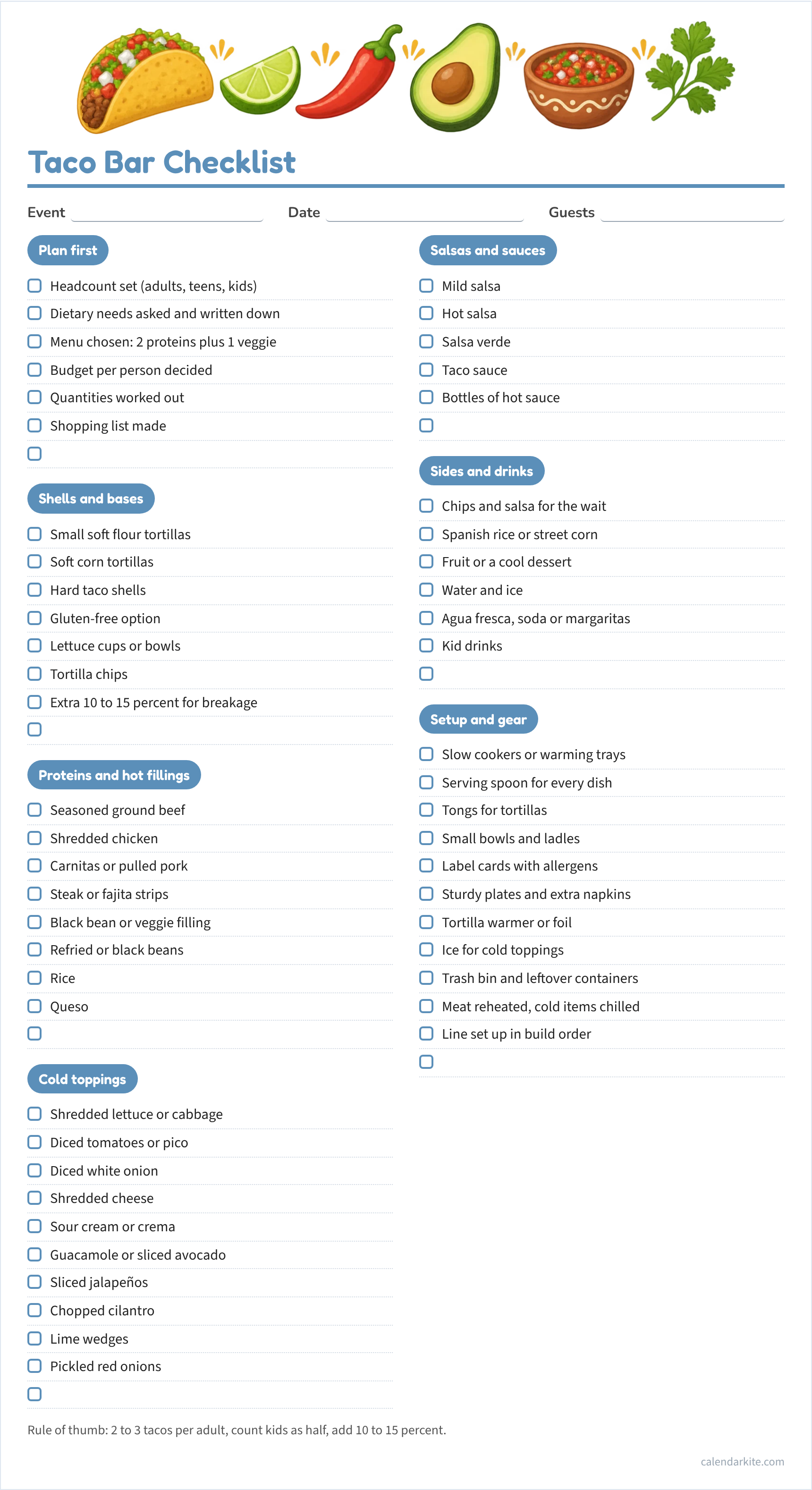
Pastel blue with little taco-themed drawings across the top, this is a good fit for family taco night or a casual class party. Print it on US Letter or A4; I test both, so the checkboxes stay clear of the margins.
Floral Taco Bar Checklist Printable
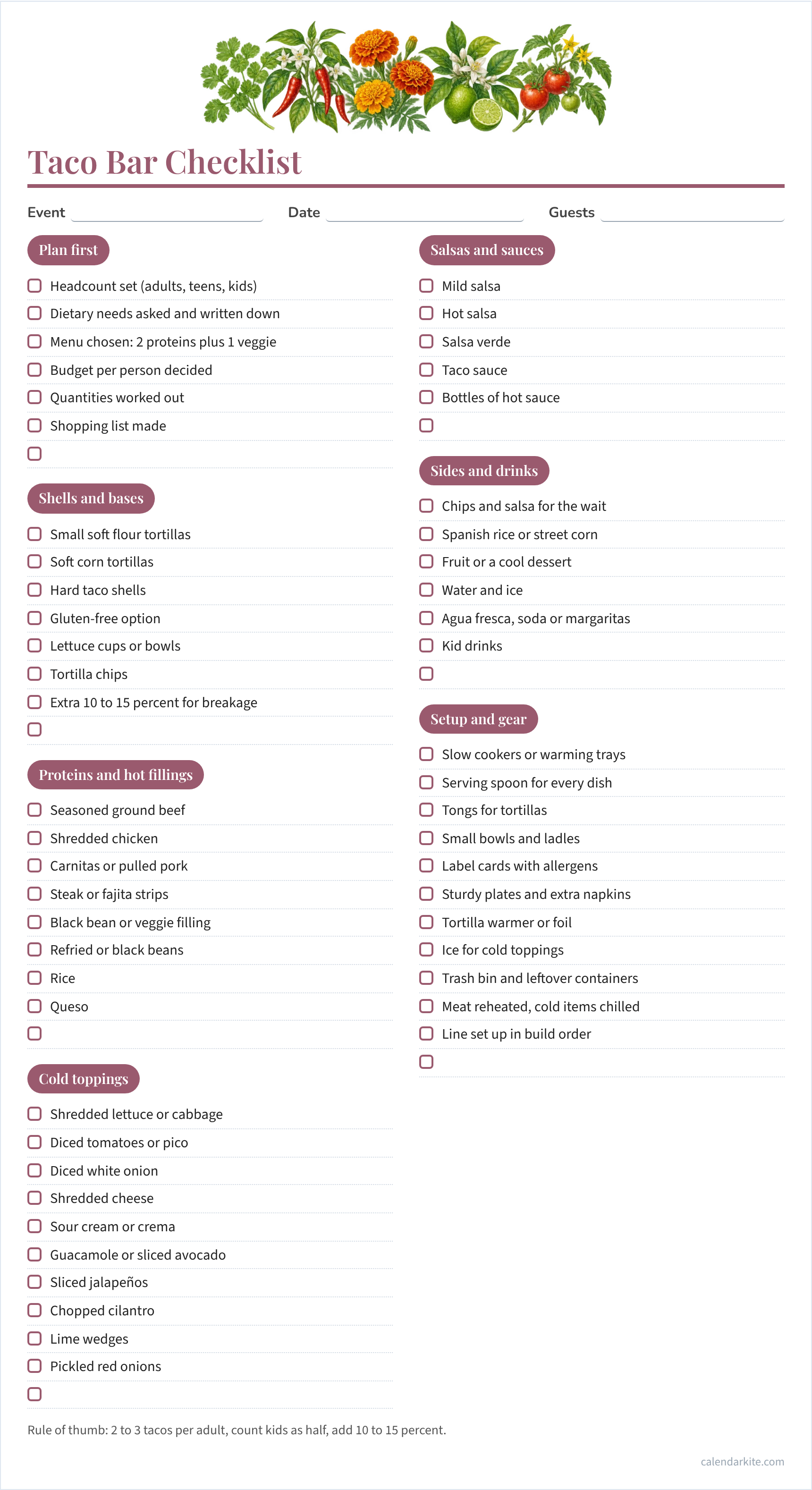
With watercolor flowers and elegant serif headings, this suits a bridal shower, garden party or Cinco de Mayo brunch. I'd print it beside your guest list so the shopping and setup stay in one spot.
Fun Colorful Taco Bar Checklist
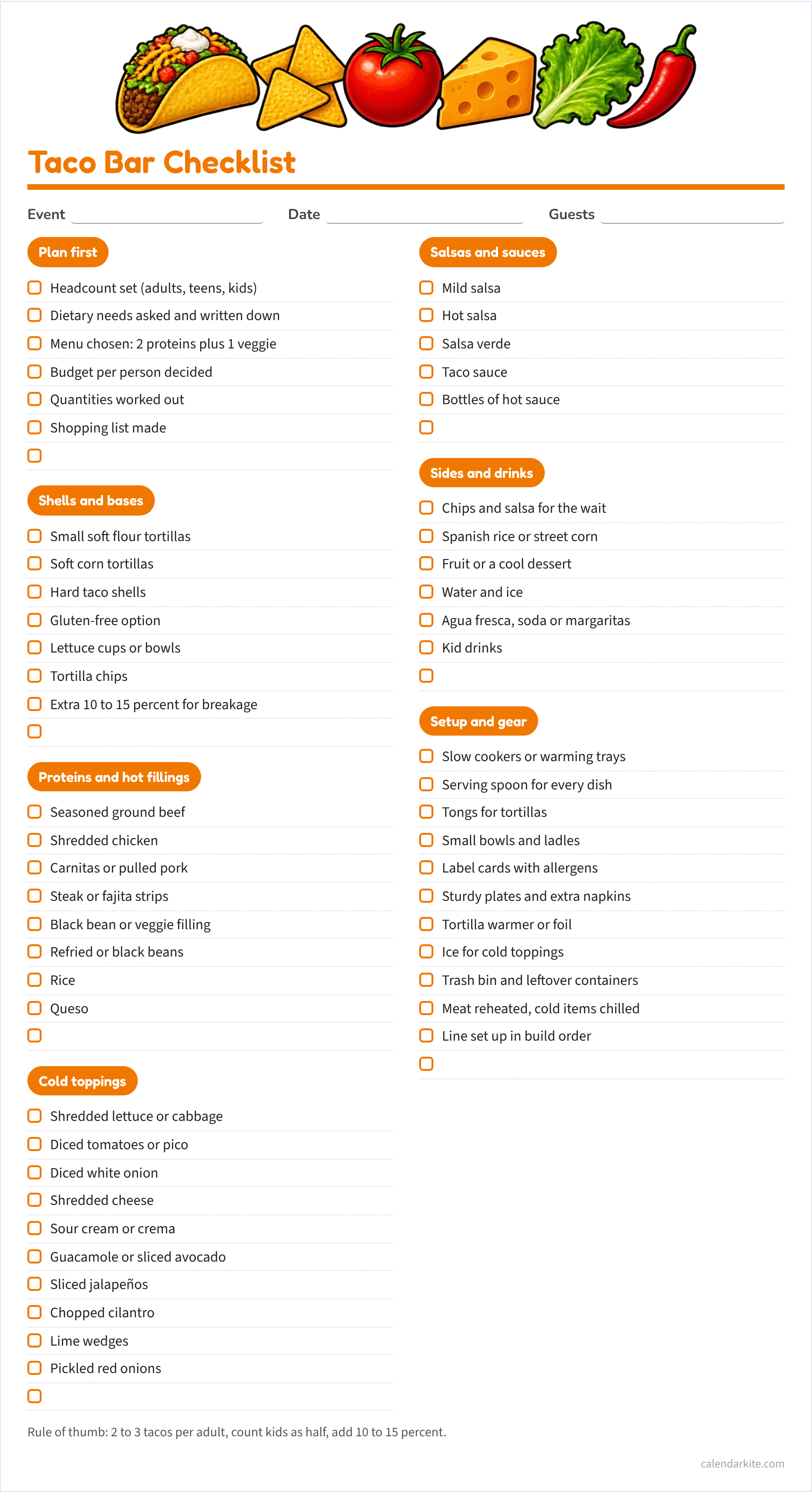
Bright orange and yellow with bold cartoon art makes this one right for birthday parties and kid-friendly taco nights. At my house, my two kids tick off the toppings themselves, and I enlarged the checkboxes so small hands can mark them.
Simple Minimalist Taco Bar Checklist
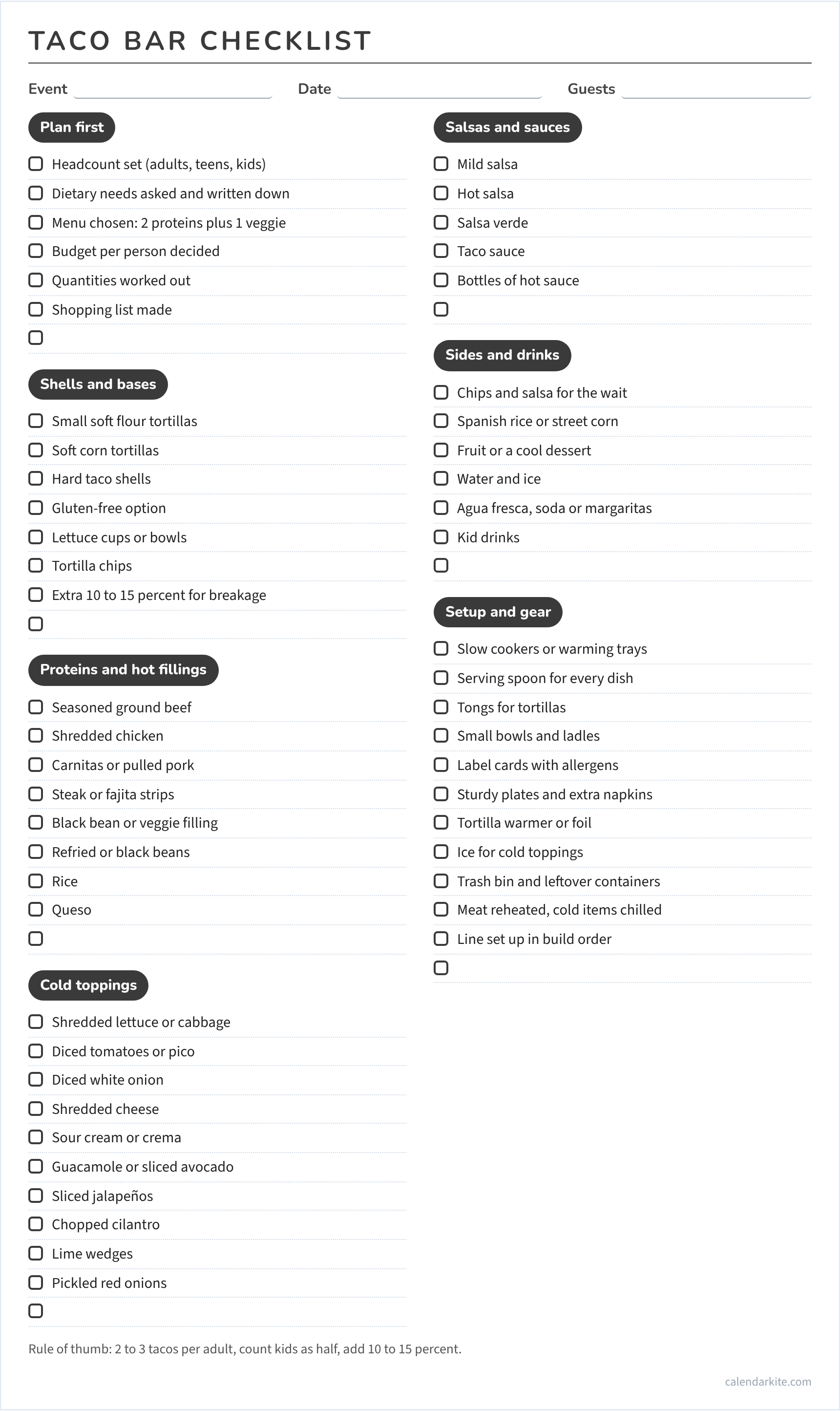
Thin gray lines and a light uppercase heading keep this version quiet, ideal if you want a no-fuss list for a weeknight dinner. I keep a paper copy on the fridge next to my calendar and cross things off as I shop.
Aesthetic Taco Bar Checklist
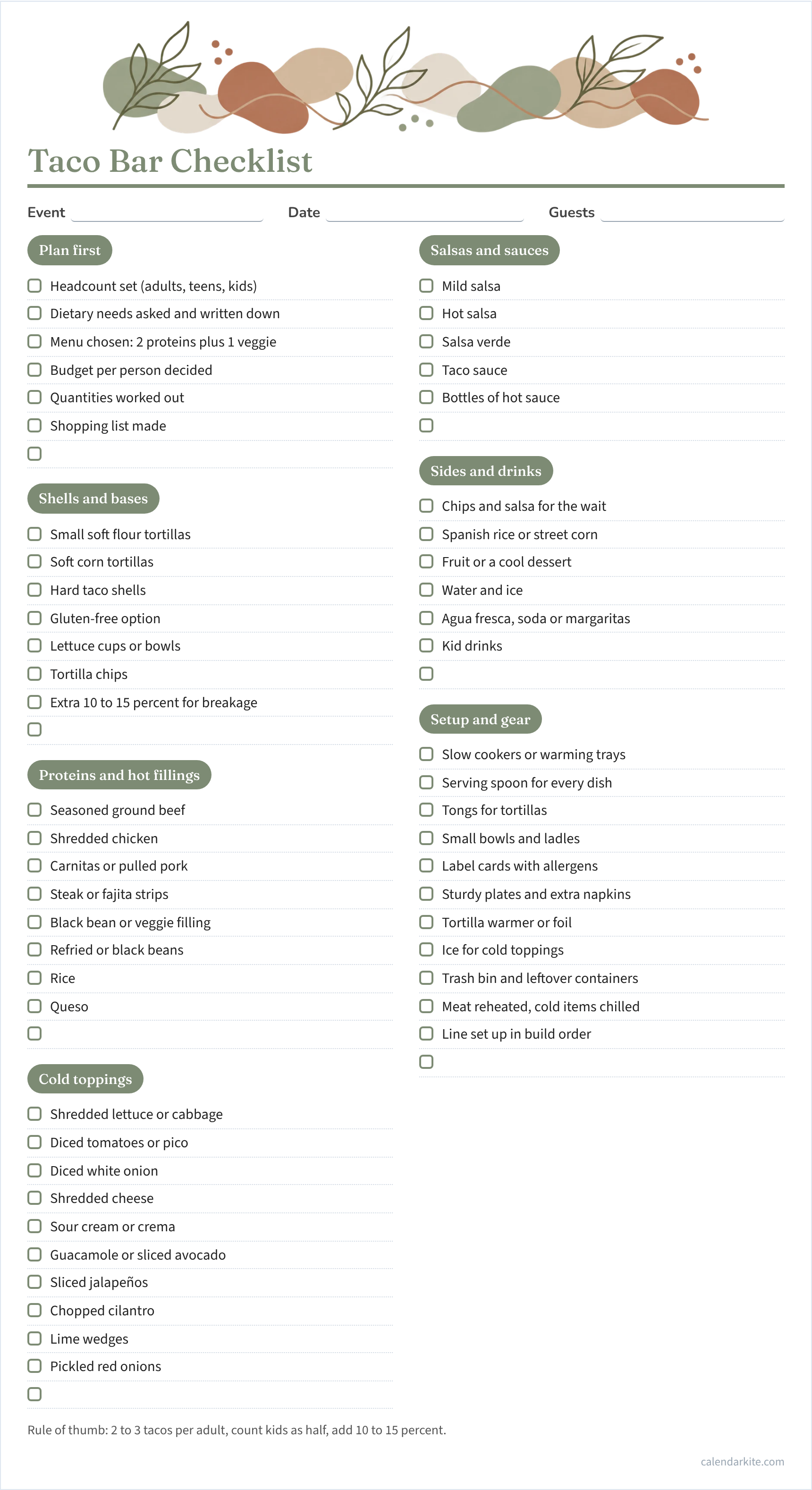
Muted sage, sand and terracotta with soft line-art leaves suit a stylish dinner party or a Pinterest-worthy taco spread. The most common mistake I see is forgetting drinks and serving utensils, so double-check those before guests arrive.
Vintage Taco Bar Checklist Printable
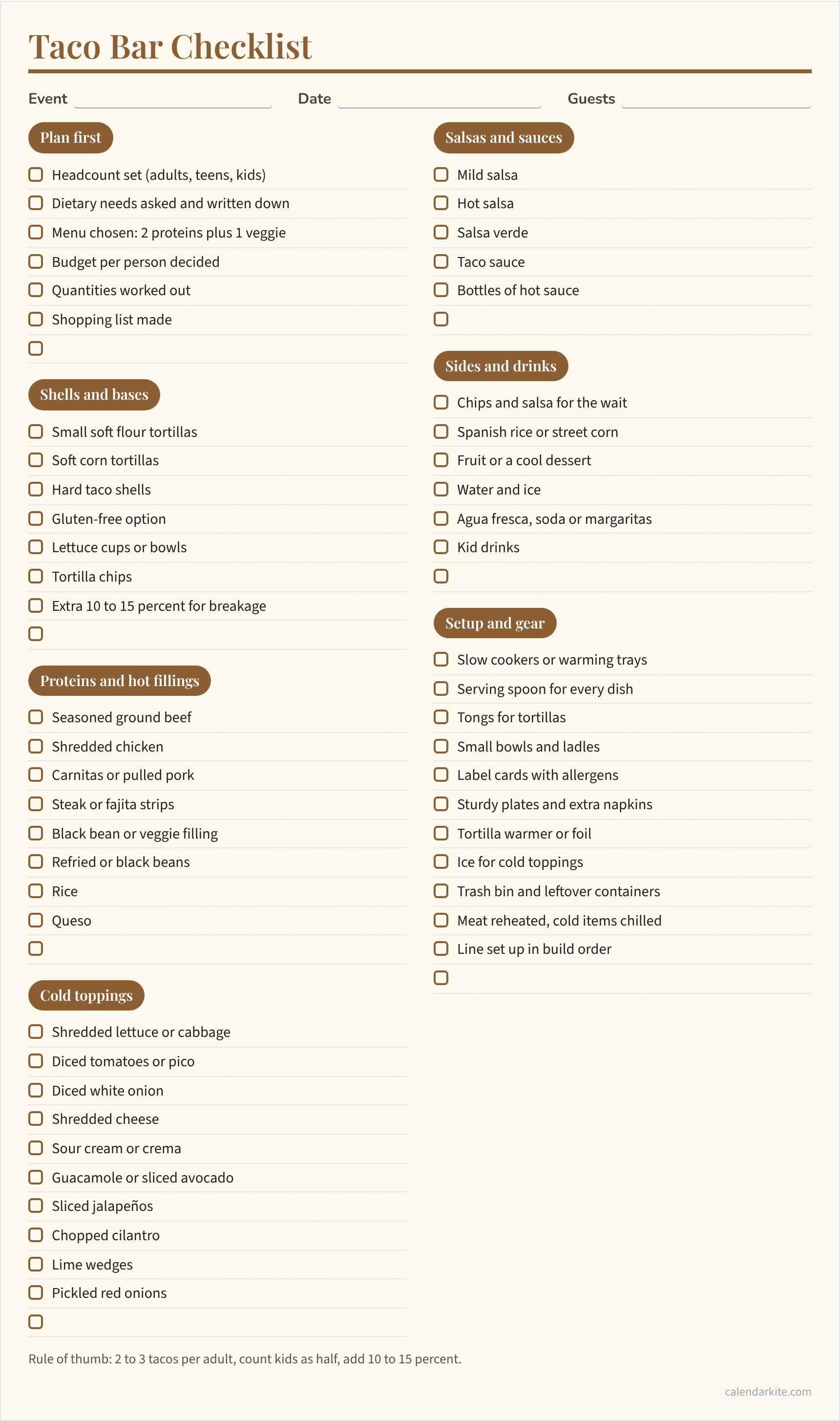
Cream paper and brown serif headings give this a cozy, recipe-card feel for family gatherings and potlucks. I like it tucked into the planner I keep on the kitchen counter, where the checklist doubles as a shopping reminder.
Modern Taco Bar Checklist Printable
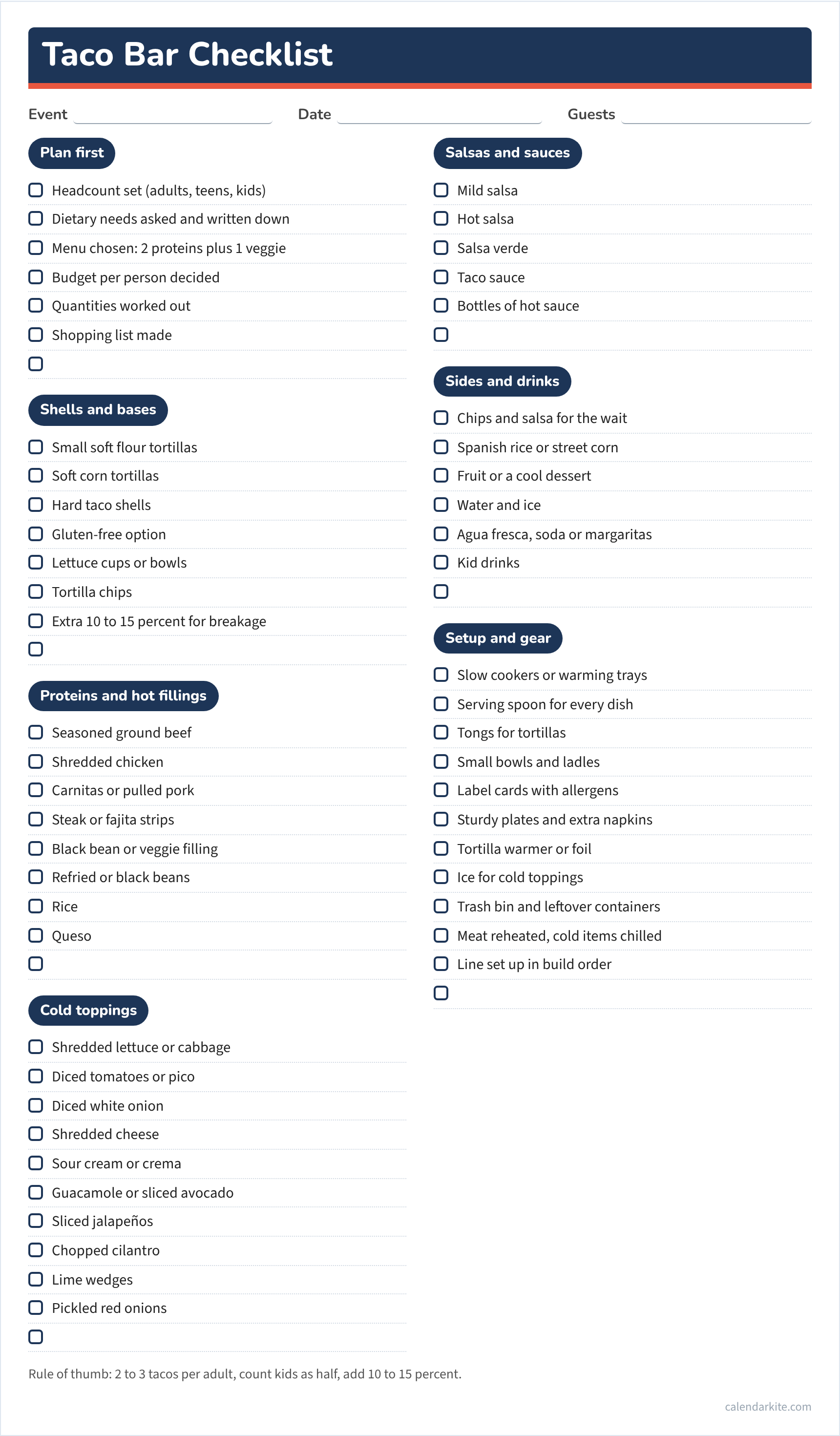
A navy header band with a coral accent gives this a clean, modern look for office potlucks, team lunches and big catered-style taco bars. From my office admin days, I know a bold header helps a shared list get noticed on a busy counter.
Taco bars are forgiving, but they fail in a predictable way: one forgotten item, usually the serving spoon, the limes or the second salsa. I keep a paper calendar on the fridge and a planner on the kitchen counter, and a party page like this one lives between them for the week before an event. Everything below explains how to use the sheet and how to size it for your crowd.
What a good taco bar checklist covers
A useful checklist does more than list toppings. It starts with the decisions that come before shopping: how many people are coming, who has dietary needs, how much you want to spend. Those answers change every number that follows, so I put them in the first group on the sheet.
After planning, the list follows the line your guests walk: shells and bases, proteins and hot fillings, cold toppings, salsas and sauces, then sides and drinks. The last group is the one people forget, which is gear and setup. Spoons, tongs, ice, labels, napkins and a place for the trash are what keep a good menu from turning into a messy table.
I sorted the sheet this way because of my office years. When I kept supply lists and staff rotas readable, I learned that a list organised by how you will use it beats one organised alphabetically. Nobody shops or sets up in alphabetical order.
How to fill in this printable
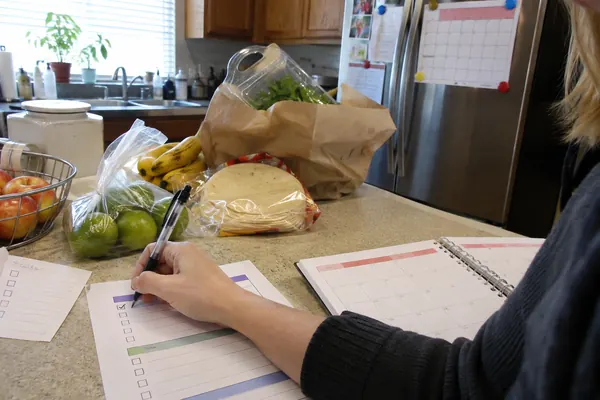
You can type straight into the sheet on this page. Add the event name, the date and your guest count at the top. Tick the items you plan to serve, rewrite any line that does not fit your menu, and use the blank row at the end of each group for the thing only your family does, like pineapple salsa or a particular brand of hot sauce.
I suggest working through it in three passes:
- Planning pass: fill in the first group and cross out everything you will not serve, so the list shrinks to your actual menu.
- Shopping pass: tick items as they go into your cart or basket, and note quantities next to each line.
- Setup pass: on the day, use the last group to check the table, one dish at a time.
Your entries save in your browser, so you can come back to it midweek. When you are happy with it, print it. A blank PDF is also available if you would rather write the whole thing by hand with a pen.
Try this: Before you tick a single box, write your guest count at the top and circle the first two proteins you will serve. Every other decision gets easier once those two are fixed.
How much food per person
Quantities are where most hosts guess, and guessing leads to either a mountain of leftover lettuce or an empty tray of meat at the end of the first wave. A dependable starting point is 2 tacos per adult when you are also serving rice, beans and chips, and 3 tacos per adult when tacos are the entire meal. Count children under 10 as half an adult and teenagers as one and a half, because teenagers will outeat the room.
From there, a few numbers cover most of the table:
- Cooked meat: about 2 ounces per taco, so 4 to 6 ounces per adult. In raw ground meat, that is roughly one third of a pound per person.
- Shells and tortillas: one per planned taco, plus 10 to 15 percent for tears and cracked shells.
- Shredded cheese: about 1 ounce per person.
- Sour cream and guacamole: about 1 ounce per person each, since people serve themselves once.
- Salsa: 2 to 3 ounces per person across all your salsas.
- Rice and beans: about half a cup of each per person.
For a quick example, 12 adults eating tacos as the main meal need about 4 pounds of raw meat, around 36 tacos’ worth of shells plus 5 or 6 spares, and three quarters of a pound of shredded cheese. These are planning numbers, not laws. If your friends are big eaters or the party runs long, round up on the meat and tortillas first, because those are the items people notice when they run out.
Shells and bases
Offer at least two kinds of shell. Small soft flour tortillas suit kids and anyone who wants a loaded taco. Soft corn tortillas are the better choice for guests who avoid gluten, and hard shells give the crunch many people expect. A bag of tortilla chips doubles as a base for nachos and a snack while people wait.
Plan more tortillas than you think you need, and keep the extras sealed until you need them. Hard shells arrive cracked in every box, and soft tortillas dry out and tear if they sit on the table uncovered. A tortilla warmer, or a clean towel inside a covered dish, keeps soft ones pliable for an hour or more.
I also keep a line on the sheet for lettuce cups or bowls. They cost almost nothing and they give low-carb guests and the gluten-free crowd something to build on without feeling like an afterthought.
Proteins and hot fillings
Two proteins plus one vegetarian filling is the sweet spot for most gatherings. Seasoned ground beef and shredded chicken are the safe pair, and either can cook in a slow cooker while you do something else. Carnitas, pulled pork or steak strips raise the party feel if your budget allows one of them. Black beans, sautéed peppers and onions, or roasted sweet potato give vegetarians a real filling instead of a plate of toppings.
Keep the total protein at your per-person figure, not your per-protein figure. Guests take a little of each, so if you cook the full amount of each protein you will end up with far too much. Split the weight between them instead, and lean slightly toward the one you expect to be more popular.
Hot fillings need a way to stay hot. A slow cooker on the warm setting works for ground meat, shredded meat and beans. For rice and queso, a small warming tray or a covered casserole in a low oven keeps them ready. Put a serving spoon in every dish, and write the spoon on your list so it does not stay in the kitchen drawer.
Toppings that earn their place
Five to eight cold toppings is enough for most groups. The reliable core is shredded lettuce or cabbage, diced tomato or pico de gallo, diced white onion, shredded cheese, sour cream or crema, and lime wedges. Add guacamole or sliced avocado, sliced jalapeños, chopped cilantro and pickled red onions if you want the bar to look generous.
Rough quantities help here too. One head of lettuce serves about eight people, one tomato about four, one onion about six, one lime about two, and one bunch of cilantro about ten. These are handy when you are standing in the produce aisle with a list and no calculator.
Limes are the item I see forgotten most often. A small tray of wedges makes a bar feel complete, and they cost very little. I put them near the top of my own list for that reason.
Try this: Look at your topping list and cut it to eight. Then ask which two would be missed most, and mark those with a star so they are the last thing you cut if the budget tightens.
Salsas, sauces and heat levels
Two salsas is the minimum, and three is better. A mild tomato salsa, a hotter red or chipotle salsa, and a tangy salsa verde cover almost every taste. Add a bottle or two of hot sauce for the people who want more heat, and a taco sauce if you have kids who prefer the familiar.
Label the heat level on a small card next to each bowl. It stops the awkward moment when a guest who avoids spice takes a big spoonful of the wrong one, and it saves you from answering the same question twenty times. Use plain index cards or a simple folded paper tent.
If you make salsas ahead, they usually taste better after a night in the fridge. Put that on your timeline, not on party day. Fresh pico is the exception: cut it the morning of the event so the tomatoes do not go watery.
Sides and drinks
Rice and beans are the classic sides, and they also stretch your protein, so they are worth the small cost. Spanish rice, cilantro lime rice, refried beans and black beans all work. Street corn, a simple fruit salad or a jicama slaw add freshness without a lot of extra work.
For drinks, keep it simple: water with ice, one or two flavoured options such as agua fresca or lemonade, and a separate choice for kids. If you are serving margaritas or beer, put the glasses and the lime on the list as well, since those are easy to overlook next to the food.
A dessert does not need to be elaborate. Churros, a tray of cookies or cold watermelon slices round out the meal, and none of them need a place on the serving line.
Serving gear and food safety
The gear list is the one I wrote after watching too many parties fall apart at the table. You need a serving spoon or tongs for every dish, small bowls for toppings, sturdy plates that can hold a loaded taco, plenty of napkins, and a trash bin within reach. Paper plates that fold under the weight of three tacos are a common mistake, so buy the heavier kind.
On food safety, cooked food should not sit out for more than 2 hours, or 1 hour if it is hotter than 90°F outside. Keep hot fillings hot in slow cookers or warming trays, and set bowls of cold toppings over ice or swap them for fresh bowls from the fridge midway through the party. Keep a few containers ready for leftovers so you can refrigerate them as soon as the meal winds down.
At home, I clear a spot where the dog cannot reach before I set anything on the table. It sounds minor, but a low table full of taco toppings is the most tempting thing a dog will see all week.
Setting up the line in the right order
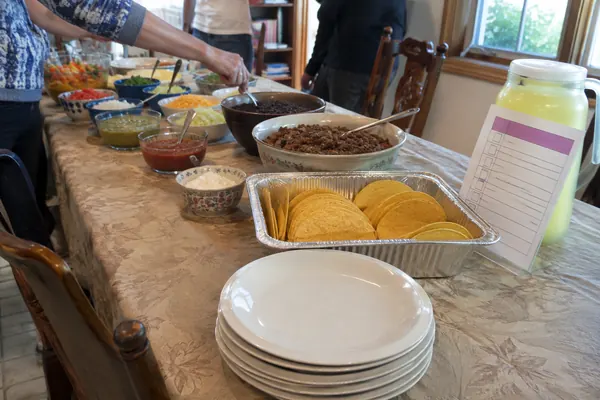
Guests should move in the same order they would build a taco. A line that works in nearly every kitchen goes from plates to shells, then protein, then hot sides such as rice and beans, then cold toppings, then salsas and sauces, with napkins and utensils at the end. Putting napkins last means nobody is juggling them while holding a full plate.
If your space allows, set up two lines or a single table that people can approach from both sides. Once you pass about 15 guests, a single line becomes a traffic jam, and a second set of the most popular items is cheap insurance. For large groups, I place chips and a drink station away from the line so people who are already served do not block it.
Keep heavier items at the start, since the first dish is the one people pile highest, and keep the lightest, most delicate toppings near the end. Put your most expensive topping where portions are easiest to control, and use a small spoon for it.
A make-ahead timeline
Almost everything on the checklist can be done before the day of the party, which is the main reason a taco bar is such a calm way to host. A simple timeline keeps it that way:
- Three days before: finalise the headcount, confirm dietary needs and complete your shopping list.
- Two days before: shop for everything except fresh produce and tortillas.
- The day before: cook the meats, make the salsas, chop firm vegetables, shred the cheese and store each item in a labelled container.
- The morning of: buy or cut tomatoes, avocado and herbs, set out serving dishes, label the cards and chill the drinks.
- One hour before: reheat the meat and beans, warm the tortillas and set the line in order.
Write the dates next to each step on your sheet or on your calendar. A monthly calendar on the fridge is where I put the shopping day, so it competes with everything else going on that week. If you want a layout that fits that purpose, the printable monthly calendar works well for it.
Dietary needs and allergies
Ask guests about dietary needs when you invite them, not when they arrive. A short message covers it: vegetarian, vegan, gluten-free, dairy-free and any serious allergies. Put what you learn in the first group of the checklist so the menu is built around it from the start.
A taco bar handles most diets well because everything is separate. Corn tortillas and lettuce cups cover gluten-free guests, a bean or vegetable filling covers vegetarians, and leaving cheese and sour cream in their own bowls helps dairy-free guests. Use separate serving spoons for each dish, because shared spoons carry cheese into the vegan beans within minutes.
For serious allergies, such as nuts or shellfish, read the labels on seasoning packets and sauces, and tell the guest exactly what is in each dish. A label card with the main ingredients is a small step that makes people feel looked after.
Variations for different events
The same checklist works with small changes. For a casual family Taco Tuesday, cut the list down to one protein, five toppings and one salsa, and let the kids build their own. If you plan your dinners by the week, a printable weekly meal planner shows you where a taco night fits without repeating last week’s menu.
For a graduation, birthday or other big event, add a drinks station, a dessert and a few decorations, and use the extra blank rows for them. The grad party checklist covers the wider planning around the day, and the taco bar sheet handles the food side of it.
For potlucks, assign toppings, sides and drinks to guests and keep the protein yourself. A potluck sign-up sheet helps you avoid ending up with six bags of chips and no salsa. For a Cinco de Mayo gathering, add lime-heavy drinks and a few festive extras. For a walking taco version, swap shells for single-serve chip bags and ladle the fillings straight into them.
Budget and shopping tips
A taco bar is usually one of the cheaper ways to feed a group, with typical costs landing somewhere between $5 and $12 per person depending on your proteins, how much is homemade and where you shop. Meat and tortillas are the biggest costs, so if you need to save, put your money there and keep toppings simple.
Buy in bulk where it makes sense: large bags of tortillas, whole chicken thighs and block cheese you shred yourself cost less than their prepared counterparts. Skip the pre-made versions of things you can chop in five minutes, but consider buying pico, guacamole or salsa if your time is tight.
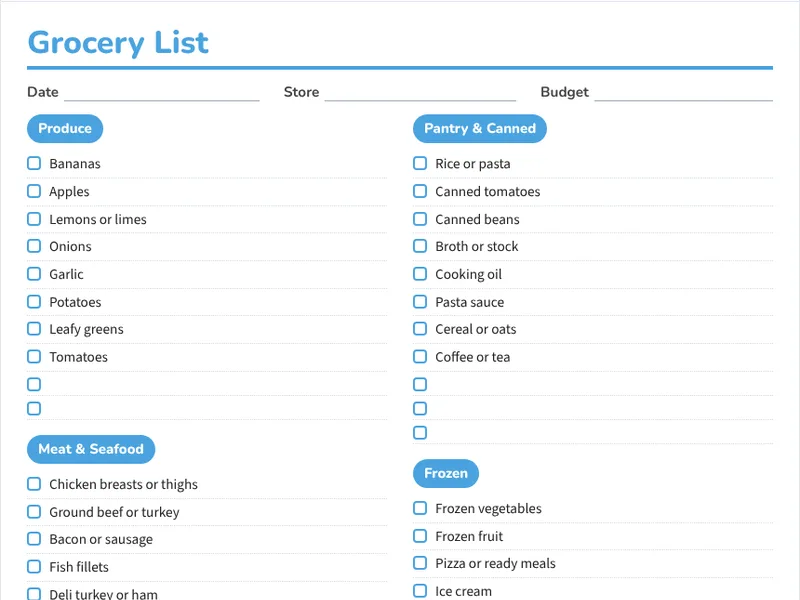
When you shop, take the checklist with you and tick items off in the aisle. If you like a separate pantry list, a grocery list printable is useful for the usual weekly items so the party items are not mixed in with your cereal and laundry detergent.
Printing and keeping your checklist
The sheet is built for a single US Letter page, and I test-print every printable on my home inkjet on both US Letter and A4 so nothing gets clipped. Print in black and white if you are making several copies, and use the standard quality setting; draft mode can make the checkboxes harder to read.
Make two copies if two people are helping. One stays in the kitchen for prep and one goes on the table so a friend can check dishes off while you are busy. A clipboard or a magnet on the fridge keeps it from disappearing under groceries.
Save your finished sheet when the party is over. Next time, you will have your quantities, your favourite brands and a note of what ran out first. If you plan other events as well, my printable checklists collection has more sheets in the same style. Ohio
Common questions
What do you need for a taco bar?
You need shells or tortillas, two or three proteins, a handful of cold toppings, at least two salsas, a side such as rice or beans, and serving gear for every dish. The checklist on this page groups all of that in the order guests move down the line.
How many tacos should I plan per person?
Plan 2 tacos per adult when rice, beans and chips are on the table, and 3 when tacos are the whole meal. Count kids under 10 as half an adult, teenagers as one and a half, and add 10 to 15 percent for breakage and seconds.
How many toppings should a taco bar have?
Five to eight toppings is plenty for most gatherings, plus two or three salsas. More than that slows the line and raises your cost without making guests happier.
How far ahead can I prep a taco bar?
Most of it can be done the day before: cook and refrigerate the meat, chop the toppings, make the salsas and pack everything in labelled containers. Slice avocado and warm the food on the day itself.
How long can taco bar food sit out?
Food safety guidance says perishable food should not sit out for more than 2 hours, or 1 hour if it is hotter than 90°F outside. Keep hot fillings hot in slow cookers and put cold toppings in bowls set over ice.
Can I edit the checklist before printing?
Yes. You can type into every line and field, tick boxes, change any item and add your own in the blank rows. Your changes save in your browser, and there is also a blank PDF if you prefer to write by hand.
 Camping Checklist Printable: Free One-Page Packing List
 Checklist: A Free Printable You Can Fill In, Edit and Print
 Grocery List Printable
 Baby Shower Planning Checklist (Free Printable)
 Moving Out of State Checklist
 Move Out Cleaning Checklist (Free Printable)