
Savings Tracker: Free Printable Sheet to Reach Your Goal

A savings tracker is a sheet where you write down every deposit and withdrawal for one savings goal, plus the running balance and how close you are to the target. The free printable above does exactly that. Fill in what you are saving for, the goal amount and the date you want to reach it, then log each transaction as it happens.
| Date | Source or note | Deposit | Withdrawal | Balance | % of goal |
|---|---|---|---|---|---|
Balance = last balance plus deposit minus withdrawal. % of goal = balance divided by goal amount.
Free for personal, classroom and office use. Your entries are included in the print, PDF and PNG. Prints on US Letter and fits A4.
Black and White Savings Tracker Printable
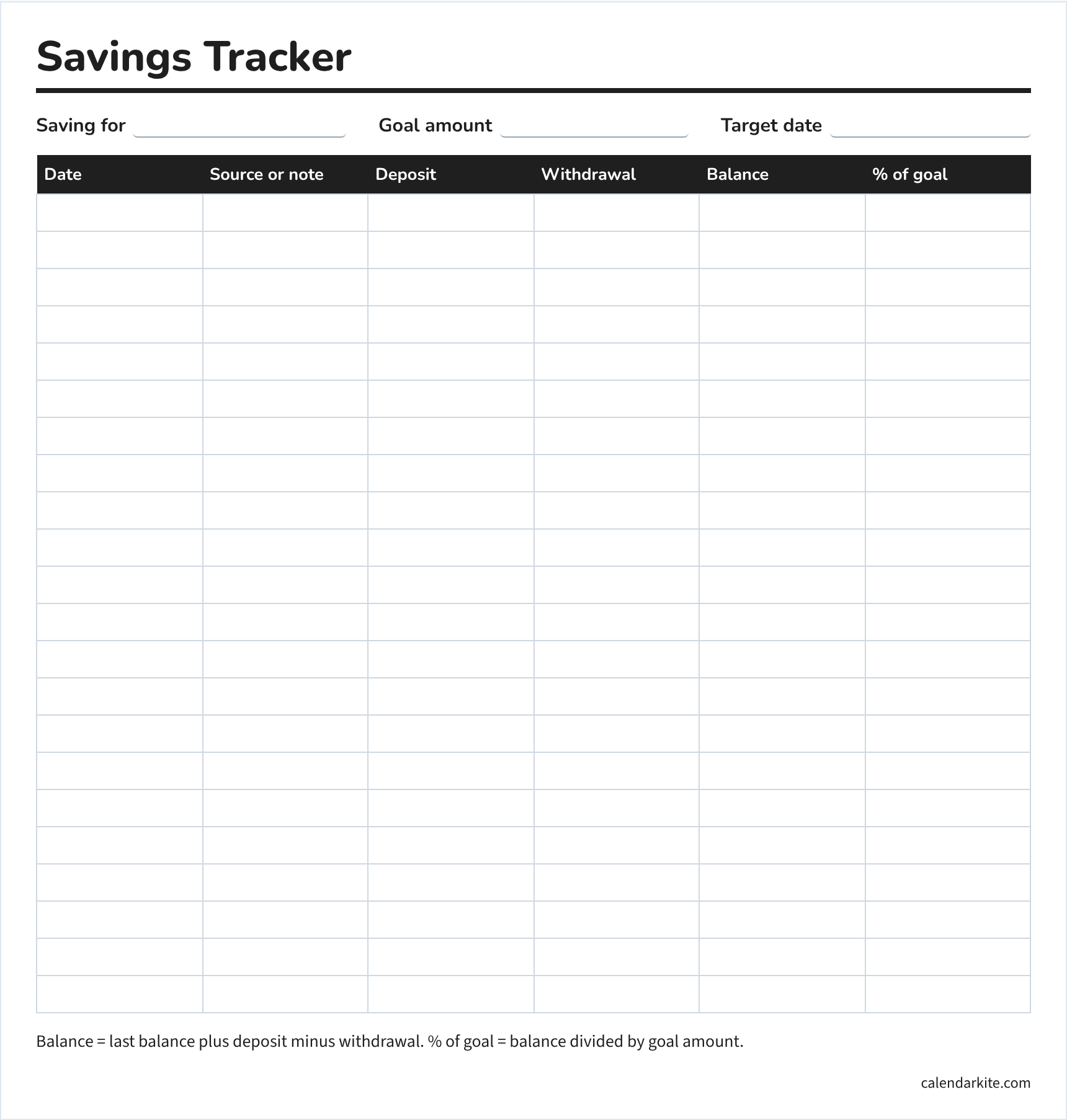
This is the one I print most, because plain black lines save ink and photocopy cleanly for a shared household binder. It suits anyone tracking one goal, like an emergency fund, and prints crisply on my home inkjet.
Pink Savings Tracker
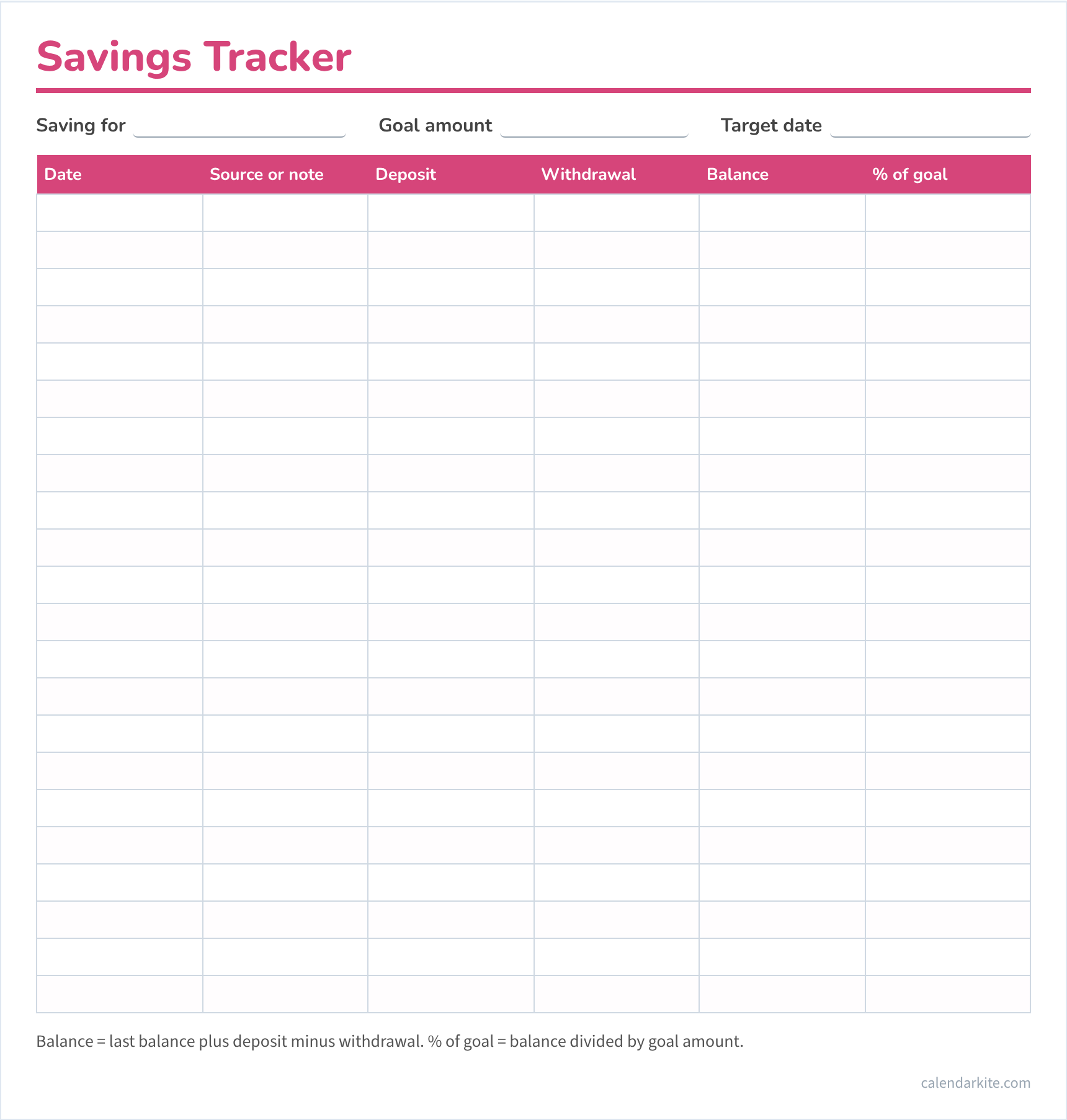
A soft pink tracker works well if you want a savings page that feels encouraging rather than like a bank statement. I'd use it for a vacation fund and color in each step as you go, keeping it pinned beside your planner.
Sage Green Savings Tracker Printable
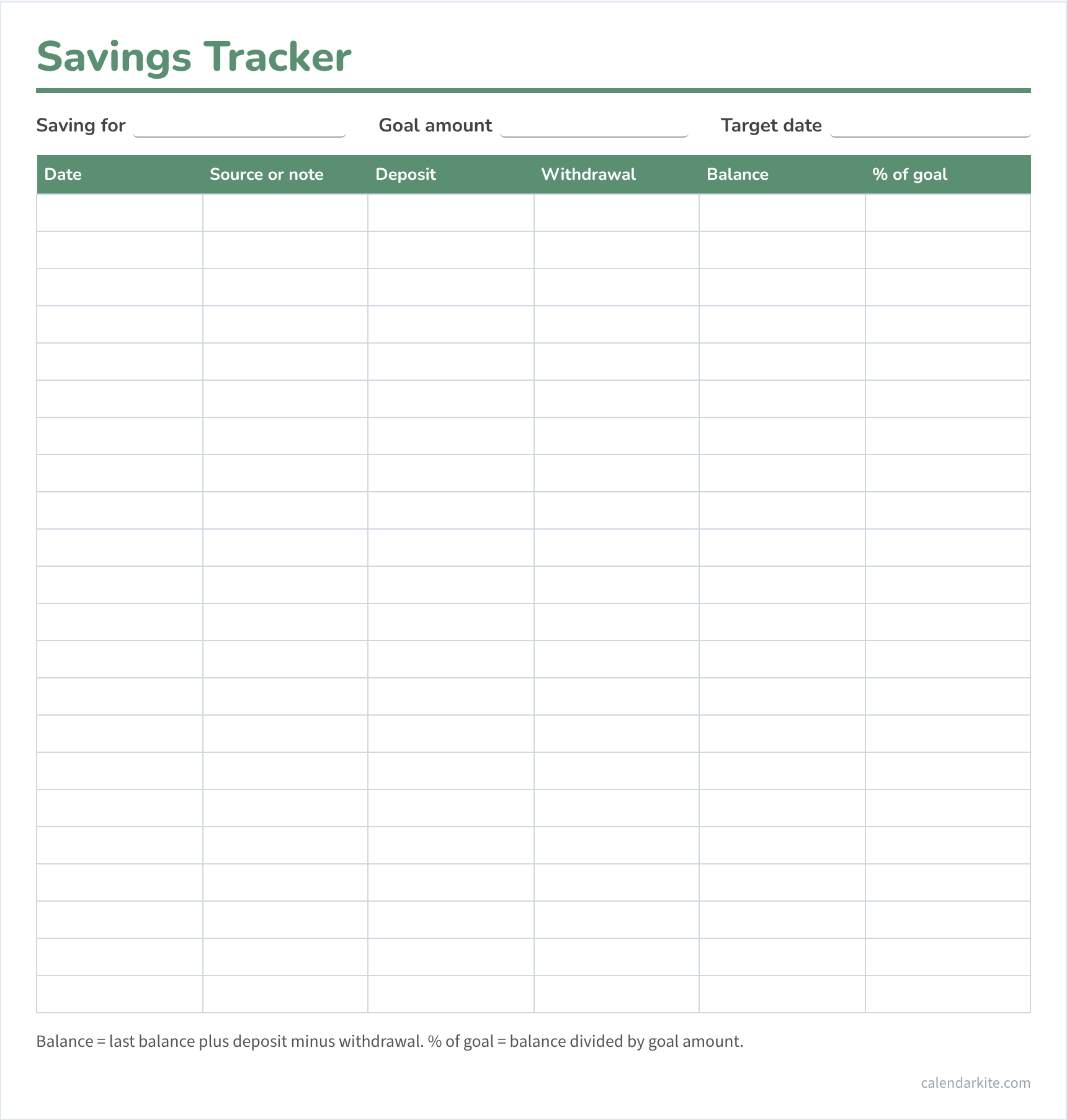
Sage green is calm and easy on the eyes, which helps when a budget conversation feels tense. It suits couples saving together for a house deposit; I keep a page like this beside the paper calendar on my fridge.
Lavender Savings Tracker
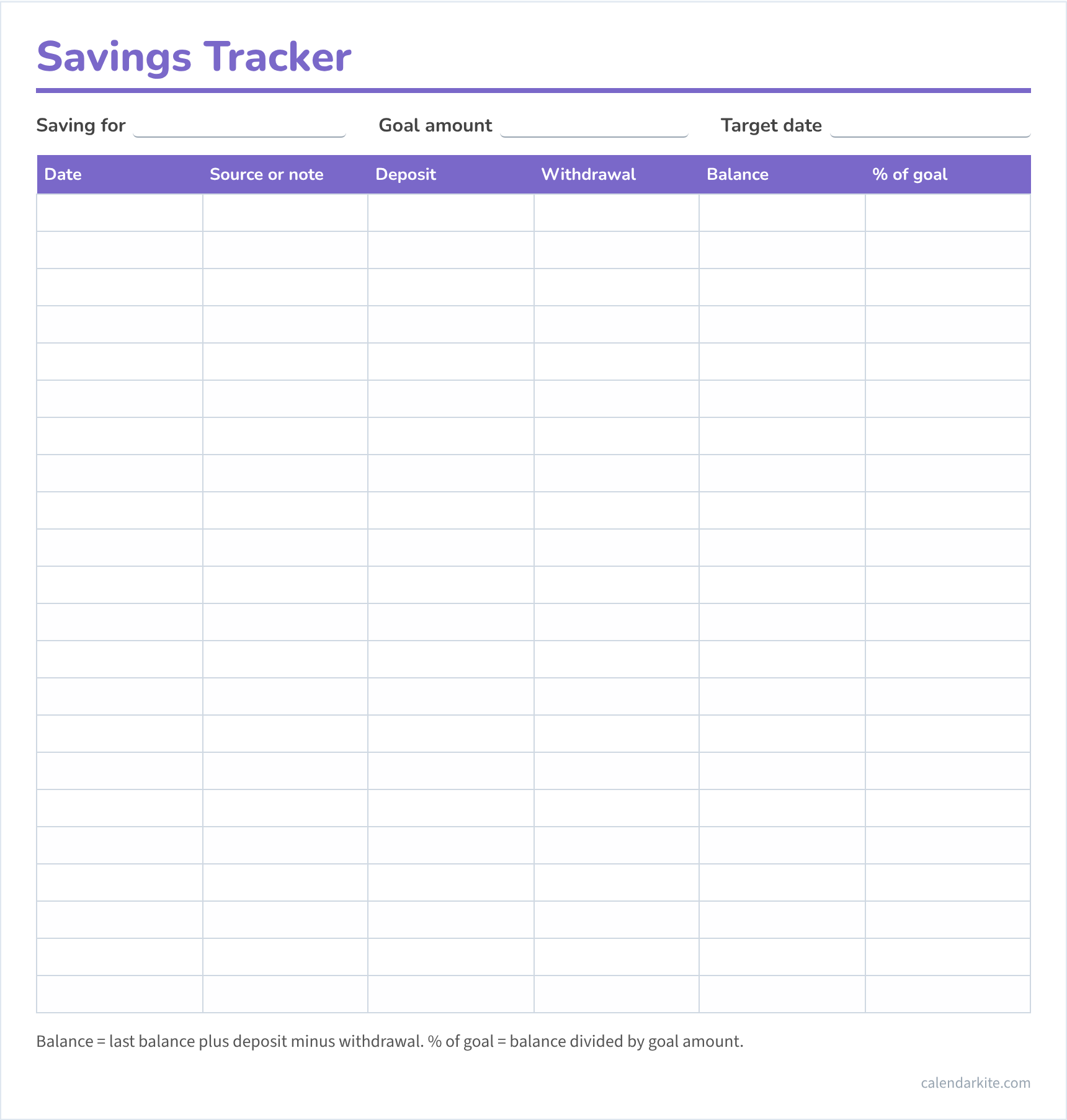
Lavender gives a tracker a gentle, planner-friendly look without shouting for attention. It's a good fit for a monthly savings challenge, and I'd print it on US Letter or A4 and slip it into a binder.
Cute Savings Tracker Printable
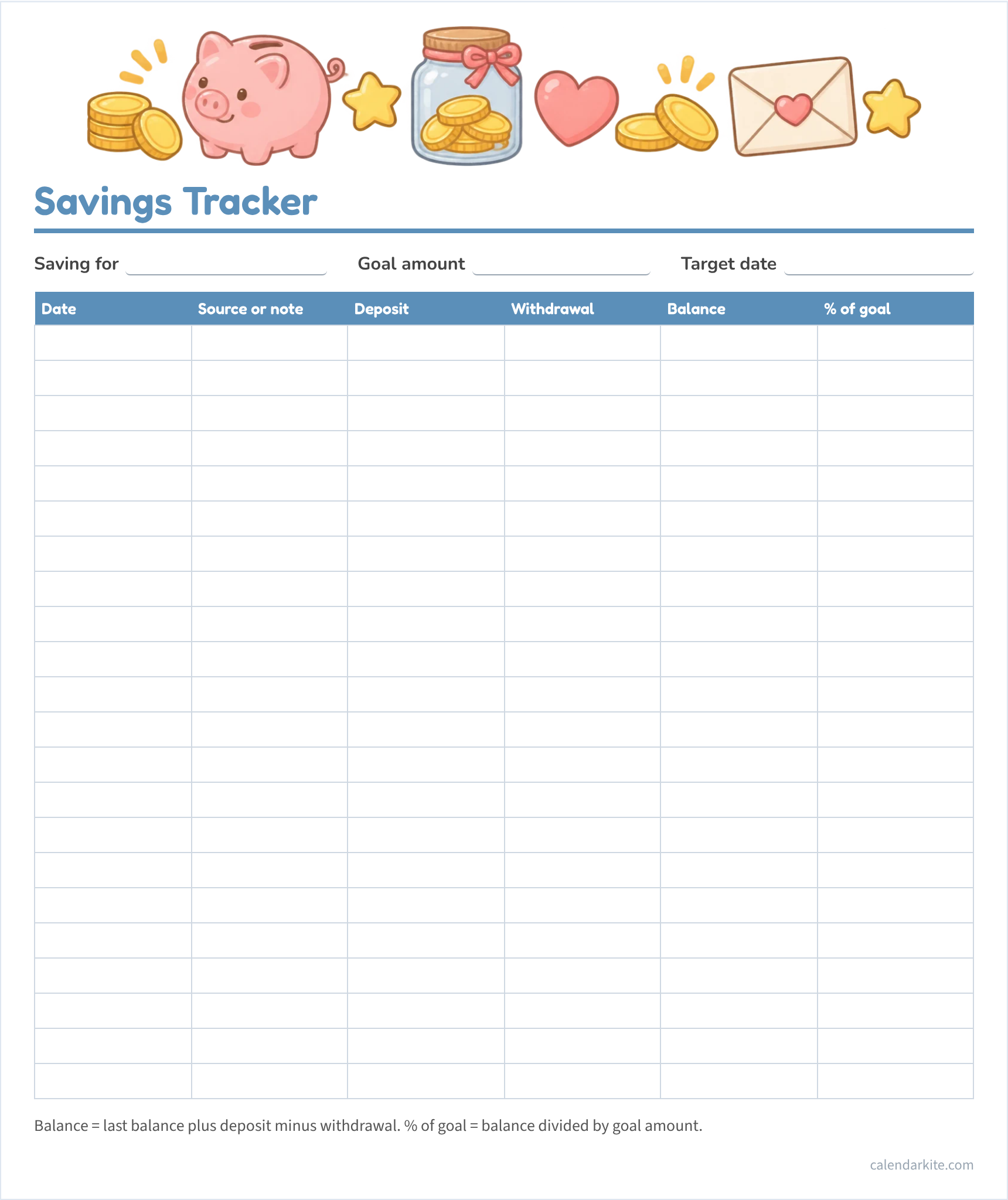
The pastel blue and hand-drawn style make saving feel like a game, which I find keeps motivation up on slow weeks. It suits a small goal such as a new bike or a birthday gift, and the boxes are big enough to write in.
Floral Savings Tracker Printable
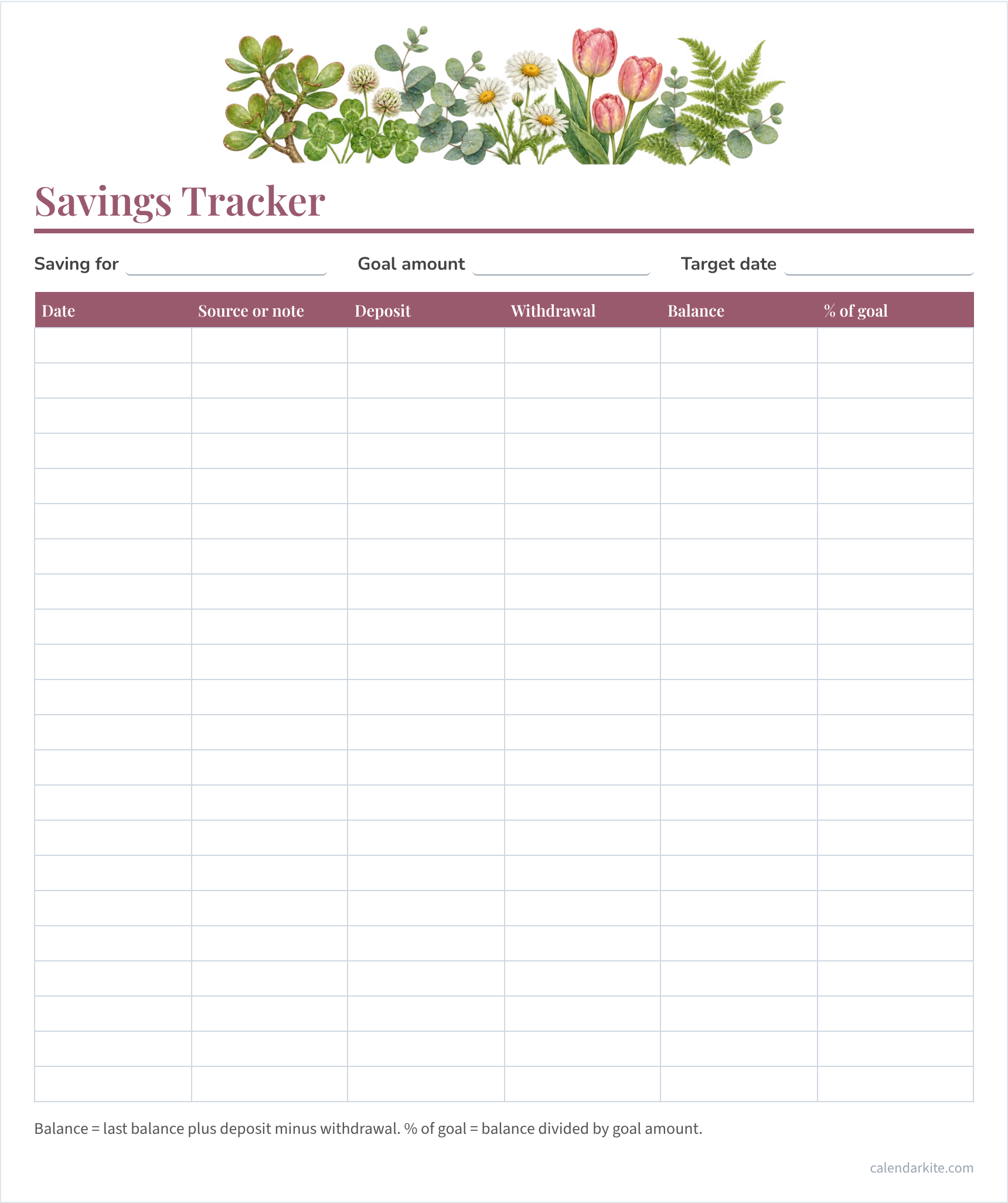
Watercolor flowers and elegant serif headings give this version a polished look for a wedding or holiday fund. One mistake I see is cramped writing space, so I kept the entry lines roomy beneath the artwork.
Fun Colorful Savings Tracker
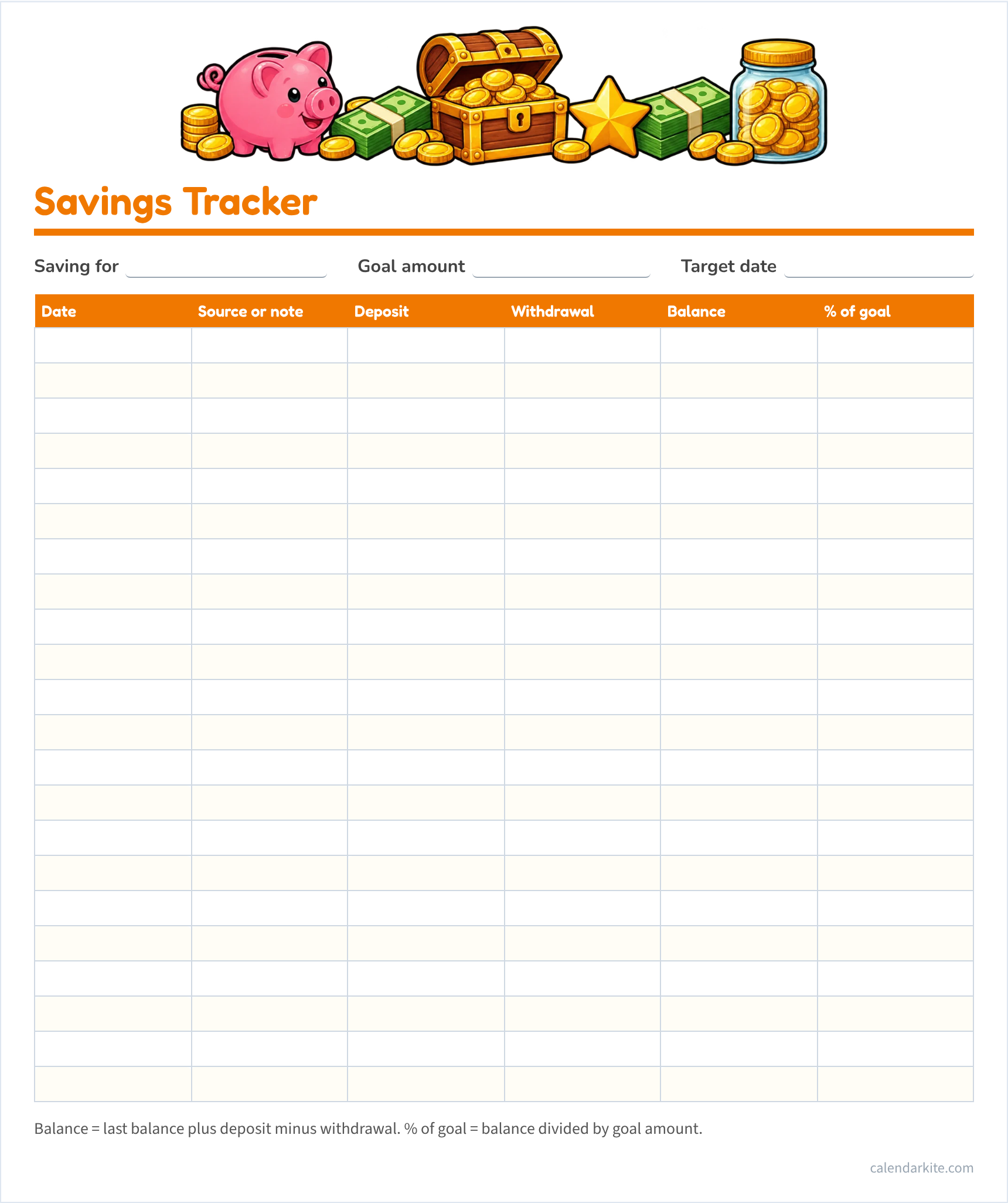
Bright orange and yellow with bold cartoon pictures make this a fun choice for children saving allowance toward a toy. My own two kids respond better to a chart they can color in, so I'd let them mark each deposit themselves.
Minimalist Savings Tracker Printable
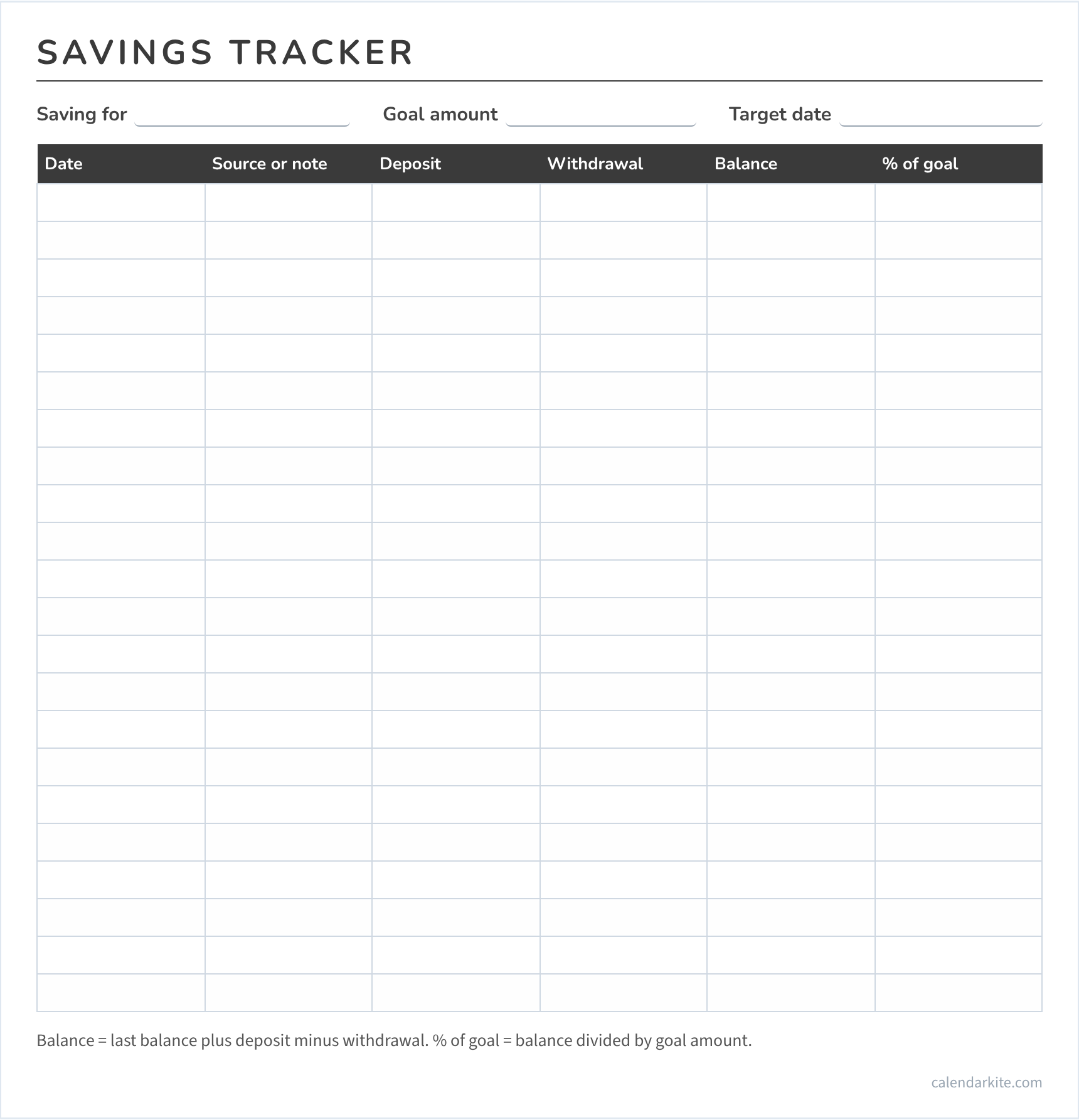
Thin gray lines and a light uppercase heading keep this version quiet and uncluttered. In my office years I learned that the simplest sheet gets used, so I'd choose it for tracking a steady monthly transfer to savings.
Aesthetic Savings Tracker
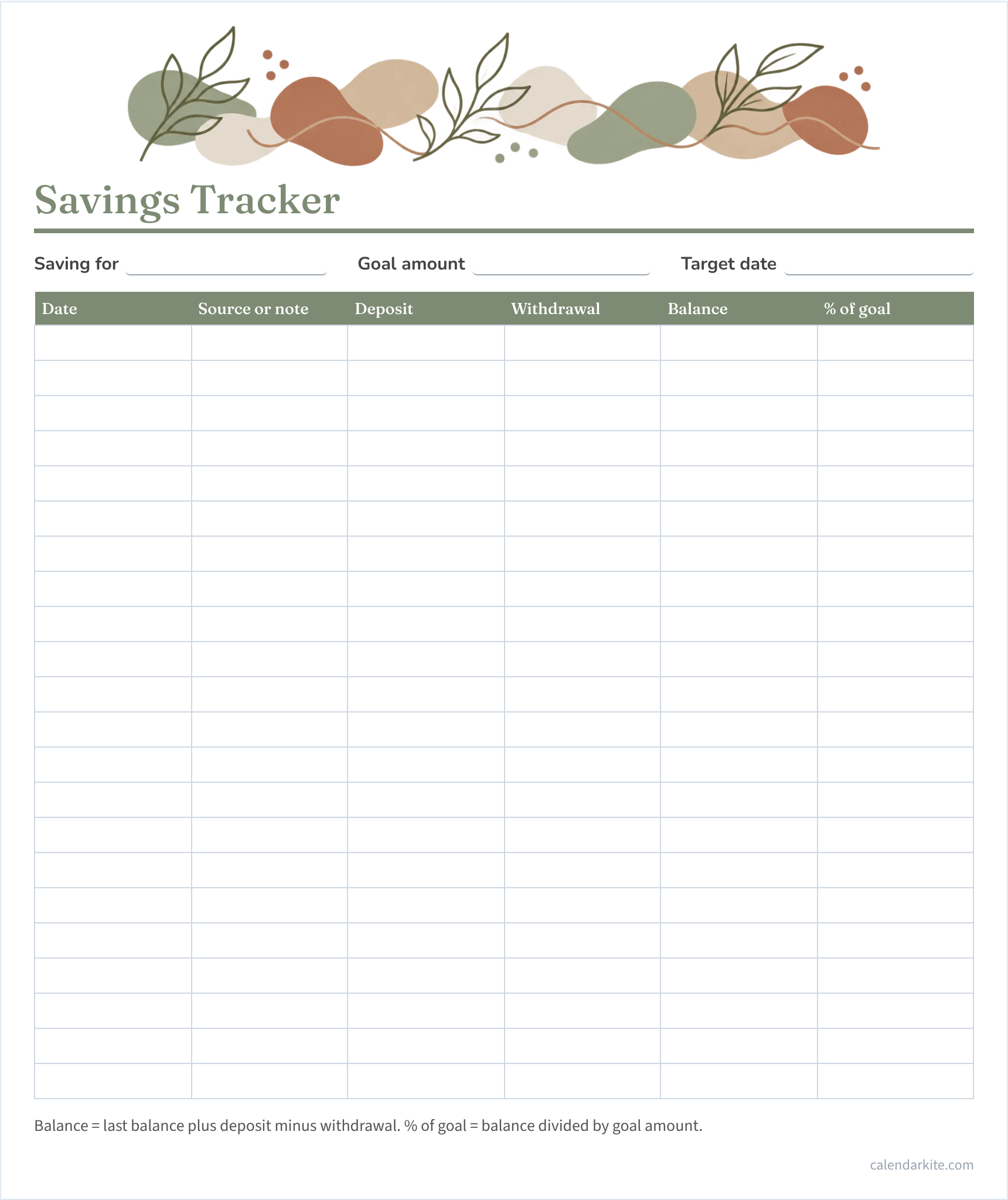
Muted sage, sand and terracotta with soft line-art leaves suit anyone who likes a planner that looks good on an open desk. I'd use it for a sinking fund, such as car repairs, and it prints in soft tones on my inkjet.
Modern Savings Tracker Printable
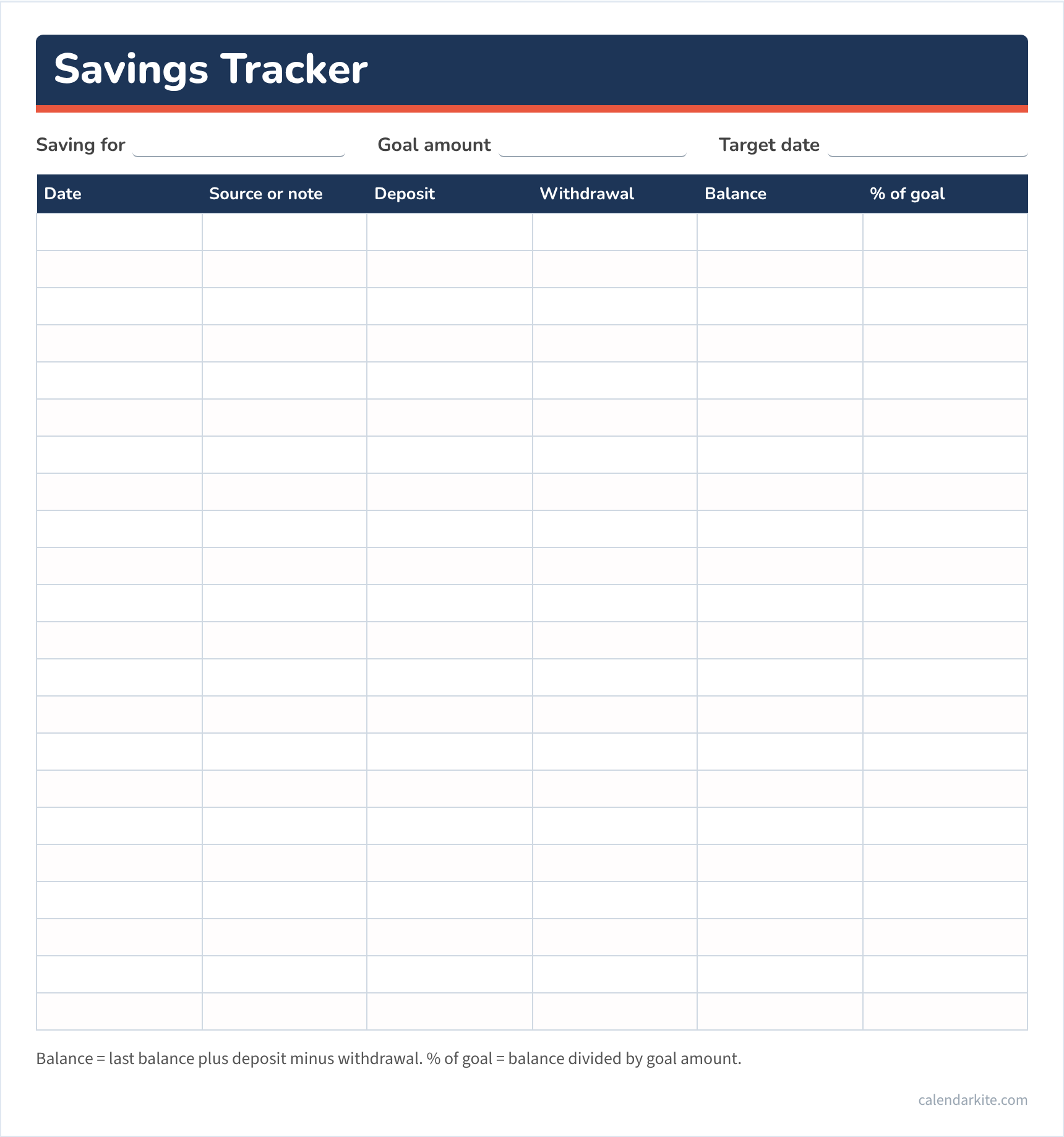
The navy header band and coral accent make the goal and total easy to read at a glance, which suits a larger target like a down payment. I'd keep it on the kitchen counter beside my planner.
You can type straight into the sheet on this page. Every line and field is editable, and your entries save in your browser, so you can come back and add to it. When you are ready, print it. There is also a blank PDF if you would rather write everything by hand.
What a savings tracker does that a bank app does not
Your bank app tells you your balance. It does not tell you why the money is there, how much of it belongs to which goal, or how far along you are. A savings tracker fills that gap. One sheet equals one goal, so you always know that this $640 is for the holiday trip and not the car repair fund.
Writing the amount down also does something an app cannot. It slows you down for about ten seconds, and that small pause makes a deposit feel like a decision rather than a leftover. Seeing a column of dated entries gives you proof that you are doing the thing, even in weeks when the total barely moves.
The sheet works for any goal with a number attached: an emergency fund, a deposit on a flat, school fees, a new laptop, a wedding, holiday gifts. It also works as a plain record for a long-term savings account you contribute to every payday.
How to fill in the savings tracker
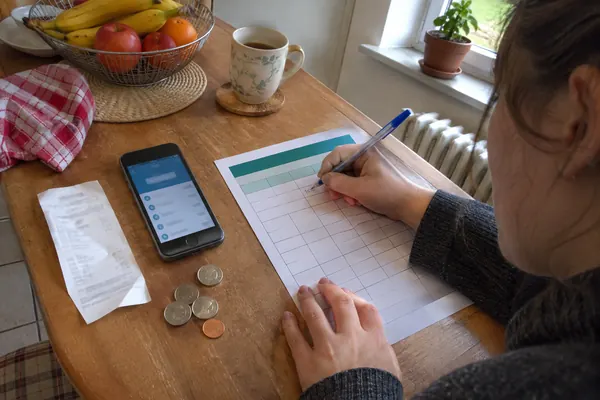
Start with the three fields at the top. Saving for is the name of the goal, written specifically (“Summer trip to Maine” beats “Vacation”). Goal amount is the total you want to end with. Target date is when you want to have it.
Then work down the table, one row per transaction:
- Write the date of the deposit or withdrawal.
- In Source or note, put where the money came from or where it went (“tax refund”, “overtime”, “sold bike”, “car tire”).
- Enter the amount in Deposit or Withdrawal, never both on one row.
- Work out the new balance: last balance plus the deposit, or minus the withdrawal.
- Divide the balance by your goal amount to get the percent of goal.
The first row is your starting balance. If you already have $200 set aside, log it as a deposit with the note “starting balance” so the running total begins at the right place.
Try this: Before your first entry, write the goal amount and target date, then divide the goal by the number of weeks until that date. Put that weekly figure in the margin. It is your pace for the whole sheet.
Setting a goal amount and date you can actually hit
The most common reason a savings plan stalls is a goal with no date, or a date with no arithmetic behind it. Take the goal, subtract what you already have, and divide by the number of paydays between now and the target date. That figure is what each deposit needs to be.
If the number makes you wince, change the date first. Pushing a trip back two months costs you very little, while shrinking the goal can mean you end up with a trip you did not want. If the date is fixed, such as a tuition bill or a wedding, then the goal is fixed too, and the only lever left is how much you pay in each time or where the extra money comes from.
For an emergency fund, the usual guidance is three to six months of essential expenses. That can be a huge number if you are starting from zero, so I suggest a first milestone of one month of rent and bills, then a second sheet for the next milestone. Small finish lines get crossed more often than distant ones.
A worked example with real numbers
Say you want $1,200 for a family trip in ten months. You already have $150 in a separate savings account. That leaves $1,050, which works out to $105 a month, or roughly $24 a week if you save weekly.
Your first row reads: Date 3/1, Note “starting balance”, Deposit $150, Balance $150, % of goal 12.5%. Your second row, a week later: Deposit $25 from grocery budget leftovers, Balance $175, % of goal 14.6%. If a $60 tire repair forces a withdrawal in week five, you log it in the Withdrawal column and the balance drops honestly. Nothing about the sheet is spoiled by a setback.
The percent column is there for motivation, not math class. Round it to the nearest whole number. Watching 12 become 25 and then 50 is what makes people keep filling in the rows.
Who this savings tracker suits
It suits anyone who wants an exact record rather than a pretty picture. That includes people saving a fixed amount each payday, freelancers who deposit whenever invoices land, couples saving toward a shared goal, and students putting aside part of a summer job.
It also suits people who are wary of apps. Some folks do not want to link a bank account to yet another service just to see a progress bar. A sheet on paper has no login, no subscription and no notifications to ignore.
If you share a goal with a partner, keep one copy where both of you can reach it and agree that whoever deposits writes the entry. In my house, two kids and a dog mean the fridge is the one place everyone walks past, so that is where shared paper lives. A sheet in a drawer does not get filled in.
Money saving chart versions to try

A money saving chart is the color-in cousin of the tracker. You divide your goal into equal boxes, say 100 boxes of $10 for a $1,000 goal, and shade one each time you save that amount. It is quick and very satisfying, and children in particular enjoy it.
The two formats do different jobs, so I often suggest using both. Use the log on this page as the source of truth, with dates, notes and balances. Then use a visual chart for the feeling of progress. If you like the filling-up effect, the thermometer goal tracker gives you a column to shade as the balance climbs.
You do not need a special design to make a chart. Draw a grid on scrap paper, label the box value at the top, and tick off boxes as you go. The log carries the accuracy, so the chart can stay loose.
Try this: Pick a box value that equals one small, repeatable saving, such as a $5 bill or the change from a coffee you skipped. Divide your goal by it to see how many boxes you need.
Savings challenges that fit a tracker
Saving challenges are structured plans with a fixed pattern of deposits. They pair well with a log because the pattern gives you the numbers and the log keeps them honest. A few popular ones:
- 52-week challenge: save $1 in week one, $2 in week two, and so on up to $52. The year’s total is $1,378.
- 100 envelope challenge: number envelopes 1 to 100 and put in that many dollars each. The total is $5,050.
- Fixed weekly amount: the same sum every payday, such as $25. Less exciting, easier to keep up.
- Round-up or $5 bill rule: every $5 bill you receive goes in the jar and onto the sheet.
The 52-week version is back-loaded, which means your biggest deposits come in the weeks when holiday spending hits if you start in January. Many people flip it and start with $52, working down to $1, so the hardest weeks come while motivation is highest. Either way, log each deposit with its date and the balance will take care of itself.
If a spending freeze appeals more than a deposit pattern, the no-spend calendar pairs with this sheet nicely: tick the days you spent nothing, then log the money you kept as a deposit.
How to find the money to save
A tracker records savings, but it cannot create them. If the deposits are not appearing, the answer is usually in your spending, so look at that before you blame willpower. A one-month review of where money goes will turn up a few leaks: unused subscriptions, delivery fees, bank charges, impulse buys.
If you have not put your spending on paper yet, a budget planner will show you the gap between what comes in and what goes out. If your income changes from week to week, an income tracker tells you what a typical week really brings in, so you can set deposits from the lowest realistic figure.
Pay yourself first where you can. Move the deposit to savings on payday, before the money becomes spending money, then log it. Saving what is left over sounds sensible, but there is rarely anything left over.
Where to keep the money you track
The sheet records the money. It does not hold it. Keep the cash somewhere separate from your everyday account so it does not get spent by accident. A dedicated savings account, ideally labeled with the goal, makes it easy to match the balance on your sheet to the balance at the bank.
For US savers, check that the account is insured. Deposits at banks insured by the FDIC are covered up to $250,000 per depositor, per bank, per ownership category, and credit unions have a similar protection through the NCUA. Compare interest rates too, because online savings accounts often pay noticeably more than a basic branch account.
Once a month, reconcile. Compare the last balance on your sheet to the real balance in the account. If they differ, look for interest paid, a fee, or a deposit you forgot to write down, then add a row for the difference. In my office years, I learned that a log you never check against the real thing quietly drifts, so I do this on the first of the month.
Tracking more than one goal
Most households are saving for several things at once: a car repair cushion, a holiday, a birthday gift. The cleanest way is one sheet per goal, each with its own name, target and date. Clip them together or tuck them behind each other in a folder or binder.
If you only have one savings account, you can still separate the goals on paper. Log each deposit on the sheet it belongs to, and the totals of all sheets should add up to the account balance. Some banks let you create nicknamed sub-accounts, which makes this easier.
Rank your goals. When money is tight, the emergency fund comes first, then anything with a hard date, then the nice-to-haves. If you have debts with high interest, check the debt payoff tracker too, since paying those down can be the best saving you ever make.
Keeping the habit going
The best place for the sheet is wherever you already look every day. I keep a paper calendar on the fridge and a planner on the kitchen counter, and a savings sheet clipped inside the planner gets filled in far more reliably than one buried in a folder. Pick one spot and stick to it.
Link the update to something fixed. Payday, Sunday evening with a cup of tea, or the first of the month all work. If you can, pair the entry with your bills so it feels like part of one money routine. A bill tracker next to the savings sheet makes a good weekly pair.
Celebrate milestones, and keep it cheap. At 25, 50 and 75 percent, mark the row with a star or a note about how it felt. Ten seconds of acknowledgment goes a long way toward getting you to 100.
Try this: Choose your update day right now and set a repeating reminder for it. Write the day in the margin of the sheet so the habit has an address.
Common savings tracker mistakes
The first is vagueness: a goal called “savings” with no amount and no date. Give every sheet a number and a deadline, or it turns into a diary of deposits with no direction.
The second is logging only the good news. If you take money out and do not write it down, your sheet says one thing and your account says another, and you stop trusting the sheet. Record withdrawals the same day. When I test the layout, I made the Withdrawal column the same width as Deposit for this reason: a withdrawal is part of the story, not a shameful footnote.
The third is setting the deposit too high. A heroic number lasts three weeks, then the whole plan collapses. A modest amount you repeat for months beats a bold one you abandon. And the fourth is waiting for the perfect start. Begin this week with whatever you have, even $10.
Printing tips
The sheet is laid out for US Letter, and I test-print each printable on my home inkjet on both US Letter and A4, so it prints cleanly on either size. Choose “Fit to page” or “Actual size” in your print dialog, and leave margins at default. Black and white is fine, and it saves color ink for other things.
If you plan to write by hand, print on slightly heavier paper, about 24 lb or 90 gsm, so pen ink does not show through. Pencil works well for the Balance and % of goal columns, since you may need to correct a sum. Fill in the top fields on screen first so your handwriting does not have to squeeze into them.
When a sheet is full, print a fresh one and carry the last balance onto the first row as the starting balance. Keep finished sheets in a folder, because a stack of them is a good reminder of what you have already achieved. For more finance sheets in the same style, browse the printable trackers and logs.
Savings tracker ideas for kids and families
Children understand saving better when they can see it. Give a child their own copy, let them pick a goal such as a bike, a game or a gift for someone, and help them write each deposit from allowance or birthday money. Use round numbers and a goal they can reach in a few weeks, since a year is an eternity to an eight-year-old.
Shading boxes works better for younger children than a balance column, so a color-in money saving chart may suit them more, with the log kept by a parent. Older kids can handle the sums and the percent column, which is a quiet way to practice division with money they care about.
For families saving together, a single shared sheet for a holiday or a big purchase makes everyone feel part of it. Put it up where all can see, decide who writes the entries, and let people add notes about where each bit came from.
What to do when you reach your goal
When the balance hits the goal amount, write the date on the sheet, circle the final balance and take a moment. Then decide what the money is for. If it is a purchase, make it, and record the withdrawal so the sheet is complete. If it is an emergency fund, keep the sheet going, and set a higher target for the next stage.
Some people like to roll straight into a new goal at the same deposit amount, so the habit does not stop. Your payday transfer is already set up, so the money just points somewhere new. That keeps the momentum without any new effort.
If you ever miss your target date, do not scrap the sheet. Cross out the old date, write a new one, and recalculate the weekly pace. A late finish is still a finish. For related planning, see the goal tracker for non-money goals and the personal finance tracker for a wider picture of your accounts.
Common questions
What is a savings tracker?
A savings tracker is a sheet where you record each deposit and withdrawal for a savings goal, along with your running balance. It shows how far you have come and how far you have left to go.
How do I use a printable savings tracker?
Write your goal, target amount and date at the top. Then log each deposit with its date, work out your new balance, and note what percent of the goal you have reached. Keep the sheet somewhere you will see it.
What is the difference between a savings tracker and a money saving chart?
A money saving chart is usually a color-in grid where each box stands for a fixed amount. A savings tracker is a log with dates and balances. The log is more exact, and the chart is more visual. Many people use both.
How often should I update my savings tracker?
Update it every time money moves into or out of your savings. If that is too often, pick one fixed day each week and log everything from the past seven days in one sitting.
How much should I save each month?
Divide your goal amount by the number of months until your target date. For a $1,200 goal in 10 months, that is $120 a month. If the number feels too big, lengthen the timeline before you shrink the goal.
Can I track more than one savings goal on this sheet?
Use one sheet per goal. Mixing goals on one page makes the balance column meaningless. Print as many copies as you need and clip them together.
 Reading Log: Free Printable You Can Fill In and Print
 College Assignment Tracker: Free Printable Sheet
 Habit Tracker Printable (Free Monthly Sheet)
 Goal Tracker: Free Printable Sheet You Can Fill In and Print
 Job Application Tracker: Free Printable Sheet
 Workout Log Template (Free Printable Fitness Log)